
On this page
Start here
Quick answer
If a Samsung washer is actively overflowing, pause it and close the water valves immediately if they are safely reachable, then isolate power only from a dry, safe location. Keep clear of standing water near electrical equipment and hot water. Once the flow has stopped, determine whether water is still entering, returning through the drain, foaming excessively, or escaping from a hose, door, drawer, or tub. Samsung treats continuous filling as a service condition and warns that an overflow or drain problem may involve hot water, hose routing, or a front-load pump filter. Do not keep running test cycles until the water and electrical risks are controlled.
Before you begin
Safety first
- Do not work around wet electrics, open the cabinet, loosen pressurized fittings, bypass a lock, or perform energized electrical checks. If the area is immediately dangerous, keep clear and obtain appropriate emergency help before appliance service.
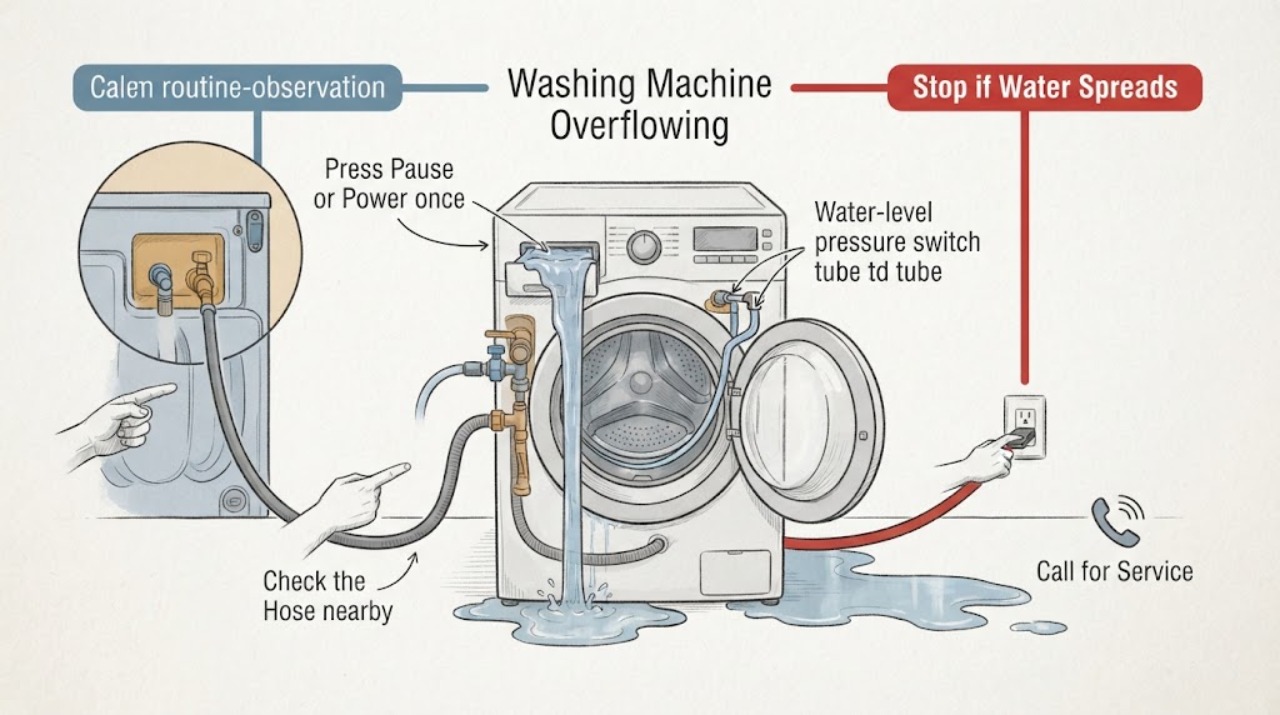
Work through in order
Diagnostic checks
Use only checks that match the exact appliance or system and its official guide.
-
Check 1
Press Pause or Power once, and from a dry, safe location close the hot and cold water valves if water is still entering; keep away from wet electrical equipment and do not reach into a moving or hot tub.
Expected result: The flow stops when the valves are closed, the flow continues after pausing, water is already on the floor, or the water may be hot.
Next step: Keep the washer off. If the area is wet or unsafe, do not touch the plug or controls; isolate the area and obtain qualified help. If the area is dry and safe, record the display and model before continuing.
Why this matters
Why: A washer that continues to fill needs prompt service, while a floor leak or hot water adds immediate safety risk. Closing the valves limits further inflow but does not prove which component failed.
-
Check 2
After the washer is still and the water risk is controlled, identify where the water first appeared: from the top or detergent drawer, door or lid, rear hoses, drain hose, underside, or from the tub during filling or draining.
Expected result: The water source is a supply connection, drain path, drawer or door, tub, or cannot be seen safely.
Next step: Use only the corresponding visible check below. If the source is underneath, internal, or unsafe to access, leave the washer isolated and request service.
Why this matters
Why: The first point of escape separates a hose or drain-routing issue from oversudsing, a closure seal, continuous filling, or an internal leak. Water from underneath or an unseen source should not be chased by tilting or opening the cabinet.
-
Check 3
If water rises while the washer is filling, inspect the visible hot and cold supply hoses for kinks, damage, or an obviously loose connection, and confirm the valves remain closed until the area is safe; do not loosen a pressurized fitting.
Expected result: A hose is damaged or visibly displaced, the valves and hose paths look normal, or the tub continues to fill even after the controls are paused.
Next step: Do not restart a washer with a damaged hose or persistent inflow. Keep the water valves closed and request model-specific service; do not open the cabinet or test the valve electrically.
Why this matters
Why: A damaged connection can leak, while continued filling after a pause can indicate an inlet valve or water-level control fault. Visual inspection cannot establish safe internal repair.
-
Check 4
If the problem appears during draining or the washer shows a drain or overflow indication, inspect the visible drain hose for kinks, crushing, damage, excessive insertion, or an airtight standpipe connection; do not remove the retaining screw at the back.
Expected result: The hose route is visibly restricted or incorrect, water returns from the drain, the hose is damaged, or the tub remains full.
Next step: Correct only an obvious external routing issue allowed by the exact manual, with the washer off and the floor safe. If water remains, is hot, or the problem returns, stop and request service.
Why this matters
Why: Samsung identifies drain-hose installation as a common drain issue and connects overflow indications with water that cannot leave at the expected rate. A damaged hose or persistent full tub needs service.
-
Check 5
If the water is foamy or escaping around the drawer or door, stop adding products and compare the detergent type and amount with the model instructions; use only an empty, cool maintenance cycle later if the manual authorizes it and the leak has stopped.
Expected result: Large amounts of suds are present, the detergent drawer is above its maximum mark, non-HE product was used, or little foam is visible and the water still rises.
Next step: Do not run another loaded cycle while overflow is unresolved. Follow the model detergent instructions and arrange service if the leak or overflow returns; never mix cleaning chemicals.
Why this matters
Why: Samsung links excess or unsuitable detergent to suds, residue, performance problems, and leaks. Little foam makes a water-level, valve, drain, or physical leak path more important to investigate.
-
Check 6
For a front-load washer with water remaining, use an emergency drain or pump-filter procedure only when the exact model manual authorizes it, the water is cool, and the area is dry enough to work safely; skip this step on models without that access.
Expected result: The water drains through the model's permitted path, the filter is visibly obstructed, the water is hot, or the procedure is unavailable or unsafe.
Next step: Stop if the water is hot, the floor becomes wet, or the manual does not cover the procedure. Do not remove panels, force a filter, or remove the drain-hose retaining screw; request service instead.
Why this matters
Why: Samsung's pump-filter access is model-dependent and hot water can cause injury. A blockage may explain a drain or overflow symptom, but the procedure cannot safely be generalized to every washer.
-
Check 7
Only after the source has stopped, the area is dry, and the exact manual permits it, perform one short empty observation or power cycle; record whether the washer immediately begins filling, drains, displays an overflow code, or remains normal.
Expected result: The washer behaves normally, begins filling without control, overflows or leaks again, or displays the same or a new error.
Next step: Stop immediately for a repeat symptom and request service with the model, display, water source, cycle stage, and actions already taken. Do not perform repeated test cycles.
Why this matters
Why: A repeat overflow confirms that the underlying condition remains. A washer that begins filling unexpectedly or leaks again should not be used as a test appliance.
Use your observations
Decision map
Find the observation that best matches what you see, then follow the next safe action.
-
PATH 01Next step
What you see
Water continues entering while the washer is paused or powered off at its controls.
Do this next
Arrange qualified service and follow the exact model guidance.
Why this path and its safety boundary
Why it matters: Close the water valves if safely reachable, keep the washer out of use, and request service for a continuous-fill condition.
-
PATH 02Next step
What you see
The floor is wet near the plug, outlet, appliance connection, or other electrical equipment.
Do this next
Arrange qualified service and follow the exact model guidance.
Why this path and its safety boundary
Why it matters: Do not touch wet electrical equipment or pull a wet plug. Keep people away and obtain qualified electrical or appliance help.
-
PATH 03Next step
What you see
Water first escapes at a supply hose or visible rear connection.
Do this next
Arrange qualified service and follow the exact model guidance.
Why this path and its safety boundary
Why it matters: Keep the supply valves closed and do not run the washer with a damaged or displaced hose. Use service for a connection that cannot be made safe externally.
-
PATH 04Next step
What you see
Water appears during draining and the visible drain hose is kinked, damaged, too deeply inserted, or airtight at the standpipe.
Do this next
Arrange qualified service and follow the exact model guidance.
Why this path and its safety boundary
Why it matters: Correct only a plainly visible routing issue allowed by the model manual. If the hose is damaged or water remains, stop and request service.
-
PATH 05Next step
What you see
Large suds escape from the drawer or door and excess or unsuitable detergent was used.
Do this next
Arrange qualified service and follow the exact model guidance.
Why this path and its safety boundary
Why it matters: Stop the loaded cycle, follow the model detergent guidance, and do not mix cleaning products. If overflow or leakage returns, use service.
-
PATH 06Next step
What you see
The tub is full after a hot cycle or the permitted drain path is not available.
Do this next
Arrange qualified service and follow the exact model guidance.
Why this path and its safety boundary
Why it matters: Treat the water as hot, wait according to the model safety guidance, and do not open an unlisted filter or panel. Request service if it cannot be drained safely.
-
PATH 07Next step
What you see
Water is coming from underneath, inside the cabinet, a damaged door seal, or an unknown source.
Do this next
Arrange qualified service and follow the exact model guidance.
Why this path and its safety boundary
Why it matters: Do not tilt, open, or run the washer to locate it. Keep water isolated and request model-specific service.
-
PATH 08Next step
What you see
Overflow returns after a safe external correction or one permitted empty observation.
Do this next
Arrange qualified service and follow the exact model guidance.
Why this path and its safety boundary
Why it matters: Leave the water valves closed and the washer unused. Give service the exact model, code, stage, water path, and safety observations.
Helpful context
Understand the symptom
Protect the room first
Overflowing water can create a slip hazard and an electrical hazard. Pause the washer, close both supply valves if they are safely accessible, and keep water away from plugs, outlets, power strips, and the appliance connection. If the floor or connection is wet, do not touch electrical equipment; get qualified help. Do not reach into moving water or a tub that may contain hot water.
The water's path is the key clue
Water that keeps entering after the washer is paused points toward an inlet-control or water-level problem. Water that rises only while draining points toward drain routing, a restricted outlet, or return flow. Suds can make a washer appear to overflow and can escape through a drawer or door. Water appearing at one connection or at the bottom needs a different, model-specific leak check.
Front-load and top-load checks are not identical
Samsung's pump-filter procedure applies only to front-load models, and the safe handling of water inside the tub depends on the model. Use the exact manual before opening a filter or emergency drain. Never remove the screw that secures the drain hose at the back of the washer, because Samsung warns that doing so can cause automatic draining and additional errors.
Safety boundary
Stop conditions
- Stop immediately for continuous inflow, active leakage, standing water near electrical equipment, a damaged pressurized hose, or water that may be hot.
- Stop for smoke, burning odor, arcing, a hot plug or outlet, repeated circuit trips, or exposed wiring.
- Do not tilt the washer, open the cabinet, force a door, remove an unlisted filter, or remove the drain-hose retaining screw.
- Do not run repeated test cycles or mix cleaning chemicals while overflow, suds, or a drain fault remains unresolved.
Only after diagnosis
Potential parts
- water inlet valve
Consider only after continuous filling is confirmed and qualified diagnosis links the symptom to the exact model's inlet control.
Do not select a valve from overflow symptoms alone; confirm the complete model and manufacturer fit information. - water-level sensor or pressure system
Consider only when the exact model procedure and qualified testing show that water-level sensing is not reporting correctly.
Confirm model-specific documentation and fit before any replacement. - drain pump or drain hose
Consider only when a persistent drain or overflow condition remains after safe visible hose routing and permitted filter checks.
Confirm washer style, complete model, and approved service procedure before selecting a part.
When checks do not resolve it
Need a professional?
Use qualified service for continuous filling, persistent overflow, an internal or underside leak, a recurring drain or overflow code, failed visible corrections, or any suspected valve, sensor, pump, lock, wiring, or control fault.
Safety scope: Do not work around wet electrics, open the cabinet, loosen pressurized fittings, bypass a lock, or perform energized electrical checks. If the area is immediately dangerous, keep clear and obtain appropriate emergency help before appliance service.
Common questions
FAQ
What should I do first if my Samsung washer is overflowing?
Pause the washer and close the water valves if safely reachable. Keep clear of wet electrical equipment and hot water. If water continues entering or the area is unsafe, leave the washer off and request qualified help.
Can too much detergent make a Samsung washer overflow?
Excess or unsuitable detergent can create heavy suds and residue that contribute to leaks and performance problems. Follow the exact model and detergent instructions, and never mix cleaning products.
Could the drain hose cause a Samsung washer to overflow?
Yes. Kinks, damage, incorrect insertion, an airtight standpipe connection, or a hose that slips can prevent proper draining or allow water to return. Check only the visible routing allowed by the model guide.
Should I open the pump filter when water is in the washer?
Only on a front-load model when the exact manual authorizes the procedure, the water is cool, and the area is safe. Stop for hot water, wet electrical risk, an unavailable procedure, or a filter that will not open normally.
Read the exact guide
Official sources
- How to use detergent in your Samsung washing machineSamsung · Samsung washer HE detergent type, amount, dispenser maximum, and product-safety guidance
- Samsung washing machine will not drainSamsung · Samsung washer overflow and drain errors, hot-water caution, hose routing, and front-load filter scope
- Water fill issues with Samsung washing machinesSamsung · Samsung washer water supply, continuous filling, hose routing, fill errors, and service guidance
- Samsung washing machine is leakingSamsung · Samsung washer leak-source, pump-filter, drain hose, leveling, and detergent-suds guidance
- Samsung washing machine information and error codesSamsung · Samsung washer overflow, drain, fill, door, voltage, and water-level error guidance
Community feedback
Share a repair observation
Share a plain-text repair observation. Accepted observations are published automatically; this page may take a moment to update.