
On this page
Start here
Quick answer
A Sharp heat-pump dryer can produce condensed water during drying. If water is leaking, stop the cycle and identify whether it is coming from the loading-door gasket, the removable water tank, or an optional direct-drain hose. On the applicable model, a full tank can trigger a warning; a bent or displaced discharge hose can prevent proper drainage; lint on the inner door or gasket can allow water to escape at the door. Empty and refit an intact tank, correct only an obvious accessible hose position according to the exact manual, or clean accessible lint from the door and gasket. If the tank, hose, gasket, or concealed cabinet path is damaged, the leak persists, or water is near electrical parts, stop using the dryer and arrange authorised service. Do not open the cabinet or assume every Sharp dryer has the same drainage layout.
Before you begin
Safety first
- Do not operate with an active or unexplained water leak, damaged tank, hose, gasket, or water near electrical equipment. Do not open the cabinet, remove the door seal, pull internal hoses with tools, or test live parts.
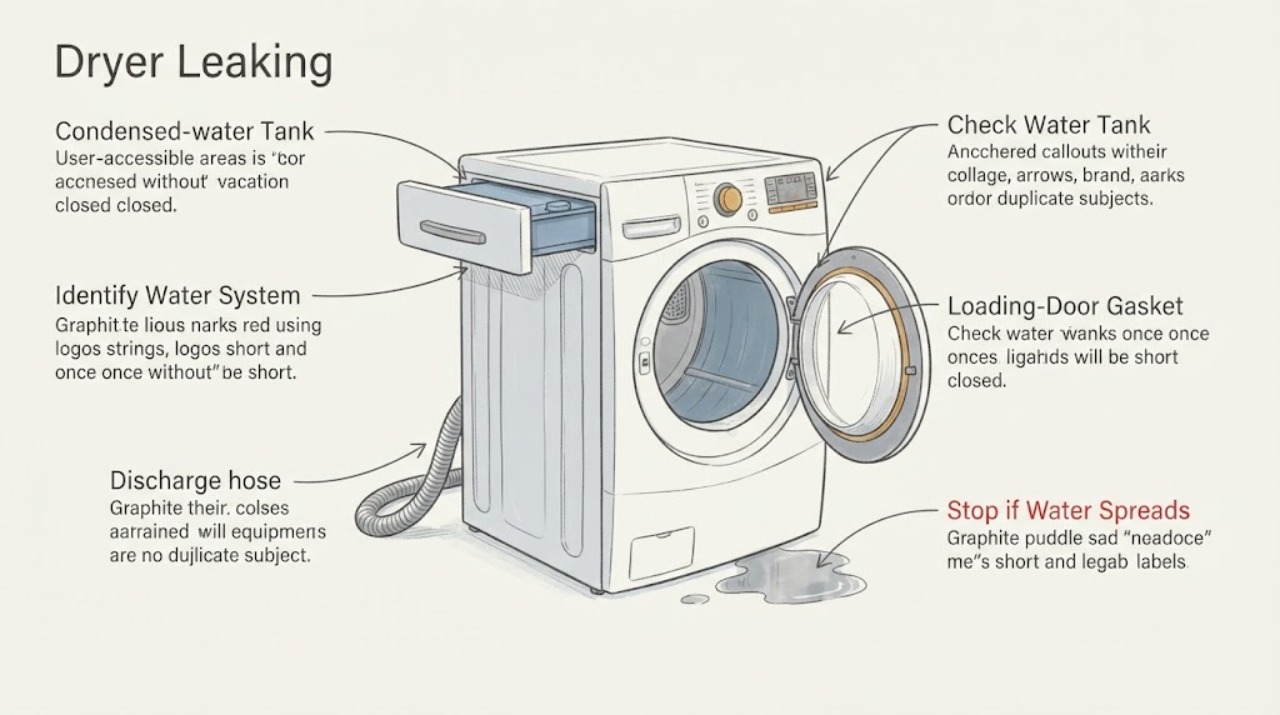
Work through in order
Diagnostic checks
Use only checks that match the exact appliance or system and its official guide.
-
Check 1
Record the exact Sharp model and use its manual to determine whether it is a heat-pump dryer with a removable water tank, an optional direct-drain hose, or another drainage arrangement.
Expected result: The manual identifies a tank, a direct-drain connection, both, or neither; note any water-tank or filter warning shown on the controls.
Next step: Continue only with the matching external check in the exact manual. If the layout cannot be identified without moving or opening the dryer, stop and arrange service.
Stop if: Do not move a stacked dryer, open the cabinet, or probe for a hidden tank or hose.
Why this matters
Why: The tank and hose checks are conditional on the model. Sharp's product catalog includes heat-pump dryers, but a brand-level symptom does not prove that every Sharp model has the same water path.
-
Check 2
Stop the programme and inspect from a dry, stable position around the loading-door edge and gasket, the front water-tank area, the accessible rear drain connection, and the floor.
Expected result: Moisture is at the door, under or around the tank, at the direct-drain hose, inside the cabinet, or near an outlet, plug, cord, or control.
Next step: Photograph the source and continue only with the corresponding dry, user-accessible check. For cabinet moisture or water near electrical equipment, leave the dryer off and request service.
Stop if: Do not run the dryer to reproduce an active leak or put hands into standing water.
Why this matters
Why: The location separates a door-gasket path, tank seating/fullness, drain-hose routing, and an unsafe or concealed internal leak. A puddle alone does not identify a failed internal part.
-
Check 3
If the exact model uses a removable water tank, wait until the programme has ended and the dryer is safe to handle, then remove and empty the tank only as the manual shows; refit an intact tank fully.
Expected result: The tank is full, not seated, cracked, wet around its housing, or normal and dry after refitting; a water-tank warning may be on or flashing.
Next step: Empty and refit only an intact tank using the exact model procedure. Keep the dryer off and arrange service for damage, water around the housing, a warning that returns, or a leak that continues.
Stop if: Do not remove a tank while the programme is running, force a drawer, seal a crack, or access a pump behind the tank.
Why this matters
Why: Sharp links a full tank with a tank warning and tells the user to empty and refit it. A cracked tank, wet housing, recurring warning, or persistent leak is not established by reseating alone.
-
Check 4
If the model is connected directly to a drain, visually follow the accessible discharge hose from the dryer to the outlet without disconnecting pressurised plumbing or moving the appliance.
Expected result: The hose is bent, folded, stepped on, loose, displaced from the outlet, or intact and secured as the manual requires.
Next step: Correct only an obvious accessible bend or secure a displaced end according to the exact manual. If the hose is damaged, inaccessible, blocked, or the leak returns, leave the dryer off and contact authorised service.
Stop if: Do not pull out internal hoses with tools, disconnect the rear connection while water may discharge, extend the hose by guesswork, or open the cabinet.
Why this matters
Why: Sharp states that a bent discharge hose can accompany a water-tank warning and warns that a hose coming out during discharge can cause flooding. An intact visible hose does not rule out a concealed blockage or internal fault.
-
Check 5
If water appears at the loading door, wait for the dryer to cool and wipe only the accessible inner door surfaces and gasket with a soft damp cloth as described by the manual.
Expected result: Lint or residue is accumulated on the inner door or gasket, the gasket is visibly damaged or displaced, or the surfaces are clean but water still escapes at the door.
Next step: Clean accessible lint without sharp tools or solvents, then keep the dryer off if the gasket is damaged or the leak recurs. Arrange service for a seal, door, or internal source that is not clearly resolved.
Stop if: Do not remove the gasket, dismantle the door, or run a cycle to test a damaged seal.
Why this matters
Why: Sharp identifies lint accumulation on those surfaces as a possible reason for water leaking from the loading door. A damaged gasket or continued leakage after cleaning is not a routine cleaning result.
-
Check 6
Prepare a service handoff with the exact model, tank or direct-drain configuration, leak location, amount and timing, warning symbols, tank and hose observations, and whether cleaning or refitting changed the leak.
Expected result: The leak persists, returns after one permitted external correction, comes from a damaged or concealed component, or occurs near electrical equipment.
Next step: Keep the dryer off and give the record and model information to Sharp or an authorised appliance service provider.
Stop if: Do not test live components, bypass a warning, or replace a pump, seal, sensor, or hose solely from the word “leaking.”
Why this matters
Why: A full tank, bent hose, or lint-covered gasket is different from a recurring leak or a hidden cabinet fault. Sharp's manual directs persistent problems to authorised service and says not to repair a nonfunctional product yourself.
Use your observations
Decision map
Find the observation that best matches what you see, then follow the next safe action.
-
PATH 01Next step
What you see
The model uses a removable water tank and the tank warning is present, the tank is full or not seated, and there is no electrical hazard.
Do this next
Empty and refit only an intact tank using the exact manual. If water remains around the housing, the tank is damaged, or the warning/leak returns, stop and arrange authorised service.
-
PATH 02Next step
What you see
The model uses a direct drain and the hose is bent, folded, displaced, or not securely routed to the outlet.
Do this next
Correct only the accessible routing issue allowed by the model manual. Keep the dryer off for a damaged, blocked, inaccessible, or repeatedly leaking hose.
-
PATH 03Next step
What you see
Water is localized at the loading door and lint or residue is visible on the inner door or gasket, without cabinet or electrical moisture.
Do this next
Clean those accessible surfaces with a soft damp cloth as directed. A damaged gasket or a leak that continues after cleaning requires service rather than door disassembly.
-
PATH 04Next step
What you see
Water comes from inside the cabinet, the source is unclear, the tank/hose/gasket is damaged, the leak recurs, or water reaches the outlet, plug, cord, or controls.
Do this next
Do not operate or investigate further. Keep the area dry, isolate power only from a dry and safe location if possible, and contact Sharp or an authorised appliance service provider.
Helpful context
Understand the symptom
Start with the model's water path
Sharp sells heat-pump dryers, and the opened Sharp manual for the KD-HD9S7GW-B describes water accumulating in a tank during drying or being routed through an optional discharge hose. Other Sharp models may use a different layout. Read the model number before applying a tank or drain-hose check, and do not pour water into the dryer or remove panels to find a leak.
The leak location changes the next check
Water at the loading door points toward the inner door surface or gasket; water at the rear or drain connection points toward the tank or discharge path; water from inside the cabinet is not a user-level hose adjustment. A small amount of moisture at one location is not enough to identify a failed pump, seal, or heat exchanger.
Stop before an external leak becomes an electrical hazard
Keep the dryer off while an active leak is being located. Only handle an intact tank or a clearly accessible hose from a dry, stable position. If water reaches the outlet, plug, cord, controls, or hidden cabinet parts, stop and arrange service; Sharp's manual says persistent problems should go to an authorised service provider and warns against repairing a nonfunctional product yourself.
When checks do not resolve it
Need a professional?
Arrange authorised service when the leak persists after the exact model's permitted tank, hose, and door-surface checks; a component is damaged or inaccessible; a warning returns; or water reaches electrical equipment.
Safety scope: Do not operate with an active or unexplained water leak, damaged tank, hose, gasket, or water near electrical equipment. Do not open the cabinet, remove the door seal, pull internal hoses with tools, or test live parts.
Have this ready
- Exact Sharp model and serial information
- Whether the dryer uses a tank or direct drain
- Leak location, amount, timing, and warning symbols
- Tank, drain hose, loading-door, and gasket observations
Common questions
FAQ
Why is my Sharp heat-pump dryer leaking water?
Start by locating the water. On the applicable Sharp models, water may be associated with a full or poorly seated tank, a bent or displaced direct-drain hose, or lint on the inner loading-door and gasket surfaces. The exact model determines which checks apply.
What should I do if the Sharp dryer water-tank warning is on?
If the model has a removable tank, stop the programme, wait until it is safe to handle, empty the tank, and refit it as the exact manual shows. If the warning returns, the tank housing is wet or damaged, or the leak continues, arrange authorised service.
Can a bent drain hose make a Sharp dryer leak?
Sharp's manual says a bent discharge hose can be associated with a water-tank warning and warns that a hose that comes out during discharge can cause flooding. Inspect only the accessible routing and follow the exact model manual; do not dismantle the rear plumbing.
Can I keep using the dryer to find the source of the leak?
No. Stop an active or unexplained leak rather than reproducing it. Keep water away from electrical equipment and arrange service for a recurring, concealed, or damaged leak.
Read the exact guide
Official sources
- Dryer | Sharp SingaporeSharp Singapore · Sharp Singapore dryer product catalog identifying heat-pump dryer models
- SHARP DRYER KD-HD9S7GW-B V2108Sharp Singapore · Sharp heat-pump dryer water tank, direct-drain hose, loading-door leak, and service guidance for the named model
Community feedback
Share a repair observation
Share a plain-text repair observation. Accepted observations are published automatically; this page may take a moment to update.