
On this page
Start here
Quick answer
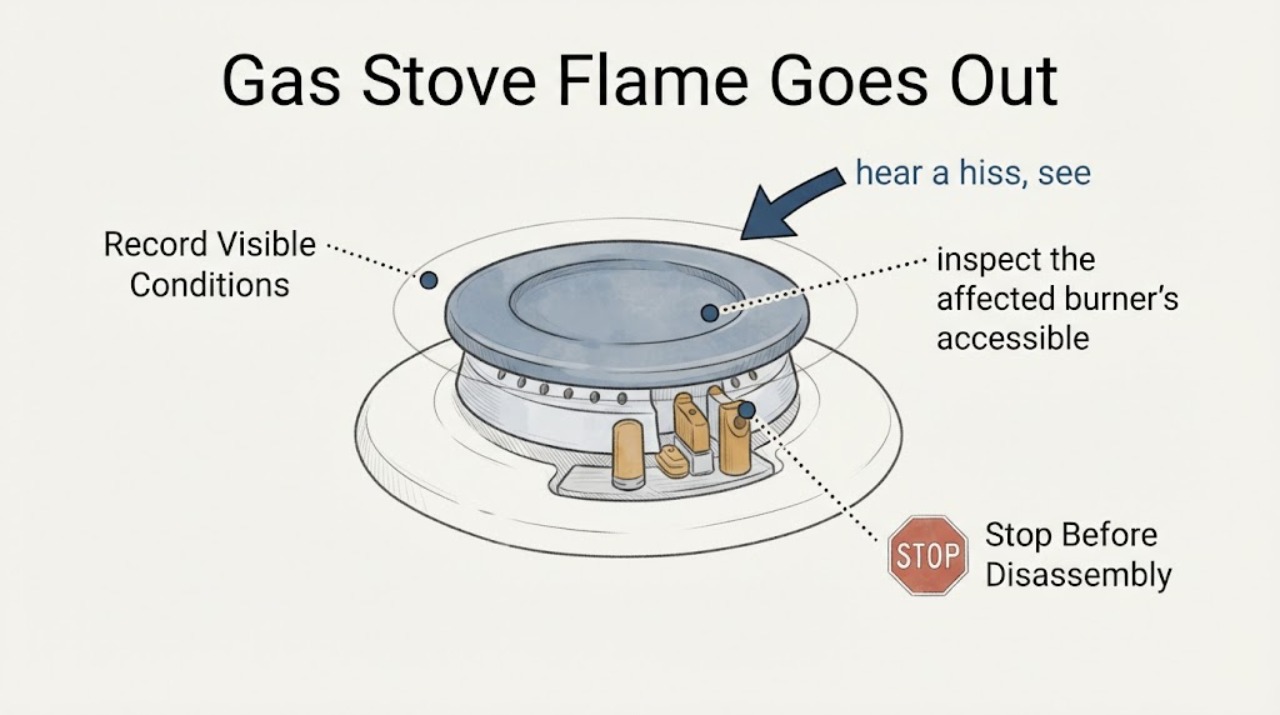
A gas burner that lights only while the knob is held and goes out when you release it should not be kept running by holding the knob down or by bypassing a safety device. If you smell gas, turn away from the appliance, leave the home immediately, and call the gas supplier or emergency services from outside without operating switches or electrical equipment. If there is no gas smell, let the stove cool, verify only the accessible burner cap/head is clean, dry and correctly seated according to the exact manual, and note whether one burner or all burners are affected. A single burner that still will not stay lit, or several burners that are weak or flickering, needs qualified appliance or gas-service diagnosis; do not guess a valve or flame-sensing part and do not move the stove to inspect its gas connector.
Work through in order
Diagnostic checks
Use only checks that match the exact appliance or system and its official guide.
-
Check 1
If you smell gas, hear a hiss, see an unlit burner with the knob on, or suspect a leak, stop trying to light the stove and leave the home immediately. Do not turn lights on or off, use a phone inside, light a match, or operate other electrical equipment; call the gas supplier or emergency services from outside or a neighbor's location.
Expected result: There is a gas odor, hissing, an unlit burner after gas was opened, or uncertainty about whether gas is escaping.
Next step: Do not re-enter or relight the appliance until the gas supplier, fire service or qualified professional says it is safe. Do not move the stove or inspect its connector yourself.
Stop if: Stop all user checks immediately for gas odor, hissing, smoke, fire or symptoms such as dizziness or breathing difficulty.
Why this matters
Why: The flame-out symptom may have left unburned gas, and a leak cannot be safely diagnosed by repeated ignition. The CPSC treats suspected gas leakage as an evacuation and professional-assistance event.
-
Check 2
Only if there is no gas smell and the stove is cool, record the exact pattern without a prolonged trial: does one burner light and then go out when the knob is released, do all burners do it, and does the flame flicker or appear weak while the knob is held? Do not keep the knob depressed to keep a flame burning.
Expected result: Only one burner is affected, several burners are affected, the flame is weak or flickering, or the burner will not light at all.
Next step: Continue only with the cool, external cap/head and moisture checks below. For multiple affected burners, contact the gas provider or a qualified appliance professional rather than adjusting the supply yourself.
Why this matters
Why: A single-burner pattern points first to that burner's accessible assembly or a model-specific local fault, while a multi-burner weak or flickering pattern can involve the gas supply or installation. Neither pattern proves a specific internal part.
-
Check 3
With the controls OFF and the appliance cool, inspect the affected burner's accessible cap and head. If the exact manual identifies them as user-removable, confirm they are clean, dry and seated in the correct position; wipe away safe, visible spill residue with the method the manual permits. Do not enlarge ports, insert improvised objects, adjust a valve or work on the gas line.
Expected result: The cap/head is visibly misaligned, wet or contaminated, or it looks correctly assembled but the flame still dies when the knob is released.
Next step: Correct only the clearly documented, user-accessible assembly issue and allow moisture to dry. If the flame-out remains, stop using that burner and request service; do not hold the knob down during cooking.
Stop if: Stop if cleaning would require removing a gas tube, disturbing an orifice, forcing a component, or reaching behind the control panel.
Why this matters
Why: Samsung and Whirlpool identify clean, correctly positioned burner components and dry ports as relevant external ignition checks. A correctly assembled burner that still goes out needs model-specific diagnosis; it does not prove that a sensor or valve is defective.
-
Check 4
Check the surrounding conditions without moving the stove: note whether another burner is being lit at the same time, whether a downdraft hood is blowing across the flame, and whether the gas supply has recently been installed, changed or interrupted. Do not adjust pressure, relight repeatedly or pull the appliance forward.
Expected result: Several burners are weak or flickering, the problem changes when other burners or a downdraft are used, or the issue began after gas-supply work or an interruption.
Next step: Stop using the stove and contact the gas provider or a qualified installer/service technician for supply and installation checks. Do not adjust a regulator or gas valve yourself.
Why this matters
Why: Samsung associates a no-stay-lit pattern in its cooktop guidance with low gas pressure in some circumstances, and Whirlpool notes that downdraft airflow can affect flame stability. These are bounded manufacturer observations, not proof of the unknown stove's cause.
-
Check 5
If the flame still goes out after the exact manual's safe external checks, or if the stove has a persistent clicking sound, uneven flame, repeated gas odor or any damaged connector, record the model label and the affected burner pattern for service. Keep the stove off until the diagnosis is complete.
Expected result: The burner remains lit only while the knob is pressed, several burners are affected, the igniter keeps clicking after controls are OFF, or any gas or connector warning remains.
Next step: Use qualified appliance or gas service. Do not hold the knob down during use, bypass a safety device, open the gas manifold, replace a gas part, or test the appliance with panels removed.
Stop if: Keep the stove out of service for gas odor, damaged connector, persistent clicking, unstable flame or any need for internal access.
Why this matters
Why: The official sources support service or gas-provider escalation but do not identify a failed valve, thermocouple, regulator or control for an unknown model. Moving the appliance or bypassing its flame-safety system can create a gas or fire hazard.
Use your observations
Decision map
Find the observation that best matches what you see, then follow the next safe action.
-
PATH 01Next step
What you see
Gas is smelled, a burner is hissing without a stable flame, or the knob may have left gas flowing.
Do this next
Leave immediately, avoid switches, flames and phones inside, and call the gas supplier or emergency services from a safe location. Do not relight or move the stove until cleared.
Why this path and its safety boundary
Why it matters: This is a possible gas-leak or unburned-gas condition, not an ordinary flame-adjustment problem.
-
PATH 02Next step
What you see
There is no gas smell, only one burner is affected, and its accessible cap/head is wet, dirty or visibly misaligned.
Do this next
With controls off and the stove cool, clean/dry and reseat only the components the exact manual identifies as user-removable. Stop using the burner if the flame still dies when the knob is released.
Why this path and its safety boundary
Why it matters: A local burner-assembly or moisture condition is plausible within the manufacturer's external guidance, but it is not proof of an internal component failure.
-
PATH 03Next step
What you see
Several burners are weak, flickering or go out when the knobs are released, especially when another burner is being lit.
Do this next
Stop using the stove and ask the gas provider or qualified installer/service technician to check the supply and installation. Do not adjust pressure or a regulator yourself.
Why this path and its safety boundary
Why it matters: A gas-supply or installation issue becomes more plausible than a single dirty cap; Samsung's guide identifies low gas pressure as one possible cause in its product family.
-
PATH 04Next step
What you see
The burner components are clean, dry and correctly seated, but the flame still goes out when pressure is released, or the igniter continues clicking after the controls are off.
Do this next
Keep the stove off and arrange qualified appliance service. Do not keep the knob depressed, bypass a safety device, open the gas manifold or test internal parts.
Why this path and its safety boundary
Why it matters: The remaining fault is model-specific and may involve the flame-safety or ignition path, but the available evidence does not establish which part failed.
-
PATH 05Next step
What you see
Inspection would require moving the stove, loosening a connector, opening the control area, or using a tool on a gas valve or orifice.
Do this next
Stop the inspection and use a qualified gas or appliance professional. The CPSC specifically warns not to move an appliance to inspect its connector.
Why this path and its safety boundary
Why it matters: The task has crossed into gas-system work that cannot be safely scoped without the model, installation details and qualified equipment.
Helpful context
Understand the symptom
Why releasing the knob matters
The assigned symptom is specific: the flame appears while pressure is applied to the knob and goes out when the knob is released. That pattern means the stove is not maintaining a safe operating flame, but it does not identify a particular valve, sensor or other internal component. Samsung's guide gives low gas pressure as one possible explanation for burners that will not stay lit in its cooktop family, while Whirlpool's guidance separates burner alignment, moisture, ports and gas-supply checks. Because this stove has no brand or model in the task, use those pages as bounded examples and confirm the exact manual before any user-level procedure.
Treat gas odor as an evacuation issue
A flame that goes out can leave unburned gas near the burner. If you smell gas, do not keep pressing the knob, attempt another ignition, or operate lights, phones or other electrical equipment inside. The CPSC instructs people who suspect a gas leak to leave immediately and call the gas supplier or 911 from a neighbor's location. This article does not tell the reader to open a gas line, adjust a valve or move the appliance.
What can be checked without naming a part
When there is no gas smell and the appliance is cool, the useful external checks are limited to the burner cap/head being clean, dry and seated, visible moisture or spill residue, and whether the behavior affects one burner or several. Whirlpool says burner ports should not be enlarged or distorted and sends adjustment work to a trained repair specialist. A repeated failure after those checks is a service decision, not proof that a thermocouple, valve or control has failed.
When checks do not resolve it
Need a professional?
Call the gas supplier or emergency services immediately if gas is smelled or a leak is suspected. Otherwise arrange qualified appliance or gas service when the flame still goes out after the exact manual's safe external checks, several burners are affected, the igniter continues clicking, the flame is unstable, or inspection would require moving the stove or opening gas controls.
Common questions
FAQ
Why does the flame go out when I release the gas-stove knob?
That pattern confirms only that the burner is not maintaining a safe flame after the start command. Possible explanations vary by model and installation. Check only the documented, accessible burner assembly when the stove is cool and free of gas odor; do not name or replace an internal part from the symptom alone.
Can I keep pressing the knob so the burner stays lit?
No. Do not hold the knob down during cooking or bypass a safety device. If the flame will not remain lit after the exact manual's safe external checks, keep that burner off and arrange qualified service.
What should I do if I smell gas after the flame goes out?
Stop trying to ignite the burner and leave the home immediately. Do not turn lights on or off, use a phone inside or light a match. Call the gas supplier or emergency services from outside or a neighbor's location.
Does a weak flame prove the gas valve is bad?
No. Several burners that are weak or flickering can indicate a supply or installation issue, while a single burner can have an assembly or moisture issue. The available generic guidance does not prove a valve, regulator or flame-sensing part.
Can I pull the stove forward to inspect the gas connector?
Do not move it to inspect the connector. The CPSC warns that moving an appliance can cause an older weakened connector to fail and directs connector inspection or replacement to a qualified professional.
Read the exact guide
Official sources
- What can you do when the burner of your Samsung gas cooktop does not ignite or has other ignition issuesSamsung Canada · Manufacturer-specific example, not a match for the unknown stove. Used for the bounded observations that burner components should be clean and correctly positioned, that no-stay-lit symptoms may be associated with low gas pressure in its product family, and that gas-provider/service escalation is appropriate.
- Certain Older Gas Connectors May Be DangerousU.S. Consumer Product Safety Commission · Government safety source used for the evacuation, no-switches/no-flames and no-moving-the-appliance boundary when gas is suspected. It does not diagnose this stove or authorize connector work.
- Gas Range & Cooktop - Electric Ignition for Surface BurnersGE Appliances · Manufacturer-specific reference used only for the limited service boundary that persistent igniter clicking after the controls are off warrants stopping use, disconnecting power if safe and turning off gas until service. It does not identify the unknown stove's model or cause.
- Gas Burners are Clicking but Not LightingWhirlpool Product Help · Manufacturer guidance used for burner-component alignment, moisture, visible port blockage, downdraft effects and the owner's-manual/service boundary. It is not a model-specific diagnosis for the unknown stove.
Community feedback
Share a repair observation
Share a plain-text repair observation. Accepted observations are published automatically; this page may take a moment to update.