
On this page
Start here
Quick answer
Summit refrigerator frost buildup is not diagnosed by the frost alone because Summit sells both manual-defrost and auto-defrost designs. First record whether frost is on the refrigerator rear wall, in the freezer, around a door seal, or blocking an air path, then check the temperature setting, door closure, packing, and model defrost instructions. If your model uses manual defrost, follow its procedure and never chip frost with a sharp tool or accelerate it with an electric heater or hair dryer. Frost that returns quickly, blocks the door or airflow, appears on an auto-defrost refrigerator, or comes with poor cooling, a leak, damaged cord, smoke, or burning odor needs qualified Summit or appliance service.
Work through in order
Diagnostic checks
Use only checks that match the exact appliance or system and its official guide.
-
Check 1
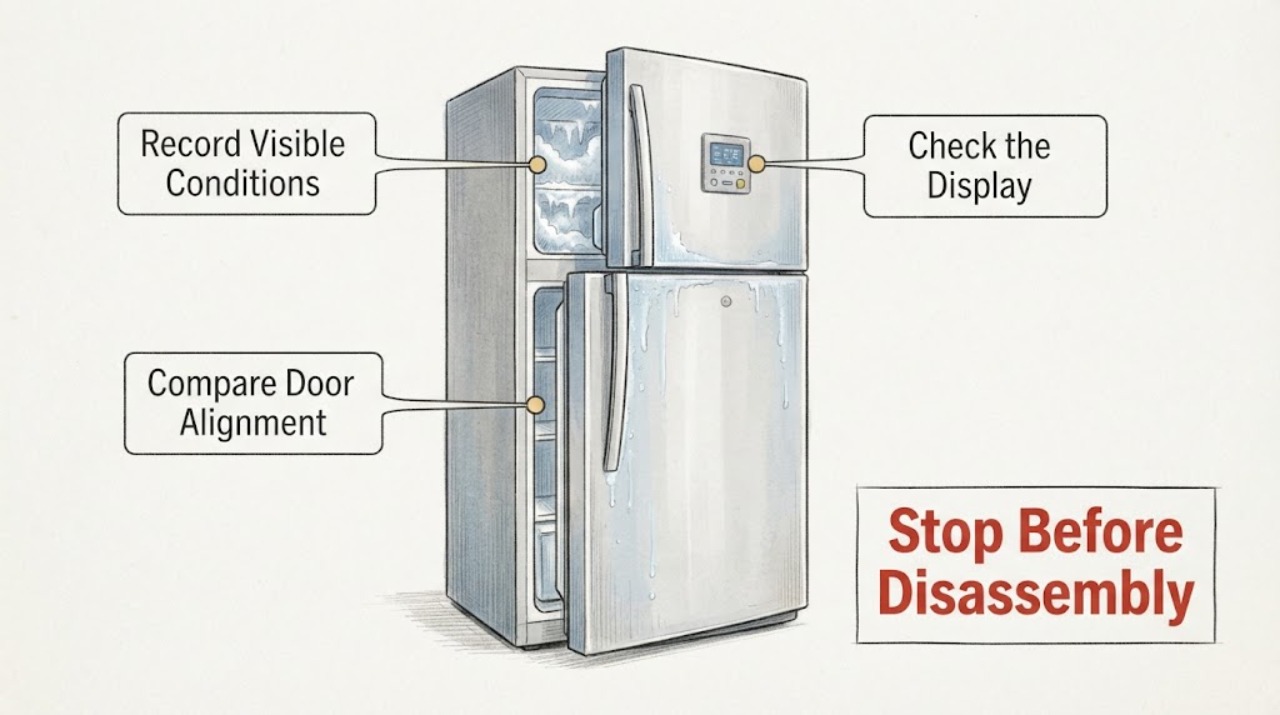
With the refrigerator closed except for a brief inspection, record exactly where frost is forming: the refrigerator rear wall, a freezer wall or shelf, the door gasket, around a vent, or across most of the compartment. Find the model number and check whether that compartment is manual-defrost, auto-defrost, or frost-free in the Summit manual.
Expected result: Frost is limited to a thin rear-wall area, reaches the manual-defrost threshold in a freezer, follows the door edge or vent, or covers an area that the model describes as auto-defrost or frost-free.
Next step: Use the matching model instructions before changing settings or defrosting. Do not assume a freezer threshold applies to a refrigerator compartment or to a frost-free model.
Why this matters
Why: A limited rear-wall cycle can be part of an automatic-defrost design, while threshold-level freezer frost requires the manual procedure for a manual-defrost model. Frost at the gasket or vent makes warm-air entry or restricted circulation more likely; widespread frost on an auto-defrost or frost-free section needs service-oriented diagnosis.
-
Check 2
Check the thermostat or digital temperature control without removing any panel. Verify that it is not set at the coldest or maximum position and note whether the control is in an off, defrost, or other documented state. If the setting was changed, make one model-approved adjustment and allow the cabinet time to stabilize before judging the frost.
Expected result: The control is at its coldest setting, in an unintended state, or at the normal setting while frost continues; temperature and cooling are also recorded.
Next step: Use only the model manual's control range and wait for stabilization after one adjustment. If the setting is normal and frost continues or cooling is abnormal, continue with the seal and airflow checks rather than repeatedly cycling the control.
Why this matters
Why: A colder-than-needed setting can increase frost and may explain frost that improves after a warmer documented setting. Frost that persists with a normal control setting, especially with poor cooling or temperature swings, is less likely to be a simple setting issue.
-
Check 3
Inspect the door from outside for a package or shelf holding it open, a gasket gap, dirt on the accessible seal, or a cabinet that is visibly out of level. Close the door slowly and confirm the gasket contacts the cabinet around the accessible perimeter; do not adjust concealed hinges.
Expected result: The door does not close fully, the gasket has a visible gap or damage, frost follows the door edge, or the seal and closure appear normal.
Next step: Remove only a loose obstruction and clean the accessible gasket as the manual permits. If the gasket is damaged, the door is misaligned, or frost returns with a good seal, arrange qualified service instead of forcing the door or adjusting hidden hardware.
Why this matters
Why: A door that admits warm, moist room air can create frost at the edge and force longer cooling. A clean, continuous seal with frost elsewhere makes packing, temperature, drainage, or a defrost fault more likely; it does not identify an internal part.
-
Check 4
Look from inside for large containers or food pressed against the rear wall or blocking vents. Leave the clearances shown in the model manual and wipe wet containers or spilled moisture before closing the door.
Expected result: Frost is concentrated behind a blocked area or around wet food, the compartment is tightly packed, or the air paths and contents are arranged as the manual shows.
Next step: Rearrange loose food and containers without removing vents or covers, then monitor after the compartment stabilizes. If frost forms again with clear air paths, follow the model defrost and service guidance.
Why this matters
Why: Summit says blocked airflow can cause temperature inconsistency and that properly wrapped, dry food reduces frost buildup. A clear interior with widespread frost makes a simple packing explanation less likely.
-
Check 5
For a manual-defrost compartment, follow the exact Summit manual only after protecting the food: turn the thermostat to the documented off position, disconnect power, let the frost melt, collect the water, dry the compartment, and restart as instructed. For an auto-defrost refrigerator section, inspect only the visible drain opening and follow its manual rather than forcing water or a tool into the path.
Expected result: The frost melts completely using the documented procedure and the appliance returns to normal, the drain or frost is inaccessible, or the frost returns soon after restart.
Next step: Restore food only after the model's stabilization guidance is met. Do not use sharp or metallic tools, boiling water, a hair dryer, or an electric defrost device. Arrange service for rapid recurrence or any internal obstruction.
Why this matters
Why: A complete defrost followed by normal cooling supports a temporary frost load in a manual-defrost design. An inaccessible path or rapid recurrence points toward a door, drain, airflow, sensor, heater, or control issue that cannot be identified safely from the frost pattern.
-
Check 6
With power disconnected only when the manual allows and it is safe to reach the plug, inspect the accessible rear area for heavy dust on an external condenser, inadequate clearance, or a damaged cord. Do not open the rear cover or perform live electrical tests.
Expected result: The condenser area is dusty or clearance is restricted, or the accessible rear area is clear while frost and cooling problems remain.
Next step: Clean only an externally accessible condenser as the model manual describes and restore the required clearance. If frost or poor cooling persists, stop troubleshooting and provide the model, frost location, settings, and defrost history to qualified service.
Why this matters
Why: Summit links dirty rear condenser coils and reduced clearance with refrigeration operating problems. A clear external area does not rule out a sealed-system, defrost, fan, sensor, or control fault.
Use your observations
Decision map
Find the observation that best matches what you see, then follow the next safe action.
-
PATH 01Next step
What you see
Frost is limited to a manual-defrost freezer and has reached the thickness stated in the Summit guidance, with the door seal and control otherwise normal.
Do this next
Follow the exact model defrost procedure, protect the food, dry the compartment, and allow it to return to operating temperature. Never chip the frost or use an electric heat source.
Why this path and its safety boundary
Why it matters: The frost load is consistent with the maintenance condition Summit describes for manual-defrost compartments.
-
PATH 02Next step
What you see
Frost collects along the door edge or behind tightly packed food, and the door or airflow path improves after a loose obstruction is corrected.
Do this next
Keep the gasket contact and vent clear, dry wet containers, and monitor one stabilized cooling period. Arrange service if the seal cannot close continuously or frost returns.
Why this path and its safety boundary
Why it matters: Warm-air entry or restricted cold-air circulation is more likely than an internal defrost component failure.
-
PATH 03Next step
What you see
Frost covers an auto-defrost or frost-free section, returns soon after a documented defrost, or appears with poor cooling or temperature inconsistency despite normal settings and clear airflow.
Do this next
Stop removing covers or repeatedly defrosting as a substitute for diagnosis. Arrange qualified Summit or appliance service and give the model, frost location, temperature behavior, door-seal result, and timing of recurrence.
Why this path and its safety boundary
Why it matters: A defrost, drain, fan, sensor, sealed-system, or control problem is more likely, but frost does not identify which component has failed.
-
PATH 04Next step
What you see
Smoke, a burning odor, a hot or damaged cord, water near electrical parts, repeated breaker trips, or an unsafe leak accompanies the frost or cooling problem.
Do this next
Stop using the refrigerator, keep clear, and disconnect power only if it is safe to do so. Contact qualified appliance or electrical service; do not reopen the unit to continue testing.
Why this path and its safety boundary
Why it matters: This is outside routine frost maintenance and creates an immediate electrical, water, or appliance safety boundary.
Helpful context
Understand the symptom
Why Summit refrigerators can have different frost patterns
Summit documentation covers more than one refrigeration design. Its troubleshooting FAQ says manual-defrost refrigerators and freezers need defrosting when frost on freezer walls reaches about 1/8 to 1/4 inch, while the model manual determines the exact procedure. Other Summit models use automatic defrost in the refrigerator compartment, where a limited rear-wall frost cycle can melt and drain; excessive buildup is a reason to check the thermostat, gasket, drain opening, and airflow. Identify the compartment and model type before treating the frost as a failed part.
Protect the cabinet and food while checking
Keep the door closed as much as practical, move food only as needed to protect it, and place a towel or shallow container where melting water can be collected during a documented defrost. Do not remove an interior cover, bypass a control, or probe an ice-covered surface. Summit's instructions warn that sharp or metallic tools can damage cooling coils, and that electrical defrost devices or hair dryers can damage plastic parts. Internal defrost, sealed-system, electrical, and control repairs belong to a qualified technician.
When checks do not resolve it
Need a professional?
Arrange qualified Summit or appliance service when frost returns quickly after the model-approved defrost, appears across an auto-defrost or frost-free compartment, blocks airflow or the door, or remains with a normal setting, intact gasket, and clear packing. Do not replace a thermostat, defrost heater, fan, drain component, sensor, or control based on frost pattern alone. Stop using the refrigerator for smoke, burning odor, a hot or damaged cord, water near electrical parts, repeated breaker trips, or an unsafe leak.
Common questions
FAQ
How much frost is too much on a Summit freezer?
Summit's troubleshooting guidance says manual-defrost refrigerator or freezer compartments should be defrosted when frost reaches about 1/8 to 1/4 inch, but models vary. Use the exact model manual before applying that threshold.
Can I remove Summit refrigerator frost with a knife or hair dryer?
No. Summit warns that sharp or metallic tools can damage cooling coils and that a hair dryer or electric defrost device can damage plastic parts. Use only the model's documented defrost method.
Why does frost keep forming behind food in my Summit refrigerator?
Blocked airflow, food pressed against a cold rear wall, wet containers, an overly cold setting, or a door that does not seal can contribute. Clear only loose obstructions and use the model manual if frost returns.
When does recurring frost need service?
Use qualified service when frost returns soon after the documented defrost, covers an auto-defrost or frost-free section, or is accompanied by poor cooling, a damaged seal, a leak, smoke, burning odor, or electrical damage.
Read the exact guide
Official sources
- REFRIGERATOR - FREEZERSummit Appliance · Summit refrigerator-freezer operation, noise, frost defrosting, airflow, and service guidance
- Product Troubleshooting FAQSummit Appliance · Summit manual-defrost refrigerator and freezer thresholds and safe defrost procedure
- Product Troubleshooting FAQSummit Appliance · Summit refrigerator cooling, frost, door, airflow, condenser, and noise troubleshooting
Community feedback
Share a repair observation
Share a plain-text repair observation. Accepted observations are published automatically; this page may take a moment to update.