
On this page
Start here
Quick answer
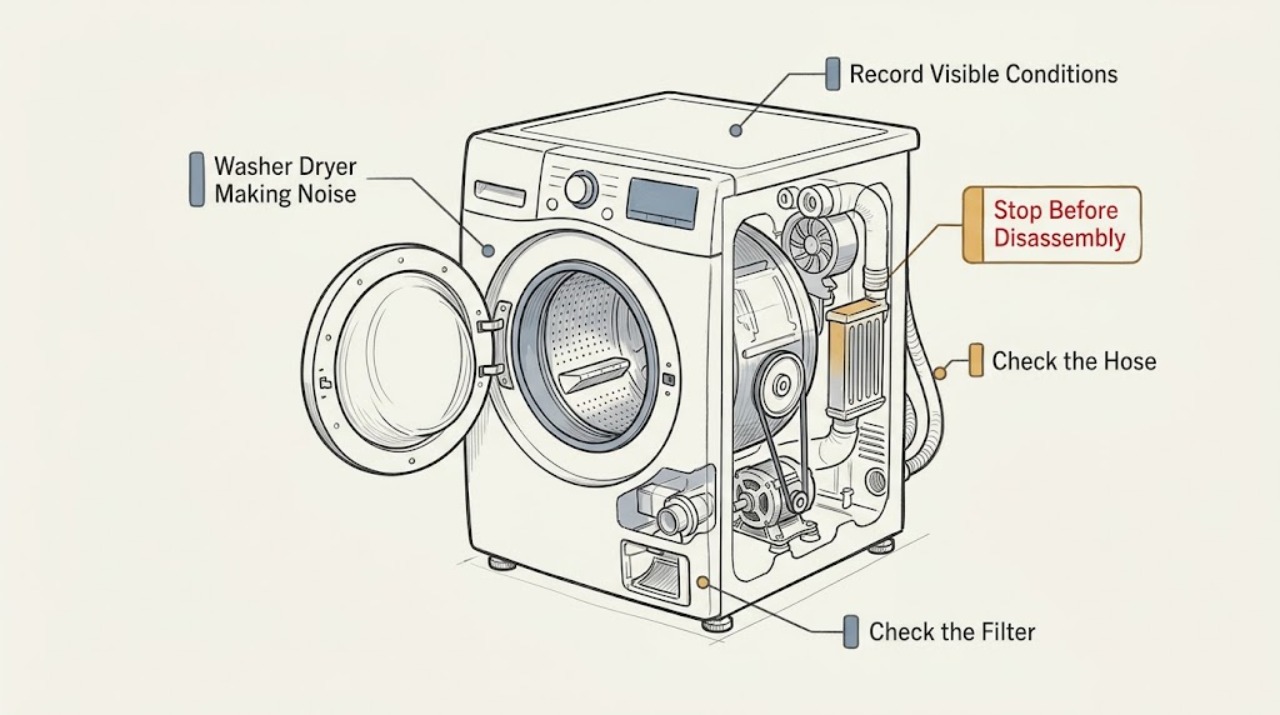
First note whether the sound occurs while filling, washing, draining, spinning, or drying. A brief click from clothing hardware, a low pump or compressor sound, or a short start-up thump can be normal on some models, but continuous metal scraping, violent banging, smoke, a burning smell, a hot cabinet, gas odor, sparks, a repeated breaker trip, or a water leak requires stopping the appliance. Pause it, wait for all motion and heat to end, check only the load, visible drum area, leveling, lint filter, and accessible hose or vent, then use the exact manual for the model. If the noise remains with an empty drum or needs a panel, live electrical test, gas work, or internal part diagnosis, keep the unit out of service and arrange qualified appliance repair.
Work through in order
Diagnostic checks
Use only checks that match the exact appliance or system and its official guide.
-
Check 1
Press Pause or Cancel, keep hands away from the drum, and wait until all rotation, heat, and water movement have stopped. From a safe position, record the sound and note smoke, burning odor, gas odor, sparks, a hot cabinet, a leak, or a breaker trip.
Expected result: The appliance stops normally with no hazard, or it continues moving, heating, leaking, sparking, smoking, or producing a strong burning or gas odor.
Next step: If there is no hazard, continue only after the appliance is still and cool enough to touch externally. If a hazard is present, isolate the appliance only if this can be done safely, leave the area for gas or smoke, and arrange appropriate emergency or qualified service help.
Stop if: Stop immediately for smoke, flames, gas odor, sparks, exposed conductors, a repeated breaker trip, a hot cabinet, uncontrolled movement, or active water escaping near electricity.
Why this matters
Why: A normal stop leaves room for low-risk external checks; a failed stop or hazard may involve moving, electrical, heating, gas, or water systems and must not be investigated by repeated runs.
-
Check 2
With the appliance off and safe, identify whether the noise occurs during water fill, wash agitation, drain, spin, dry start, dry rotation, dry reversing, or cool-down. Listen from outside without placing a hand near moving parts, and note whether it comes from the door, upper cabinet, bottom, rear hose area, or exhaust outlet.
Expected result: The sound is limited to one phase or it occurs across both the wash and dry sides; it is a click, hum, gurgle, rattle, thump, squeal, grinding sound, or metallic scrape.
Next step: Use the matching wash, spin, or dry branch below and compare the description with the model manual; do not run a dangerous sound merely to reproduce it.
Stop if: Stop if localization would require removing a cover, reaching behind a running drum, touching the exhaust while overheated, or operating through smoke, odor, sparks, or a leak.
Why this matters
Why: A phase-specific symptom narrows the next safe check, while a sound shared by both sides raises the priority of common leveling, installation, enclosure, or supply issues. Sound quality is a clue, not a part diagnosis.
-
Check 3
For a wash-side sound, inspect only the empty pockets and loose hardware in the load, the visible drum and door seal, and the accessible drain or filter area described by the manual. If the sound occurs during fill, check that an external hose is not loose or striking the cabinet; if it occurs during drain, do not force a trapped object out of the pump.
Expected result: A coin, zipper, wire, loose hose, blocked accessible filter, or other visible cause is found, or the tub and external path look clear while the sound continues.
Next step: Remove only a loose, reachable item with the appliance disconnected or otherwise made safe according to the manual. If the source is not reachable, the filter is not user-serviceable, or the noise persists, stop and request service.
Stop if: Stop for water escaping, a sharp metal-on-metal sound, a damaged seal, an object trapped behind the drum, or any need to put a hand into an inaccessible opening.
Why this matters
Why: Laundry hardware and an external hose can make intermittent clicking or rattling; a continuous bottom rattle or grinding sound after visible checks can indicate pump or motor-area trouble that is not established by sound alone.
-
Check 4
For a spin-only sound, stop the cycle, wait for the tub to stop, and redistribute or reduce the load. With the machine empty and still, check whether it rocks when gently pressed at the corners and whether it is contacting a wall, cabinet, hose, or stacked appliance. On a recently installed front loader, use the installation manual to confirm that shipping hardware was handled correctly.
Expected result: The load is bunched or unusually heavy, the cabinet rocks or walks, an external contact is visible, shipping hardware may still be present, or the empty appliance remains noisy.
Next step: Correct only the load, external contact, or leveling adjustment described by the manual, then run one supervised test. If the empty drum still roars, grinds, scrapes, or bangs, keep the appliance out of service.
Stop if: Stop for violent movement, a machine that walks, a tub striking the cabinet, exposed or damaged shipping hardware, a broken suspension part, or metal scraping.
Why this matters
Why: An uneven load, unstable feet, external contact, or installation condition can create pounding and vibration during spin; noise with an empty, stable tub shifts concern toward suspension, bearings, motor, or other rotating hardware.
-
Check 5
For a dry-side sound, stop and cool the load before checking every pocket, fastening zippers and buttons, and removing only loose items that are plainly accessible. Inspect the visible drum, door seal, lint screen, and surrounding cabinet for an obstruction; do not remove panels or reach toward the fan, belt, heater, rollers, or motor.
Expected result: The sound follows coins or clothing hardware, is a brief start or reverse thump, is a low hum or gurgle, or is a continuous squeal, screech, grinding sound, or sharp metallic scrape.
Next step: After the safe load and visible checks, run no more than one supervised test only when there is no safety symptom. If the sound persists, stop and provide the technician with the phase and recording.
Stop if: Stop for metallic scraping, a squeal that worsens, smoke, burning odor, unusual heat, a damaged drum seal, sparks, or a fan or belt obstruction that is not accessible without a cover.
Why this matters
Why: Some models can make brief operating sounds from clothing, rollers, a compressor, or a drain pump. Continuous sharp scraping or a sound that persists with an empty drum is more consistent with a condition needing model-specific inspection.
-
Check 6
Before any otherwise safe dry test, clean the lint screen as the manual directs and confirm the accessible exhaust outlet is not visibly blocked or crushed. Keep the dryer away from combustible clutter and do not dismantle the duct or cabinet to chase a noise.
Expected result: The lint screen or visible outlet is restricted, the cabinet or laundry is unusually hot, drying is taking much longer, airflow is weak, or the airflow path appears clear.
Next step: Stop and arrange qualified dryer service for persistent restriction, heat, or noise. Use only the exact manual and locally applicable installation guidance for any user-accessible exhaust cleaning.
Stop if: Stop for smoke, flames, burning odor, a hot cabinet, scorching laundry, weak airflow with overheating, damaged ducting, or repeated electrical protection trips.
Why this matters
Why: Restricted airflow can increase heat and create a fire risk; a clear visible path does not prove that the internal duct, fan, heater, or control is safe. Excess heat with noise needs service rather than repeated cycles.
-
Check 7
If the noise persists after the relevant safe external check, arrange qualified appliance repair and provide the model, cycle phase, load type, sound recording, whether the drum was empty, recent installation or movement, visible leak or odor, and any display indication.
Expected result: The issue is repeatable, occurs with an empty drum, affects both wash and dry phases, returns after load and leveling correction, or requires access behind a panel or to a gas, heater, motor, pump, or electrical circuit.
Next step: Keep the appliance unplugged or otherwise isolated only as the manual and local safety practice permit, do not use it for normal laundry, and let the technician perform model-specific testing.
Stop if: Stop all operation for fire signs, gas odor, sparks, water near electricity, repeated breaker trips, uncontrolled heat, or violent movement.
Why this matters
Why: The remaining possibilities include rotating support, motor, pump, fan, belt, heater, suspension, control, installation, or exhaust faults. A symptom alone cannot select a safe replacement component.
Use your observations
Decision map
Find the observation that best matches what you see, then follow the next safe action.
-
PATH 01Next step
What you see
The sound occurs while filling or washing and changes with the hose, clothing, or wash motion.
Do this next
Arrange qualified service and follow the exact model guidance.
Why this path and its safety boundary
Why it matters: Check pockets, visible drum hardware, and external hose contact only after stopping safely. If a bottom rattle or grinding sound continues, arrange service for pump or motor-area diagnosis.
-
PATH 02Next step
What you see
The sound occurs only while water is draining.
Do this next
Arrange qualified service and follow the exact model guidance.
Why this path and its safety boundary
Why it matters: Use the manual to locate any user-accessible filter, inspect only a safe external area, and never force an object from the pump. A leak or persistent grinding requires service.
-
PATH 03Next step
What you see
The sound is pounding, rattling, or vibration that rises during spin and the load is bunched or the cabinet moves.
Do this next
Arrange qualified service and follow the exact model guidance.
Why this path and its safety boundary
Why it matters: Pause, redistribute or reduce the load, check stable external footing, and perform one supervised test. If the empty tub is noisy, stop and arrange inspection.
-
PATH 04Next step
What you see
The dryer sound is a brief click from clothing hardware, a short start or reverse thump, or a model-described low hum or gurgle without heat or odor symptoms.
Do this next
Arrange qualified service and follow the exact model guidance.
Why this path and its safety boundary
Why it matters: Secure clothing hardware, empty pockets, and compare the pattern with the exact model manual. Monitor only one supervised cycle and stop if the sound changes or becomes continuous.
-
PATH 05Next step
What you see
The dry-side sound is continuous squealing, screeching, grinding, or sharp metallic scraping, or it continues with an empty drum.
Do this next
Arrange qualified service and follow the exact model guidance.
Why this path and its safety boundary
Why it matters: Keep the dryer out of service and arrange qualified inspection; do not open the cabinet or choose rollers, belts, bearings, or a motor from the sound alone.
-
PATH 06Next step
What you see
Noise is paired with weak exhaust, a restricted lint path, unusually long drying, a hot cabinet, scorching, smoke, or burning odor.
Do this next
Arrange qualified service and follow the exact model guidance.
Why this path and its safety boundary
Why it matters: Stop the dryer. Address only an immediately accessible lint-screen issue when cool and safe; obtain qualified service for the exhaust, heater, fan, or internal cabinet and do not run another cycle to test it.
-
PATH 07Next step
What you see
There are flames, smoke, gas odor, sparks, exposed wiring, repeated breaker trips, active water near electricity, or uncontrolled movement.
Do this next
Arrange qualified service and follow the exact model guidance.
Why this path and its safety boundary
Why it matters: Stop using the appliance, move away from the hazard, and follow local emergency, gas, electrical, or fire guidance. Do not open panels or attempt a repair.
Helpful context
Understand the symptom
The cycle is the first useful clue
Record the exact moment the sound starts and stops. Fill or wash noises point toward the water path, clothing, tub, or pump; drain noises point toward the pump and any accessible filter; a noise that rises with spin speed points toward load balance, leveling, suspension, or rotating hardware; a dry-only sound points toward the drum, rollers, belt, fan, compressor, or drain system. A washer-dryer can have separate wash and dry mechanisms, so do not assume one fault explains every stage.
What can be normal is model-specific
Manufacturer examples are useful for recognizing patterns, not for proving that a sound is safe on every appliance. LG describes brief clicks from zippers or buttons, some thumps from rollers, compressor hum, and drain-pump gurgling as possible dryer operating sounds. It also distinguishes persistent sharp metallic scraping as a reason for support. Follow the exact manual for your model and stop if the sound is new, worsening, or paired with an operating problem.
Protect the dryer airflow path
Before a dry cycle, empty pockets and clean the lint screen as directed. The CPSC explains that lint can reduce airflow, cause excessive heat, and contribute to a dryer fire. Do not remove cabinet panels or reach into a fan, heater, motor, or duct. A hot cabinet, smoke, burning smell, damaged exhaust, or a recurring high-heat symptom is a stop-and-service condition.
When the sound needs a technician
Do not keep running a machine that scrapes, bangs violently, walks across the floor, leaks, smells scorched, sparks, trips protection, or becomes unusually hot. If the sound continues with the drum empty, returns after a safe load and leveling check, or cannot be localized without opening the cabinet, preserve the appliance state and give a qualified technician the recording, cycle stage, load, model, and safety symptoms.
Only after diagnosis
Potential parts
Only after a qualified diagnosis links persistent spin vibration or an empty-drum noise to the relevant support hardware; load imbalance alone does not identify a part.
Only when the sound is localized to draining or the lower cabinet and a technician confirms the failed component; do not force objects or open the pump area.
Only after model-specific inspection confirms a worn or damaged internal rotating component; a brief model-described sound is not enough to select a part.
Only after qualified diagnosis of persistent airflow or heat symptoms; clean the user-accessible lint screen as directed and do not dismantle the cabinet or duct system.
When checks do not resolve it
Need a professional?
The sound persists after a safe load redistribution and external leveling check., The drum is noisy when empty, or the sound is continuous grinding, scraping, or screeching., The machine walks, bangs violently, leaks, or has a damaged seal, support, hose, or enclosure., The dryer has weak airflow, unusual heat, scorching, smoke, or a burning odor., Diagnosis would require an internal panel, energized circuit, heater, motor, fan, pump, or gas-related access., A protection device trips again or the sound is accompanied by sparks, exposed wiring, or gas odor.
Common questions
FAQ
Why does my washer dryer make noise only during spin?
A spin-only sound can follow an uneven load, unstable feet, contact with nearby objects, or an installation issue. Pause safely, redistribute the load, and check stable external footing. If an empty drum still bangs, grinds, or scrapes, stop and arrange service.
Is a clicking or thumping dryer sound always a failure?
Not always. In its dryer guidance, LG describes clothing hardware, some roller thumps, compressor hum, and drain-pump gurgling as possible operating sounds for its examples. The exact model manual controls the decision; persistent sharp metallic scraping, heat, odor, or an operating problem is not a keep-running condition.
Can a coin or wire cause washer dryer noise?
Yes, a loose item can strike a drum or reach a pump, but the safe response is limited to checking pockets, the visible drum, and any user-accessible area named in the manual after the machine is stopped. Do not reach behind the tub or force an object from a pump.
When should I stop using a noisy washer dryer?
Stop for metal scraping, violent banging or walking, smoke, burning or gas odor, sparks, a hot cabinet, scorching, a water leak near electricity, or repeated breaker trips. Also stop when the noise persists with an empty drum or requires a panel, live-circuit test, gas work, or internal part access.
Read the exact guide
Official sources
- [LG washing machine noises] A rattling noise occurs during washing.LG USA Support · Supports the distinction between ordinary wash operation and continuous bottom rattling or grinding that may need professional inspection for LG washer examples.
- CPSC Publication 5022 - Overheated Clothes Dryers Safety AlertU.S. Consumer Product Safety Commission · Supports the lint, airflow, heat, exhaust-maintenance, combustible-clothing, and qualified-service safety boundary for clothes dryers generally; it is not a diagnosis for a particular washer-dryer model.
- [LG Dryer] Noise From the DryerLG USA Support · Supports clothing-hardware, roller, compressor, drain-pump, belt, and persistent metallic-scrape examples for LG dryers and washer-dryer combos; exact sounds vary by model.
- LG Washer - Troubleshooting Noises During the CycleLG USA Support · Supports phase separation, load redistribution, leveling, shipping-hardware, foreign-object, and service guidance for LG washer examples; other brands and models require their own manuals.
Community feedback
Share a repair observation
Share a plain-text repair observation. Accepted observations are published automatically; this page may take a moment to update.