
On this page
Start here
Quick answer
First determine whether water is still in the drum, whether the appliance drains slowly, or whether it drains but leaves clothes too wet. Keep the appliance off, allow hot water to cool, and disconnect it from mains power before opening a service cover or handling a pump filter. Check the visible drain hose for kinks, compression, a loose end, or a high or submerged loop; then distinguish a blocked household standpipe or sink from a machine-side restriction. If the exact model has an owner-accessible pump filter, drain residual water into a shallow container before removing it and refit every cap securely. Do not force the door, reach into moving parts, or operate with a leak or water near electrical parts. Persistent humming without flow, no pump response, repeated error, leak, or a clear path with no drainage needs qualified service.
Before you begin
Safety first
- Disconnect mains power before documented filter work, do not force a locked door, do not reach into a moving drum or pump, do not open the cabinet for wiring work, and do not operate with water near electrical parts, a leak, overheating, smoke, sparks, burning smell, or repeated trip.
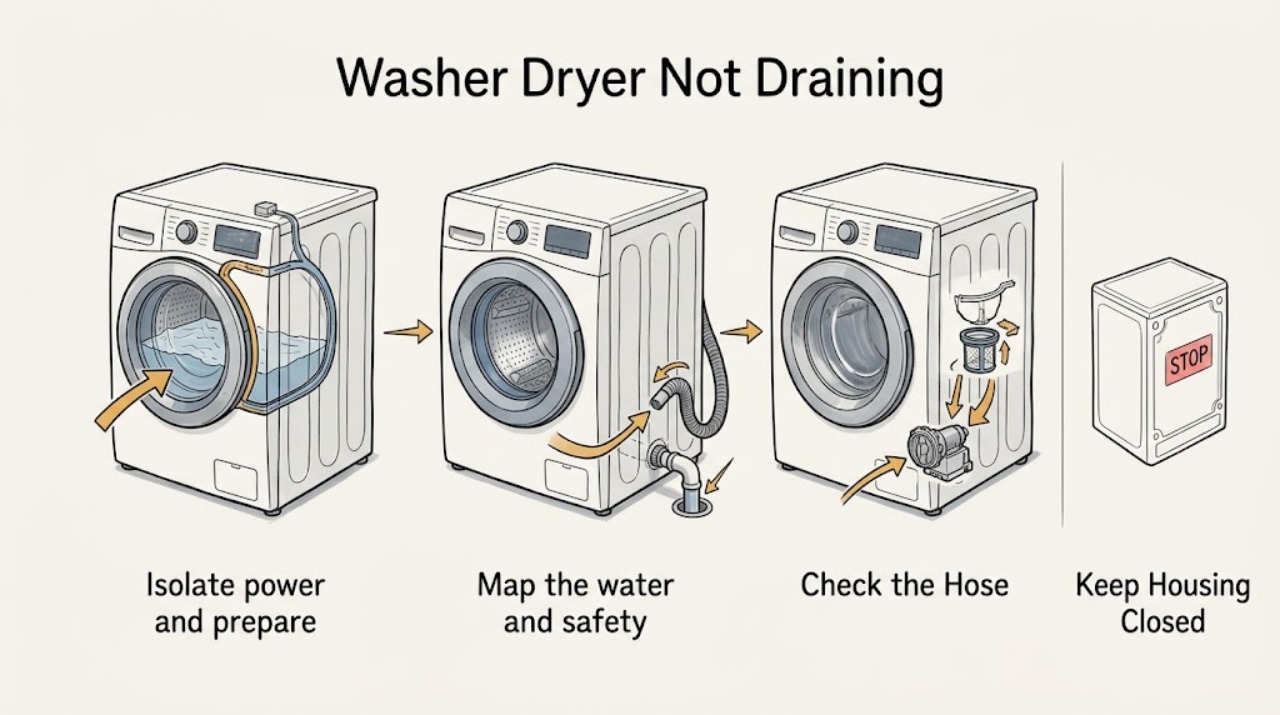
Work through in order
Diagnostic checks
Use only checks that match the exact appliance or system and its official guide.
-
Map the water and safety symptom
With the machine stopped and no hands near the drum, note whether the drum is full, partly full, or empty; whether water is on the floor; whether the door remains locked; whether clothes are only too wet; and whether the display shows a complete code or flashing pattern. Look for a wet cord or receptacle, smoke, burning smell, unusual heat, or a repeated protective-device trip.
Expected result: Water remains in the drum, water drains slowly, the drum is empty but laundry is wet, a leak is present, or the appliance shows a code or safety symptom.
Next step: If no safety symptom is present, continue with the external hose and household-drain checks. If water is hot, wait for it to cool; if the door is locked with water inside, do not force it.
Stop if: Stop for standing water near electrical parts, a wet cord or receptacle, a burst hose, smoke, burning smell, overheating, sparks, or a repeated trip.
Why this matters
Why: A full drum directs the check to the drain path, filter, pump, and household drain. An empty drum with wet clothing can reflect spin, load-balance, or suds behavior instead of a blocked drain. A leak or wet electrical area is a stop condition, not another test branch.
-
Isolate power and prepare for residual water
Turn the appliance off, disconnect it from mains power, allow hot water to cool, and place a shallow pan and towels below the user-accessible drain area. Use the exact model manual to confirm whether the unit has a residual drain hose and an owner-accessible pump filter; do not open a hidden panel or start dismantling if access is not documented.
Expected result: The appliance is safely isolated and cool, residual water can be directed into a pan, the access procedure is clear in the manual, or there is no documented user-accessible filter path.
Next step: Proceed only when power is isolated, water has cooled, and the container is stable. If the manual does not show a safe access route or the container cannot contain the water, close the appliance and request service.
Stop if: Do not open the filter or cover while powered, with hot water present, or when water may reach the cord or receptacle.
Why this matters
Why: A filter opening can release the water left in the tub, and hot water can burn. Model differences determine whether a filter can be cleaned by the owner; no documented access means the pump path should be handled by service.
-
Check the drain hose, standpipe, and sink separately
Inspect the entire visible drain hose behind the washer-dryer for a kink, compression against the wall, crushing, a loose end, or an end submerged in water. Check that the hose is routed at the height and in the support arrangement specified by the exact manual. If the manual permits a controlled test, direct the hose into a suitable container or laundry sink and observe the outlet without flooding the floor.
Expected result: The hose is kinked or pinched, the hose end is submerged or unsupported, water flows from the hose into a container, or no water flows despite a clear hose.
Next step: Correct only an obvious external routing problem and secure the hose as the manual shows. If the container test points to a blocked household drain, stop using that drain and arrange plumbing service; if no flow remains, continue to the model-approved filter check.
Stop if: Do not disconnect a hose over an uncontrolled floor, allow water to reach electrical parts, or keep testing after a hose leak or burst is found.
Why this matters
Why: A restricted or incorrectly routed hose can stop or slow drainage. If water exits the hose during a controlled test, the household standpipe or sink drain is more likely blocked; if no water exits through a clear hose, the restriction is more likely at the filter, pump, or control path.
-
Clean an owner-accessible pump filter only after draining safely
With power disconnected and residual water cooled, follow the exact manual to drain through the residual hose if provided, then remove the pump filter slowly over the pan. Clear lint, coins, buttons, or other debris from the filter and opening using the manual-approved method. Refit the filter, hose cap, and access cover securely before reconnecting power.
Expected result: The filter contains debris, the filter is clear, water leaks while the cap is loose, the cap or filter will not seat, or the model has no documented user-accessible filter.
Next step: If the filter and caps refit without force, reconnect power and perform one model-approved drain or spin test while observing from outside. If the filter will not seat, leaks, or cannot be accessed safely, leave the appliance off and request service.
Stop if: Do not reach into the pump, use sharp tools to force debris out, operate without the filter or cap, or continue when water reaches electrical parts.
Why this matters
Why: Foreign objects or lint can restrict the pump inlet. Water leaking after reassembly can indicate a cap, hose, seal, or filter seating problem. A clear filter does not prove that the pump or control circuit works, and an inaccessible filter is a service boundary.
-
Use pump sound and load clues to separate causes
After the external hose and filter path are safe and reassembled, run only the model's documented drain or spin test. Stand clear and listen for a pump hum while watching for water at the intended drain outlet; do not touch the drum or pump area. If the drum drained but clothes remain wet, record whether the load was a single bulky item, badly unbalanced, or unusually sudsy.
Expected result: The pump hums and water flows, the pump hums but no water flows, the pump is silent, the drum drains but does not spin, or the drum drains and spins after a load correction.
Next step: If a corrected external load completes drain and spin, monitor one normal load. If there is no flow, no pump response, recurring water, or a persistent no-spin condition, stop tests and request service for the pump, control, drive, or household drain as indicated.
Stop if: Stop for abnormal grinding, hot cabinet, burning smell, smoke, sparks, leaks, standing water near electrical parts, or repeated trip.
Why this matters
Why: A hum with no flow points toward a remaining restriction or pump impeller problem; silence can point toward pump power, wiring, control, or a safety interlock. An empty drum with wet clothes can result from load balance, low-spin programme, or excess suds rather than the drain hose alone.
-
Use the exact model code and rule out siphoning
Record the complete display code, not just a guessed abbreviation, and use the exact owner manual or manufacturer support page for that model. Review the installation diagram for hose height, air gap, standpipe or sink connection, and any anti-siphon requirement. Do not apply another brand's error-code meaning or change plumbing dimensions by guesswork.
Expected result: The code identifies a drain-related condition, the hose is installed too low or submerged, the household drain backs up, or the exact manual shows no applicable user correction.
Next step: Correct only an obvious installation issue exactly as the manual specifies and make one supervised test. If the household drain backs up, use a plumber; if the code returns or the path is clear, arrange appliance service.
Stop if: Do not keep restarting a leaking or waterlogged appliance, alter the drain connection without the manual, or open electrical panels to chase a code.
Why this matters
Why: A drain code can be triggered by the machine-side path, household plumbing, hose routing, or a sensor/control decision. Incorrect hose placement can cause siphoning or backflow and can make a pump appear to fail. An unresolved code after the manual's external checks needs service.
-
Stop after one safe test and hand off useful evidence
After one complete, safe drain test, record whether water left the drum, whether the pump hummed, whether the drum spun, whether the household drain accepted water, whether the filter was clear, and whether a code returned. Do not repeat full cycles or open the cabinet to inspect the pump, motor, wiring, or control.
Expected result: The appliance still retains water, drains only intermittently, leaks after filter work, hums without flow, remains silent, or the same code returns.
Next step: Leave the washer-dryer off and request qualified appliance service; request plumbing service when the machine outlet flows but the household drain backs up. Provide the exact model, code, water level, test result, filter condition, and any leak or safety symptom.
Stop if: Stop immediately for a leak near electrical parts, hot water that cannot be contained, smoke, sparks, burning smell, overheating, or repeated protective-device trip.
Why this matters
Why: A clear visible hose and filter do not establish that the pump, impeller, wiring, control, lock, or sensor is healthy. Intermittent drainage and a recurring code are service evidence, while a blocked household drain belongs with plumbing service.
Use your observations
Decision map
Find the observation that best matches what you see, then follow the next safe action.
-
PATH 01Next step
What you see
Water reaches electrical parts, the appliance leaks, water is hot or uncontrolled, smoke, sparks, burning smell, overheating, or repeated trip occurs
Do this next
Leave the appliance off, keep clear of wet or hot parts, and arrange qualified appliance or electrical service.
-
PATH 02Next step
What you see
Water exits the appliance hose during a controlled test but the standpipe or sink backs up
Do this next
Stop using the blocked drain and arrange plumbing service; do not blame or replace the appliance pump first.
-
PATH 03Next step
What you see
Visible hose is kinked, compressed, loose, submerged, or installed contrary to the manual
Do this next
Correct only the obvious routing issue according to the manual and perform one supervised test.
-
PATH 04Next step
What you see
Owner-accessible pump filter contains debris or was not securely refitted
Do this next
Drain residual water with power isolated, clean and refit the filter and caps, then perform one model-approved drain test.
-
PATH 05Next step
What you see
Pump hums without flow, is silent with a clear path, or the code returns
Do this next
Stop testing and arrange qualified appliance service for pump, control, wiring, or sensor diagnosis.
-
PATH 06Next step
What you see
Drum empties but clothes remain wet after an unbalanced, bulky, sudsy, or low-spin load
Do this next
Correct only the documented load or programme issue and monitor one normal cycle; persistent wet loads need service.
Helpful context
Understand the symptom
Start with where the water stops
A washer-dryer that leaves water in the drum has a different problem from one that empties the drum but leaves clothes unusually wet. The water can be held by a kinked hose, blocked household drain, pump filter, pump, or control decision. Do not assume that a code from one brand applies to another machine; record the complete display and use the exact manual.
Water and mains power create a separate safety boundary
Turn the controls off, let hot water cool, and unplug or isolate the appliance before opening a service cover or removing a filter. Prepare a shallow pan and towels because residual water can spill. If a leak reaches the cord, receptacle, or other electrical parts, stop immediately. Never force a locked door, run a pump with hands inside, or open the cabinet to inspect wiring.
When checks do not resolve it
Need a professional?
Request qualified appliance service when safe external hose, household-drain, model-approved filter, load, and code checks do not restore drainage. Use plumbing service when the appliance hose drains but the household standpipe or sink backs up; use electrical service for a damaged supply or repeated protective-device trip.
Safety scope: Disconnect mains power before documented filter work, do not force a locked door, do not reach into a moving drum or pump, do not open the cabinet for wiring work, and do not operate with water near electrical parts, a leak, overheating, smoke, sparks, burning smell, or repeated trip.
Have this ready
- Provide the exact model, complete display code, water level and temperature, drain-hose and household-drain observations, filter condition, pump sound, spin result, load condition, and any leak or electrical symptom.
Common questions
FAQ
What should I check first when a washer-dryer will not drain?
Turn it off, let hot water cool, disconnect mains power, and check the visible drain hose for kinks or compression. Then distinguish a blocked household drain from a machine-side restriction and use the exact manual before opening an owner-accessible pump filter.
Can I clean the washer-dryer pump filter with water in the drum?
Only if the exact model documents that access. Disconnect power, allow hot water to cool, direct residual water into a shallow pan, and open the filter slowly. If the water cannot be contained, the filter is not user-accessible, or the caps will not refit securely, stop and request service.
Why are clothes wet even though the washer-dryer emptied?
The drum may have drained but failed to complete a proper spin because of a bulky or unbalanced load, a low-spin programme, or excess suds. Correct only the documented load or programme issue and monitor one cycle. If the machine repeatedly leaves clothes wet, arrange service.
Read the exact guide
Official sources
- [LG front load washing machine - Leakage] The washing machine leaks water at the front.LG USA Support · General safety clue for front-load washer-dryer filter work; exact model access differs
- LG Washer - Troubleshooting Washer Does Not Drain or Spin (Clothes Too Wet)LG USA Support · General diagnostic concepts for washer-dryer drainage; follow the exact appliance manual
- [LG Washing Machine] Water Not Draining (OE Error)LG USA Support · General diagnostic sequence for comparable washer-dryer drainage layouts; exact access and dimensions remain model-specific
Community feedback
Share a repair observation
Share a plain-text repair observation. Accepted observations are published automatically; this page may take a moment to update.