
On this page
Start here
Quick answer
Excessive washing-machine vibration is usually decided by when it occurs and whether the machine stays stable. A single bulky or absorbent item, an overloaded or tangled load, an unlevel machine, an unsuitable floor, loose external hoses, or—only after a new installation or move and when the manual confirms it—transport hardware can cause shaking. Stop immediately if the washer walks, bangs violently, leaks, exposes a cord or outlet to water, makes metal-grinding sounds, smells burnt, smokes, sparks, or trips protection. Do not tilt the machine, open its cabinet, or keep running it to see whether the damage gets worse. Start with a dry, stopped-machine observation, then make only safe, model-appropriate load and installation checks; persistent vibration after those checks needs qualified service.
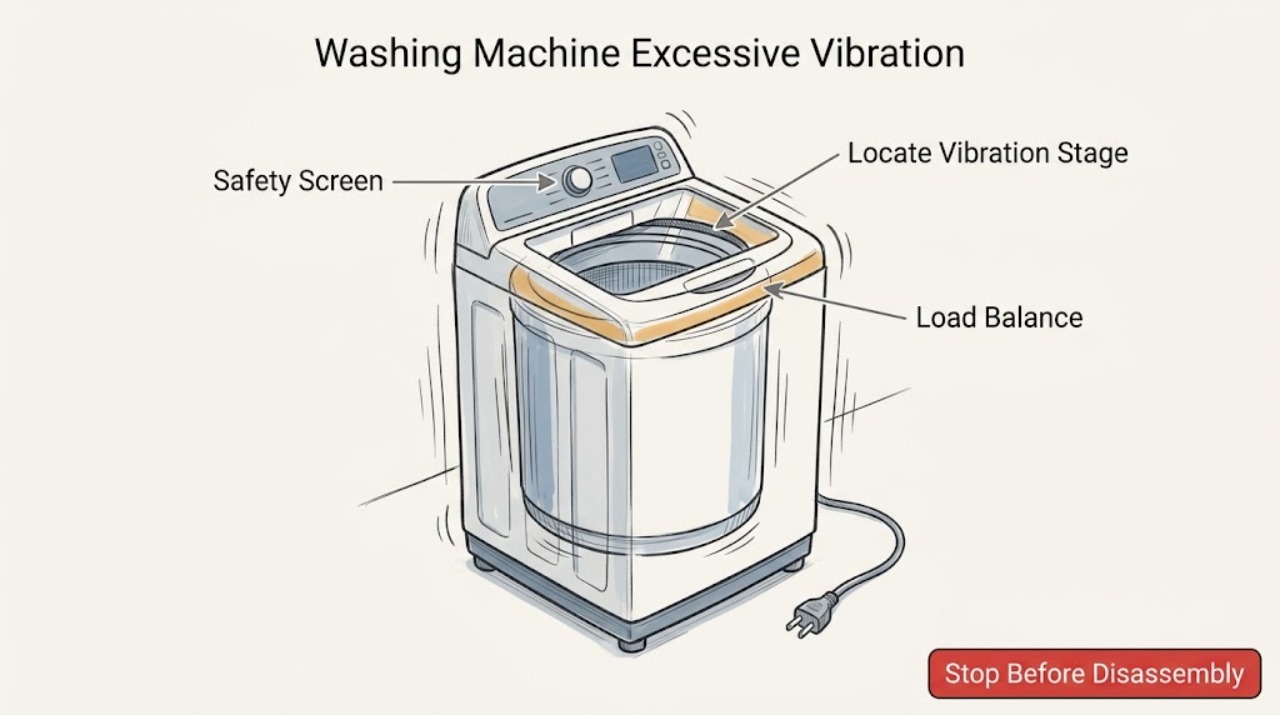
Work through in order
Diagnostic checks
Use only checks that match the exact appliance or system and its official guide.
-
Check 1
Stop the washer and observe from a dry, stable position without touching wet electrical equipment or moving the cabinet.
Expected result: Record walking, violent banging, a leak, water near the cord or outlet, metal grinding, smoke, burning odor, sparks, unusual heat, a damaged hose or cord, or a repeated protection trip.
Next step: If a hazard is present, keep clear, close water only if safely reachable, isolate power only from a dry safe position, and arrange qualified appliance, plumbing, or electrical service.
Stop if: Do not restart the washer, tilt it, reach behind it, or touch wet parts after a safety symptom.
Why this matters
Why: These signs can turn a vibration problem into a water, shock, fire, or mechanical hazard.
-
Check 2
Record whether the vibration occurs during filling, tumbling, draining, ramp-up, or high-speed spin, and whether it is a shake, rock, walk, knock, or grind.
Expected result: Spin-only movement supports load, leveling, or suspension paths; a knock from a loose hose or a grind from the drum area changes the next check; vibration at all stages suggests installation or an internal fault.
Next step: Keep the machine stopped and write down the load, cycle, floor, and exact sound before any low-risk adjustment.
Stop if: Do not run repeated high-speed tests when the cabinet walks, impacts hard, leaks, or makes metal-on-metal noise.
Why this matters
Why: Timing and sound location separate normal brief movement from a repeatable mechanical or installation problem.
-
Check 3
With the drum stopped, inspect the load for one heavy or bulky item, tangled items, an overfilled drum, or laundry packed against one side.
Expected result: A single absorbent item, tightly packed load, or clump supports an imbalance; a reasonable, evenly distributed load that still vibrates points toward installation or service.
Next step: Redistribute or reduce the load only as the manual permits, then monitor a normal cycle without deliberately increasing spin stress.
Stop if: Do not add heavy objects as a permanent counterweight, exceed capacity, or continue if the washer walks or bangs violently.
Why this matters
Why: Official guidance notes that one item can create the same imbalance as an overloaded load, especially during spin.
-
Check 4
From outside the cabinet, check whether the washer stands on a hard, level surface and whether it visibly rocks when gently observed from a stable position; do not lift or tilt it.
Expected result: A rocking cabinet, a foot that does not contact the floor, a sloped or flexible floor, or an unstable base supports an installation cause; a stable cabinet with continued vibration keeps an internal fault possible.
Next step: Use the exact installation manual for any foot adjustment and keep the appliance upright; arrange installation or appliance service if stability cannot be corrected safely.
Stop if: Do not put hands under the machine, remove panels, use improvised wedges, or adjust hardware while the washer is energized or wet.
Why this matters
Why: Uneven feet and unsuitable floors can amplify normal spin forces and cause walking.
-
Check 5
Look at reachable water and drain hoses and nearby storage for visible contact with the cabinet, wall, or floor; do not pull the washer out.
Expected result: A hose tapping the cabinet can create a knocking noise during spin; a kink, leak, or strained connection is a water-safety concern rather than a vibration adjustment.
Next step: Secure only a safely visible hose position as the manual permits; for a leak, close water if safe, keep the washer off, and arrange plumbing or appliance service.
Stop if: Do not disconnect hoses, reach behind the machine, or run it with a damaged hose or water near electricity.
Why this matters
Why: Loose hoses are listed as an external vibration or noise source, while a damaged or wet connection can cause flooding and electrical risk.
-
Check 6
If the vibration began with a new installation or relocation, review the exact installation manual for transport bolts, packing, shipping blocks, and required foot adjustment without reaching behind or opening the cabinet.
Expected result: The manual may identify transport hardware that must be removed after installation; hardware is not a valid explanation when the washer has not recently been installed or moved.
Next step: Have the installer or a qualified technician verify the installation against the exact manual; do not remove unknown hardware yourself.
Stop if: Do not operate a newly installed machine with suspected shipping hardware, and do not remove rear hardware without model instructions and safe access.
Why this matters
Why: Transport hardware can hold the tub for shipping and cause severe vibration if left in place, but removal instructions are model-specific.
-
Check 7
Record whether vibration follows a drain problem, excessive suds, an unbalanced-load message, or water remaining in the drum, without opening wet service points.
Expected result: A drain or foam condition can change load distribution and the spin decision; water remaining with movement, leaks, or a pump fault requires stopping rather than another spin test.
Next step: Use the exact manual's drain or detergent guidance and arrange service if the condition recurs or water cannot be safely cleared.
Stop if: Do not open a filter or hose into an uncontrolled wet area, run a high-speed cycle with residual water, or touch wet electrics.
Why this matters
Why: The spin system may be responding to water or load conditions instead of having a primary suspension fault.
-
Check 8
With the washer empty, cool, dry, and disconnected only as the manual permits, observe the visible drum opening for an off-center basket, damaged seal, foreign object, or obvious cabinet damage; do not dismantle it.
Expected result: A visibly displaced drum, grinding or clanking, damaged seal, loose counterweight sign, or severe movement without a load supports an internal service fault; a centered, quiet drum does not rule one out.
Next step: Keep the washer out of service and provide the observation to qualified appliance repair when internal symptoms are present.
Stop if: Do not reach into moving parts, remove the cabinet, test wiring, or tilt the appliance to inspect underneath.
Why this matters
Why: Worn shock absorbers, bearings, basket, or other internal parts can cause persistent imbalance and require professional assessment.
-
Check 9
After a safe load or installation correction, monitor one ordinary cycle from a nearby safe position rather than forcing a maximum-spin test.
Expected result: Normal movement with no walk, impact, leak, grinding, heat, or warning suggests the corrected load or installation was relevant; recurrence means the cause remains unresolved.
Next step: Stop monitoring and arrange service if vibration returns, worsens, or occurs with a different ordinary load.
Stop if: Do not continue monitoring after walking, violent impact, leak, grinding, smoke, odor, or an electrical trip.
Why this matters
Why: One quiet cycle is evidence about the change, not proof that a damaged suspension, bearing, or floor is healthy.
-
Check 10
Prepare a service record with the model number, front- or top-load configuration, cycle stage, load type, floor, foot or hose observations, installation or move history, error messages, and safety symptoms.
Expected result: A precise record shows whether the fault follows a load, installation, drain or foam condition, or persists empty and balanced with mechanical signs.
Next step: Keep the washer out of service when the cause is unresolved or movement is severe, and arrange qualified appliance service.
Stop if: Do not select or replace a suspension, bearing, basket, motor, or foot from the symptom alone.
Why this matters
Why: The technician can choose an inspection of the suspension, bearings, basket, counterweights, drive, hoses, or installation without unsafe user disassembly.
Use your observations
Decision map
Find the observation that best matches what you see, then follow the next safe action.
-
PATH 01Safety boundary
What you see
The washer walks, bangs violently, leaks, exposes electricity to water, grinds metal, smokes, smells burnt, sparks, overheats, or trips protection repeatedly.
Do this next
Stop use, keep clear, close water or isolate power only when safely reachable, and arrange qualified appliance, plumbing, or electrical service.
Why this path and its safety boundary
Why it matters: The appliance may cause injury, water damage, fire, shock, or further mechanical damage.
Safety stop: Do not restart, tilt, move, or open the washer after a safety symptom.
-
PATH 02Safety boundary
What you see
Vibration occurs during spin with one bulky, absorbent, tangled, or uneven load.
Do this next
Redistribute or reduce the load according to the manual and monitor an ordinary cycle once.
Why this path and its safety boundary
Why it matters: Load imbalance is the leading explanation and can occur without an appliance defect.
Safety stop: Stop if the machine walks, bangs, leaks, or repeats vibration with a balanced load.
-
PATH 03Safety boundary
What you see
The drum is tightly packed or the vibration follows an overloaded wash.
Do this next
Use a smaller, evenly distributed load within the manual's capacity guidance; service is needed if the symptom persists.
Why this path and its safety boundary
Why it matters: Overloading can prevent even distribution and increase spin movement and wear.
Safety stop: Do not exceed capacity or use heavy objects as a counterweight.
-
PATH 04Safety boundary
What you see
The cabinet rocks, a foot does not contact the floor, or the floor or base flexes.
Do this next
Use the exact installation manual or qualified installer for safe foot and floor correction while keeping the machine upright.
Why this path and its safety boundary
Why it matters: An unstable installation can amplify normal spin forces and cause walking.
Safety stop: Do not lift, tilt, slide, or wedge the washer while it is connected or wet.
-
PATH 05Safety boundary
What you see
The problem began after first installation or relocation and the exact manual identifies transport bolts or packing material.
Do this next
Have the installation checked against the exact manual by the installer or qualified technician before further use.
Why this path and its safety boundary
Why it matters: Shipping hardware can restrain the tub and cause severe vibration if it remains installed.
Safety stop: Do not remove unknown rear hardware or continue running the new or moved washer with severe vibration.
-
PATH 06Safety boundary
What you see
The vibration includes a repeatable tap or knock from a reachable hose contacting the cabinet or wall.
Do this next
Secure only a safely reachable hose position as the manual permits; arrange plumbing or appliance service for a leak or strained connection.
Why this path and its safety boundary
Why it matters: An external hose can create noise, but a wet or damaged connection is a separate water hazard.
Safety stop: Do not disconnect hoses, reach behind the washer, or run it with water near electricity.
-
PATH 07Safety boundary
What you see
Vibration follows excessive suds, a drain warning, residual water, or an unbalanced-load message.
Do this next
Follow the exact model's drain and detergent guidance and arrange service if water remains or the condition recurs.
Why this path and its safety boundary
Why it matters: Water or foam conditions can affect load distribution and spin behavior.
Safety stop: Do not run high-speed tests with residual water or open wet service points without safe model instructions.
-
PATH 08Safety boundary
What you see
The empty or balanced washer still vibrates, or the drum shows grinding, clanking, displacement, or excessive play.
Do this next
Keep the washer out of service and arrange qualified appliance diagnosis.
Why this path and its safety boundary
Why it matters: Suspension, bearing, basket, counterweight, drive, or another internal component may be involved.
Safety stop: Do not dismantle, tilt, reach into moving parts, or perform live electrical work.
-
PATH 09Safety boundary
What you see
The machine is upright and stable, the load is balanced, and vibration persists across ordinary cycles.
Do this next
Stop repeated testing and arrange qualified service with the vibration stage and history.
Why this path and its safety boundary
Why it matters: A recurring installation, floor, suspension, bearing, basket, or drive issue remains possible.
Safety stop: Do not keep running the washer to see whether it worsens.
-
PATH 10Safety boundary
What you see
A safe load or installation correction is followed by one ordinary cycle with no walk, impact, leak, grinding, heat, odor, or electrical warning.
Do this next
Monitor normal use and arrange service if excessive vibration returns.
Why this path and its safety boundary
Why it matters: The changed load or installation was likely relevant, but one quiet cycle does not rule out an intermittent fault.
Safety stop: Stop immediately if any safety symptom returns.
Helpful context
Understand the symptom
Classify the vibration before changing anything
Note whether the vibration starts during filling, tumbling, draining, or high-speed spin, and whether the cabinet rocks, walks, bangs, or only hums lightly. A single heavy item can be as unbalanced as an overloaded drum. A problem that began immediately after installation or relocation has a different evidence path from a vibration that developed gradually on the same load and floor. Stop first if the machine is moving toward a wall, hose, step, or electrical point.
Load balance is the first low-risk branch
Manufacturers describe single bulky items, absorbent items, tangled laundry, and overloading as common causes of spin vibration. With the machine stopped, redistribute or reduce the load according to the manual and avoid treating one successful load as proof that the washer is sound. If the washer vibrates with different ordinary loads, or the movement is severe, continue to the installation and service branches instead of adding weight as a permanent fix.
Installation matters after a move or on a new machine
All feet should rest securely on a hard, level, stable surface. Transport bolts or packing material are relevant only to a new installation or relocation and only when the exact installation instructions identify them. Do not reach behind a confined machine or remove hardware from an unknown model. A floor that flexes, a pedestal that is loose, or a cabinet that rocks can transmit vibration even when the drum load is reasonable.
Grinding and persistent movement point inside
A loose hose or accessible foreign object can make noise, but metal grinding, repeated hard impact, an off-center drum, or vibration that persists with a balanced load can indicate suspension, bearing, basket, counterweight, or drive trouble. Those parts require diagnosis. Keep the washer out of service when movement is violent or a safety symptom occurs; do not tilt, dismantle, or perform live electrical work.
Safety boundary
Stop conditions
- Stop for walking, violent impacts, leaks, water near electricity, metal grinding, smoke, burning odor, unusual heat, sparks, damaged parts, or repeated electrical trips.
- Do not tilt, lift, drag, dismantle, or open the washing machine; do not reach into a rotating drum or perform live electrical work.
- Do not run further high-speed tests when the machine is unstable, leaking, grinding, or damaging the floor, wall, hoses, or cabinets.
- Treat transport bolts as a new-installation or relocation question only when the exact manual confirms them; do not remove unknown hardware.
- Do not select or replace suspension, bearing, basket, motor, counterweight, or other parts from vibration alone.
Only after diagnosis
Potential parts
- leveling foot or lock hardware
Consider only if the exact installation diagnosis finds damaged or missing leveling hardware after the machine's floor and stability are confirmed.
Foot and lock designs vary by model; keep the appliance upright and confirm the exact model before selecting a part. - suspension or shock absorber assembly
Consider only when qualified diagnosis finds persistent empty-drum vibration or worn suspension after load and installation causes are excluded.
Suspension parts are model-specific and require safe internal access; do not infer fit from a vibration symptom. - drum bearing or basket support
Consider only when grinding, play, or basket displacement leads a qualified technician to a bearing or support diagnosis.
Bearing and basket assemblies differ by model and may require extensive service; confirm the diagnosis and fit. - transport hardware kit
Consider only after a new installation or relocation when the exact manual or installer confirms missing, damaged, or required transport hardware.
Transport hardware is model-specific and is not a permanent operating part; do not use a generic kit or remove unknown hardware.
When checks do not resolve it
Need a professional?
Arrange qualified appliance service when excessive vibration persists with balanced loads and a stable upright installation, when the washer walks or bangs, when grinding or internal movement is present, or when an installation or transport-hardware issue cannot be safely confirmed. Use plumbing or electrical service for an implicated hose, water, outlet, cord, or protection fault.
Common questions
FAQ
Why is my washing machine vibrating so much during spin?
Common causes include a single bulky or tangled load, overloading, an unlevel machine, an unstable floor, loose hoses, or transport hardware left after a new installation or move. Persistent vibration with a balanced load, grinding, or walking needs service.
Can one item make a washing machine vibrate?
Yes. Manufacturer guidance notes that one heavy or absorbent item can become as unbalanced as an overloaded drum. Stop the washer, redistribute or reduce the load according to the manual, and stop using it if it walks, bangs, leaks, or repeats the problem.
How do I know if my washing machine is unlevel?
A cabinet that rocks or has a foot not firmly contacting a hard, stable floor supports an installation problem. Keep the machine upright and use the exact installation manual or qualified installer for foot adjustment. Do not lift, tilt, or work under an energized or wet washer.
Could shipping bolts cause excessive vibration?
Yes, but this is primarily a new-installation or relocation check. Transport bolts hold the tub during shipping and can cause severe vibration if left in place. Confirm their status only from the exact installation instructions or with the installer; do not remove unknown rear hardware.
When does washer vibration mean a serious fault?
Walking, violent impacts, metal grinding, vibration with an empty or balanced drum, a leak, smoke, burning odor, unusual heat, sparks, or a repeated electrical trip are stop conditions. Keep the washer out of service and arrange qualified appliance, plumbing, or electrical help as appropriate.
Read the exact guide
Official sources
- Washing machine vibrates and movesBosch Home Appliances · Bosch washing machines; used for general installation mechanisms, not brand-specific fit or instructions
- Washing Machine Noisy or Shaking During Spin Cycle?Zanussi · Front- and top-load washing machines; exact model manual controls installation and filter access
- How to Stop a Washer From ShakingWhirlpool · General Whirlpool washer guidance used for common washer mechanisms; exact model manual controls
Community feedback
Share a repair observation
Share a plain-text repair observation. Accepted observations are published automatically; this page may take a moment to update.