
On this page
Start here
Quick answer
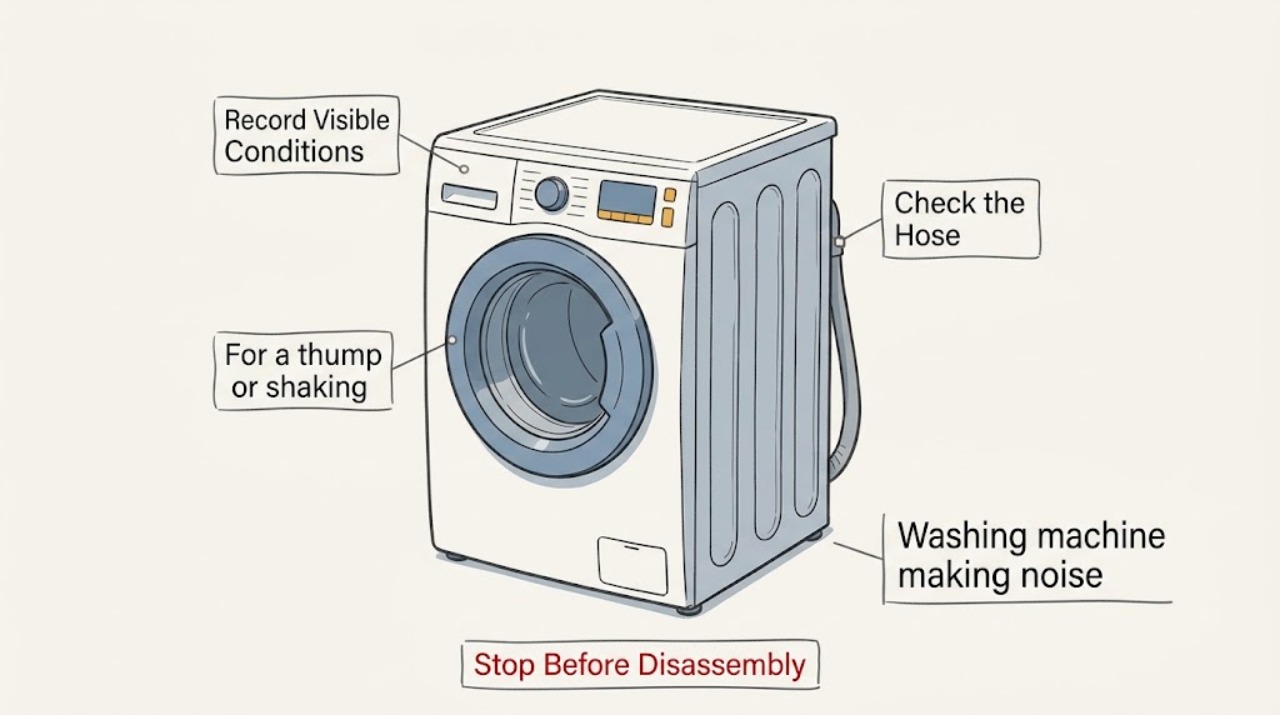
A washing machine can hum, click, gurgle, or shift normally, but a new grinding, metallic scrape, repeated bang, or violent vibration needs a closer check. Note whether the sound occurs during filling, draining, agitation, or spin. With the washer stopped and stable, remove external objects, inspect visible hoses, check the load and level only as the model allows, and record whether the sound follows the empty machine. Stop immediately for walking, impact, leaking, metal-on-metal grinding, smoke, burning smell, sparking, or repeated power trips.
Work through in order
Diagnostic checks
Use only checks that match the exact appliance or system and its official guide.
-
Check 1
Record the exact sound as hum, click, gurgle, rattle, thump, scrape, grind, or bang, and note whether it occurs during fill, wash or agitation, drain, or spin; stop if the cabinet moves violently.
Expected result: A hum or gurgle during drain can be pump activity, while a click at the start can be a lid or door lock. Thumping at spin suggests load or leveling, and grinding or rubbing during wash or spin needs a closer mechanical check.
Next step: Use the matching hose, load, level, external-object, or professional-service check below. Do not keep running the machine to reproduce a severe sound.
Why this matters
Why: The stage changes which parts could be involved; the same sound has different significance during fill, drain, and high-speed spin.
-
Check 2
With the washer stopped, check the outside, top, and accessible rear area for items leaning against the cabinet and for inlet or drain hoses that can strike the cabinet; do not move a wet or unstable washer.
Expected result: A loose household object or hose that contacts the cabinet can create a rattle or bang which follows water flow or vibration. A cracked hose, wet connection, or leak is not a harmless noise source.
Next step: Remove only an external object and keep visible hoses clear without pulling their connections. Close water valves and request service for damage, leakage, or a hose that cannot be safely repositioned.
Why this matters
Why: External contact is a low-risk explanation for a rattle, but hose damage or a leak changes the issue to an appliance or plumbing repair boundary.
-
Check 3
For a thump or shaking during spin, stop the programme and inspect the load without reaching into a moving drum; redistribute a tightly packed, single bulky, or uneven load and check from outside whether the washer stands level and stable.
Expected result: A noise that disappears with a balanced load supports an imbalance branch. If the cabinet rocks, walks, or bangs even with a suitable load, leveling, floor, installation, or suspension concerns remain.
Next step: Use the model installation instructions for leveling. If the washer continues to walk, strike the cabinet, or leak, stop using it and arrange appliance service.
Why this matters
Why: An uneven load can create basket movement and extra noise; a stable floor and firm feet are needed for safe spin operation.
-
Check 4
If the washer was recently installed or moved, check the installation documentation for shipping or transit hardware and confirm that any required removal or leveling was completed; do not remove hardware by guesswork.
Expected result: Noise and vibration beginning after installation, or continuing because transit material remains, supports an installation branch. An older washer with a new noise is not explained by shipping hardware alone.
Next step: Use the manual or installer for any shipping-hardware or leveling correction. If the required hardware is inaccessible or the machine still vibrates, request appliance service.
Why this matters
Why: Shipping materials and leveling requirements differ between front-load and top-load designs and must be matched to the exact model.
-
Check 5
With power isolated and the drum empty, inspect only the visible drum, door or lid seal, dispenser area, and accessible filter cover for a coin, zipper, debris, or rubbing mark; do not reach into hidden pump or drive areas.
Expected result: A loose object may cause a click or metallic noise and can obstruct a pump. A scrape that remains with an empty drum, a rough rubbing mark, or a pump that only hums points toward a mechanical or drain-system fault.
Next step: Remove only an object that is plainly visible and safe to pick up. Stop for metal grinding, a jammed filter, an inaccessible object, or any need to open the cabinet; arrange appliance service.
Why this matters
Why: Small objects can move between the basket and tub or block the pump, while an empty-drum noise is less likely to be caused by laundry balance.
-
Check 6
After a safe external correction, document whether the noise returns, whether it is tied to a particular stage or speed, and whether the washer is level, dry, and stable; do not run another cycle when a stop condition is present.
Expected result: A noise that is gone after a balanced load or removed external object supports that branch. Persistent noise with an empty drum, unusual motor or pump sound, walking, leakage, or electrical symptoms indicates a fault.
Next step: Request appliance repair for persistent or worsening noise, internal mechanical symptoms, or any safety symptom. Preserve the sound description, stage, model, and recent installation or load history.
Why this matters
Why: The result distinguishes an operating-condition noise from an internal bearing, suspension, pump, motor, or control issue without authorizing a teardown.
Use your observations
Decision map
Find the observation that best matches what you see, then follow the next safe action.
-
PATH 01Next step
What you see
The noise is a hum, gurgle, click, or whir tied to sensing, locking, draining, or a normal direction change.
Do this next
Arrange qualified service and follow the exact model guidance.
Why this path and its safety boundary
Why it matters: Compare the sound with the model manual and observe only from a safe distance; escalate if it becomes harsh, persistent, or is paired with a fault symptom.
-
PATH 02Next step
What you see
A rattle or bang follows a hose, nearby object, or cabinet contact during fill or vibration.
Do this next
Arrange qualified service and follow the exact model guidance.
Why this path and its safety boundary
Why it matters: Remove the external object or safely clear visible hose contact; do not pull connections, and arrange service for a damaged hose or leak.
-
PATH 03Next step
What you see
Thumping, vibration, or walking is concentrated in spin or follows a bulky, single, or uneven load.
Do this next
Arrange qualified service and follow the exact model guidance.
Why this path and its safety boundary
Why it matters: Stop, redistribute the load, and check stable leveling using the exact installation guidance; repeated walking or impact needs appliance service.
-
PATH 04Next step
What you see
Grinding, rubbing, repeated metallic impact, or a noise remains with an empty drum.
Do this next
Arrange qualified service and follow the exact model guidance.
Why this path and its safety boundary
Why it matters: Stop using the washer and request appliance repair for an inaccessible object, pump, suspension, bearing, motor, or drive fault; do not remove panels.
-
PATH 05Next step
What you see
The washer leaks, moves violently, smells burnt, smokes, sparks, trips power, or shows a hot or damaged cord.
Do this next
Arrange qualified service and follow the exact model guidance.
Why this path and its safety boundary
Why it matters: Stop immediately, isolate water and power only from a dry safe position, keep clear of wet electrics, and obtain qualified appliance or electrical help.
Helpful context
Understand the symptom
Do not diagnose a washer from the word loud alone. A hum while sensing or draining, a click as a lid or door locks, and some motor or gear sounds can be normal for the design. A repeating scrape, sharp metallic impact, or noise that worsens with speed is a different branch.
Keep the washer stable while checking it. Never reach into a moving drum, remove a cabinet panel, or continue a cycle that is walking, leaking, overheating, or producing an electrical smell. Shipping or transit hardware, leveling, and filter access are model-specific.
Safety boundary
Stop conditions
- Stop immediately for walking, cabinet impact, violent shaking, leaking, metal-on-metal grinding, a jammed drum or pump, smoke, burning smell, sparking, a hot or damaged cord, or repeated breaker trips.
- Do not reach into a moving drum, remove cabinet panels, remove transit hardware by guesswork, force a filter, or continue cycles to reproduce a severe noise.
Only after diagnosis
Potential parts
- hose restraint or leveling hardware
Consider only when the exact installation instructions or a technician identify hose contact or leveling hardware as the cause.
Confirm the washer model, floor, drain pan, and installation design before selecting hardware; do not infer fit from a noise description. - pump, suspension, bearing, or drive component
Consider only after a technician confirms an internal component fault from persistent empty-drum noise, abnormal pump sound, or repeat vibration.
Internal parts are model-specific and may require qualified installation; do not order or replace one based only on the sound name.
Common questions
FAQ
Why is my washing machine making a grinding noise?
Grinding or rubbing can occur during wash or spin from normal motor or gear behavior on some designs, but overload, leveling, a trapped object, pump restriction, or an internal fault can make it louder. Stop for metal grinding or a noise that remains with an empty drum.
How do I stop a washer from banging during spin?
Stop the cycle, redistribute a bulky or uneven load, and check that the machine is stable and level under the exact installation guidance. Repeated walking or cabinet impact needs service.
Is a humming washer normal?
A hum can be normal during sensing, motor direction changes, or draining. It is not normal if paired with no water movement, a jammed pump, overheating, burning smell, smoke, sparking, or repeated power trips.
Read the exact guide
Official sources
- Vibration, Walking or Off Balance - Front Load WasherWhirlpool Product Help · Front-load washer installation, shipping material, leveling, and load-balance guidance
- Rattling - NoiseWhirlpool Product Help · Top-load washer rattle, hose, and external-object guidance
- Knocking or Thumping - NoiseWhirlpool Product Help · Top-load washer noise, hose, load, and level guidance
- Grinding or Rubbing Noise - WasherWhirlpool Product Help · Front-load washer grinding, rubbing, load, level, and drain-pan guidance
- Clicking or Clacking - Noise - WasherWhirlpool Product Help · Washer start-of-cycle clicking and lid-lock sound guidance
- TROUBLESHOOTING – WASHERWhirlpool · Washer operating sounds, objects, vibration, leaks, and troubleshooting boundaries
Community feedback
Share a repair observation
Share a plain-text repair observation. Accepted observations are published automatically; this page may take a moment to update.