
On this page
Start here
Quick answer
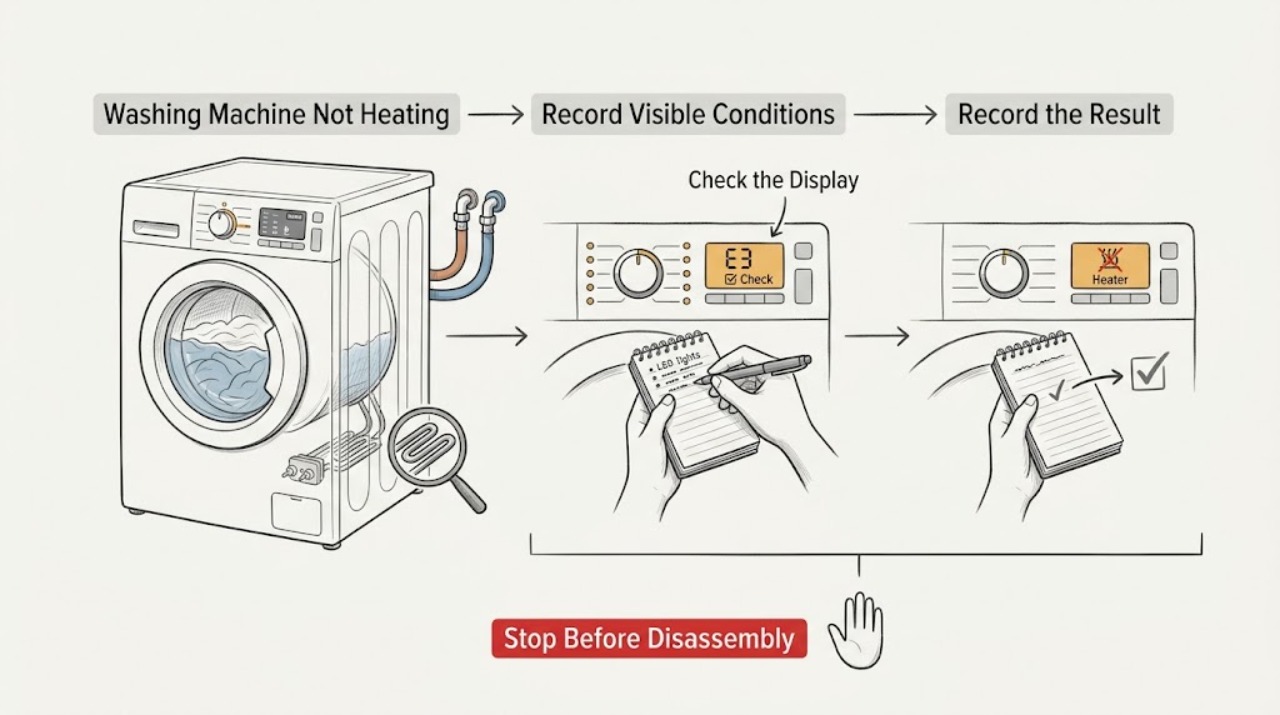
A washing machine that seems not to heat may be receiving cold water, blending hot and cold water by design, using a low-temperature or rinse phase, or moving on before cold incoming water reaches the selected setting. Some models heat water internally and others rely partly or entirely on the household hot-water supply, so do not assume every washer has the same heater or that a cool door or tub proves a failure. Check the selected cycle, the household hot-water result, and the visible hose and faucet setup without opening the machine. If an error, leak, burning odor, smoke, shock, or tripped circuit is present, stop using it and arrange qualified appliance service.
Work through in order
Diagnostic checks
Use only checks that match the exact appliance or system and its official guide.
-
Check 1
Stop the cycle if there is a leak, standing water near electricity, a burning odor, smoke, a shock, damaged cord, or a tripped circuit; otherwise record the selected cycle, temperature option, and whether the symptom occurs during fill, wash, or rinse.
Expected result: The symptom is limited to a cold or rinse phase, occurs on a temperature-controlled wash phase, or is accompanied by a safety warning or error.
Next step: For any safety warning, stop using the washer and arrange qualified appliance or electrical help. If there is no warning, continue with the supply and setting checks without opening the machine.
Why this matters
Why: A cold or rinse phase may be intentional, while a repeated cold result on a cycle that should heat is more significant. Water, heat, electrical, or error symptoms can make continued operation unsafe.
-
Check 2
Choose a cycle and temperature exactly as the washer's own controls and manual describe, selecting the cycle before changing its temperature option; do not infer a heating failure from a low-temperature, cold, or rinse phase.
Expected result: The cycle uses cold or mixed water, the temperature option is fixed or unavailable, or a supported warm or hot wash still finishes noticeably cold.
Next step: Repeat the observation only on the correct cycle if the machine is safe to use. If the intended cycle remains cold, record its name and model number and proceed to the water-supply check; do not alter hidden settings.
Why this matters
Why: The program may be controlling temperature by design, and selecting a temperature before the cycle can be ignored on some models. A supported warm or hot cycle that repeatedly stays cold deserves further supply and model-specific review.
-
Check 3
From a normal, safe sink operation, note whether the household hot-water supply becomes hot and whether another recent load may have used the available hot water; do not change the water-heater controls for this diagnosis.
Expected result: The sink supply is also cool, becomes hot only after a delay, or is hot while the washer result remains cold.
Next step: Address a household hot-water issue separately. If the sink supply is hot, keep the washer settings unchanged and inspect only the exposed washer hoses and faucet positions before requesting service.
Why this matters
Why: A cool household supply, long pipe run, or depleted hot-water supply can explain a cool wash. Hot water at the sink with a repeated cold washer result shifts attention to the washer's inlet arrangement or model-specific heating path.
-
Check 4
With the washer stopped and the area dry, look at the exposed hot and cold inlet hose labels, faucet positions, visible kinks, and connection area without disconnecting a hose or removing a panel.
Expected result: The hoses appear reversed, a faucet is not open, a hose is kinked, a connection is wet, or the visible setup looks correct.
Next step: If a faucet is closed, use only the normal user control to restore it when the area is dry and safe; otherwise photograph the arrangement and have service correct or verify the connections. Do not pull on hoses, open the cabinet, or handle wet electrical parts.
Why this matters
Why: Reversed or restricted inlet connections can send the wrong water temperature or reduce flow. A wet connection is a leak issue, and a normal external view does not rule out an internal valve, heater, sensor, or control fault.
-
Check 5
Review the model manual or official support page for whether this model uses an internal heater, a hot-water inlet, or both, and record any temperature-related message or error exactly as displayed.
Expected result: The documentation describes internal heating on selected cycles, household hot-water dependence, an automatic time limit, or a model-specific error.
Next step: Follow only the model's documented user-level checks. If the correct supply and cycle are present but the issue persists, stop there and request appliance service rather than testing an element, sensor, or control.
Why this matters
Why: A model-specific design changes the diagnostic path; a time-limited energy-saving behavior is not the same as a failed heater. An error code cannot be interpreted reliably across brands or models.
-
Check 6
Prepare a service handoff with the brand and model, cycle and temperature option, fill and wash phase, household hot-water result, exposed hose arrangement, load history, error text, leaks, and any odor, smoke, shock, or trip event.
Expected result: The record supports normal low-temperature behavior, a household supply problem, an inlet or installation issue, or a persistent model-specific heating fault.
Next step: Request qualified appliance service for a repeated failure on the correct cycle or any model-specific error. Use qualified electrical help for a damaged cord, outlet, water-contact electrical issue, shock, or repeated trip.
Why this matters
Why: The sequence lets a technician separate user settings and incoming water from an internal heater, sensor, valve, or control diagnosis without unsafe disassembly.
Use your observations
Decision map
Find the observation that best matches what you see, then follow the next safe action.
-
PATH 01Next step
What you see
The cool result occurs during a cold selection, rinse, mixed-temperature phase, or an energy-saving cycle.
Do this next
Confirm the cycle sequence in the exact manual. If clothes and cycle performance are otherwise normal, do not replace a part based only on a cool rinse.
Why this path and its safety boundary
Why it matters: The washer may be operating normally and using a temperature different from the user's expectation.
-
PATH 02Next step
What you see
The nearby sink supply is cool or slow to become hot, especially after several loads.
Do this next
Have the household hot-water issue assessed and do not assume a washer heater failure. Recheck the washer only after the supply issue is resolved and the model instructions permit use.
Why this path and its safety boundary
Why it matters: The washer may not be receiving enough hot water, and a long supply path or depleted household supply can affect the result.
-
PATH 03Next step
What you see
The household supply is hot, exposed hoses and faucets are correctly arranged, and a supported warm or hot wash repeatedly stays cold.
Do this next
Stop user-level diagnosis and request appliance service with the model and exact cycle details. Do not open the cabinet or perform electrical component tests.
Why this path and its safety boundary
Why it matters: An inlet valve, internal heater, sensor, control, or model-specific limitation is more plausible than a household supply problem.
-
PATH 04Next step
What you see
There is water near electrical equipment, a hot connection, burning odor, smoke, shock, damaged cord, repeated trip, or a persistent error.
Do this next
Stop using the washer, keep clear of wet electrical equipment, and arrange qualified appliance or electrical service; use emergency help for smoke or fire. Do not reset repeatedly or test internal parts.
Why this path and its safety boundary
Why it matters: The problem has moved beyond a temperature preference and may create shock, fire, or water-damage risk.
Helpful context
Understand the symptom
A cool wash does not always mean a failed heater
Washers may use different temperatures during filling, washing, and rinsing. Warm water can be a mixture of hot and cold supply, and an efficient cycle may advance before cold incoming water reaches its selected target. Some machines heat selected cycles internally; others depend more on the household hot-water line. Without a brand, model, cycle, and phase, treat the symptom as a temperature-path question rather than assuming an element failure.
Start with the setting and supply
Confirm the cycle first, then the temperature option. A cold rinse or an energy-saving cycle may be behaving normally. From a normal, safe sink operation, note whether the household hot water is actually hot and whether recent loads have used it up. At the washer, inspect only the exposed hoses and faucets for labels, reversed connections, kinks, or a closed valve. Do not remove panels or make a live electrical check.
When service is the right next step
If the correct temperature cycle repeatedly stays cold after the household supply and exposed connections are verified, the model may have a heater, sensor, valve, control, or installation issue. That cannot be identified safely from the outside. Give the technician the model, cycle, phase, water-supply details, error message, and whether the drum ever warms.
Safety boundary
Stop conditions
- Stop using the washer for a leak, standing water near electrical equipment, burning odor, smoke, shock, damaged cord, hot or discolored connection, repeated circuit trip, or persistent error.
- Do not open the cabinet, test a heater or sensor electrically, probe wiring, bypass a lock or control, change household water-heater settings for a diagnosis, or handle wet electrical parts.
- Do not assume every model has an internal heater or that an exact temperature applies across brands. Use the model manual and qualified service when the correct cycle and supply still produce a cold result.
When checks do not resolve it
Need a professional?
Call qualified appliance service when a supported warm or hot cycle repeatedly stays cold after the household hot-water supply and exposed hose arrangement are verified, or when an exact model error appears. Use qualified electrical help for shock, damaged wiring or cord, water near electrical equipment, overheating, or repeated circuit trips.
Common questions
FAQ
Why is my washing machine water cold when I selected warm or hot?
The cycle may blend hot and cold water, begin with cold water, use an energy-saving time limit, or depend on a household hot-water supply that is cool or depleted. Confirm the exact cycle and supply before suspecting an internal heater.
Do all washing machines have an internal water heater?
No. Heating design and temperature behavior vary by model. Some selected cycles use an internal heater, while other machines rely more on the hot-water inlet or mix the incoming supplies. Check the exact manual before considering an internal component.
When should I stop using the washing machine?
Stop for a leak, water near electrical equipment, burning odor, smoke, shock, damaged cord, hot connection, repeated circuit trip, or persistent error. Keep clear of wet electrical parts and arrange qualified appliance or electrical service.
Read the exact guide
Official sources
- [LG Washing Machine] Why Isn’t the Water Heating Up During a Wash?LG USA Support · LG support guidance used to illustrate model variation; the page warns that images and content can differ by product.
- Washers Not Getting Warm WaterGE Appliances · GE washer support guidance used as a model-specific example; do not transfer its temperature behavior to an unspecified washer.
- Water Not Hot or Not Warm Enough - Product HelpWhirlpool Product Help · Whirlpool top-load washer support guidance used for general examples; exact hose layout and cycle behavior depend on the washer model.
Community feedback
Share a repair observation
Share a plain-text repair observation. Accepted observations are published automatically; this page may take a moment to update.