
On this page
Start here
Quick answer
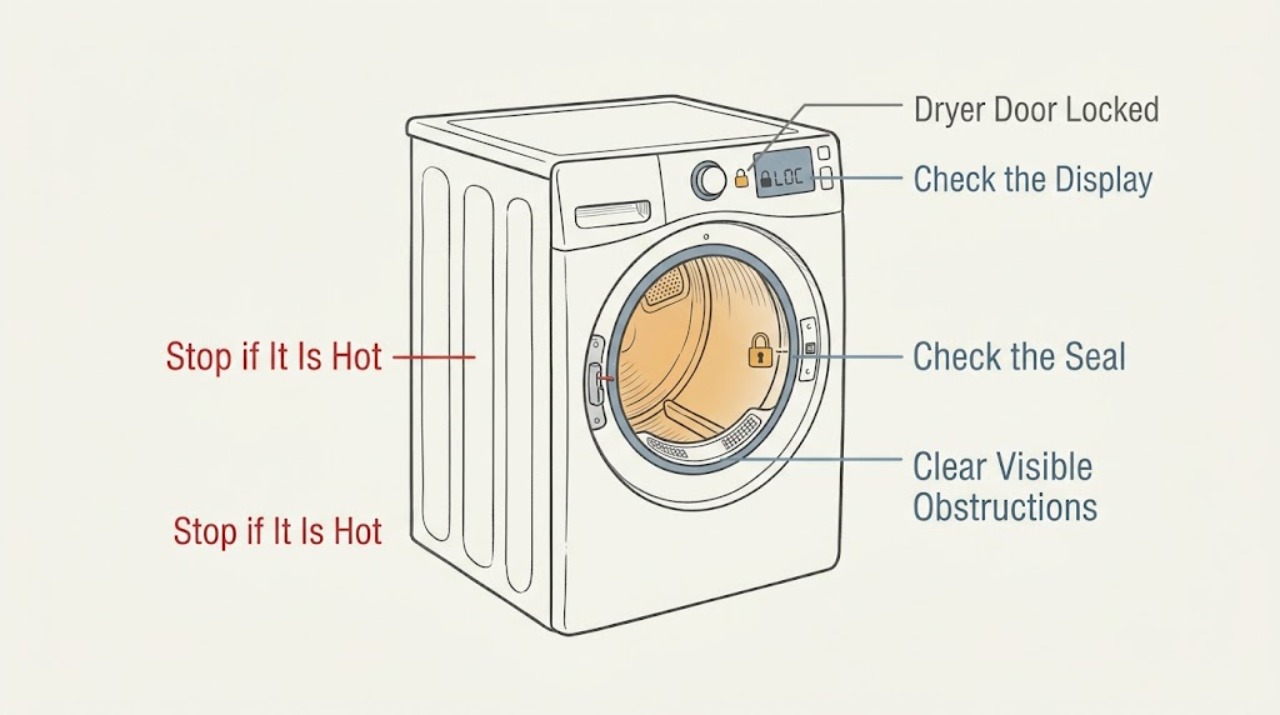
First decide whether the Whirlpool dryer has a locked control panel or a physically locked door. On an ordinary dryer, Loc usually means Control Lock is enabled: the controls will not respond, but this is not evidence that the door itself is locked. Hold the model's Control Lock key for the documented three-second sequence. If the display shows ERR, make sure the door is fully latched and that clothing is not caught in the latch. A true door lock after a wash portion, with water remaining or Dry Mode active, points to a Whirlpool All-In-One washer-dryer and requires its combo-specific safety procedure. Do not pry the door or use the combo manual-release method on a standalone dryer; stop and arrange service if the drum is moving or hot, the latch is damaged, a code returns, or the door remains physically locked when the machine is stopped and cool.
Work through in order
Diagnostic checks
Use only checks that match the exact appliance or system and its official guide.
-
Check 1
Before pulling on the door, note whether the appliance is a standalone dryer or a Whirlpool All-In-One washer-dryer, whether the drum is moving or hot, and whether the display shows Loc, ERR, another code, or no code.
Expected result: Loc appears and the controls do not respond; ERR appears; the machine is a combo with water or a wash/dry cycle; or the door is physically stuck with no relevant code.
Next step: Use the control-lock check for Loc, the latch and obstruction check for ERR, and the combo safety branch only when the appliance is actually an All-In-One. Keep the door closed if the drum is moving or hot.
Stop if: Stop if the door, hinge, latch, cord, plug, or control area is damaged, wet, smoking, or hot enough to make contact unsafe.
Why this matters
Why: Loc points to Control Lock on an ordinary dryer, while ERR points toward an incomplete latch. A combo can hold its door for water, Tumble Fresh, or Dry Mode. A physically stuck door without those patterns needs model-specific diagnosis rather than a guessed reset.
-
Check 2
On a standalone Whirlpool dryer showing Loc or an unresponsive panel, hold the model-designated Control Lock key for the documented three-second unlock sequence; do not guess if the key is a dual-function button.
Expected result: The Loc indicator clears and the controls respond, or Loc remains, the key does not respond, or the door is still physically stuck.
Next step: If the controls respond and the door opens normally, use the dryer normally while observing for a return. If Loc persists or the door is physically stuck, record the model and arrange service; do not bypass the lock.
Why this matters
Why: A cleared Loc identifies a control setting rather than a failed door latch. A persistent Loc can reflect a model-specific key assignment, a control problem, or a setting that has not been cleared; it does not justify prying the door.
-
Check 3
With a standalone dryer stopped and cool, look from outside around the door opening and latch for clothing, lint, packing material, or another visible obstruction; close the door firmly without slamming or forcing it.
Expected result: The obstruction clears and the door latches, the door still will not align or latch, or ERR returns after a clear closure.
Next step: Remove only a loose, visible obstruction and retry the model-approved closure. If the latch is loose, damaged, misaligned, or ERR returns, stop and request service rather than removing the door or panels.
Stop if: Do not reach into a moving or hot drum, use a tool to defeat the latch, or force a hinge or door seal.
Why this matters
Why: A caught garment, packing material, overloaded drum, or visible latch obstruction can prevent the door from registering closed. Persistent ERR after a clear, firm closure makes latch, alignment, or door-switch service more likely.
-
Check 4
If ERR remains after the visible latch check, use Whirlpool's documented dryer reset for that error: turn the dryer's circuit breaker off for the stated one-minute interval, restore power, start a timed-dry cycle, and monitor only if the door is intact and the appliance is safe.
Expected result: The code clears and the door latches, or ERR returns immediately or during the monitored start.
Next step: If ERR returns, stop using the dryer and arrange qualified service with the model number and code. Do not repeat resets or run the dryer with an unreliable latch.
Why this matters
Why: A reset can clear a temporary control state, but a returning ERR indicates that the closure, latch, door switch, wiring, or control issue still needs model-specific diagnosis. The reset does not prove a repair.
-
Check 5
If the appliance is a Whirlpool All-In-One washer-dryer and the door remains locked after washing, check whether water remains, Tumble Fresh is active, or Dry Mode has started; keep the door closed while the drum, water, and laundry are hot or moving.
Expected result: Water remains, Dry Mode or Tumble Fresh is active, the cycle completes and the door releases, or the door stays locked after the safe cycle condition ends.
Next step: Allow the documented combo condition to end. If the door remains locked, follow the exact All-In-One manual or contact service; use a manual-release procedure only when that exact combo documentation applies and all of its safety prerequisites are met.
Stop if: Never force the combo door, open it while the drum moves, or use a manual release without isolating power, closing the water faucet, cooling the load, and draining water as the exact procedure requires.
Why this matters
Why: Whirlpool identifies remaining water, Tumble Fresh, and Dry Mode as combo-specific reasons for a locked door. A door that stays locked after those conditions end is not safely diagnosed by ordinary-dryer Control Lock steps.
-
Check 6
Record the complete model and serial information, appliance type, display code, cycle state, whether the drum is moving or hot, and whether the door is merely unresponsive or physically unable to open before contacting Whirlpool.
Expected result: The model clearly identifies a standalone dryer or All-In-One combo, or the architecture and symptom remain uncertain.
Next step: Use the exact model manual or provide the recorded details to qualified Whirlpool service. Keep the appliance out of use if the door or interlock cannot be trusted.
Why this matters
Why: Whirlpool's support path uses model information for the correct manual and service route, and the door behavior differs between a dryer and a washer-dryer combo. Uncertainty is a reason to pause, not to order a generic latch or attempt a combo release.
Use your observations
Decision map
Find the observation that best matches what you see, then follow the next safe action.
-
PATH 01Next step
What you see
Do this next
Use the exact model's three-second Control Lock sequence. If the indicator will not clear, stop at service rather than opening the cabinet or bypassing the control.
-
PATH 02Next step
What you see
Do this next
With the dryer stopped and cool, clear only the visible obstruction and close the door firmly. If ERR returns or the latch is damaged, stop and request service.
-
PATH 03Next step
What you see
Do this next
Keep the door closed while hot or moving and follow the exact combo manual. Drain and use any manual release only under that model's prerequisites; otherwise arrange service.
-
PATH 04Next step
What you see
Do this next
Stop using the appliance, preserve the model and symptom details, and arrange qualified service. Do not pry, drill, remove panels, or bypass the interlock.
Helpful context
Understand the symptom
A control lock is not a locked door
On a regular Whirlpool dryer, Loc identifies the Control Lock feature. It prevents the controls from responding and prevents a cycle from being started, but it does not by itself establish that the physical door is trapped. The exact key varies by model, so use the owner's manual rather than guessing a button combination. If the display is blank, preserve the symptom and check power before treating the problem as a door fault.
Do not mix dryer and combo behavior
Whirlpool's All-In-One washer-dryer has a water-containing wash system and can keep the door locked when water remains, a freshness option is active, or Dry Mode has started. Its manual-release instructions include draining the water and using a release strap after safe isolation. A standalone dryer does not use that same wash-door interlock, so a physically stuck door on a dryer should be handled through the dryer model's instructions or service instead of a guessed combo procedure.
Keep the first checks visible
Only inspect the door opening from the outside when the drum has stopped and the appliance is safe to approach. Whirlpool identifies clothing, packing material, latch obstruction, overload, and door alignment as reasons a dryer door may not close or latch. Do not reach into a moving or hot drum, remove cabinet panels, or bypass an interlock to make the appliance run.
Safety boundary
Stop conditions
- Do not pry, drill, pull hard on, or defeat the dryer door, latch, or interlock.
- Do not open a door while the drum is moving or while the load or water is hot.
- Do not use an All-In-One washer-dryer manual-release procedure on a standalone dryer.
- Do not remove panels, probe live wiring, or continue operating a dryer with a damaged or unreliable latch.
Only after diagnosis
Potential parts
- dryer door latch or door-switch assembly
Consider this only after the exact model shows a persistent ERR or a damaged or misaligned latch and a qualified diagnosis confirms the latch or switch is the failed component.
Confirm the complete Whirlpool model and manufacturer's fit information; do not assume a standalone-dryer latch fits an All-In-One washer-dryer or another model. - dryer control-panel lock or control component
Consider this only when the exact model's Loc behavior persists after the documented Control Lock sequence and service diagnosis separates a control fault from a physical latch problem.
Control-lock keys and components vary by model; confirm fitment and diagnosis before ordering any part.
When checks do not resolve it
Need a professional?
Call qualified Whirlpool service if the physical door remains locked when the dryer is stopped and cool, ERR returns after a clear closure and the documented reset, the latch or hinge is damaged, the combo door remains locked after water and cycle conditions are resolved, or the correct architecture is uncertain. Stop immediately for a moving or very hot drum, water near electrical parts, a damaged cord or plug, smoke, burning smell, or any need to open the cabinet or bypass an interlock.
Common questions
FAQ
Does Loc mean my Whirlpool dryer's door is physically locked?
Usually not on a standalone dryer. Whirlpool defines Loc as Control Lock, which disables the controls and prevents operation. Use the exact model's documented Control Lock unlock sequence; do not pry the door.
What does ERR mean on a Whirlpool dryer?
Whirlpool says ERR appears when the door is not completely closed and latched. Check for clothing or packing material at the latch and close the door firmly; some models have more than one latch. If ERR returns, arrange service.
Why can a Whirlpool All-In-One washer-dryer keep its door locked?
Whirlpool lists water remaining in the tub, Tumble Fresh, and Dry Mode as combo-specific reasons. This behavior and its manual-release procedure should not be applied to an ordinary standalone dryer.
Should I use a screwdriver or pull the latch to open a locked Whirlpool dryer?
No. Keep the door closed if the drum is moving or hot. A standalone dryer needs exact-model service for a persistent physical lock; a combo requires its own isolation, cooling, draining, and model-specific release instructions.
Read the exact guide
Official sources
- ERR - Error Code - DryerWhirlpool · Whirlpool dryer ERR door-latch behavior and documented reset
- Door is Locked at the End of the Wash Cycle - All-In-One Washer DryerWhirlpool · Whirlpool All-In-One washer-dryer door lock conditions after washing
- Reach Out To Whirlpool: Contact UsWhirlpool · Whirlpool dryer and combo model-number identification and support routing
- Loc - Error Code - DryerWhirlpool · Whirlpool standalone dryer Control Lock behavior and model-specific unlock guidance
- Not Starting or Not Operating - DryerWhirlpool · Whirlpool dryer Control Lock, door latch, obstruction, moisture, and model-specific operation checks
- Unlocking the Door Manually - All-In-One Washer DryerWhirlpool · Whirlpool All-In-One washer-dryer manual door release safety prerequisites
- Door Not Closing - DryerWhirlpool · Whirlpool dryer door obstruction, overload, latch, and leveling checks
Community feedback
Share a repair observation
Share a plain-text repair observation. Accepted observations are published automatically; this page may take a moment to update.