
On this page
Start here
Quick answer
First identify where the moisture starts and whether your Whirlpool dryer has a Steam cycle, a HybridCare or other water-drain system, or neither. On Steam models, a few drips on the door after a small Steam load can be condensation, while water at the rear points to the faucet, Y connector, hose, or dryer inlet connection. Whirlpool also says a restricted vent can keep moisture inside a vented dryer and create a puddle behind it; on HybridCare models, an incorrectly seated filter or crushed or overly long drain hose can put water on the floor. Stop using the dryer for a steady or unexplained leak, water near electricity or gas, overheating, smoke, or any condition requiring cabinet access, and use the exact model manual or qualified service.
Before you begin
Safety first
- This article covers ordinary-access observation of the door, floor, visible Steam connection, lint screen, visible vent, and applicable HybridCare filter or drain hose. It does not authorize cabinet removal, gas or energized work, forced hose disconnection, or internal component testing.
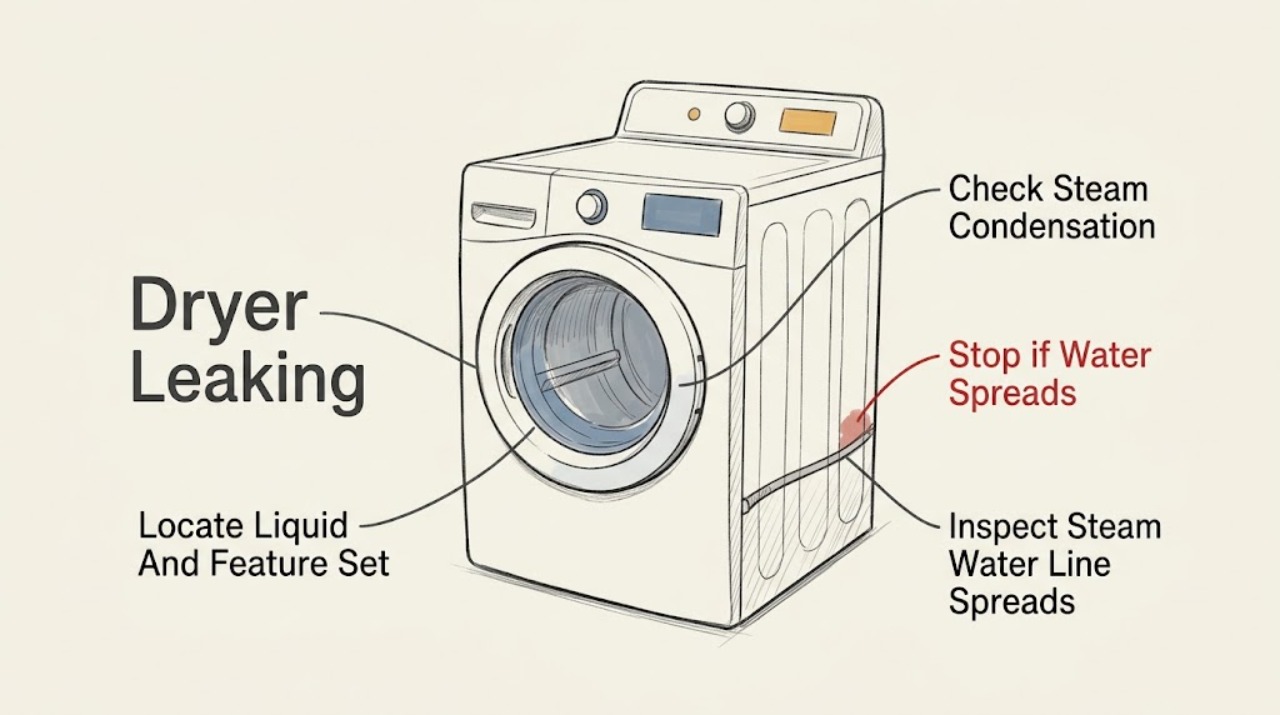
Work through in order
Diagnostic checks
Use only checks that match the exact appliance or system and its official guide.
-
Check 1
With the Whirlpool dryer stopped and cool, identify the liquid and record where the first wet spot appears: on the door or drum, at a rear faucet or hose, beneath the cabinet, behind the exhaust, near a HybridCare filter or drain hose, or away from the dryer. Note whether the selected cycle was Steam and whether the machine has a water line or model-specific water-drain system.
Expected result: The moisture is a few drops on the door after Steam, starts at a visible rear water connection, appears behind a vented dryer, appears on the floor of a HybridCare model, comes from underneath or inside the cabinet, or is not clearly from the dryer.
Next step: Choose the matching symptom-led branch without opening the cabinet: check Steam condensation, inspect a visible Steam connection, check the vent, or check the applicable HybridCare filter and drain path. If the source or feature set is uncertain, keep the dryer off and prepare the model number for service.
Stop if: Stop for a steady flow, water near electricity or gas, smoke, burning, overheating, a damaged hose, or any need to move the appliance or remove a panel.
Why this matters
Why: Door drips after Steam can be condensation; a rear wet connection implicates a Steam water line; a puddle behind a vented dryer can be retained exhaust moisture; and HybridCare water on the floor has model-specific filter and drain checks. An internal, steady, or external-source leak cannot be safely classified from location alone.
-
Check 2
If the dryer has a Steam cycle and wetness is limited to the door or interior drum, compare the load and cycle with the exact manual; after cooling, inspect the accessible door and gasket surfaces from outside without forcing the door or reaching into the drum.
Expected result: A small Steam load left a few drops or wet spots on the door or drum, or water is pooling beyond the door and the symptom repeats or occurs with a normal load.
Next step: For a small post-Steam drip, dry the accessible door area and follow the model's Steam load guidance. For repeated or larger leaks, continue only with the rear connection or service branch; do not add cycles simply to test the leak.
Stop if: Stop if the door seal is torn, the door will not close, water enters the cabinet, or the drum must be accessed while hot or moving.
Why this matters
Why: Whirlpool says smaller Steam loads can produce wet spots or condensation and that steam can condense on the door and produce a couple of drips when opened. Repeated pooling, water outside the door seal, or a leak independent of Steam is not explained by normal condensation.
-
Check 3
Only if the exact Whirlpool dryer is a Steam model, inspect from outside the faucet, Y connector, visible inlet hose, and dryer inlet connection for a wet coupling, drip, kink, bulge, cut, or missing washer; do not disconnect a pressurized hose.
Expected result: A connection is wet during or after Steam, the hose is kinked or damaged, all visible connections are dry, or the dryer has no Steam water line.
Next step: If a connection is wet or damaged, close the water faucet and leave the dryer unused; arrange service or follow only the exact model's installation instructions for a safe hose replacement. If the visible connections are dry but water remains, stop and request model-specific diagnosis.
Stop if: Stop if water sprays, the hose is split or bulged, the faucet cannot be shut off, or inspection would require moving the dryer or opening the cabinet.
Why this matters
Why: A wet rear connection makes an inlet hose, washer, coupling, faucet, or inlet-valve connection more likely than door condensation. Whirlpool's water-line guidance identifies the dryer inlet valve and calls for checking the connector, faucet, and hoses for leaks. A dryer without Steam has no basis for this water-line diagnosis.
-
Check 4
For a vented Whirlpool dryer, inspect the lint screen, visible vent run between the dryer and wall, and exterior exhaust hood for lint, debris, crushing, kinks, or weak airflow; limit the check to normal controls and safe outside-access areas.
Expected result: Drying takes longer, the cabinet is unusually warm, steam or moisture is visible at the door, little lint reaches the screen, the vent run is crushed or blocked, or the vent path appears clear while the leak continues.
Next step: If the accessible vent path is restricted, keep the dryer off until the lint screen and vent system are cleaned according to the installation instructions, using qualified vent cleaning for inaccessible or unsafe sections. If the path is clear or the puddle persists, arrange service rather than opening the cabinet.
Stop if: Stop for overheating, smoke, fire signs, absent airflow, or any cleaning task that requires unsafe roof, wall, or cabinet access.
Why this matters
Why: Whirlpool says restricted venting can retain hot wet air, show steam or moisture, and allow water to accumulate in the dryer or venting and form a puddle behind it. A clear vent path with a continuing leak makes a vent explanation less likely and does not identify an internal component.
-
Check 5
Only if the exact model is a Whirlpool HybridCare dryer with a water-drain path, inspect from outside whether the filter is correctly seated and whether the supplied drain hose is crushed, kinked, restricted, or routed beyond the model's installation limits; do not open the housing or reroute a pressurized connection.
Expected result: The filter is not seated, the drain hose is crushed or kinked, the hose routing does not match the manual, or the filter and drain path appear correct while water still reaches the floor.
Next step: With the dryer off and cool, reseat only the accessible filter as the model manual describes and correct only an obvious hose position that does not require disassembly. If the leak continues, keep the dryer out of service and arrange model-specific diagnosis.
Stop if: Stop if water is near electricity, the filter or housing is damaged, the hose is leaking, or correction would require opening the cabinet or moving the appliance.
Why this matters
Why: Whirlpool says water can accumulate on the floor when the HybridCare filter is not properly seated, and a restricted or incorrectly routed drain hose can prevent water from draining. A correct visible setup with continuing water does not identify an internal pump, seal, or condenser fault.
-
Check 6
After the applicable visible checks, leave the dryer powered off and close the Steam water faucet when present; record the model number, fuel type, feature set, leak location, liquid, cycle, load, and whether the leak stopped without running another cycle to reproduce it.
Expected result: The moisture was a one-time small post-Steam door drip that does not recur, a visible vent or water-path issue remains, or the leak is persistent, internal, unexplained, or accompanied by a safety symptom.
Next step: Use the exact model manual or Whirlpool service channel for a persistent condition and provide the recorded observations. Keep the dryer out of service until a qualified provider determines it is safe to operate.
Stop if: Stop and seek urgent professional help for water near electrical parts, gas odor, smoke, fire signs, flooding, a burst hose, or overheating.
Why this matters
Why: A one-time small post-Steam drip can fit Whirlpool's condensation explanation. A recurring leak, liquid from the cabinet or underside, or a leak with electrical, gas, heat, or structural damage requires model-specific service; the symptom does not select a replacement part by itself.
Use your observations
Decision map
Find the observation that best matches what you see, then follow the next safe action.
-
PATH 01Safety boundary
What you see
Only a few clear drips appear on the door after a Steam cycle, especially with a small load, and no water reaches the floor or cabinet.
Do this next
Dry the accessible door area, follow the exact model's Steam load guidance, and monitor the next appropriate use. Escalate if the amount increases, appears without Steam, or reaches the floor.
Why this path and its safety boundary
Why it matters: This pattern is consistent with Whirlpool's documented condensation or small-load wet-spot explanation, not proof of a failed water valve.
Safety stop: Do not continue operating if the door seal is damaged, water enters the cabinet, or the drip becomes a steady leak.
-
PATH 02Safety boundary
What you see
Water begins at the faucet, Y connector, visible inlet hose, or rear inlet connection on a Steam dryer during or after a Steam cycle.
Do this next
Close the Steam water faucet, leave the dryer unused, document the wet connection, and arrange service or use only model-specific installation guidance for the hose and connection.
Why this path and its safety boundary
Why it matters: A water-line connection or hose issue is more likely than condensation on the door, but an outside drip does not identify the failed component.
Safety stop: Do not pressurize a split, bulged, or spraying hose, and do not open the cabinet to reach the inlet valve.
-
PATH 03Safety boundary
What you see
A vented dryer has long dry times, excess warmth, steam or moisture at the door, little lint on the screen, and a puddle behind the appliance near the vent path.
Do this next
Keep the dryer off until the lint screen and accessible vent path are corrected according to the installation instructions; use qualified vent cleaning for unsafe or inaccessible sections.
Why this path and its safety boundary
Why it matters: Restricted exhaust is a plausible contributor because Whirlpool says moisture can accumulate in the dryer or venting and drip onto the floor when hot wet air cannot escape.
Safety stop: Stop for overheating, smoke, fire signs, absent airflow, or any cleaning task that requires unsafe access or cabinet removal.
-
PATH 04Safety boundary
What you see
A Whirlpool HybridCare model has water on the floor and its visible filter, drain hose, or routing does not match the model instructions.
Do this next
Keep the dryer off, follow the exact HybridCare manual for accessible filter seating and drain routing, and arrange service if water remains or the path is damaged.
Why this path and its safety boundary
Why it matters: A filter-seating or water-drain restriction is plausible on this model family; the same check does not apply to a conventional vented or Steam-only dryer.
Safety stop: Do not open the cabinet, run the dryer with water near electricity, or force a damaged filter or hose into place.
-
PATH 05Safety boundary
What you see
The dryer has no applicable Steam or HybridCare explanation, the vent path is clear, or liquid comes from underneath or inside the cabinet, recurs independently of the cycle, or cannot be localized safely.
Do this next
Keep the dryer out of service, check only for an obvious external source without moving the appliance, and arrange model-specific qualified diagnosis with the full model number and observations.
Why this path and its safety boundary
Why it matters: The documented condensation, vent, and model-specific water-path checks do not establish this leak. An internal component, installation source, or unrelated household leak remains possible.
Safety stop: Do not run another cycle, remove panels, bypass a safety device, or order a valve, pump, gasket, filter, or other part without diagnosis.
Helpful context
Understand the symptom
Why the same puddle can have different causes
Whirlpool's dryer support separates Steam-function leaks, vent-restriction moisture, and HybridCare water-on-floor symptoms. A conventional vented dryer may create a puddle behind the machine when moist air cannot escape, while a Steam dryer has an external water connection. A HybridCare dryer has model-specific filtration and drainage checks. Confirm the feature set from the controls, manual, or model number before applying a water-line or drain procedure.
Start with a cool, ordinary-access inspection
Stop the cycle and allow the dryer to cool. From outside the appliance, note the liquid, the first wet location, the selected cycle, and whether the moisture is a few drops or a continuing flow. Check only the door area, floor, faucet and visible hose connections when present, lint screen, visible vent run, filter seating, and drain hose where the exact model has one. Do not run another cycle just to reproduce an unexplained leak, remove a cabinet panel, or reach into a moving drum.
When the leak is a service condition
A leak from inside the cabinet or underneath the machine, a damaged hose, water near electrical parts, gas odor, smoke, scorching, or overheating is not a routine condensation check. Keep the dryer out of service and arrange qualified repair. Provide the technician with the full model number, fuel type, feature set, leak location, liquid, cycle, and any visible vent or drain symptoms.
Safety boundary
Stop conditions
- Do not run another cycle to reproduce an unexplained leak or use the dryer with water near electrical parts.
- Do not open the cabinet, reach into a moving or hot drum, bypass a safety device, or work on gas or energized components.
- For a Steam dryer, close the water faucet and stop for a split, bulged, kinked, or spraying inlet hose or connection.
- For a HybridCare dryer, stop for a damaged filter housing, leaking drain hose, or water that remains on the floor after the model-specific visible check.
- Do not order a replacement valve, hose, gasket, filter, pump, or condenser until the exact model and failed component are confirmed.
Only after diagnosis
Potential parts
- Steam dryer inlet hose or connection washer
Consider this category only when the exact model has a Steam water connection and inspection or diagnosis confirms a leaking, damaged, or failed hose connection; a door drip or vent puddle alone does not justify ordering it.
Confirm the exact Whirlpool model and installation instructions before ordering; do not substitute a hose or washer by appearance alone. - HybridCare dryer drain hose or filter seal
Consider this category only for a confirmed HybridCare model when the visible drain path or filter housing is damaged or a qualified diagnosis identifies it as the source of floor water.
Confirm the exact model and HybridCare installation details before ordering; conventional vented dryers do not use this model-specific water path.
When checks do not resolve it
Need a professional?
Arrange qualified Whirlpool or appliance service if the leak is steady, recurring, internal, unexplained after the visible checks, reaches electrical or gas connections, occurs with a damaged or spraying hose, or continues after the applicable Steam, vent, or HybridCare issue is corrected. Keep the dryer off for flooding, smoke, fire signs, gas odor, overheating, or any condition requiring cabinet access or moving the appliance.
Safety scope: This article covers ordinary-access observation of the door, floor, visible Steam connection, lint screen, visible vent, and applicable HybridCare filter or drain hose. It does not authorize cabinet removal, gas or energized work, forced hose disconnection, or internal component testing.
Common questions
FAQ
Why does my Whirlpool dryer leave a few drops on the door after Steam?
Whirlpool says steam can condense on the door and produce a couple of drips when the door is opened. Smaller Steam loads can also create wet spots or condensation. Treat a small post-Steam drip as potentially normal only when no water reaches the floor or cabinet; recurring or increasing water needs diagnosis.
Where should I look if water is leaking from the back of a Whirlpool Steam dryer?
With the dryer stopped and cool, look from outside at the faucet, Y connector, inlet hose, and dryer's water inlet connection. Whirlpool says those connection points should be checked for leaks. Close the faucet and stop using the dryer if a hose or connection is wet, damaged, or spraying.
Can a blocked vent make a Whirlpool dryer look like it is leaking?
Yes. Whirlpool explains that restricted venting can keep hot, wet air inside the dryer or venting material, where moisture can accumulate and form a puddle behind the appliance. Check the lint screen and ordinary-access vent path, but arrange qualified cleaning or repair for unsafe or inaccessible sections.
What should I check on a Whirlpool HybridCare dryer with water on the floor?
Only if the exact model is HybridCare, confirm from outside that the filter is seated correctly and the supplied drain hose is not crushed, kinked, restricted, or routed contrary to the model instructions. Whirlpool identifies those as model-specific water-on-floor checks. Keep the dryer off and arrange service if water remains or the path is damaged.
What if my Whirlpool dryer has no Steam or HybridCare feature but still leaks?
Do not apply Steam water-line or HybridCare drain guidance to a different model. Check only the applicable vent and external installation conditions; if liquid comes from underneath or inside the cabinet, recurs, or cannot be localized safely, keep the dryer off and use the exact model manual or qualified service.
Read the exact guide
Official sources
- Water on Floor - HybridCare Dryer - Product Help | WhirlpoolWhirlpool · Official Whirlpool guidance for HybridCare models only; filter seating and drain-hose limits do not generalize to conventional dryers.
- Dryer Vent may be Blocked or Restricted - Product Help | WhirlpoolWhirlpool · Official Whirlpool guidance for vented dryer exhaust symptoms; exact installation and model instructions apply.
- Dryer - Product Help | WhirlpoolWhirlpool · Official Whirlpool dryer support index showing separate vent, Steam, and model-specific troubleshooting paths.
- Water on the Door - Dryer - Product Help | WhirlpoolWhirlpool · Official Whirlpool Product Help for Steam dryers and door wetness; exact model instructions still apply.
- Installation of Water Line - Dryer - Product Help | WhirlpoolWhirlpool · Official Whirlpool installation guidance for Steam dryers; not applicable to dryers without a Steam water line.
- Leaking During Steam Cycle - Dryer - Product Help | WhirlpoolWhirlpool · Official Whirlpool Product Help for Steam dryers; it does not establish a leak path for a non-Steam model.
Community feedback
Share a repair observation
Share a plain-text repair observation. Accepted observations are published automatically; this page may take a moment to update.