
On this page
Start here
Quick answer
A Whirlpool WED99HEDC is a 7.3 cu. ft. HybridCare ventless dryer with heat-pump technology, so warm air that feels cooler than a conventional dryer and a longer heating phase can be normal. F2E1, F6E1, and F4E4 appearing together should not be treated as proof that three parts need replacement. Record the exact display order and the cycle stage first. Whirlpool's official dryer information identifies F2E1 with a keypad/UI condition, its service tech sheet lists F6E1 as a UI-to-CCU communication error and F4E4 as low L2 line voltage on the covered platform, but the exact WED99HEDC manual must control because the model page has no documents available. With power safely off, clean only the user-accessible lint and HybridCare filters and inspect the visible drain/ventilation arrangement. If a code returns, power is abnormal, drying remains poor, or there is burning smell, smoke, abnormal heat, arcing, or a repeated trip, stop and arrange qualified appliance or electrical service rather than entering diagnostics or replacing a board, compressor, or sensor by guesswork.
Before you begin
Safety first
- Owner checks are limited to recording the display and timeline, safely checking household protection devices, cleaning accessible filters with power disconnected, and inspecting visible installation conditions. Do not enter service diagnostics, open the cabinet or control console, probe live terminals, bypass interlocks, alter wiring, open the heat-pump/refrigeration circuit, or select a compressor, board, keypad, sensor, heater, or pump from these codes alone.
Work through in order
Diagnostic checks
Use only checks that match the exact appliance or system and its official guide.
-
Check 1
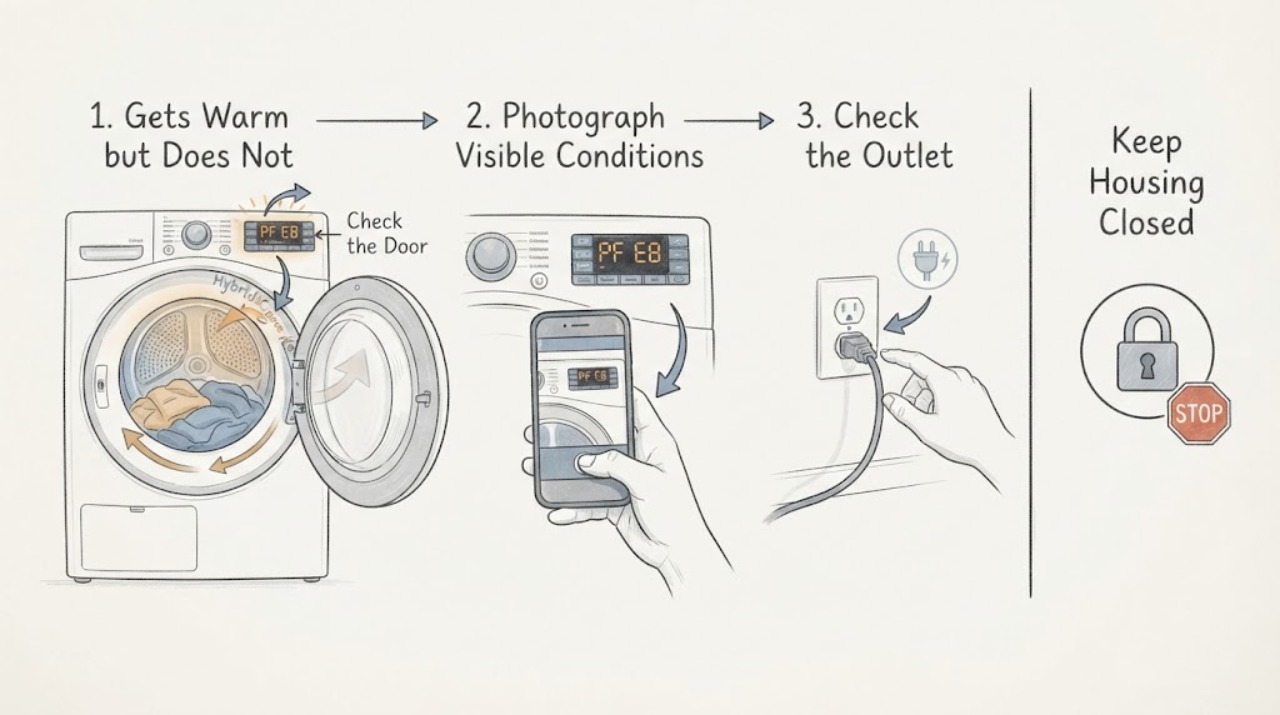
Before clearing anything, photograph or transcribe every display exactly as shown, including spaces, alternating characters, and the order F2E1, F6E1, or F4E4 appeared. Record the complete WED99HEDC label, country or market, electric configuration, selected cycle, time from start to the first code, and whether the drum was turning, warm, or still wet.
Expected result: One code appears first, all three arrive together, the order changes between attempts, or the display is incomplete or uncertain.
Next step: Keep the photo and timeline for the service request and use the exact model documentation when it becomes available. Do not combine the three codes into a single part diagnosis.
Stop if: Do not enter service diagnostics, clear stored faults, or restore power merely to obtain another code recording.
Why this matters
Why: The sequence is the key new split: F4E4 first after a power event points toward a supply branch, while F2E1 or F6E1 first points toward an interface/communication branch on the opened Whirlpool platform sheet. An uncertain display cannot safely select a code meaning.
-
Check 2
Stop using the dryer immediately for smoke, a burning or electrical smell, abnormal cabinet or outlet heat, arcing, damaged cord or plug, water reaching electrical areas, or a breaker that trips again. From a dry, safe position, turn the dryer off and disconnect power only if doing so is safe; otherwise keep clear and get qualified help.
Expected result: There is no hazard and the dryer is cool and dry, or one of the listed hazard signs is present or repeats.
Next step: For a hazard, leave the dryer off and contact appropriate appliance or electrical emergency help. Without a hazard, continue only with the following power-off external checks.
Stop if: Do not restart to reproduce the code, probe live terminals, bypass a safety device, or remove the cabinet, heat-pump unit, heater, pump, or control covers.
Why this matters
Why: A hazard or repeated power trip overrides ordinary drying checks. The HybridCare manual warns that service requires power disconnection and that lint or filters must not be run loose, damaged, blocked, or missing because overheating can result.
-
Check 3
Compare the reported warmth and timing with the selected cycle while the dryer is not showing a hazard: note whether it was an automatic moisture-sensing cycle or a timed cycle, whether the door was repeatedly opened, and whether the load was densely packed or contained heavy wet items.
Expected result: The air feels only mildly warm, the cycle is long but progresses, the automatic cycle ends early with damp items, or a timed cycle also fails to dry a small suitable load.
Next step: Record the cycle and result. If the exact model guide permits a normal user cycle and no code or hazard is active, use that documented cycle once; otherwise leave the dryer off and move to service with the code timeline.
Stop if: Do not run repeated high-heat or timed cycles to force a diagnosis, and do not assume a compressor or heater is defective from temperature feel alone.
Why this matters
Why: Low-temperature heat and a longer phase are expected in HybridCare operation; automatic cycles sense moisture and stop at the selected dryness. Persistent failure on a controlled load, especially with active codes, is not explained by the cooler feel alone.
-
Check 4
With power disconnected, clean the lint screen and the user-accessible HybridCare filter exactly as the HybridCare guidance describes. Check that each filter is dry, undamaged, fully seated, and that the visible air outlet or cooling-fan screen is not blocked by lint or a sheet. Do not open the heat-pump or refrigeration enclosure.
Expected result: A filter or visible grille is blocked, a filter is wet or not seated, or the accessible path is clear and the codes or poor drying remain.
Next step: Correct only the visible filter or grille condition and document it. If a code returns or drying remains poor, do not dismantle the cabinet; arrange qualified service.
Stop if: Never operate with a loose, blocked, damaged, or missing filter, and do not use sharp tools, compressed air into the cabinet, or a live fan test.
Why this matters
Why: Whirlpool links blocked lint/HybridCare filtration and blocked cooling ventilation with longer drying or poor results. A clear accessible path does not prove a fan, sensor, compressor, or control failure; it moves the case to model-specific service.
-
Check 5
Still without power, inspect only the visible drain arrangement and surrounding ventilation allowed by the exact model installation guidance: look for a kinked or displaced drain hose, a visibly full container if fitted, standing water, or the dryer pushed tightly against a wall or placed in a cold room. Do not disconnect plumbing, open panels, or touch refrigerant or pump components.
Expected result: Water is not draining visibly, a hose is kinked or too high, the room is unusually cold, the visible arrangement is normal, or there is no way to confirm the WED99HEDC-specific drain setup.
Next step: Correct only a plainly visible condition that the matching model guide permits. If the arrangement is normal or the exact setup is uncertain, provide the photos and code sequence to a qualified servicer.
Stop if: Do not pour water into the dryer, force a drain, dismantle the water circuit, or open the sealed heat-pump/refrigeration system.
Why this matters
Why: HybridCare removes moisture through its water-management path and its performance depends on the installation environment. The opened HybridCare manual gives general filter, drain, level, and room-temperature guidance, but the WED99HEDC page does not provide an exact manual; do not invent a hose height, container procedure, or pump diagnosis.
-
Check 6
For F4E4, a blank display, or a code that followed a power interruption, inspect the household breaker or fuse state once from a dry, safe position and note whether the appliance is supplied normally. Leave terminals and wiring untouched: do not perform voltage testing on an energized appliance, change wiring, use an extension cord, or repeatedly reset the circuit. If there is no hazard and F2E1 is the only returning code, Whirlpool's public F2E1 page allows one one-minute breaker-off/on reset followed by a brief observation; do not repeat it.
Expected result: A breaker or fuse is open, the trio returns after power is restored, F2E1 returns during the one approved check, or household supply appears normal while F4E4 persists.
Next step: Stop after the single safe check and arrange qualified electrical or appliance service with the exact code order, model, cycle stage, and reset result. Do not order a board, keypad, compressor, sensor, or power part from the code combination alone.
Stop if: Any repeat trip, hot connection, smell, spark, or damaged wiring ends the check immediately; do not enter diagnostic mode or make a live measurement.
Why this matters
Why: The opened tech sheet associates F4E4 with low L2 voltage at the CCU and F6E1 with UI-to-CCU communication, while F2E1 is a keypad/UI condition in that technician platform. A normal-looking breaker does not prove the appliance supply or electronics are sound.
Use your observations
Decision map
Find the observation that best matches what you see, then follow the next safe action.
-
PATH 01Next step
What you see
F4E4 appeared first or immediately followed a power interruption, blank display, or breaker event, with no smoke or electrical damage.
Do this next
Check the household protection device once from a safe, dry position, then stop and have a qualified electrician or appliance servicer verify the exact WED99HEDC supply and appliance path.
Why this path and its safety boundary
Why it matters: On the opened Whirlpool dryer tech sheet, F4E4 is the low-L2-voltage path. The later F2E1/F6E1 messages may be a sequence around the control interface, but the code combination does not identify a failed board or compressor.
-
PATH 02Next step
What you see
F2E1 appears first during user-interface operation and there is no F4E4 power event, no hazard, and no persistent loss of display.
Do this next
If the appliance is safe and the exact model guidance permits it, perform the public page's single power reset and brief observation only once. If F2E1 returns, arrange service.
Why this path and its safety boundary
Why it matters: Whirlpool's user help page labels F2E1 as a keypad issue, while the technician sheet describes a UI/stuck-button or mismatch condition. The two documents do not authorize opening the console or entering service diagnostics.
-
PATH 03Next step
What you see
F6E1 follows normal-looking power and a responsive display, or the complete trio repeats after a single safe reset.
Do this next
Keep the dryer off, send the code photo and cycle timeline to qualified Whirlpool appliance service, and ask for the exact WED99HEDC documentation and a system diagnosis before authorizing parts.
Why this path and its safety boundary
Why it matters: The technician sheet places F6E1 in the UI-to-CCU communication path, but the exact WED99HEDC manual is not available on the model page. A repeated mixed sequence therefore supports a service boundary, not a part selection.
-
PATH 04Next step
What you see
No hazard is present, filters and visible ventilation are clear, and the dryer feels warm but leaves a small suitable load damp or ends an automatic cycle early.
Do this next
Record cycle, load, room, filter, and drain observations and arrange qualified service if the result repeats; do not diagnose the sealed refrigeration circuit, compressor, or sensor from warmth alone.
Why this path and its safety boundary
Why it matters: The HybridCare manual makes cooler-feeling low-temperature operation and longer heating normal, but it also identifies blocked filters, sensor contact, load size, room temperature, and drainage/installation as drying-performance checks. Persistent poor drying after those external checks remains unresolved.
-
PATH 05Next step
What you see
Smoke, burning smell, abnormal heat, arcing, damaged power parts, a water leak into electrical areas, or a repeated breaker trip is present at any point.
Do this next
Stop use, keep clear, isolate power only if safe, and contact appropriate qualified appliance/electrical or emergency help. Do not restart the dryer.
Why this path and its safety boundary
Why it matters: This is a safety escalation, not a drying-performance branch. A single reset or clean filter cannot make continued operation safe.
Helpful context
Understand the symptom
Why this WED99HEDC symptom needs a different split
The exact WED99HEDC is a ventless HybridCare heat-pump dryer. Its official HybridCare guidance says it recycles the same air at lower temperatures, takes longer to heat than a conventional dryer, pumps water from wet clothes to a drain, and may make a compressor hum or occasional gurgling sound. That means warm-but-not-dry is not enough to condemn a heater or compressor. The three-code combination adds a second decision: which code appeared first, at what cycle stage, and whether a supply event preceded the control messages.
Do not merge the three displays into three part diagnoses
The Whirlpool tech sheet opened for this research is marked for service technicians. It lists F2E1 as a stuck-button or UI mismatch that appears only in service diagnostic mode, F6E1 as communication from the UI to the CCU, and F4E4 as low L2 voltage detected at the CCU. The public F2E1 help page gives a limited owner reset, but a recurring or mixed sequence still needs the exact model documentation and qualified service. Because the WED99HEDC Owner's Center page has no documents available, these meanings should be recorded as platform-level references, not as permission to enter diagnostics, open the cabinet, or select a replacement board, compressor, or sensor.
When checks do not resolve it
Need a professional?
Contact Whirlpool or a qualified appliance servicer for recurring or mixed F2E1/F6E1/F4E4, unresolved poor drying after accessible filter and installation checks, or any suspected control, supply, drain, or heat-pump fault. Use qualified electrical help for repeated trips or supply concerns; use emergency help for smoke, arcing, fire, or dangerous overheating.
Safety scope: Owner checks are limited to recording the display and timeline, safely checking household protection devices, cleaning accessible filters with power disconnected, and inspecting visible installation conditions. Do not enter service diagnostics, open the cabinet or control console, probe live terminals, bypass interlocks, alter wiring, open the heat-pump/refrigeration circuit, or select a compressor, board, keypad, sensor, heater, or pump from these codes alone.
Have this ready
- Provide the full WED99HEDC model and serial label, market, photographs of each display, exact code order, cycle and stage, time to first code, whether the drum turned and felt warm, filter and visible drain observations, recent power events, breaker behavior, and any smell, smoke, heat, leak, or unusual sound.
Common questions
FAQ
Is a cool-feeling Whirlpool heat-pump dryer automatically broken?
No. Whirlpool's HybridCare guidance says the dryer uses lower-temperature ventless heat-pump drying and a longer heating phase, so it can feel cooler than a traditional dryer. Poor drying that persists with clear filters and a suitable load, or that occurs with returning codes, still needs service.
Do F2E1, F6E1, and F4E4 prove that three parts must be replaced?
No. The opened Whirlpool technician sheet places them in UI, UI-to-CCU communication, and low-L2-voltage paths, while the WED99HEDC Owner's Center page has no exact documents available. Record the order and have the exact model path diagnosed instead of buying parts from a generic code table.
Can I keep resetting the dryer until it dries?
No. Whirlpool's public F2E1 page describes one one-minute breaker reset and a brief observation, followed by service if the code returns. Do not repeat resets, enter diagnostics, or continue testing when there is a trip, smell, smoke, abnormal heat, arcing, or water near electrical parts.
Read the exact guide
Official sources
- WED99HEDC | WhirlpoolWhirlpool · Exact Whirlpool Owner's Center page for the assigned WED99HEDC model; it confirms the model and configuration and states that no documents are available on the page.
- F2E1 Error Code - DryerWhirlpool Product Help · Official Whirlpool Product Help page opened for the public F2E1 label and limited owner-level reset; it is not a substitute for the exact WED99HEDC manual.
- Tech Sheet - W11087921 - Rev AWhirlpool · Official Whirlpool technician sheet opened to verify the three code descriptions. It is marked for service technicians and is not an exact WED99HEDC owner manual, so it supplies code-path evidence without authorizing user diagnostics or part selection.
- Owner's ManualWhirlpool · Official Whirlpool HybridCare owner manual opened for platform behavior and user-maintenance boundaries; because the WED99HEDC page has no documents available, the exact WED99HEDC manual remains controlling for any model-specific instruction.
Community feedback
Share a repair observation
Share a plain-text repair observation. Accepted observations are published automatically; this page may take a moment to update.