
On this page
Start here
Quick answer
For a Whirlpool WED8000DW3 that previously smelled burnt and contained heavy lint, the disappearance of the smell after cleaning does not make it safe to keep running or prove that a thermal fuse or heating element failed. Treat the earlier odor and lint as a fire and airflow event first: leave the dryer off if any scorch, hot connection, smoke, odor, damaged cord, or restricted vent remains, and have the internal and home vent path professionally checked. Once a qualified check finds no residual hazard, confirm the exact model literature and a heated cycle, then separate the two-breaker electric supply from airflow and the heating circuit. A no-heat result after cleaning is evidence that service must inspect the supply, vent, heater, thermal protection, wiring, and controls; it is not a part-selection shortcut based on timing.
Before you begin
Safety first
- Do not run the dryer while burnt odor, smoke, scorch, a hot or damaged cord or receptacle, unusual cabinet heat, lint escape, a blocked vent, or a returned fault remains. Do not open the cabinet or terminal area, probe live circuits, bypass thermal protection, dismantle the heater or blower, or keep resetting a breaker.
Work through in order
Diagnostic checks
Use only checks that match the exact appliance or system and its official guide.
-
Check 1
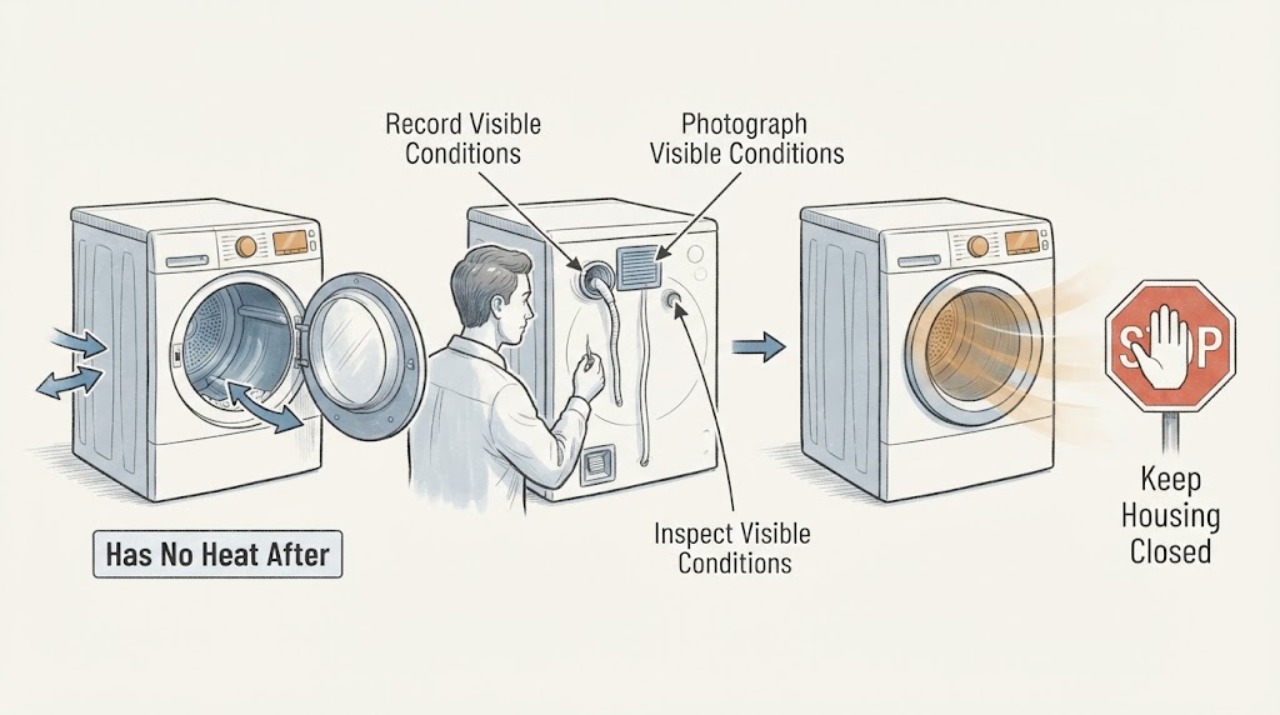
Leave the dryer off and cool. From outside, record any remaining burnt odor, smoke, scorch or melted marks, a hot or damaged cord or receptacle, lint around the door or housing, a very warm cabinet, and whether the outside hood or duct is blocked. Do not restart it to see whether the smell returns.
Expected result: Any odor, smoke, scorch, hot connection, damage, visible lint escape, unusually warm cabinet, or blocked vent remains; or the exterior is cool and clear.
Next step: For any warning, keep the dryer disconnected when safe and arrange qualified appliance and vent inspection. Only if no warning remains should you proceed to the model and cycle identification; do not open panels as a user test.
Why this matters
Why: A remaining fire, heat, or electrical warning takes priority over a no-heat diagnosis. A clean smell alone does not clear hidden lint, wiring, heater, blower, or vent damage.
-
Check 2
Photograph the rating plate and retrieve the Whirlpool literature for the complete WED8000DW3 model. Record whether the drum turns, whether the controls and drum light work, which cycle was selected, and any exact display code; do not transfer a procedure from another Whirlpool dryer.
Expected result: The exact model literature is available, the display is blank, the drum turns without warmth, or a code or vent warning is shown.
Next step: Keep the exact model, code, cycle, and prior odor/lint history together for service. If the literature cannot be matched, stop model-specific testing and request Whirlpool support.
Why this matters
Why: The model literature determines the cycle and service boundary. A blank panel or a motor that runs without heat can reflect supply or heating-path issues, while a code may identify a required service path; none selects a part by itself.
-
Check 3
If the dryer is confirmed as an electric model and no hazard remains, look at both household breakers from a dry standing position and note whether the cord or receptacle is discolored or loose. Do not remove the terminal cover or make electrical measurements.
Expected result: One breaker is tripped, the cord or receptacle is damaged or hot, the dryer has no full supply, or the external supply appears normal while a heated cycle remains cold.
Next step: Do not repeatedly reset a tripped breaker or use the dryer with a damaged connection. Arrange qualified electrical or appliance service to verify supply and wiring; do not infer a thermal fuse or heater from the timing of the cleaning.
Why this matters
Why: Whirlpool explains that an electric dryer uses two supply legs: one can run the motor while the other serves the heater. A supply or connection issue can therefore produce tumbling with no heat, but a normal-looking breaker does not clear the appliance heating circuit.
-
Check 4
With power disconnected and the dryer cool, inspect only the accessible lint screen, screen housing, hose connection, wall connection, and outside hood. Look for crushed or disconnected ducting, lint, nests, or weak exhaust; do not insert tools into the duct or dismantle the cabinet.
Expected result: The screen or duct is loaded, crushed, disconnected, or weak at the outside hood, or the accessible path is clear after cleaning.
Next step: Keep the dryer off until an obstructed or inaccessible home vent is professionally cleaned or inspected. If the path is clear but the dryer remains cold, arrange appliance service rather than replacing a heater or fuse by guesswork.
Why this matters
Why: Whirlpool identifies lint buildup, crushed or kinked ducting, nests, and weak airflow as restricted-vent signs and fire risks. Clearing a visible obstruction can improve airflow but cannot prove that hidden lint, the blower, heater, wiring, or thermal protection is undamaged.
-
Check 5
Only after the prior odor, lint, vent, and electrical checks are cleared by the exact manual or a qualified inspection, use Whirlpool’s model-appropriate heated-cycle check: an empty heated timed cycle for the documented interval, then observe general warmth from the doorway without reaching toward the drum or heater.
Expected result: The dryer warms, stays completely cold, produces a new smell or smoke, or shows an airflow or fault code.
Next step: Stop immediately for odor, smoke, unusual heat, or a code. If it remains cold without a hazard, give service the model, cycle, supply, vent, and prior lint history and do not repeat the test.
Why this matters
Why: Warmth means the heating system is producing heat and the earlier complaint may involve airflow or cycle performance. A cold result on the correct cycle, a new odor, smoke, or a code requires service; it does not identify one fuse or element.
-
Check 6
Prepare the service handoff with the complete WED8000DW3 model, the burnt-smell and lint timeline, what was cleaned or disassembled, whether the smell disappeared, the no-heat cycle result, breaker behavior, vent condition, and every code or warning. Do not authorize a part solely because the symptom followed cleaning.
Expected result: The dryer was opened or cleaned before the no-heat symptom, the vent was restricted, a breaker or connection was abnormal, or no external cause is found.
Next step: Ask qualified service to inspect the appliance interior and entire vent path, verify supply and wiring, and diagnose the heating and thermal systems before selecting a replacement part. Keep the dryer out of service until cleared.
Why this matters
Why: The history helps a technician prioritize fire-safety, vent, wiring, heater, thermal, blower, and control inspection. It does not distinguish a damaged heating element from a thermal device, supply, connector, or control fault.
Use your observations
Decision map
Find the observation that best matches what you see, then follow the next safe action.
-
PATH 01Next step
What you see
Any burnt odor, smoke, scorch, melted material, hot or damaged cord or receptacle, unusually warm cabinet, visible lint escape, or blocked vent remains after cleaning.
Do this next
Stop use, disconnect power only when safe, and arrange qualified appliance and vent inspection. Do not run another cycle or open the cabinet.
Why this path and its safety boundary
Why it matters: The dryer remains in a fire or electrical safety branch. Removal of the smell does not prove that the original heat or lint event is resolved.
-
PATH 02Next step
What you see
The exact model is confirmed, the dryer is on a documented heated cycle, no warning remains, and the drum turns but no warmth is produced.
Do this next
Arrange qualified service with the full odor, lint, vent, breaker, and cycle history. Do not repeatedly cycle the dryer or replace parts from timing alone.
Why this path and its safety boundary
Why it matters: The remaining possibilities include an electric supply leg, wiring or connection, heating element, thermal protection, control, or airflow-related damage. A no-heat result does not select a thermal fuse or heater.
-
PATH 03Next step
What you see
An electric WED8000DW3 has a tripped breaker, damaged supply connection, or no confirmed full supply while the drum can still turn.
Do this next
Leave the dryer off and have a qualified electrician or appliance technician verify the supply, cord, receptacle, and appliance connection. Do not reset protection repeatedly or open the terminal area.
Why this path and its safety boundary
Why it matters: Whirlpool’s two-leg explanation makes an incomplete electric supply a plausible cause of tumbling without heat, but it does not prove the appliance heating circuit is intact.
-
PATH 04Next step
What you see
The vent screen, hose, wall connection, or outside hood is loaded, crushed, disconnected, nested, or weak in airflow, even though visible lint was cleaned from the dryer.
Do this next
Keep the dryer off until the entire vent run is inspected or professionally cleaned. Reassess heating only after the vent and appliance are cleared as safe.
Why this path and its safety boundary
Why it matters: The earlier lint event may have involved the home vent path rather than only the screen or cabinet. Restricted airflow can retain heat and create a fire risk, and cleaning the appliance alone does not clear the path.
-
PATH 05Next step
What you see
The vent and external supply are cleared, the model-appropriate heated check remains cold, or an airflow or fault code returns.
Do this next
Stop using the dryer and provide the complete model, code, cycle, odor/lint history, cleaning work, supply result, and vent findings to qualified service.
Why this path and its safety boundary
Why it matters: The problem has reached the professional boundary. The heating assembly, thermal protection, blower, wiring, sensor, and control require diagnosis; none is proven by the cleaning timeline.
Helpful context
Understand the symptom
The burnt smell changes the first decision
A dryer that smelled burnt and contained unusually heavy lint should not be treated as an ordinary no-heat complaint. Whirlpool says restricted venting hampers drying and poses a fire hazard; heat that remains inside can make the cabinet warm and can be accompanied by steam, lint around the door or filter, or weak airflow. Cleaning visible lint can remove the smell without proving that the vent, blower, wiring, heater, or thermal protection is safe. If any scorch, odor, smoke, heat damage, or restriction remains, stop before any heating test.
What a no-heat result means after cleaning
Whirlpool’s opened WED8000DW3 model search did not expose a public exact-model article, so use the complete model number to retrieve the matching manual. The general Whirlpool guidance supports checking the selected cycle, the electric supply, and the vent path, then arranging service when the dryer remains cold. The sequence—burnt smell, lint cleanup, then no heat—is useful history for a technician, not proof that a thermal fuse or heating element is the failed part.
Only after diagnosis
Potential parts
- Whirlpool WED8000DW3 heating assembly or element
Consider an element only after service verifies the exact model, full supply, wiring, airflow, thermal protection, and control command. A no-heat result after lint cleanup does not prove the element is the failed part.
Use the complete WED8000DW3 model and Whirlpool literature or service diagnosis before ordering; do not substitute a similar Whirlpool dryer part. - Whirlpool WED8000DW3 thermal protection, thermostat, blower, wiring, or control component
These are conditional service findings when the earlier lint or heat event may have affected airflow or protection. A thermal device may have opened because of an underlying vent, heater, wiring, or control problem, so it should not be selected from chronology alone.
Internal inspection and electrical diagnosis require qualified service with power isolated; keep the dryer out of service until the fire and vent risk is cleared.
When checks do not resolve it
Need a professional?
Arrange qualified appliance and vent service before further testing when the dryer previously smelled burnt or contained heavy lint and now has no heat, when the vent path is restricted or inaccessible, when a breaker or connection is abnormal, or when the model-appropriate heated check remains cold.
Safety scope: Do not run the dryer while burnt odor, smoke, scorch, a hot or damaged cord or receptacle, unusual cabinet heat, lint escape, a blocked vent, or a returned fault remains. Do not open the cabinet or terminal area, probe live circuits, bypass thermal protection, dismantle the heater or blower, or keep resetting a breaker.
Have this ready
- Provide the complete WED8000DW3 model, serial if available, the burnt-smell and lint timeline, photos of any scorch or lint location, what was cleaned or opened, the selected cycle, whether the drum turns, breaker and cord behavior, vent condition, airflow warning, and the result of any single permitted heated check.
Common questions
FAQ
If the burnt smell is gone after cleaning, can I run the Whirlpool dryer again?
Not automatically. The odor disappearing does not prove hidden lint, vent restriction, wiring damage, heater damage, or thermal protection is safe. Keep it off until the appliance and full vent path are cleared by the exact manual or qualified service.
Does no heat after lint cleanup mean the thermal fuse blew?
No. A fuse, element, supply leg, connector, wiring, blower, airflow problem, or control can produce no heat. Have service find the cause before selecting a fuse or heater, especially after a burnt-smell event.
What does Whirlpool recommend for checking heat?
Whirlpool’s general guidance uses a heated timed cycle with an empty dryer and a brief warmth check, but this case has a prior odor and heavy-lint safety history. Do not perform that check while any hazard or vent restriction remains.
Can I clean only the lint screen and assume the vent is clear?
No. Whirlpool distinguishes the lint screen from the full vent run, wall connection, and outside hood. Lint, nests, crushed ducting, or weak airflow outside can remain after the screen and cabinet are cleaned.
Read the exact guide
Official sources
- Welcome to Whirlpool Customer CareWhirlpool · Official Whirlpool Owner Center opened to establish the exact-model and serial-number support boundary for WED8000DW3; it does not identify a component from the no-heat symptom.
- Error Codes in DryersWhirlpool Product Help · Official Whirlpool dryer code guidance used only for recording AF or F-code results and escalating persistent codes; it does not establish that a code is present in this case.
- Dryer Vent may be Blocked or RestrictedWhirlpool Product Help · Official Whirlpool dryer safety guidance used because the assigned case includes a burnt smell and heavy lint; it supports stopping for restricted airflow but does not identify a heater or thermal component.
- Kitchen And Laundry Appliance Manuals | WhirlpoolWhirlpool · Official Whirlpool manuals portal opened for the assigned WED8000DW3 topic; it requires the complete model number and does not itself publish the model-specific no-heat diagnosis.
- Dryer is Not HeatingWhirlpool Product Help · Official Whirlpool dryer guidance used for heated-cycle identity, electric two-breaker supply, gas distinction, and model-specific service routing; it does not diagnose the assigned WED8000DW3 thermal fuse or heating element.
- Dryer is not Drying or Experiencing Long Dry TimesWhirlpool Product Help · Official Whirlpool guidance used to distinguish cycle and airflow behavior from persistent no-heat and to define the service handoff; it does not select a thermal fuse or heater.
- AF or "Check Vent" - DryerWhirlpool Product Help · Official Whirlpool guidance used for AF or Check Vent interpretation and external screen, hose, and hood checks; it does not establish that the assigned dryer has a particular code or part failure.
Community feedback
Share a repair observation
Share a plain-text repair observation. Accepted observations are published automatically; this page may take a moment to update.