
On this page
Start here
Quick answer
Treat a Whirlpool GEW9250PW1 that runs briefly, does not keep heating, and returns E1 after multiple repairs as an unresolved service fault—not proof that the next part is another heater, thermostat, or thermistor. Stop using it if it overheats, smells burnt, sparks, trips power, or has damaged wiring; otherwise isolate power before any inspection and do not remove panels or make live measurements. Record the exact display, cycle stage, heat duration, drum and blower behavior, vent condition, supply symptoms, and every part already replaced. Whirlpool's official parts list identifies this exact model as an electric dryer with separate control, harness, heater, thermal cut-off, thermostat, thermistor, blower, and exhaust components, so the recurrence must be traced across the sensor-to-control, heater circuit, airflow, wiring, and power paths. Ask for a written diagnosis that states what was tested, what result was found, what was changed, and what condition would count as a recurrence before authorizing another repair.
Before you begin
Safety first
- Disconnect power before any service. Do not open panels, test live wiring, bypass the door or belt switch, bridge thermal protection, or operate the dryer with panels or exhaust safety parts removed. Stop for smoke, burning smell, abnormal heat, sparks, damaged wiring, or repeated trips.
Work through in order
Diagnostic checks
Use only checks that match the exact appliance or system and its official guide.
-
Check 1
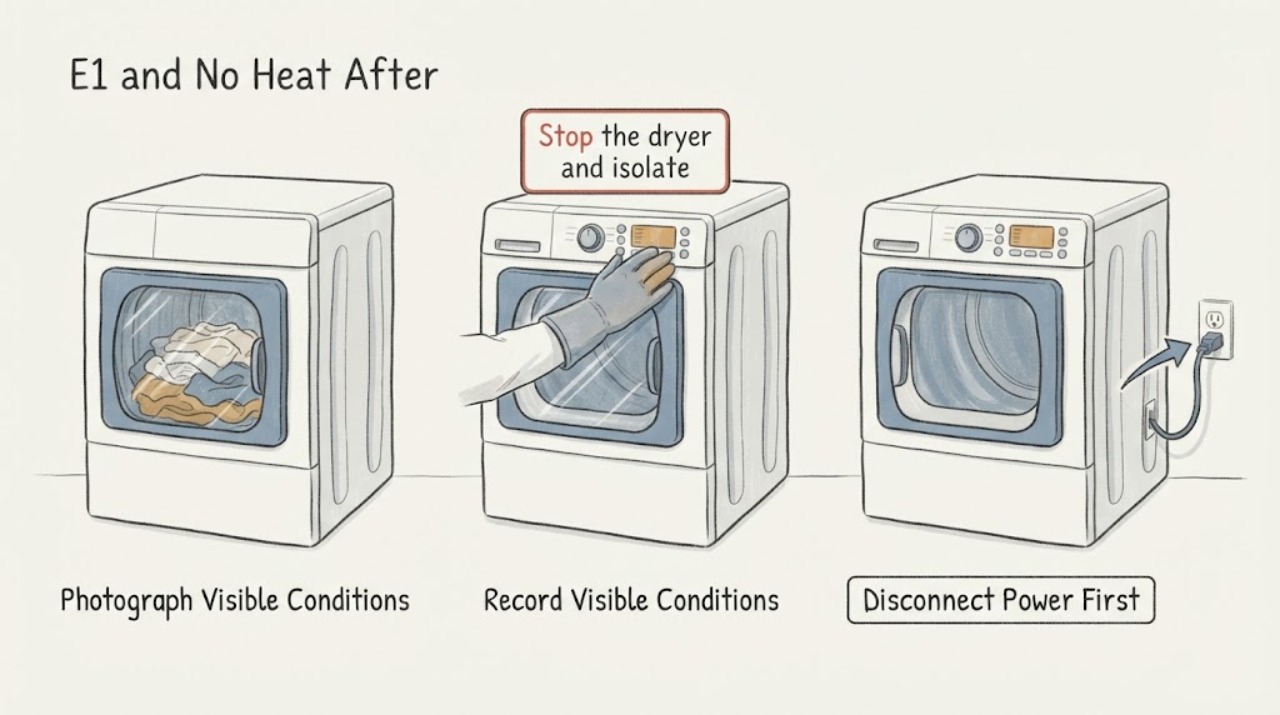
Stop the dryer and isolate power before inspection. If there is a burning smell, smoke, sparking, abnormal cabinet heat, melted insulation, or a breaker trip, keep clear and seek urgent qualified appliance or electrical help; otherwise turn the dryer off and disconnect power from a dry, safe position. Do not run another cycle just to reproduce E1.
Expected result: Record whether the drum was turning, whether heat stopped before the code, whether the cabinet or outlet was hot, whether the smell was lint-like or electrical, and whether the breaker or fuse operated.
Next step: Keep the dryer isolated and arrange qualified service. Use the event record to distinguish a safety escalation from a recurring diagnostic fault.
Stop if: Do not remove the console or rear panel, defeat the door or belt switch, probe live terminals, or restart the dryer while a burning smell or electrical damage is present.
Why this matters
Why: A hazard or repeated power event moves the case out of ordinary symptom checks. Even without a hazard, a code that returns after multiple repairs is not a safe reason for repeated powered testing by the owner.
-
Check 2
With power disconnected, photograph or transcribe the display exactly as it appeared: E1 versus an alternating F# E# code, any spaces or segments, time from start to shutdown, selected cycle and heat setting, and whether the message cleared when the door was opened or Power was pressed.
Expected result: The code is a stable E1, changes to another code, appears only after heat begins, appears immediately at startup, or cannot be captured reliably.
Next step: Attach the photo and exact model/serial label to the service request and ask the provider to identify the applicable GEW9250PW1 tech-sheet path before testing.
Stop if: Do not enter service diagnostics, clear stored faults, or restore power solely to obtain a more convenient code recording.
Why this matters
Why: Timing and complete characters separate a heat-stage recurrence from a control or power event. An incomplete or changing code must not be mapped to a different Whirlpool dryer family or used to pick a part.
-
Check 3
Document what has already been repaired or replaced, separating observation from action: heating element, thermostat, thermal cut-off, thermistor, vent cleaning, control, harness, or other work. For each item, record the date, exact part identity if known, test result before replacement, and whether the symptom changed afterward.
Expected result: A part was replaced without a recorded failure, a part tested normal but was replaced anyway, the same fault returned immediately, or the dryer worked for a period before E1 recurred.
Next step: Ask for a written diagnosis that distinguishes confirmed failed parts from parts changed as a precaution and identifies the next measurement or observation that would falsify the proposed cause.
Stop if: Do not authorize another replacement solely because it is the only major part not yet changed.
Why this matters
Why: Multiple replacements do not prove those parts were the cause or that the new parts are correctly connected. Immediate recurrence points toward an unresolved upstream/downstream condition, wiring or connector issue, airflow/temperature relationship, control interpretation, or installation/power problem.
-
Check 4
From outside the disconnected dryer, record the visible airflow and installation evidence without dismantling the exhaust system: lint-screen condition, hose crushing or kinks, exterior hood obstruction, vent length or routing changes, and whether the blower sound was normal before the code. Do not reach into the cabinet or run an airflow test with panels removed.
Expected result: The accessible path is blocked or crushed, the outside hood does not open freely, the path looks clear but heat lasts only briefly, or the blower sound changes before E1.
Next step: Correct only a plainly visible external obstruction with power isolated; otherwise request qualified duct and appliance diagnosis. Keep the dryer off if E1 returns or any abnormal heat or odor occurs.
Stop if: Do not remove the blower housing, bridge a thermal device, or run the dryer with ducting or safety panels removed.
Why this matters
Why: A restricted or changing airflow path can alter temperature and dry time, but a clear visible vent does not rule out a blower, internal duct, sensor, harness, control, or heat-circuit issue. The service record must state what portion of the vent path was actually checked.
-
Check 5
Request a written service report before approving another repair. It should name the exact code and cycle stage, identify the test or measurement used, state the observed result, list parts actually found failed, note the vent and supply checks, and define what will count as a recurrence after repair.
Expected result: The provider can show a failed component and the test that isolated it, cannot reproduce E1, proposes another part without a test, or says the vent/power path was not fully assessed.
Next step: Escalate to a Whirlpool-qualified technician or second diagnostic opinion when the report lacks measured evidence. Ask for a written repair-versus-replace recommendation only after the recurrence condition is explicit.
Stop if: Do not operate the dryer unattended to prove the repair, accept a reset as a diagnosis, or continue if it overheats, smells burnt, sparks, or trips power.
Why this matters
Why: A reproducible failure with a matching measurement supports a targeted repair. An unverified part guess or an incomplete recurrence definition leaves the same fault path unresolved and makes further replacements low-confidence.
Use your observations
Decision map
Find the observation that best matches what you see, then follow the next safe action.
-
PATH 01Safety boundary
What you see
The dryer has a burning smell, smoke, sparks, abnormal heat, melted insulation, a hot or damaged outlet/cord, or a repeated breaker trip.
Do this next
Keep the dryer off and clear. Seek emergency help for active fire or dangerous smoke, and qualified appliance/electrical service for other hazards.
Why this path and its safety boundary
Why it matters: This is an immediate fire or electrical safety branch, not an invitation to repeat E1 testing.
Safety stop: No restart, live test, panel removal, thermal-device bypass, or repeated breaker reset.
-
PATH 02Next step
What you see
E1 returns after the dryer produces heat for roughly a short interval, while the visible exhaust route has been checked and several heat-related parts have already been changed.
Do this next
Stop replacing parts by elimination. Request a written, model-specific diagnostic showing the sensor signal, control response, heating path, airflow evidence, and the exact condition that will be monitored after repair.
Why this path and its safety boundary
Why it matters: The pattern is consistent with an unresolved temperature/airflow/control/wiring relationship, but neither the timing nor the repair history identifies one failed component. The matching public GEW9250PW1 case ended with the same uncertainty and no confirmed outcome.
-
PATH 03Safety boundary
What you see
A technician documents a failed component with a reproducible measurement, the repair is made, and the report defines a supervised recurrence check without abnormal heat or odor.
Do this next
Keep the written report and monitor only as the technician specifies. Stop immediately and reopen the service case if E1, no heat, overheating, odor, or power symptoms recur.
Why this path and its safety boundary
Why it matters: This is stronger evidence for a targeted repair than a part being replaced because it was not yet changed. The result still does not prove the entire dryer is safe if E1 returns.
Safety stop: Do not extend the test, run unattended, or treat one successful cycle as proof that a recurring fault is permanently resolved.
-
PATH 04Safety boundary
What you see
The provider cannot reproduce E1, cannot show what was tested, proposes another heater/thermostat/thermistor without evidence, or did not document the vent and supply paths.
Do this next
Pause further parts purchases and request a second Whirlpool-qualified diagnostic opinion with the full repair history and code timeline.
Why this path and its safety boundary
Why it matters: The diagnosis is incomplete; the number of prior repairs is not a substitute for a measured fault isolation.
Safety stop: Do not accept a generic E1 definition, an unverified part fit, or a reset-only conclusion for this exact model.
Helpful context
Understand the symptom
The exact GEW9250PW1 is an electric Whirlpool dryer. Its official parts list points to a Use & Care Guide and Tech Sheet for this model and shows several separate paths that can affect heat: the control and main harness, heater and terminals, thermal cut-off and thermostat, thermistor and sensor harness, blower, and exhaust components. That is why a repeated E1 after several replacements is a reason to improve the evidence trail, not to keep swapping the same class of part.
A matching public case reports the GEW9250PW1 heating for about a minute before E1 returns even after the heating element, thermostat, thermal cut-off, thermistor, and exhaust paths were addressed. It is a useful pattern for what to document, not proof of the cause or a confirmed repair. The service decision should be based on measured results and a written recurrence condition, not on how many parts have already been changed.
Only after diagnosis
Potential parts
- electronic control or control-to-sensor harness
Consider only after a technician proves that the control is receiving or interpreting the temperature signal incorrectly, or that the harness/connector fails the model-specific checks.
Do not order a control or harness from E1, the model prefix, or the repair history alone; verify the exact model and connector configuration. - thermistor or temperature-sensing assembly
Consider only if the exact tech sheet and measured test show the thermistor or its wiring is out of the specified range or intermittent during the failure.
A previously replaced thermistor does not prove the replacement is correct or that the sensor path is the root cause; confirm fit and test evidence. - heater, thermal protection, or exhaust/blower component
Consider only if the technician documents a failed heater or thermal device, abnormal airflow/temperature relationship, blower fault, or damaged terminal/wiring that explains the recurrence.
Do not replace another heat-path part by elimination; assess the entire circuit and visible vent route for the exact GEW9250PW1.
When checks do not resolve it
Need a professional?
Call qualified Whirlpool appliance service for recurring E1/no heat after any repair, incomplete diagnosis, or any need to access the control, sensor, heater, thermal devices, wiring, blower, or internal ducting. Include electrical service when the supply or outlet is suspect.
Safety scope: Disconnect power before any service. Do not open panels, test live wiring, bypass the door or belt switch, bridge thermal protection, or operate the dryer with panels or exhaust safety parts removed. Stop for smoke, burning smell, abnormal heat, sparks, damaged wiring, or repeated trips.
Have this ready
- Provide GEW9250PW1, serial/rating-label details, exact E1 timing, cycle and heat setting, drum/blower behavior, vent observations, power symptoms, odor/heat history, every replaced part and test result, and the date and result of each repair.
Common questions
FAQ
Does E1 mean I should replace the thermistor again?
No. The exact model's parts list includes the thermistor, but also separate control, harness, heater, thermal protection, blower, and exhaust components. A previously replaced thermistor and a returning E1 call for measured sensor-to-control and heat/airflow evidence, not another blind replacement.
Is a clear vent enough to rule out the cause?
No. A clear visible exhaust route is useful evidence, but it does not rule out the blower, internal duct, temperature signal, harness, control interpretation, supply, or a restriction not assessed. Document exactly which path was checked and have the complete system evaluated.
Can I run the dryer for a minute to see when E1 returns?
Do not do that as a user test, especially after multiple repairs or any abnormal heat, odor, or electrical symptom. Have a qualified technician define a supervised recurrence check and stop criteria; never run it unattended or with panels removed.
What should the next repair visit provide?
Ask for the exact code and timing, the test or measurement used, the result, the part actually proven failed, the vent and supply checks, and the condition that will count as a recurrence after repair. If those are missing, pause further parts purchases and request a second diagnostic opinion.
Read the exact guide
Official sources
- Service Manual - W11169659 - Whirlpool & Maytag 27" Front-Load Gas & Electric DryersWhirlpool Corporation · Official Whirlpool service manual for a different front-load dryer family; used only for the generic warning to disconnect power before servicing and restore panels before operation, not for GEW9250PW1 code mapping.
- Whirlpool Dryer Product GuideWhirlpool Corporation · A general Whirlpool dryer guide, not the exact GEW9250PW1 manual; used only for the principle that no heat can involve supply and that F# E# codes need service, and not for an E1-specific diagnosis.
- Dryer throws E1 error despite many repairsReddit r/appliancerepair · Exact Reddit post naming Whirlpool Duet GEW9250PW1 and describing recurrent E1 after several heat-related replacements; used as an attempted-result-unknown case, not as manufacturer code authority.
- Kitchen And Laundry Appliance ManualsWhirlpool Corporation · Official Whirlpool manual portal used to route the exact model to its owner manual and literature; it does not provide a standalone E1 definition on the opened page.
- TOP AND CONSOLE PARTSWhirlpool Corporation · Official Whirlpool parts-list PDF that names GEW9250PW1 and lists its Use & Care Guide, Tech Sheet, control, harness, heater, thermal protection, thermistor, blower, and exhaust components.
Community feedback
Share a repair observation
Share a plain-text repair observation. Accepted observations are published automatically; this page may take a moment to update.