
On this page
Start here
Quick answer
First confirm that the Whirlpool dryer is on a heated cycle rather than Air Only or Air Fluff, and separate a vented electric, vented gas, or heat-pump model. For an electric model, a tripped leg of the two-breaker supply can leave the drum turning without heat; for a gas model, a closed visible shutoff can do the same. Clean the lint screen and the model-approved bottom filter, check the vent path from the outside, and record any exact display code. Do not continue testing if there is gas odor, smoke, a burning smell, arcing, a hot or scorched load, an unusually hot cabinet, or a repeated trip.
Work through in order
Diagnostic checks
Use only checks that match the exact appliance or system and its official guide.
-
Define the symptom and identify the dryer type
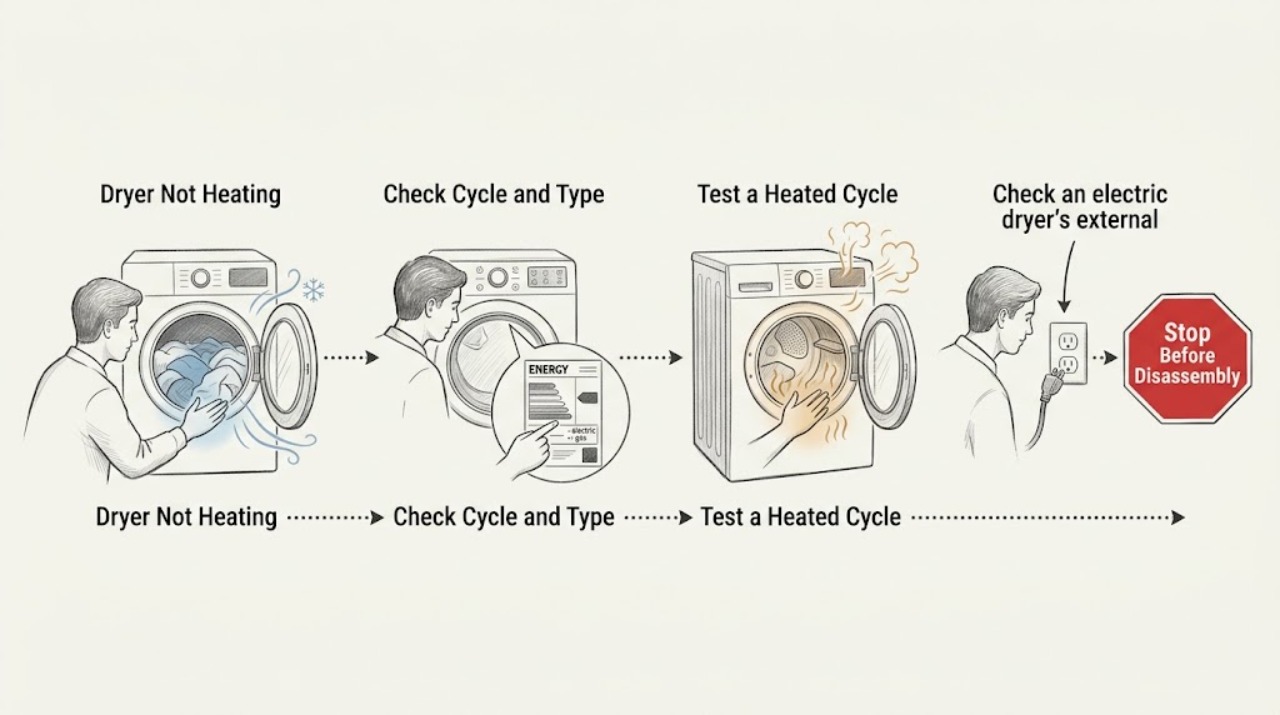
With the dryer off, read the model label and note whether it is electric, gas, vented, or heat pump. Record the selected cycle, whether the drum turns, whether any warm air is felt, the load size, and any display code.
Expected result: The drum can turn with no heat when the cycle is unheated, one supply leg is unavailable, gas is shut off, airflow is restricted, or a heat system fault is present. Heat-pump models normally use lower-temperature air and may take longer.
Next step: Continue with the matching cycle and model-type checks below; use the exact model guide if the control names differ.
Why this matters
Why: This separates a normal cycle behavior from a supply or heating fault and prevents a gas-only or electric-only check on the wrong model.
-
Rule out an intentionally unheated cycle
Check the control for Air Only, Air Fluff, or another no-heat setting. If the model guide permits a heat check, select a heated timed cycle with the drum empty and run it briefly, then open the door and feel only for a general change in air temperature without reaching toward moving parts.
Expected result: Air Only and Air Fluff are designed not to add heat. Warm air on the heated check means the heating system is operating and the original result may be a cycle, load, or airflow issue; no warmth on a correctly selected heated cycle moves the diagnosis to supply, airflow, controls, or the heat system.
Next step: If the cycle was correct and there is still no heat, follow the electric, gas, or heat-pump branch that matches the model.
Why this matters
Why: A no-heat setting is not a failed heater. If the safe check produces smoke, a burning smell, a very hot surface, arcing, or a scorched load, stop immediately and do not repeat it.
-
Check an electric dryer's external supply
Only if the model is electric, look at the household breaker panel for the two breakers serving the dryer. From a dry standing position, note whether either is visibly tripped and whether the cord or receptacle has discoloration, looseness, melting, or damage. Do not remove the dryer terminal cover; leave electrical testing to a qualified person.
Expected result: Whirlpool explains that electric dryers use two supply legs: one can run the motor while the other serves the heating element. A tripped breaker, damaged connection, or missing full supply can therefore produce tumbling with no heat.
Next step: If the external supply looks normal but a heated cycle remains cold, stop user-level electrical testing and request service for the supply or heat circuit.
Why this matters
Why: If a breaker is tripped, do not keep resetting it. If it trips again, the outlet or cord is hot or damaged, or the supply cannot be confirmed, leave the dryer off and have a qualified electrician or appliance technician inspect it.
-
Check a gas dryer's visible supply without testing ignition
Only if the model is gas and there is no gas odor, verify from the normal user-accessible area that the appliance is connected as described by its guide and that the visible shutoff handle is in the open position. Do not remove a line, light a burner, test an igniter, or run repeated cycles to see whether gas arrives.
Expected result: Whirlpool notes that a gas dryer drum can turn while a closed shutoff prevents heat. A normal-looking valve does not prove that the gas train or ignition system is safe or functional.
Next step: If gas odor is present, do not operate electrical switches or continue troubleshooting; leave the area and follow local gas-emergency guidance from a safe location.
Why this matters
Why: A closed valve can explain no heat; an open valve with no heat requires qualified service. Any gas odor, delayed ignition, unusual flame, soot, or combustion concern is an immediate stop condition.
-
Restore the model-approved airflow path
Turn the dryer off and let it cool. Clean the lint screen. On a heat-pump model, clean the bottom filter at the interval stated in its guide. From the outside, look for a crushed or disconnected vent, a blocked hood, or weak exhaust; do not insert tools into the duct or dismantle sealed heat-pump parts.
Expected result: A lint-loaded screen, blocked bottom filter, crushed duct, or restricted outside hood can extend drying and can make a normally heating dryer seem ineffective. Whirlpool identifies vent restriction as a common cause of poor drying performance and lists filter care for heat-pump models.
Next step: Have the home vent path cleaned or inspected when it is obstructed, inaccessible, or still weak after the user-accessible cleaning.
Why this matters
Why: If airflow improves and a safe heated cycle now dries normally, the restriction or filter condition was the likely cause. Persistent weak airflow or a warning such as AF or Check Vent needs duct inspection rather than a heater replacement guess.
-
Match the load and cycle to the machine
Use a normal load for the selected cycle, separate a small light load from a dense mixed load, and check that the clothes are not entering excessively wet. For a heat-pump dryer, prefer the automatic cycle recommended for a heavy load instead of assuming a timed cycle should heat immediately.
Expected result: Overloading, a poorly matched cycle, or very wet items can make the result look like no heat even when the system is producing the lower or intermittent heat expected by that program. Whirlpool states that some compact heat-pump timed cycles delay heat and that automatic cycles suit heavier loads.
Next step: Do not add a second cycle to a load that is hot, scorched, or smells burned; stop and arrange service instead.
Why this matters
Why: A normal result after correcting the load or cycle points to drying performance rather than a failed heater. If a correctly sized load remains cold on the correct heated program, retain the earlier supply and airflow findings for service.
-
Record any exact code before one safe reset
Photograph or write down the complete display code, including every letter, number, and alternating segment, along with the model number and the cycle phase. Consult the matching Whirlpool guide. If there is no hazard and the guide calls for it, perform only the guide's single power reset; do not erase a recurring code by repeated cycling.
Expected result: A code may point to a control, sensor, airflow, door, or supply condition, but its meaning varies by model. A code that returns after one documented reset is evidence for service, not permission to bypass a safety control.
Next step: Include the code, cycle, load, supply type, filter and vent observations, and what happened immediately before the failure in the service request.
Why this matters
Why: An exact code and model let the technician follow the correct diagnostic path. If the display is blank after an unexplained trip, or the code returns with heat, smoke, odor, or abnormal noise, keep the dryer off.
-
Close the diagnosis with a controlled result
After a user-level correction and only when no safety symptom exists, run one appropriate small test load on the model-approved heated cycle. Note whether the drum turns, heat returns, the cycle completes, and the clothes and cabinet remain at a normal temperature.
Expected result: Normal drying after correcting the cycle, supply condition, filter, vent, or load supports that correction. Continued cold air, a returning code, repeated tripping, excessive heat, or a new odor means the fault remains.
Next step: Stop using the dryer and arrange Whirlpool-authorized or otherwise qualified appliance service when the fault remains or any stop condition occurs.
Why this matters
Why: A failed final check should be handed to qualified service; do not open the cabinet or substitute a heater, fuse, sensor, igniter, or control without model-specific diagnosis.
Use your observations
Decision map
Find the observation that best matches what you see, then follow the next safe action.
-
PATH 01Next step
What you see
Air Only, Air Fluff, or another no-heat cycle is selected
Do this next
Select the model-approved heated cycle; if the dryer heats there, the earlier setting explains the symptom.
-
PATH 02Next step
What you see
The dryer is a compact heat-pump model and the result is low heat or a longer cycle without a hazard
Do this next
Use the recommended automatic cycle, clean the lint and bottom filters, and compare performance with the model guide; low-temperature drying can be normal.
-
PATH 03Next step
What you see
An electric model tumbles but one of its two supply breakers is tripped or the cord/receptacle is damaged
Do this next
Leave the appliance off and obtain qualified electrical or appliance service; do not repeatedly reset or open the terminal area.
-
PATH 04Next step
What you see
A gas model has a closed visible shutoff and there is no gas odor
Do this next
Follow the model guide for the normal shutoff position; if heat does not return, stop user-level gas testing and arrange qualified service.
-
PATH 05Next step
What you see
The lint screen, bottom filter, vent, or outside hood is restricted
Do this next
Clean only the user-accessible filter and have the vent path inspected or cleaned if the restriction remains; do not run an overheating dryer.
-
PATH 06Next step
What you see
A complete code returns after one guide-directed reset or the dryer remains cold on the correct cycle
Do this next
Stop using it and provide the model, exact code, cycle, supply type, and observations to qualified service.
-
PATH 07Next step
What you see
There is gas odor, smoke, burning odor, arcing, a scorched load, extreme heat, a hot damaged receptacle, or a repeated breaker trip
Do this next
Stop immediately, keep clear of the hazard, and use the appropriate emergency or qualified-service path from a safe location. Do not run another test.
Helpful context
Understand the symptom
What ‘not heating’ can mean
A dryer that tumbles is not necessarily receiving the part of its supply that makes heat. The correct path depends on the model label and on whether the drum is running, the cycle is intentionally unheated, the heat pump is operating at a lower temperature, or the appliance is showing a code. Treat the model guide as the authority when a control name or filter location differs.
Safe scope
The checks below are external observations and user controls. Do not remove panels, probe live terminals, test an igniter or flame, bypass a safety device, or open a gas connection. If a safety symptom appears, stop and arrange qualified service.
Only after diagnosis
Potential parts
- electric heating assembly
Consider only after qualified testing shows the electric heating path is open or failed and the supply and airflow are correct.
Confirm the full dryer model and the manufacturer's fit information before selecting any component. - gas ignition or heat-control assembly
Consider only after qualified service confirms a gas-model ignition or heat-control fault with safe gas pressure and airflow.
Gas components and fitment vary by model; use the model guide and qualified service findings. - thermal sensor or thermostat
Consider only when model-specific testing identifies an out-of-range temperature-sensing or thermal-protection component.
Do not substitute a thermal safety component without confirming the model-specific specification.
When checks do not resolve it
Need a professional?
Arrange qualified appliance service when a heated cycle remains cold after the correct cycle, applicable external supply, user-accessible filter, vent, and load checks; when a code returns; or when the dryer overheats. Stop immediately for gas odor, smoke, burning odor, arcing, scorched clothing, a hot or damaged cord or receptacle, repeated trips, or a dryer that cannot stop heating. Do not remove panels, probe live circuits, open gas connections, bypass a safety device, or continue testing a hazardous appliance.
Common questions
FAQ
Why does my Whirlpool dryer tumble but not heat?
Check for Air Only, then match the electric, gas, or heat-pump branch. An electric dryer can tumble with one supply leg unavailable, a gas dryer can tumble with its shutoff closed, and a heat-pump dryer can use lower heat by design.
Should I keep resetting the dryer breaker?
No. Note which breaker trips and leave the dryer off if it trips again, if the cord or receptacle is hot or damaged, or if there is an odor or smoke. A qualified person should inspect the supply and appliance.
Can a heat-pump dryer feel less hot than a conventional dryer?
Yes. Whirlpool describes heat-pump drying as lower-temperature and says cycles can take longer. Use the model-recommended automatic cycle and keep the lint and bottom filters clean; persistent cold air or a hazard still needs service.
When should I stop testing the dryer?
Stop for gas odor, smoke, burning odor, arcing, a scorched load, extreme heat, a hot or damaged cord or receptacle, or repeated breaker trips. Do not run another test or open the appliance under those conditions.
Read the exact guide
Official sources
- AF or Check Vent - DryerWhirlpool Product Help · Whirlpool dryer airflow warnings
- Dryer is Not HeatingWhirlpool Product Help · Whirlpool dryers
- Error Codes in DryersWhirlpool Product Help · Whirlpool dryer error-code guidance
- Use and Care GuideWhirlpool · Whirlpool dryer use, cycle status, and troubleshooting guidance
- Not Heating - Gas DryerWhirlpool Product Help · Whirlpool gas dryers
- Dryer Too HotWhirlpool Product Help · Whirlpool dryer overheating guidance
- Not Heating - Compact Heat Pump DryerWhirlpool Product Help · Whirlpool compact heat-pump dryers
- Not Heating - Electric DryerWhirlpool Product Help · Whirlpool electric dryers
Community feedback
Share a repair observation
Share a plain-text repair observation. Accepted observations are published automatically; this page may take a moment to update.