
On this page
Start here
Quick answer
A Whirlpool freezer can hum, buzz, click, gurgle, hiss, crack, or whoosh during normal compressor, fan, refrigerant, defrost, or ice-making cycles. First locate the sound and note whether it is brief and cycle-related or continuous, scraping, metallic, rapidly worsening, or accompanied by warming, heavy frost, water, burning odor, smoke, sparks, abnormal heat, or a tripped circuit. From ordinary safe access, check the model's controls, door seal, visible frost, blocked vents, cabinet stability, accessible condenser area, and any ice-maker or water-supply condition described in the manual. Whirlpool notes that an unusually loud vibration can be related to leveling, while a loud evaporator-fan sound together with poor cooling can indicate a fault; do not remove covers, chip frost, touch a fan or compressor, open the sealed system, or repeatedly reset a tripping circuit. Keep the freezer closed to protect food and arrange qualified service if the sound persists with poor cooling, cannot be localized safely, or crosses a stop condition.
Before you begin
Safety first
- This article supports listening, ordinary-access inspection, model-approved external maintenance, and safe triage only. Do not remove covers, reach toward fans or compressors, chip frost, handle sealed-system or refrigerant parts, access live wiring, or repeatedly reset a tripping circuit.
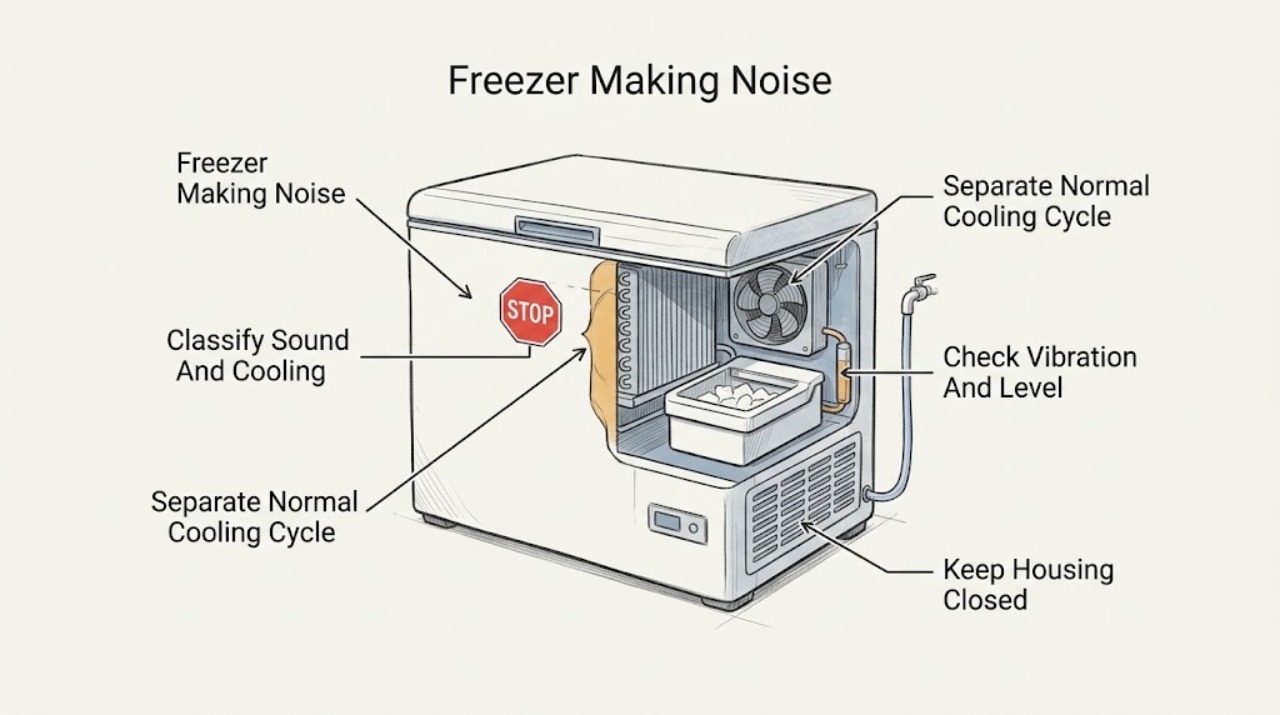
Work through in order
Diagnostic checks
Use only checks that match the exact appliance or system and its official guide.
-
Check 1
From a safe position with the freezer closed when possible, listen and record the sound's character, location, duration, and trigger: low hum, buzz, whoosh, click, gurgle, hiss, crack, rattle, scraping, grinding, or metallic knock; note whether it starts after a door opening, a cooling cycle, defrost, or ice-making fill.
Expected result: Record whether the sound is brief and repeating with a cycle, continuous, changing with the door position, coming from the rear/bottom, inside the freezer, or near the ice maker or water line. Also record whether food remains solidly frozen, the display or alarm changes, or the freezer is warming.
Next step: Use the matching branch below and preserve a short recording, model number, exact sound location, and cooling status for service; do not attempt to identify a hidden component by removing a panel.
Stop if: Stop operating the appliance and keep clear for smoke, burning odor, sparks, abnormal heat, damaged cord, water near electrical parts, refrigerant damage, or a rapidly worsening metallic or impact sound.
Why this matters
Why: A brief hum, fan airflow, gurgle, defrost drip, click, or ice-maker sound can be normal. A new persistent scrape, grind, hard knock, or loud vibration is more significant, especially when paired with poor cooling, frost, or an alarm.
-
Check 2
Compare the timing of the sound with the freezer's normal cooling and defrost behavior without changing service settings or opening the cabinet; observe whether the compressor or fan starts and stops in a normal pattern and whether the sound settles as temperature recovers.
Expected result: Classify the result as a steady low hum, a soft airflow or pulsing sound, a brief click at start/stop, a gentle gurgle or drip after a cycle, a pop or crack, or an abnormal sound that does not follow a cycle. Check whether the freezer maintains its normal temperature.
Next step: If the sound is brief and cooling is normal, document it and continue to the vibration, frost, or ice-maker check only if relevant. If it is persistent or cooling is poor, arrange model-specific service after the external checks.
Stop if: Do not keep running the freezer to observe it when the cabinet is overheating, there is burning odor or smoke, the sound includes impact or grinding, or the freezer is losing temperature and food safety is at risk.
Why this matters
Why: Whirlpool says compressor and fan humming, refrigerant or defrost-water movement, control clicks, and contraction/expansion sounds may be normal. A sound that is louder than before, continuous, or accompanied by warming is not cleared merely because the compressor runs.
-
Check 3
Without moving a built-in unit or removing a cover, check from ordinary access that the cabinet is stable on a solid floor, accessible leveling adjustments are not obviously loose, the door is aligned, and no shelf, bin, item on top, wall, or nearby object is touching and amplifying the vibration.
Expected result: Note whether the noise changes when a loose external item is removed, whether the cabinet rocks, whether the sound is transmitted through the floor or wall, and whether the door closes smoothly without rubbing.
Next step: Remove only loose external items and use the exact manual's leveling procedure if the appliance is designed for that adjustment; then recheck once. If the unit is built in, unstable, or the vibration remains, document the location and call service.
Stop if: Do not pull a heavy or built-in freezer, lift it, remove rear panels, reach behind moving parts, or continue if the cabinet, floor, cord, or water line is damaged.
Why this matters
Why: Whirlpool associates rattling or vibrating with refrigerant or water flow, objects touching the cabinet, and an unlevel appliance. If external contact and stability are corrected but the vibration remains loud or new, an internal fan, compressor, tubing, or mounting issue needs service diagnosis.
-
Check 4
Inspect only visible areas for thick frost on the rear wall or around vents, packages blocking airflow, a gasket that is visibly dirty or not contacting the cabinet, and a door or drawer that is not fully closing; do not remove an interior cover or chip ice.
Expected result: Record no visible frost with a good seal, localized frost near an airflow path, widespread heavy frost, a torn or displaced gasket, blocked vents, or a freezer that is noisy and warming at the same time.
Next step: Rearrange only accessible food to clear vents and close the door correctly. Follow the exact model manual for an approved defrost procedure; if frost returns rapidly, the fan noise persists, the gasket is damaged, or cooling is poor, keep the freezer closed and arrange service.
Stop if: Do not use a knife, scraper, heat gun, hair dryer, or other direct heat on frost, and do not touch a fan or remove the evaporator or rear cover.
Why this matters
Why: Thick frost can restrict vents and coils. Whirlpool's technical guidance for certain side-by-side models connects excessive ice around the evaporator and fan with noisy fan operation, poor cooling, door-gasket or air-leak issues, and restricted airflow. That evidence supports service triage, not a universal part diagnosis.
-
Check 5
If this model has an ice maker or water connection, note whether the sound occurs only during fill, eject, or water dispensing; verify from the model manual that the ice maker is intended to be on and that the accessible water line is not kinked or pressed against the cabinet.
Expected result: Classify the sound as a brief valve buzz/click, water running or thumping during fill, ice dropping into the bin, or a continuous buzz when the ice maker is not connected to water. Note any water, slow fill, or leak.
Next step: Use the exact manual to turn the ice maker off if it is not connected to water, correct only an obvious accessible line position, and stop the water supply from a safe accessible shutoff if a leak is present. Arrange service for a persistent valve, ice-maker, or leak noise.
Stop if: Do not handle a wet electrical area, disassemble the water valve, force a frozen line, or continue operation with a persistent leak, water near electrical parts, or a damaged supply line.
Why this matters
Why: Whirlpool describes water-valve buzzing or clicking, fill and water-line sounds, and ice dropping as possible operating sounds. A continuous buzz with no water connection, a kinked line, abnormal pressure noise, or any leak points to a water-supply or ice-maker condition rather than a compressor fault.
-
Check 6
Confirm the freezer setting and alarm state, keep interior air paths clear, and—only if the exact manual identifies an accessible condenser area—inspect and clean that area as directed with the appliance safely isolated; do not open an electrical compartment.
Expected result: Record whether the noise is accompanied by a warm cabinet, long or unusually frequent run time, heavy dust at an accessible condenser area, a temperature alarm, or no change in cooling performance.
Next step: Restore only the model-approved setting or external maintenance condition once, then allow normal recovery. If the freezer remains warm, an alarm persists, the compressor is abnormally loud, or the check requires internal access, keep food protected and request qualified service.
Stop if: Do not remove a rear or electrical cover, touch a capacitor or compressor, test live circuits, handle refrigerant, or repeatedly cycle power when a breaker trips.
Why this matters
Why: Whirlpool notes that dirty accessible condenser areas can make the compressor work harder and more loudly, while its freezer guidance says a loud evaporator-fan sound commonly accompanies difficulty staying cold. A noise plus warming is a cooling-fault triage signal, not a reason to replace a compressor or fan without diagnosis.
-
Check 7
After documenting the sound and completing only the relevant ordinary-access checks, use one model-approved control or power recovery only when there is no hazard and the manual permits it; then decide whether to keep the freezer in service or leave it off for repair.
Expected result: Record whether the sound returns immediately, whether cooling and alarms normalize, whether a breaker trips again, and whether the freezer has a persistent leak, odor, smoke, heat, or food-warming condition.
Next step: Keep the door closed, protect food, and provide the technician with the model, sound recording, timing, location, temperature/alarm behavior, frost and gasket observations, and any water-line or ice-maker result. Leave the appliance off when a stop condition is present.
Stop if: Do not repeatedly reset a breaker, run an overheating or smoking freezer, reconnect a damaged cord, or continue troubleshooting when water is near electrical parts or the sound suggests mechanical damage.
Why this matters
Why: A single normal recovery can clear a temporary control state, but a recurring sound, repeat trip, poor cooling, or safety symptom indicates a fault that needs qualified diagnosis. The absence of a sound after a reset does not prove an internal component is safe.
Use your observations
Decision map
Find the observation that best matches what you see, then follow the next safe action.
-
PATH 01Safety boundary
What you see
The freezer is maintaining temperature and the sound is a brief or low hum, fan airflow, click, gurgle, drip, pop, or crack tied to cooling, defrost, or door activity.
Do this next
Document the pattern and keep vents and the door seal in good condition. Use the exact model manual if the sound changes or cooling performance changes.
Why this path and its safety boundary
Why it matters: Whirlpool describes these sounds as possible normal operation from the compressor, fans, refrigerant, defrost water, controls, or cabinet expansion.
Safety stop: Escalate for a new persistent scrape, grind, hard impact, burning odor, smoke, sparks, abnormal heat, water, or warming freezer.
-
PATH 02Safety boundary
What you see
The sound is a rattle or vibration from the cabinet, floor, wall, shelf, or an item touching the appliance, and cooling is otherwise normal.
Do this next
Remove loose external contact and follow the model's safe leveling instructions once. Request service if the cabinet remains unstable or the vibration is loud, new, or accompanied by poor cooling.
Why this path and its safety boundary
Why it matters: An unlevel cabinet, flexible floor, external contact, refrigerant flow, or water-line movement can amplify a normal sound.
Safety stop: Do not move a built-in or heavy unit, open panels, or continue if the cord, cabinet, floor, or water line is damaged.
-
PATH 03Safety boundary
What you see
The sound is scraping, grinding, or loud fan noise from inside the freezer, especially with visible heavy frost, blocked airflow, or warming.
Do this next
Keep food protected, use only the exact manual's approved defrost path, and arrange service if the noise persists or frost rapidly returns. Do not remove the fan cover.
Why this path and its safety boundary
Why it matters: Frost or an airflow restriction can interfere with a fan. Whirlpool's technical pointer describes noisy evaporator-fan and ice-accumulation concerns for specified side-by-side models, so the exact model and service history matter.
Safety stop: Do not chip frost, apply direct heat, reach toward a fan, or operate through smoke, burning odor, sparks, abnormal heat, or a damaged cabinet.
-
PATH 04Safety boundary
What you see
The sound occurs only during ice-maker fill/eject or water dispensing, or is a buzz from the water-valve area.
Do this next
Confirm the ice maker's intended state and inspect only the accessible line as the manual allows. Turn the ice maker off when the model permits and it is not connected to water; arrange service for persistent noise or leakage.
Why this path and its safety boundary
Why it matters: A brief buzz, click, water fill, thump, or ice-drop noise may be normal. A continuous buzz with no water connection, a kink, abnormal water pressure, or a leak needs correction or service.
Safety stop: Do not disassemble the valve, force a frozen line, or touch wet electrical areas. Stop for a persistent leak or water near electrical parts.
-
PATH 05Safety boundary
What you see
The noise is unusually loud or continuous and the freezer is warming, alarming, heavily frosted, or running much longer than expected.
Do this next
Record temperature/alarm behavior, gasket and frost observations, and the exact model. Keep the door closed and request qualified Whirlpool or appliance service if external checks do not resolve it.
Why this path and its safety boundary
Why it matters: The combination can indicate restricted airflow, door-seal or moisture leakage, a fan issue, dirty accessible condenser area, or another cooling fault. Sound alone cannot identify the failed component.
Safety stop: Do not replace a compressor, fan, thermostat, thermistor, or defrost part by guesswork; do not open the sealed system or electrical compartment.
-
PATH 06Safety boundary
What you see
There is smoke, burning odor, sparking, abnormal heat, repeated breaker operation, a damaged cord, water near electrical parts, a major leak, or visible cabinet damage.
Do this next
From a safe position, stop using the freezer and disconnect power or close an accessible water shutoff only if doing so does not require contact with a hazard. Leave the area if there is smoke or fire risk and contact appropriate emergency or qualified service help.
Why this path and its safety boundary
Why it matters: The immediate priority is people, fire/electrical safety, and food protection; noise diagnosis is no longer an appropriate DIY task.
Safety stop: Do not touch wet components, use a flame, operate electrical switches near a suspected gas or fire hazard, repeatedly reset power, or reopen the appliance to investigate.
Helpful context
Understand the symptom
Start with sound, timing, location, and cooling
A sound is more useful when it is described by when it occurs and where it comes from. A low hum that starts after the door has been opened may be the compressor or a fan restoring temperature. A gentle gurgle, hiss, drip, click, or brief crack can accompany refrigerant movement, defrost, controls, or expansion. By contrast, a new scraping sound from inside the freezer, a hard metallic knock, or a loud vibration that continues while the cabinet warms deserves a focused check. The exact Whirlpool model matters: an upright freezer, bottom-freezer refrigerator, and side-by-side refrigerator may place fans, water components, and controls in different locations.
Use frost and temperature as deciding evidence
Noise alone does not identify a failed part. Thick frost can obstruct vents or an evaporator fan and can occur with poor door sealing or an airflow problem. Whirlpool's service pointer describes a possible combination of poor or no cooling, a noisy evaporator fan, and ice accumulation in the freezer compartment for specific models; it is not a universal diagnosis for every Whirlpool freezer. If the freezer remains at its expected temperature and the sound follows a normal cycle, document it rather than replacing a part by guesswork. If the sound is paired with warming, an alarm, heavy frost, or a compressor that runs unusually long, use the model manual and service route.
Keep the checks external and model-specific
Safe checks are limited to ordinary access: note the setting and alarm, confirm the door closes and the gasket contacts the cabinet, keep interior vents clear, remove items that are touching or amplifying vibration, and check that an accessible condenser area is maintained as the manual permits. Do not pry off an interior panel, reach toward a fan, use a sharp tool on frost, open a rear cover, handle refrigerant tubing, or make electrical measurements. If a built-in or fully loaded appliance would have to be moved, leave that work to a qualified technician.
Safety boundary
Stop conditions
- Stop immediately for smoke, burning odor, sparks, arcing, abnormal heat, a hot or damaged cord, repeated breaker operation, or visible electrical damage; disconnect only from a safe position and arrange qualified help.
- Stop for water near electrical parts, a persistent or major leak, a wet damaged supply line, or cabinet damage; do not touch wet components or continue cycling the freezer.
- Stop for a new grinding, scraping, hard metallic impact, or rapidly worsening mechanical sound, especially when cooling is falling; do not reach toward a fan, compressor, or moving part.
- Do not remove interior or rear covers, handle refrigerant or sealed-system tubing, access live electrical parts, or make live electrical measurements as a noise check.
- Do not chip frost, use knives or direct heat, force a frozen water line, or disassemble an ice maker or water valve; use only the exact model manual's approved external or defrost procedure.
- Keep the freezer closed and protect food when it is warming, alarming, or without reliable cooling; do not continue a sound test at the expense of food safety.
When checks do not resolve it
Need a professional?
Arrange qualified Whirlpool or appliance service when the noise is persistent, unusually loud, paired with warming, heavy frost, an alarm, a damaged gasket, repeated tripping, a leak, or an ice-maker/water-line fault; when external leveling or model-approved maintenance does not help; or whenever diagnosis would require opening a cover, reaching a fan or compressor, handling refrigerant, or accessing live electrical parts.
Safety scope: This article supports listening, ordinary-access inspection, model-approved external maintenance, and safe triage only. Do not remove covers, reach toward fans or compressors, chip frost, handle sealed-system or refrigerant parts, access live wiring, or repeatedly reset a tripping circuit.
Common questions
FAQ
Is a humming Whirlpool freezer normal?
Often. Whirlpool says a low hum can come from the compressor or fans and can be normal. It needs attention when it is new, unusually loud, continuous, or paired with poor cooling, heavy frost, a burning odor, smoke, heat, or repeated tripping.
Why does my Whirlpool freezer rattle or vibrate?
Possible amplifiers include an unlevel cabinet, a flexible floor, items touching the cabinet, refrigerant flow, or water-line movement. Remove only loose external contact and follow the exact manual's safe leveling instructions; persistent loud vibration needs service.
Could frost cause a loud freezer fan?
It can. Thick frost can restrict airflow, and Whirlpool's service pointer for specified side-by-side models links ice buildup with noisy evaporator-fan and poor-cooling symptoms. Do not chip frost or remove a fan cover; use the model manual or arrange service.
Why does the freezer buzz near the ice maker?
A brief valve buzz, fill sound, or ice drop can be part of ice production. If the ice maker is enabled without a water supply, Whirlpool says it may buzz; check the model-specific on/off state and accessible line condition, and stop for a leak or water near electrical parts.
When should a noisy Whirlpool freezer be serviced?
Request service for a persistent or unusually loud sound, sound with warming, alarm, heavy frost, repeated breaker operation, water, burning odor, smoke, sparks, abnormal heat, or any diagnosis that would require removing covers or reaching the fan, compressor, wiring, or sealed system.
Read the exact guide
Official sources
- Service Pointer - W11550688 - Rev A - No/Low Cool, Noise From Freezer Compartment SxS RefrigeratorWhirlpool Digital Assets · Only the listed Whirlpool-family side-by-side models and serial range in the service pointer; do not generalize it to every freezer.
- 7 Freezer Problems & How to Help Fix ThemWhirlpool · Whirlpool consumer troubleshooting guidance; exact model instructions and qualified service govern internal diagnosis.
- Refrigerator Noise - GurglingWhirlpool Product Help · Whirlpool refrigerator guidance applicable to models with a freezer compartment; exact model manual controls maintenance access.
- Refrigerator Noise - Rattling or VibratingWhirlpool Product Help · Whirlpool refrigerator noise guidance; exact freezer configuration and built-in installation may differ.
- Ice Maker Not Working - TroubleshootingWhirlpool Product Help · Whirlpool refrigerator ice-maker guidance; only models equipped with the described ice maker and water system apply.
- Humming NoiseWhirlpool Product Help · Whirlpool Product Help explanation for humming; a freezer model may have different component layout.
- Refrigerator Normal Sounds and NoisesWhirlpool Product Help · Whirlpool's general full-size refrigerator guidance; the exact freezer model manual controls component location and procedure.
- Freestanding Ice Maker NoisesWhirlpool Product Help · Whirlpool freestanding or undercounter ice-maker guidance; an integrated freezer ice maker may use different controls.
Community feedback
Share a repair observation
Share a plain-text repair observation. Accepted observations are published automatically; this page may take a moment to update.