
On this page
Start here
Quick answer
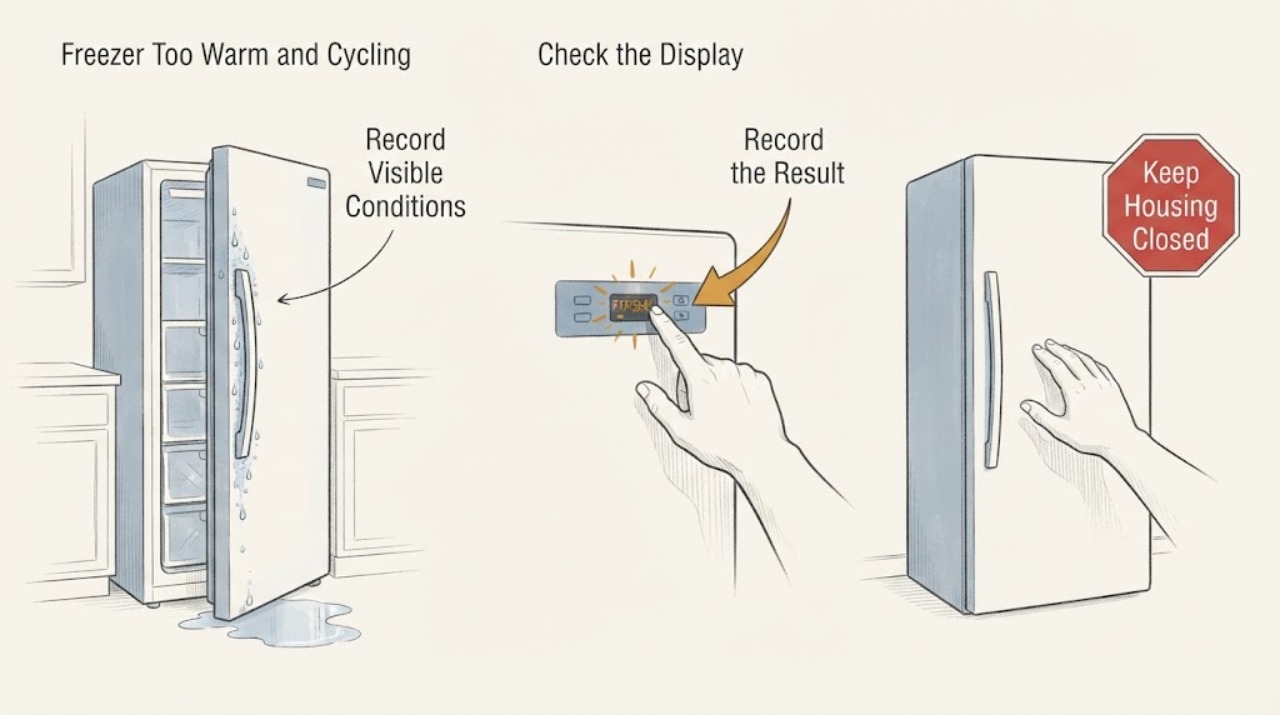
For a Whirlpool WRS325FNAM00 freezer that is warmer than expected and seems to cycle frequently, measure the food compartment with an appliance thermometer before interpreting the sound. Whirlpool's general refrigerator guidance uses 0°F as the freezer target and says to allow 24 hours after a small control adjustment; a recent installation or large warm load can take 24 to 48 hours to settle. Keep the door closed while it recovers, then check visible door-seal contact, blocked vents, frost, heat sources, and accessible clearance without moving the refrigerator or opening panels. Frequent compressor operation can be a response to warm food, door openings, room heat, or an incorrect setting; it does not by itself prove a compressor, relay, sensor, fan, or sealed-system failure. If the measured temperature stays high after the recovery period, frost returns quickly, the door will not seal, or electrical/overheating symptoms appear, protect the food and arrange qualified Whirlpool refrigeration service.
Work through in order
Diagnostic checks
Use only checks that match the exact appliance or system and its official guide.
-
Check 1
Place or read an appliance thermometer in the center of the freezer compartment, away from the wall, door, and air outlet, and record the temperature with the date and time while keeping the door open only briefly.
Expected result: The measured temperature is at or below 0°F, above 0°F but below 40°F, or at/above 40°F; the reading is changing after a recent event; or no reliable thermometer is available.
Next step: Repeat one reading after the documented recovery interval and keep the door closed between checks. If food is at or above 40°F, still contains no ice crystals, or the time above that temperature is uncertain, follow FDA food-safety guidance rather than tasting it.
Stop if: Do not keep opening the door to watch the temperature, and do not handle food or the appliance in standing water or around damaged electrical parts.
Why this matters
Why: The 0°F value is the normal Whirlpool/FDA freezer target, while a warmer reading indicates a cooling-performance concern even if the compressor can be heard. Food safety cannot be decided from frost appearance or smell alone.
-
Check 2
Read the freezer control and any cooling-off or alarm indication, then compare the labels and settings with the Whirlpool WRS325FNAM00/WRS325FNAM Owner's Manual reached through Whirlpool's model lookup; make at most one normal setting change.
Expected result: Cooling was off, the freezer is set warmer than intended, an alarm is active, or the setting is already correct but the measured temperature is high.
Next step: Restore cooling only through the normal control and wait at least 24 hours before judging the change. Do not enter an undocumented service mode or repeatedly change the setting.
Stop if: Stop for a darkened or damaged control, a hot cord, sparking, repeated breaker trips, or any need to remove a panel.
Why this matters
Why: A control state can explain a warm compartment without proving a failed compressor. Whirlpool says to use the model manual because control panels and their functions vary; a correct setting with a persistent high measurement shifts attention to seal, airflow, frost, installation, or service causes.
-
Check 3
Record whether a power interruption, recent installation, large warm grocery load, or prolonged/frequent door opening occurred before the temperature rose; do not compensate by repeatedly opening the freezer or adding more unfrozen food.
Expected result: The event occurred soon after power returned, a large load was added, the door was held open, or none of those conditions occurred and the temperature has remained high.
Next step: Keep the doors closed and allow the documented recovery period, then take one new thermometer reading. Move food to a known-safe cold location if the temperature is unsafe; arrange service if it remains high.
Stop if: Do not use an extension cord, repeatedly reset a tripped protective device, or continue operating after smoke, an electrical odor, overheating, or water near wiring.
Why this matters
Why: Whirlpool says warm contents, frequent door openings, and recent installation can lengthen recovery, with some situations taking 24 to 48 hours. If no reversible event explains the reading or recovery does not occur, frequent cycling is a symptom rather than a component diagnosis.
-
Check 4
Inspect the closed freezer door and gasket from outside for a visible gap, folded or torn seal, frost concentrated at the opening, or a package preventing closure; look at accessible interior vents only long enough to see whether food is covering them.
Expected result: The door closes evenly with continuous gasket contact and vents are clear, or there is a gap, damaged gasket, frost around the opening, or blocked airflow.
Next step: Remove only an accessible package obstruction and clean the gasket as the exact manual permits. Arrange service for a torn seal, misalignment, persistent gap, or frost that returns after the safe recovery period.
Stop if: Do not force the door, pull the gasket from its channel, dismantle the interior, or use a knife, pick, hair dryer, or heater on ice.
Why this matters
Why: A weak seal admits warm humid air and can create frost, while blocked vents can prevent cold-air circulation. A good visible seal and clear vents make those causes less likely but do not identify a compressor, fan, defrost, or sealed-system fault.
-
Check 5
From the room and without moving the refrigerator, note nearby heat sources, blocked air space, a visibly dirty accessible grille or condenser area, and whether the appliance is in an unusually hot location; use only the clearance and cleaning instructions for the exact model.
Expected result: The refrigerator is near a heat source, its ventilation space is obstructed, an accessible area is visibly dusty, or the installation appears normal.
Next step: Restore only accessible manual-approved clearance or cleaning without pulling the refrigerator forward. If inspection requires moving the appliance or removing a cover, stop and arrange service.
Stop if: Do not move a connected refrigerator, reach behind it, remove the rear cover, or vacuum an inaccessible condenser by dismantling the cabinet.
Why this matters
Why: Whirlpool identifies room conditions, heat sources, blocked ventilation, and loading as factors that can increase run time or cause temperature fluctuation. A normal installation does not rule out an internal refrigeration or defrost issue, but it prevents an unsupported clearance or coil diagnosis.
-
Check 6
Log the compressor sound and temperature together from a normal standing position: note whether the sound is a steady long run, repeated short starts, or simply a normal on/off cycle, and compare it with the thermometer trend rather than listening for a part failure.
Expected result: The freezer reaches or approaches 0°F after recovery while the sound varies, or it stays warm while the compressor cycles repeatedly, stops with a click, or the cabinet becomes unusually hot.
Next step: If temperature is recovering, continue monitoring without repeated door openings. If temperature remains unsafe or the sound is paired with heat, smoke, repeated trips, or rapid recurrence, provide the log and photos to qualified refrigeration service.
Stop if: Do not place hands near fans, remove covers, listen with the rear panel open, or perform live electrical or refrigerant testing.
Why this matters
Why: Whirlpool describes high-efficiency compressors as operating at varying speeds or for extended periods and lists recovery, door use, room heat, and settings as common influences. Warm temperature plus abnormal cycling can involve several systems and cannot identify a compressor, relay, fan, sensor, or sealed-system fault from sound alone.
-
Check 7
Prepare the service handoff with the complete WRS325FNAM00 model tag, measured temperatures and times, recent power/load/door history, gasket and frost photos, installation observations, and the sound log; do not buy a compressor, relay, sensor, fan, or defrost part from the symptom alone.
Expected result: The freezer remains above its target after the recovery interval, frost returns quickly, the door cannot seal, or all visible checks are normal but cooling is still poor.
Next step: Keep the door closed, protect or relocate food as needed, and request Whirlpool or qualified refrigeration service for model-specific diagnosis. Ask the technician to verify the exact suffix and provide a repair recommendation after testing.
Stop if: Do not open panels, handle refrigerant, bypass controls, add refrigerant, or continue using the unit after electrical, smoke, water, or overheating warnings.
Why this matters
Why: A defrost, airflow, control, compressor, condenser, or sealed-refrigeration condition remains possible, but the external observations do not safely distinguish those causes or establish a replacement part.
Use your observations
Decision map
Find the observation that best matches what you see, then follow the next safe action.
-
PATH 01Next step
What you see
The measured freezer temperature is at or below 0°F after recovery, even though the compressor sound varies or runs for long periods.
Do this next
Keep the door closed, monitor the temperature trend, and record whether long runs follow door openings or warm loads. Do not replace a part based only on sound.
Why this path and its safety boundary
Why it matters: The cooling result is currently consistent with the food-storage target, and cycling alone does not prove a component failure.
-
PATH 02Next step
What you see
The freezer is above 0°F after 24 hours from a setting change, or after 24 to 48 hours from a recent installation or large warm load, and no door, control, or power explanation remains.
Do this next
Protect food using the measured temperature and FDA guidance, keep the door closed, and arrange qualified Whirlpool refrigeration service with the temperature log and exact model suffix.
Why this path and its safety boundary
Why it matters: The condition is no longer well explained by ordinary recovery. A cooling, airflow, defrost, or refrigeration fault remains possible, but frequent cycling cannot name which one.
-
PATH 03Next step
What you see
Frost is concentrated at the door opening or rear wall, the gasket has a visible gap, or packages cover an interior air outlet.
Do this next
Clear only the accessible obstruction and follow the exact manual's safe care instructions. Stop and call service for a damaged seal, rapidly recurring frost, or any ice that would require tools, heat, or panel removal.
Why this path and its safety boundary
Why it matters: Warm humid-air entry or restricted circulation is more likely than a sound-based compressor diagnosis, though recurring heavy frost can still need service.
-
PATH 04Next step
What you see
The display or accessible supply is abnormal, a breaker or protection device trips again, the cord is hot or damaged, or the cabinet has smoke, burning odor, water, or unusual heat.
Do this next
Stop using the refrigerator and obtain qualified electrical or appliance service. Do not touch wet electrical parts or move the connected unit.
Why this path and its safety boundary
Why it matters: This is an electrical or environmental safety boundary, not a reason to keep resetting power or diagnose a sealed-system part.
-
PATH 05Next step
What you see
The measured temperature is unsafe or the food's time above 40°F is unknown, while the appliance diagnosis is still pending.
Do this next
Keep the door closed, transfer food to a known-safe freezer or cooler when practical, and follow FDA rules for ice crystals, measured temperature, and uncertain exposure. Continue appliance service separately.
Why this path and its safety boundary
Why it matters: Food safety takes priority over deciding whether the compressor is failing. Appearance, smell, and a cold cabinet are not reliable substitutes for temperature history.
Helpful context
Understand the symptom
The task identifies the appliance as Whirlpool WRS325FNAM00. Whirlpool's Owner Center page is indexed under the WRS325FNAM family and does not display model documents there, so the final suffix should be confirmed against the rating label and the matching Owner's Manual before using any model-specific setting or clearance value.
A cold-sounding or frequently running refrigerator is not the same as a measured cold freezer. The first decision is whether the temperature is actually returning toward the food-safe target after a reversible load, door, power, or setting event. Protect food separately from the appliance diagnosis; appearance and odor are not reliable tests for food safety.
When checks do not resolve it
Need a professional?
Arrange Whirlpool or qualified refrigeration service when the WRS325FNAM00 freezer remains above its target after the documented recovery period, frost returns rapidly, the door cannot seal, or all accessible checks are normal but food is warming. Stop immediately for smoke, sparking, a burning odor, a hot or damaged cord, repeated breaker trips, water near wiring, unusual cabinet heat, or a need to move the refrigerator or open a panel. Do not chip or heat ice, add refrigerant, bypass controls, or perform live electrical or refrigerant testing.
Common questions
FAQ
Does frequent compressor cycling mean the compressor is failing?
No. Whirlpool lists warm loads, frequent door openings, room heat, settings, and recovery after installation as reasons a refrigerator may run longer or more often. Confirm the freezer temperature and its trend before treating the sound as a part diagnosis.
What freezer temperature should I use as the reference?
Whirlpool and FDA consumer guidance use 0°F as the normal freezer target. Use an appliance thermometer rather than relying only on the control setting; allow the stated stabilization period after an adjustment before judging the result.
Is food safe if the freezer warmed during a power interruption?
Use the measured food or freezer temperature and time, not smell or appearance. FDA says food that still has ice crystals or is at or below 40°F can generally be refrozen or cooked, while uncertain exposure should be discarded; keep the door closed while deciding.
Read the exact guide
Official sources
- Food and Water Safety During Power Outages and FloodsU.S. Food and Drug Administration · FDA food-safety steps for freezer power interruption, closed-door retention, and measured temperature
- Refrigerator Thermometers - Cold Facts about Food SafetyU.S. Food and Drug Administration · FDA freezer thermometer target and food-safety assessment after temperature loss
- How to Defrost the FreezerWhirlpool Product Help · Whirlpool freezer frost safety boundary and prohibited sharp-tool, hair-dryer, and heater methods; exact WRS325FNAM00 procedure must come from its manual
- Kitchen And Laundry Appliance Manuals | WhirlpoolWhirlpool · Whirlpool model-number manual lookup and model-specific literature boundary
- WRS325FNAM | WhirlpoolWhirlpool · Whirlpool WRS325FNAM00 exact-model lookup boundary; the Owner Center page is indexed under the WRS325FNAM family and identifies the base model, so the 00 suffix must be confirmed separately
- Cold Food Storage ChartFoodSafety.gov · FoodSafety.gov freezer storage target and food quality/safety context
- Tips for Properly Setting the ControlsWhirlpool Product Help · Whirlpool refrigerator freezer target temperature, thermometer placement, setting changes, and stabilization time
- Motor or Compressor Runs too Much - Product Help | WhirlpoolWhirlpool Product Help · Whirlpool refrigerator run-time factors, recovery after loading or installation, door use, room heat, and clearance
Community feedback
Share a repair observation
Share a plain-text repair observation. Accepted observations are published automatically; this page may take a moment to update.