
On this page
Start here
Quick answer
When a Whirlpool freezer is not cooling, first confirm that cooling is enabled and power is stable, then check the displayed setting, door closure, gasket, blocked vents, frost pattern, and room conditions. A large recent load or frequent door opening can temporarily raise temperature, while a damaged seal can admit warm humid air and create frost that blocks airflow. Check the ice maker only if your model has one, and keep condenser coils accessible only when the owner manual says they can be cleaned. Let the freezer stabilize after one normal control adjustment rather than repeatedly changing settings. Protect food while diagnosing, and stop for water near electrical parts, smoke, burning odor, sparking, a hot plug, repeated breaker trips, a damaged liner, or a temperature that remains unsafe. Arrange Whirlpool or qualified refrigeration service when cooling does not return after the safe external checks or frost rapidly returns.
Before you begin
Safety first
- This article supports normal-control checks, safe loading changes, visible gasket and vent inspection, manual-approved defrost or condenser care, and dry-position observations only. Do not open panels, chip ice, move a connected appliance, handle refrigerant, work on pressurized water lines, or touch wet electrical parts.
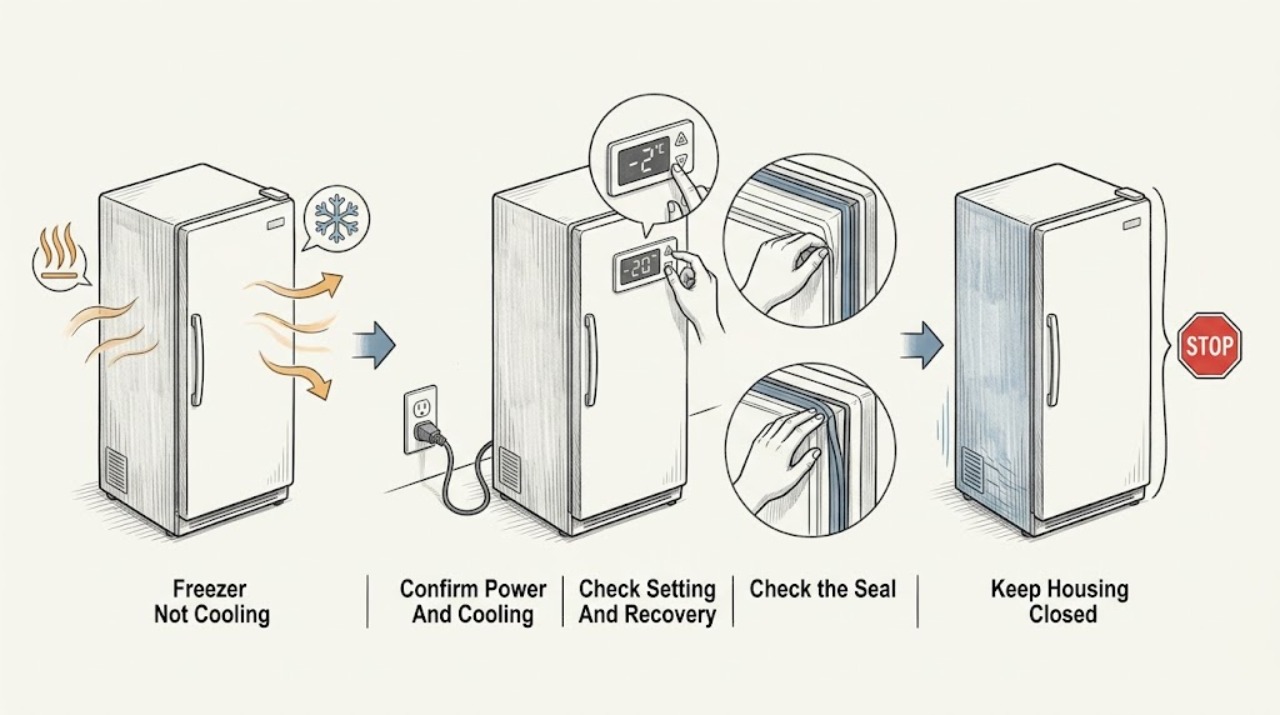
Work through in order
Diagnostic checks
Use only checks that match the exact appliance or system and its official guide.
-
Check 1
From a dry, safe position, confirm the freezer is switched on, the control panel or indicator responds, the plug and cord look intact, and cooling has not been turned off in the normal controls; note whether a breaker or protective outlet has tripped.
Expected result: The panel is dark, cooling is disabled, the outlet has no power, a protection device has tripped, or the freezer is powered and running but remains warm.
Next step: Restore cooling only through the normal model control and verify an accessible supply connection; arrange qualified electrical or Whirlpool service for repeated trips, damaged electrical parts, or absent power.
Stop if: Do not use an extension cord, touch wet electrical parts, repeatedly reset protection, or move a built-in freezer while connected.
Why this matters
Why: A disabled control or missing supply can explain no cooling without proving a compressor fault. A repeated trip, damaged cord, or hot connection points to an electrical issue rather than a temperature adjustment.
-
Check 2
Read the freezer temperature setting, over-temperature indicator, and any mode or alarm message, then compare them with the exact Whirlpool manual; make at most one normal control adjustment and leave the door closed while the compartment stabilizes.
Expected result: Cooling was off, the setting is warmer than intended, an over-temperature alert is active, a large load was recently added, or controls are correct but temperature remains high.
Next step: Use the manual's normal setting and recovery guidance, keep the door closed, and record the temperature trend; continue to the door and airflow checks if the freezer does not recover.
Stop if: Do not repeatedly change settings, enter undocumented service modes, or keep opening the door to check progress.
Why this matters
Why: A control state, load recovery, or recent door opening may explain a temporary warm condition. Correct controls with persistent high temperature point toward airflow, frost, gasket, condenser, defrost, compressor, or sealed-system causes.
-
Check 3
Inspect the visible door or lid gasket around the entire perimeter for dirt, folds, tears, or a gap; ensure packages, shelves, and baskets do not interfere with closure, and use the paper-resistance check only as Whirlpool describes for the model.
Expected result: The door or lid closes flat with even gasket contact, or paper pulls out easily at one or more sections and frost is concentrated around the opening.
Next step: Remove an accessible package obstruction and clean the gasket as the manual permits; arrange service for a torn gasket, hinge or lid alignment issue, thick frost, or a door that will not close.
Stop if: Do not force the door, pull the gasket from its channel, use a heater or sharp tool, or operate with a visible gap.
Why this matters
Why: An uneven or weak seal allows warm humid air in and can cause frost, long compressor operation, and loss of cooling. A sound seal shifts attention to airflow, controls, frost elsewhere, ambient conditions, or an internal fault.
-
Check 4
With the door open briefly, photograph the frost pattern and check that packages do not cover interior vents; note whether frost is thin, concentrated at the door, coating a rear wall, or thick enough to block shelves and openings.
Expected result: Vents are blocked by food, frost is thick or rapidly recurring, the rear wall is heavily iced, or the interior is clear while the freezer remains warm.
Next step: Rearrange accessible food to preserve the model's airflow path; follow only the exact manual's defrost procedure, and arrange service when frost returns quickly or access requires panel removal.
Stop if: Do not chip, stab, scrape, or heat ice, use a hair dryer or heat gun, or remove evaporator or interior panels.
Why this matters
Why: Blocked vents or thick frost can prevent air circulation and keep the freezer from reaching its setting. Rapid recurrence suggests a continuing seal, defrost, airflow, or control problem rather than a one-time open door.
-
Check 5
From a safe position, compare the installation with the owner manual: note nearby heat sources, blocked exterior clearance, dust at an accessible condenser area, unusual room temperature, or a built-in unit whose ventilation cannot be inspected without moving it.
Expected result: The freezer is near a heat source, exterior air space is blocked, an accessible condenser is visibly dusty, the room is outside the model's permitted conditions, or the installation appears normal.
Next step: Restore only manual-approved clearance and clean an accessible condenser as directed; do not move a built-in appliance or remove panels. Arrange service if the installation or cooling remains abnormal.
Stop if: Do not place the freezer near unsafe heat, vacuum inaccessible coils by dismantling the cabinet, or move a connected unit.
Why this matters
Why: Whirlpool says heat, inadequate clearance, or dirty accessible coils can reduce cooling, while some models have enclosed coils that are not user-cleanable. A normal installation keeps controls, frost, airflow, compressor, and sealed-system causes in scope.
-
Check 6
If the model has an ice maker, record whether it is making ice, whether ice or frost blocks its area, and whether a visible water connection or filter area is wet; do not force the shutoff arm or dismantle the fill system.
Expected result: The ice maker is frosted or not producing, the filter or water connection is wet, or the ice-maker area is dry and the freezer still does not cool.
Next step: Use the exact model instructions for a normal ice-maker or filter check and isolate the water supply for a leak; arrange service for persistent ice-maker faults, water leakage, or continued poor cooling.
Stop if: Do not operate with a cracked water path, force moving controls, reach into an energized ice maker, or treat an ice-maker symptom as permission to open the refrigeration system.
Why this matters
Why: An ice-maker or water fault can create an additional symptom but does not prove that the freezer cooling system is faulty. A dry ice-maker area shifts attention to temperature, airflow, door seal, frost, condenser, or refrigeration service.
-
Check 7
After one approved correction and a closed-door recovery period, record the freezer temperature or alarm state, listen for normal cycling, and inspect from outside for water, smoke, burning odor, abnormal heat, or repeated electrical trips.
Expected result: Temperature returns to the model's target, remains high, frost rapidly returns, the compressor never starts or runs continuously, or a safety warning appears.
Next step: Keep the door closed and follow current food-safety guidance for affected food; arrange Whirlpool or qualified refrigeration service with the model, temperature history, photos, and observed timing.
Stop if: Stop immediately for smoke, burning odor, sparking, a hot plug, water near electrical parts, a damaged liner or cord, repeated trips, or suspected refrigerant failure.
Why this matters
Why: Recovery after a setting, loading, seal, or accessible airflow correction supports a reversible cause. Persistent high temperature, rapid frost, abnormal compressor behavior, or any safety warning requires professional diagnosis and food-safety action.
Use your observations
Decision map
Find the observation that best matches what you see, then follow the next safe action.
-
PATH 01Safety boundary
What you see
The control shows cooling off, the display is dark, the outlet has no power, or a breaker or protective outlet has tripped.
Do this next
Use the normal model control or verify a dry accessible supply connection; call qualified electrical or Whirlpool service for recurring trips, damage, or absent power.
Why this path and its safety boundary
Why it matters: The immediate issue is power or control availability, not yet a proven compressor or sealed-system failure.
Safety stop: Do not repeatedly reset protection, use an extension cord, touch wet parts, or move a connected built-in appliance.
-
PATH 02Safety boundary
What you see
Cooling is enabled but a warmer setting, a recent large load, or frequent door openings preceded the temperature rise.
Do this next
Use the manual's normal temperature setting, keep the door closed, and wait for stabilization before making another adjustment.
Why this path and its safety boundary
Why it matters: The freezer may need normal recovery after a reversible control or load condition.
Safety stop: Arrange service if temperature remains unsafe or an electrical, water, smoke, or overheating warning appears.
-
PATH 03Safety boundary
What you see
The gasket has a weak contact or damage, packages block closure, or frost is concentrated around the opening or thick on the rear wall.
Do this next
Clear accessible obstructions, clean the gasket as directed, preserve vent space, and follow only the manual-approved defrost procedure; service recurring frost or a damaged seal.
Why this path and its safety boundary
Why it matters: Warm humid air and restricted airflow can keep the freezer warm and make the compressor run longer.
Safety stop: Do not pry or heat ice, remove panels, force the door, or continue with a visible gap.
-
PATH 04Safety boundary
What you see
Interior vents, exterior clearance, or an accessible condenser area is blocked or dirty, or the room or placement is unsuitable for the model.
Do this next
Restore only the manual-approved loading, clearance, room condition, and accessible cleaning; do not dismantle or move the appliance.
Why this path and its safety boundary
Why it matters: The freezer may not be able to move air or reject heat effectively.
Safety stop: Arrange service when coils are enclosed, a built-in unit cannot be inspected without moving, or temperature remains high.
-
PATH 05Safety boundary
What you see
A fitted ice maker or filter area is wet, frosted, not producing, or has a visible water-line symptom.
Do this next
Isolate the water supply when leakage is present, follow normal model instructions for the filter or ice maker, and arrange Whirlpool service for persistent water or ice faults.
Why this path and its safety boundary
Why it matters: An ice-maker, filter, or water connection may be adding a separate fault; it does not identify the freezer cooling system by itself.
Safety stop: Do not force the ice-maker arm, reach into energized mechanisms, or operate with a cracked line.
-
PATH 06Safety boundary
What you see
Power, controls, loading, door seal, frost, airflow, installation, and any fitted ice-maker checks are normal, but the freezer remains warm or frost returns rapidly.
Do this next
Keep the door closed, protect food, and arrange Whirlpool or qualified refrigeration service with the model, temperature trend, frost photos, and sound history.
Why this path and its safety boundary
Why it matters: A defrost system, fan, thermostat, control, compressor, condenser, or sealed refrigeration fault remains possible and is not safely identifiable by external checks.
Safety stop: Do not open panels, handle refrigerant, bypass controls, or continue operating after overheating, smoke, water, or electrical warnings.
-
PATH 07Safety boundary
What you see
There is water near electrical equipment, smoke, burning odor, sparking, a hot plug, repeated trips, a damaged cord, or food has warmed substantially.
Do this next
Leave the appliance off or isolate it from a dry safe position if possible, keep the door closed, apply current food-safety guidance, and arrange qualified electrical or appliance service.
Why this path and its safety boundary
Why it matters: Electrical and food safety take priority over continued cooling diagnosis.
Safety stop: Do not touch wet electrical parts, repeatedly reset protection, taste questionable food, or restart after a fire or electrical warning.
Helpful context
Understand the symptom
Start with the freezer state and temperature history
A dark control panel, a cooling-off mode, a recently loaded compartment, and a true refrigeration fault can all look like the same symptom. Record the display, current setting, alarm history, whether the compressor or fan has been audible, and when the temperature began to rise. Whirlpool says to consult the owner manual because controls and access vary by freezer type and model.
Warm air, frost, and blocked airflow reinforce one another
A door that does not seal admits humid air. That moisture freezes, and accumulated frost can block vents or coils and make it harder to maintain the set temperature. Overpacking, misplaced baskets, frequent openings, and warm food can also obstruct airflow or raise the load. Fix only accessible loading and closure problems; do not remove an interior panel or chip ice to reach an evaporator.
A freezer with an ice maker has extra water and temperature branches
If your freezer or refrigerator-freezer has an ice maker, a filter or supply issue may coexist with poor cooling, but a standalone freezer without a water connection cannot have an ice-maker water fault. Check only the normal user controls and visible line or filter area. Leave sealed cooling, defrost, thermostat, compressor, and electrical work to qualified service.
Safety boundary
Stop conditions
- Stop for smoke, burning odor, sparking, a hot or damaged plug or cord, repeated breaker or protective-outlet trips, or abnormal cabinet heat; arrange qualified electrical or Whirlpool service.
- Do not open electrical or refrigeration panels, handle refrigerant, bypass a thermostat or defrost control, or probe live circuits.
- Do not chip, stab, scrape, or heat frost with a sharp tool, hair dryer, heat gun, heater, or boiling water; follow only the exact manual-approved defrost method.
- Stop for water near controls or electrical parts, a cracked liner, a recurring leak, or an ice-maker water connection that cannot be safely isolated.
- Do not move a built-in freezer while connected, use an extension cord, or continue with a visible door gap or unsafe installation.
- Keep the door closed and use current food-safety guidance if food has warmed; do not taste questionable food to judge safety.
Only after diagnosis
Potential parts
- Whirlpool freezer door gasket
Consider this category only when a full-perimeter inspection confirms a torn or non-sealing gasket and door or lid alignment is otherwise sound.
Confirm the exact Whirlpool model and gasket profile before ordering; a gasket cannot correct a blocked vent, defrost fault, or cabinet alignment problem. - Whirlpool freezer temperature or defrost component
Consider this category only after qualified diagnosis confirms a temperature-control or defrost failure following safe external checks.
Verify the exact model and technician diagnosis; do not replace or bypass a control based only on a warm compartment. - Whirlpool freezer evaporator fan or airflow component
Consider this category only when service confirms a fan or airflow component failure after vents, frost, loading, and installation are checked.
Confirm the exact model and installation position; fan and internal-airflow work may require qualified service.
When checks do not resolve it
Need a professional?
Arrange Whirlpool or qualified refrigeration service when the freezer remains warm after power, cooling-state, setting, loading, door-seal, frost, airflow, and manual-approved installation checks; when frost returns rapidly; when the compressor, fan, defrost system, thermostat, control, or sealed refrigeration system may be faulty; or when a fitted ice maker continues to leak or malfunction. Use qualified electrical service for smoke, sparking, hot or damaged electrical parts, water near wiring, or repeated protection trips.
Safety scope: This article supports normal-control checks, safe loading changes, visible gasket and vent inspection, manual-approved defrost or condenser care, and dry-position observations only. Do not open panels, chip ice, move a connected appliance, handle refrigerant, work on pressurized water lines, or touch wet electrical parts.
Have this ready
- Provide the exact Whirlpool model, freezer type, temperature and alarm history, control setting, power and breaker observations, load and door-opening history, gasket and frost photos, airflow and installation observations, compressor or fan sound history, ice-maker or water symptoms, and any smoke, odor, heat, leak, or food-temperature concern.
Common questions
FAQ
Why is my Whirlpool freezer running but not getting cold?
Check the temperature setting, door seal, blocked vents, frost pattern, recent load, room clearance, and accessible condenser area. A warm freezer with a sound seal and clear airflow may have a defrost, fan, control, compressor, or sealed-system fault that needs service.
Can a bad door gasket make a Whirlpool freezer stop cooling?
It can make cooling ineffective by admitting warm humid air, which promotes frost and increases the cooling load. Test the visible gasket and closure path without forcing the door; a torn gasket, thick frost, or recurring temperature loss needs model-specific service.
Should I set my Whirlpool freezer to the coldest setting?
Do not keep changing the control. Whirlpool's manual advises making one normal adjustment at a time and allowing the temperature to stabilize. If the freezer remains warm after the correct setting and safe checks, investigate airflow, frost, seal, power, or service causes instead.
How do I defrost a Whirlpool freezer that is not cooling?
Use only the exact owner manual's defrost procedure for your model. Do not chip or stab ice, use a hair dryer or heat gun, remove interior panels, or pour water into an unknown opening. Rapidly returning frost should be professionally diagnosed.
When should I stop using a Whirlpool freezer that is warm?
Stop for smoke, burning odor, sparking, a hot or damaged plug or cord, repeated protection trips, water near electrical equipment, a cracked liner, or food that has warmed substantially. Keep the door closed, use current food-safety guidance, and arrange qualified help.
Read the exact guide
Official sources
- Manual Del UsuarioWhirlpool · The Whirlpool freezer manual represented by this document; use the exact manual for a different model or configuration.
- Not Powering On - Not Operating - Upright FreezerWhirlpool Product Help · Whirlpool upright freezers; use the exact model electrical requirements and manual.
- How to Avoid Frost Build UpWhirlpool Product Help · Whirlpool freezers and freezer compartments; defrost procedure and access vary by model.
- Door is Not Sealing - Forming Frost - Upright FreezerWhirlpool Product Help · Whirlpool upright freezers; use the corresponding manual for chest or refrigerator-freezer configurations.
- 7 Freezer Problems & How to Help Fix ThemWhirlpool · Whirlpool standalone and refrigerator-freezer products; exact controls and access vary by model.
Community feedback
Share a repair observation
Share a plain-text repair observation. Accepted observations are published automatically; this page may take a moment to update.