
On this page
Start here
Quick answer
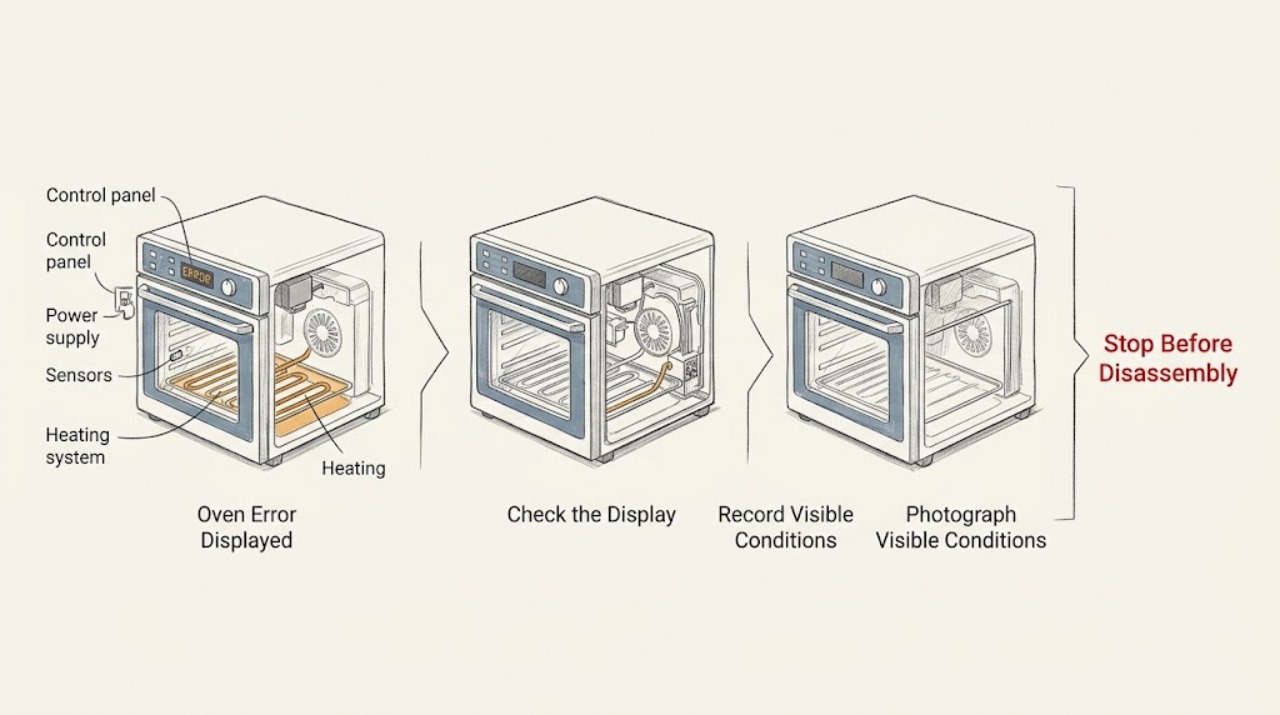
Do not guess what a Whirlpool oven error means from the letters alone. Record the complete code exactly as shown, the model number, whether the oven is gas or electric, and what the oven was doing when it appeared. First rule out an active safety problem such as gas odor, smoke, burning smell, arcing, uncontrolled heating, wet electrical parts, or repeated breaker trips. If none is present, use the exact Whirlpool manual or product-help page for that code. A single model-authorized Cancel or power reset may clear a transient message; if the code returns, stop using the oven and arrange service rather than opening it or replacing a part from the code alone.
Work through in order
Diagnostic checks
Use only checks that match the exact appliance or system and its official guide.
-
Check 1
From the front of the cool oven, write down every character exactly as displayed, including spaces, dashes, letters, numbers, and any text such as lock, power failure, demo, or call service; photograph it if safe.
Expected result: The message is a complete error code, a power or mode message, a lock message, or a text fault that is changing or returning.
Next step: Keep the complete record and do not clear it repeatedly. Use the model manual or Whirlpool code page for the exact message, then follow only the documented low-risk step.
Why this matters
Why: The exact display identifies which Whirlpool guidance may apply. A partial or guessed code cannot safely identify a sensor, control, heating, or ignition fault.
-
Check 2
Read the model and serial information without moving the appliance, and record whether the oven is gas, electric, or dual-fuel, which cavity was affected, and whether the message appeared during preheat, bake, broil, cleaning, startup, or after a power interruption.
Expected result: The model, fuel type, cavity, and stage are known, or one of those details is unavailable.
Next step: If the model is unavailable, keep the article at general safety triage and request service or locate the manual by the rating information. Do not infer a gas or electric repair from a generic code.
Why this matters
Why: The same display family can lead to different checks on different controls, cavities, or fuel systems. Missing identity information makes a code-specific interpretation unreliable.
-
Check 3
Check the display and controls for a lock, demo mode, Sabbath mode, delayed start, or power-failure indication, and compare that state with the exact owner's manual without entering a diagnostic mode.
Expected result: A lock or special mode is shown, the clock is flashing after an outage, a delayed start is set, or none of these states is present.
Next step: If the manual confirms a normal unlock, cancel, or mode exit, perform that one documented action. If the display continues to show a fault or the control does not respond, stop and request service.
Why this matters
Why: Whirlpool identifies control lock, demo mode, Sabbath mode, delayed start, and power-failure states that can make an oven appear unavailable or display a non-fault message.
-
Check 4
From a dry, safe position, look for obvious loss of display power, a tripped household breaker, a damaged or hot outlet or cord, smoke, or water near electrical equipment; do not touch damaged or wet electrical parts.
Expected result: The display is blank or power was recently interrupted, the breaker has tripped, the electrical area is damaged or wet, or the external power view is normal.
Next step: If everything is dry and undamaged, use only the exact manual's single reset procedure. If the breaker trips again or there is damage, heat, smoke, or wetness, do not reset or touch it; call a qualified electrician or appliance technician.
Why this matters
Why: A power event can generate some Whirlpool messages, while wetness, heat, visible damage, or a recurring trip can indicate an electrical hazard rather than a harmless code.
-
Check 5
For a gas or dual-fuel oven, observe only from outside whether there is gas odor, hissing, delayed ignition, an abnormal flame, or a failure to ignite; for an electric oven, note smoke, arcing, overheating, or a heating cycle that does not stop. Do not start another cycle to reproduce the code.
Expected result: Any gas, flame, smoke, arcing, overheating, or uncontrolled-heating symptom is present, or the code appears without any such symptom.
Next step: For any danger sign, leave the appliance off and follow the relevant emergency boundary. For a stable code without danger signs, preserve the code, model, fuel type, and cycle stage for qualified service.
Why this matters
Why: These observations separate an urgent gas or electrical/thermal safety condition from a code that may be a control or transient power issue. A gas and an electric oven require different professional diagnosis.
-
Check 6
If the exact Whirlpool guidance permits a Cancel or power reset and there is no gas odor, smoke, burning smell, arcing, wet electrical equipment, or repeated breaker trip, follow that one documented reset and monitor whether the same message returns.
Expected result: The code clears and does not return, or it returns immediately or after the next normal control action.
Next step: If it returns, stop using the oven and schedule qualified Whirlpool appliance service with the exact code and reset result. Do not perform repeated resets, open panels, or replace a part from the code alone.
Why this matters
Why: A code that clears once may have followed a transient power or control event. A returning code is evidence that the underlying fault remains and should not be treated as solved.
-
Check 7
Prepare the service handoff: model number, full code, fuel type, affected cavity, cycle stage, recent outage or installation, control response, door or lock state, whether the cooktop works, and any odor, smoke, flame, heat, or breaker history.
Expected result: The record describes a reproducible code without danger signs, or it documents a gas, fire, thermal, or electrical warning.
Next step: Request a model-specific appliance service visit for a recurring or unexplained code. Use emergency gas, fire, electrical, or medical help immediately when the corresponding warning is documented.
Why this matters
Why: A precise history lets a technician select the correct model procedure and distinguish control, sensor, heating, gas ignition, and supply issues without unsafe homeowner testing.
Use your observations
Decision map
Find the observation that best matches what you see, then follow the next safe action.
-
PATH 01Next step
What you see
The display shows a power-failure, clock, lock, demo, Sabbath, or delayed-start state rather than an unknown component fault.
Do this next
Use the exact owner's manual for one normal cancel, unlock, time, or mode action. If the message returns or controls remain unavailable, schedule service.
Why this path and its safety boundary
Why it matters: The oven may be waiting for a documented control action or a clock/mode correction.
-
PATH 02Next step
What you see
The complete display matches a Whirlpool code documented as potentially related to power supply or an earlier outage.
Do this next
Follow the exact model's single reset guidance only when the area is safe. If the code persists, leave the appliance unused and contact a qualified electrician or appliance technician.
Why this path and its safety boundary
Why it matters: Whirlpool says some such codes can follow supply disturbance or incorrect wiring, and a persistent code needs qualified electrical evaluation.
-
PATH 03Next step
What you see
A gas smell, hissing, delayed ignition, abnormal flame, smoke, or carbon-monoxide concern accompanies the display.
Do this next
Do not light a flame, operate electrical switches, use a phone inside, move the range, or try another ignition. Leave the area and contact emergency or gas-safety help from a safe location.
Why this path and its safety boundary
Why it matters: This is an immediate gas or combustion safety issue, not a code-clearing exercise.
-
PATH 04Next step
What you see
There is smoke, burning odor, arcing, a hot or wet cord or outlet, repeated breaker operation, or heating that continues unexpectedly.
Do this next
Stop using the oven without touching hazardous parts. Use emergency fire help for smoke or flame and qualified electrical or appliance service for the equipment.
Why this path and its safety boundary
Why it matters: Continued operation can increase fire or shock risk, and the internal cause is outside safe user checks.
-
PATH 05Next step
What you see
The message reappears after the exact manual's allowed Cancel or power-reset step.
Do this next
Keep the oven off and provide the exact code, model, fuel type, cycle stage, and reset result to qualified service. Do not swap parts based only on the display.
Why this path and its safety boundary
Why it matters: The reset did not resolve the underlying control, sensor, power, heating, or ignition condition.
Helpful context
Understand the symptom
Why the exact code and model matter
Whirlpool ovens can show a letter-and-number error, a power-failure message, a lock or mode message, or a text fault. Similar-looking codes can have different meanings across controls and models. The useful record is the complete display, model number, fuel type, stage of the cycle, and whether the oven still heats, responds, or stops. Do not apply a code explanation from another model.
What can be checked safely
Safe checks are external: read the display, identify the mode, observe the door and controls, and look for obvious power loss without touching damaged equipment. Whirlpool's general error guidance includes examples such as F9 or F9 E0, PF, LOC, and Sabbath-mode messages, but the exact manual controls the interpretation. A gas oven also has ignition and gas-supply considerations that do not apply to an electric oven.
When an error is a stop signal
A code accompanied by gas odor, hissing, abnormal flame, smoke, burning odor, arcing, overheating, or repeated electrical trips is a safety event rather than a reset opportunity. Keep the oven off and use qualified appliance, gas, electrical, fire, or medical help as appropriate.
Safety boundary
Stop conditions
- Stop immediately for gas odor, hissing, delayed ignition, abnormal flame, smoke, carbon-monoxide concern, or fire. Do not operate switches, light a flame, use a phone inside, move the range, or try another start; leave and contact emergency or gas-safety help from a safe location.
- Stop for burning odor, arcing, a hot or wet cord or outlet, visible electrical damage, uncontrolled heating, or a breaker that trips again. Do not repeatedly reset the breaker or touch electrical parts.
- Do not open panels, enter a diagnostic mode, probe wiring, remove the gas connector, adjust a regulator, manually ignite the oven, or replace a sensor, igniter, valve, control, or other part solely from an error code.
Only after diagnosis
Potential parts
- model-specific control or sensor
Consider a control or sensor only if a qualified technician confirms the exact code and model procedure identifies that component after power, mode, and wiring causes are ruled out.
Confirm the complete model number and manufacturer fit information before ordering; do not select a part from a similar-looking code. - gas oven igniter or safety valve
Consider these categories only for a gas or dual-fuel model when qualified diagnosis links the code and ignition symptom to the specific component.
Gas-system work requires the exact model procedure and qualified handling; appearance or a generic error code does not establish compatibility.
When checks do not resolve it
Need a professional?
Request qualified Whirlpool appliance service when the complete code returns after its documented single reset, the model-specific meaning is unclear, the oven remains unavailable, or a sensor, control, heating, ignition, or gas-supply fault is suspected. Use a qualified electrician for persistent power-related errors or electrical damage, and emergency gas, fire, or medical help for the relevant danger signs.
Common questions
FAQ
What should I do first when my Whirlpool oven displays an error?
Record the complete code, model, fuel type, affected cavity, and cycle stage. Rule out gas, smoke, burning, arcing, overheating, wet electrical parts, and repeated breaker trips before following the exact model guidance.
Can I reset a Whirlpool oven error code?
Only if the exact Whirlpool guidance permits a Cancel or power reset and there is no safety warning. If the code returns, stop using the oven and arrange service rather than repeating resets or replacing parts from the code alone.
Does the same Whirlpool error code mean the same thing on every oven?
No. Record the exact model and display because code formats, controls, fuel systems, and procedures vary. Use the matching owner's manual or Whirlpool product-help page.
What if the error appears with a gas smell or smoke?
Treat it as a safety event, not a reset. Do not light a flame, operate electrical switches, move the range, or try another start. Leave the area and contact emergency or gas-safety help from a safe location.
Read the exact guide
Official sources
- Nothing Is Working - No Power - Wall OvenWhirlpool Product Help · Whirlpool wall-oven product-help electrical guidance; exact range wiring varies by model.
- Why does my oven smell like gas?Whirlpool · Whirlpool residential oven odor guidance; gas and electric model behavior differs.
- Not Working After Power Outage - ElectricWhirlpool Product Help · Whirlpool electric oven product-help guidance; controls and fuel configurations vary by model.
- What to do if your gas oven is not heatingWhirlpool · Whirlpool residential gas oven guidance; exact controls and service boundaries vary by model.
- Feature Not Available or Fault Detected - Wall OvenWhirlpool Product Help · Whirlpool wall-oven models covered by the product-help article; exact displayed directions vary by model.
- Error Codes for Cooking AppliancesWhirlpool Product Help · Whirlpool cooking appliances covered by the product-help page; display meanings and actions vary by model.
- Press Cancel to Reset - RangeWhirlpool Product Help · Whirlpool range models covered by the product-help article; use the exact owner's manual for the control.
- Certain Older Gas Connectors May Be DangerousU.S. Consumer Product Safety Commission · General U.S. consumer gas-appliance safety; local emergency procedures and contacts vary.
- TROUBLESHOOTINGWhirlpool · The opened Whirlpool owner's manual is model-specific; use it as an example of why the exact manual controls the interpretation.
Community feedback
Share a repair observation
Share a plain-text repair observation. Accepted observations are published automatically; this page may take a moment to update.