
On this page
Start here
Quick answer
Identify when the sound occurs before treating it as a failed part. Whirlpool describes a brief valve or hose knock during fill, motor or gear sounds during wash, a humming pump during drain, and some clicking as normal operation on certain models. Thumping, banging, walking, or grinding that increases in spin can instead point to a loose external object, an uneven load, an unlevel machine, a drain pan contact, or shipping hardware that was not removed. Stop the cycle for metal-on-metal rubbing, violent movement, water, burning odor, smoke, sparks, a hot cord or outlet, or a tripped circuit. After the drum stops, perform only cool, external checks and the model manual's load, filter, or installation steps; bearing, suspension, pump, motor, and electrical work belongs to qualified service.
Work through in order
Diagnostic checks
Use only checks that match the exact appliance or system and its official guide.
-
Check 1
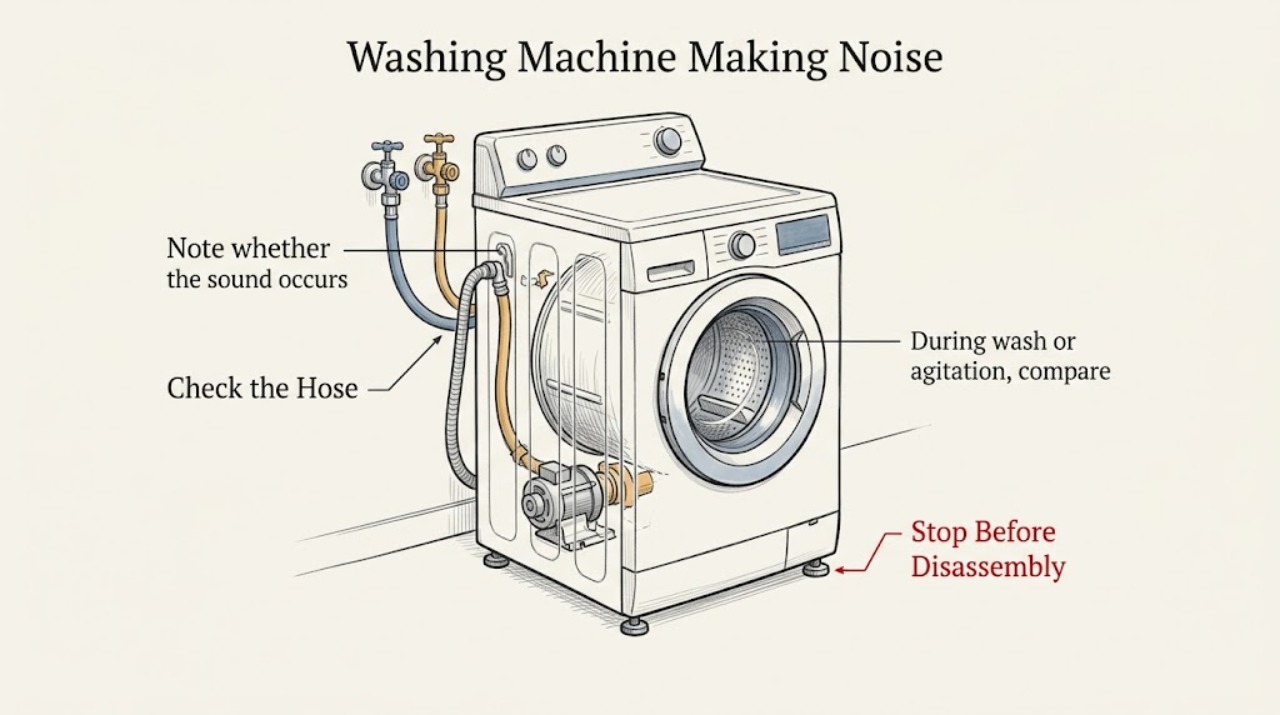
Note whether the sound occurs at fill, wash or agitation, drain, spin, or after the cycle, and listen from a safe position for a hum, click, splash, knock, thump, rattle, scrape, or grind.
Expected result: The sound is brief and tied to one normal stage, or it is persistent, getting louder, or present with abnormal motion, water, or heat.
Next step: For a brief normal-stage sound, continue with external checks and the model manual. Stop immediately for metal contact, violent movement, water, burning odor, smoke, sparks, hot wiring, or a tripped circuit.
Why this matters
Why: Stage-specific sounds can be normal valve, motor, pump, or lock operation. A persistent sound or a sound paired with a hazard needs the machine out of service.
-
Check 2
During fill, inspect from outside for a hose or nearby object tapping the cabinet and listen for a short valve sound; keep hands away from moving or wet equipment.
Expected result: The drain or inlet hose moves against the cabinet, a broom or rack touches the washer, or the sound comes from inside and continues after the external contact is absent.
Next step: After the machine stops, move only a loose nearby object and secure a visibly slack hose if the model instructions allow it. Do not pull plumbing connections or open panels; use service for an internal valve or mounting fault.
Why this matters
Why: Whirlpool notes that hose movement and objects leaning on the cabinet can create a fill or rattle noise. A sound with no external contact needs a different branch.
-
Check 3
During wash or agitation, compare the sound with drum movement and note whether it is a smooth alternating motor or gear sound, a brief transition knock, or a harsh scrape or repeated impact.
Expected result: The sound follows direction changes or the normal wash motor, or it is harsh, metallic, rhythmic with every rotation, or accompanied by a burning odor.
Next step: Stop for harsh metal contact or heat and arrange service. If the sound is a normal transition with stable operation, continue to the load and installation checks without opening the cabinet.
Why this matters
Why: Whirlpool describes some motor, gear, and drive-transition sounds as normal. A scrape, repeated impact, or heat symptom may indicate an object, drive, bearing, or electrical fault.
-
Check 4
During drain, listen for a steady pump hum and observe whether water leaves at the normal rate; do not reach toward the pump, drain opening, or a moving drum.
Expected result: The pump hums and water moves, the pump hums with little or no flow, the pump clicks or grinds, or water appears on the floor.
Next step: Stop for grinding, leakage, smoke, sparks, or a hot connection. If the exact manual identifies an owner-accessible filter, isolate power and control water before following it; otherwise keep the washer off and request service.
Why this matters
Why: A pump hum can be normal during drain, while no flow, grinding, or water outside the machine can indicate a restricted hose, filter, pump, or leak.
-
Check 5
With the washer stopped and the load accessible, redistribute clothing that is tightly packed, a single bulky item, or gathered on one side; do not place hands in a moving basket.
Expected result: The noise and shaking occur mainly in spin and improve with an evenly distributed load, or they continue with a normal mixed load.
Next step: Use the model's loading guidance and avoid a single bulky item. Stop the machine if it walks, strikes the cabinet, or cannot regain balance; arrange service if the sound persists.
Why this matters
Why: Whirlpool links spin thumping, vibration, and walking to an unbalanced or overloaded load. Persistence with a balanced load shifts attention to installation or mechanical service.
-
Check 6
From a dry position, gently test whether the cabinet rocks and inspect visible feet, a drain pan, the wall, cabinet, and surrounding items for contact; do not move a full washer.
Expected result: The machine rocks, a foot is not firmly seated, the floor flexes, a drain pan or cabinet is rubbing, or the washer is stable with no external contact.
Next step: Follow the exact installation instructions to level an empty machine if safe. Do not lift, tilt, or disassemble it; obtain service for persistent rubbing, bearing-like noise, or a damaged pan or cabinet.
Why this matters
Why: An unlevel machine or contact with a pan or nearby surface can amplify vibration and rubbing. A stable installation makes an internal suspension, bearing, drum, or drive issue more likely.
-
Check 7
If the noise began after installation or relocation, verify from the manual or installation record whether shipping bolts and packing were removed; do not reach behind a connected washer to remove hardware.
Expected result: The installation record is missing or shipping hardware may remain, or the machine was installed correctly and the noise began later.
Next step: Have the exact installation instructions checked and use qualified help if access or removal requires moving the appliance. Do not operate a machine suspected of retaining shipping hardware until assessed.
Why this matters
Why: Whirlpool says transport hardware left in a front-load washer can cause excess noise, vibration, and damage. The timing helps separate installation from a later fault.
-
Check 8
Record the model, loading style, sound description and location, cycle stage, load, water behavior, movement, installation history, and any odor, smoke, spark, leak, or trip.
Expected result: The sound repeats in the same stage with a balanced load and stable installation, or the symptom is paired with a safety warning.
Next step: Keep the washer out of service for a safety warning or unresolved severe noise and provide the record to qualified Whirlpool appliance service.
Why this matters
Why: A detailed record lets service distinguish a normal operating sound from a pump, drive, suspension, bearing, electrical, or installation fault without unsafe testing.
Use your observations
Decision map
Find the observation that best matches what you see, then follow the next safe action.
-
PATH 01Next step
What you see
Brief hum, click, hose knock, or motor sound occurs only in its expected cycle stage
Do this next
Confirm the sound is not getting louder and that the washer remains level, dry, and stable. Use the model manual if the sound changes or persists outside that stage.
-
PATH 02Next step
What you see
Knock, thump, walking, or heavy vibration is concentrated in spin
Do this next
Stop if the cabinet is being struck, then redistribute the load and check stable floor contact and leveling from outside. Persistent movement needs service.
-
PATH 03Next step
What you see
Noise began after installation or relocation
Do this next
Check the model installation record for shipping hardware, level, feet, and external contact. Do not move or tilt a full washer; use qualified help when access is needed.
-
PATH 04Next step
What you see
Humming, clicking, or grinding occurs during drain
Do this next
Watch for water movement and leaks. Follow a pump-filter procedure only when the exact manual allows owner access; no flow, grinding, or leakage needs appliance service.
-
PATH 05Next step
What you see
Harsh scrape, repeated metal impact, bearing-like rumble, or noise continues with a balanced stable load
Do this next
Stop use and arrange qualified service for internal drum, suspension, drive, pump, or bearing assessment. Do not open the cabinet or test energized parts.
-
PATH 06Next step
What you see
Water, burning odor, smoke, sparks, hot cord or outlet, violent movement, or a tripped circuit accompanies the noise
Do this next
Stop immediately, keep people away, and isolate power only from a dry safe position if that does not approach the hazard. Do not restart the washer; obtain qualified appliance or electrical service.
Helpful context
Understand the symptom
The stage and sound matter together
A low hum while water drains has a different meaning from a metallic scrape that follows drum speed. Whirlpool describes motor sounds during agitation and spin, a pump hum during drain, hose movement during fill, and a lock click at the start of some cycles. Use the cycle stage, location, rhythm, and whether water or movement is normal to decide whether a safe observation is enough or service is needed.
Installation and load checks come before parts
Whirlpool's support guidance links walking and heavy vibration to shipping hardware, feet that do not contact the floor, an unlevel floor, an overloaded load, or a single bulky item. A drain pan, wall, cabinet, loose hose, or nearby object can add a false mechanical sound. These checks can be made from outside after the machine stops; do not open the cabinet to investigate a sound.
Safety boundary
Stop conditions
- Stop for metal-on-metal scraping, repeated hard impact, violent shaking or walking, a leak, water near electrical equipment, burning odor, smoke, sparks, a hot cord or outlet, or a tripped circuit.
- Do not reach into a moving drum, hold the basket, tilt or move a full washer, remove the cabinet, or test live wiring to identify a sound.
- Do not remove shipping hardware, open a pump filter, or use an emergency drain method without the exact model instructions and cool, controlled water.
- Do not continue operating a washer when the sound is getting worse, the cabinet is being struck, or the cause remains uncertain after external checks.
Only after diagnosis
Potential parts
- drain pump or pump filter
Consider this category only when the exact manual and qualified diagnosis link no-flow or abnormal pump sound to a restriction or pump fault after visible hose and outlet checks.
Confirm the complete Whirlpool model and approved fit information; do not open a water-filled filter or pump as a sound test. - suspension or drum support component
Consider only when qualified service finds persistent spin impact or movement after load balance, leveling, floor, and installation checks are sound.
Confirm exact model fit and service procedure; suspension and drum work should not be attempted by an owner. - drive or bearing component
Consider only after qualified service confirms a persistent rotation-linked scrape, rumble, or drive fault that is not caused by load, contact, pump, or installation.
Confirm model-specific fit and approved service; do not open the cabinet or test energized parts.
When checks do not resolve it
Need a professional?
Arrange qualified Whirlpool appliance service when noise persists with a balanced load and stable installation, the pump has no flow or grinds, the drum or suspension sounds abnormal, shipping hardware may remain, the washer walks, or any leak, electrical, heat, smoke, spark, or trip stop condition occurs. Use qualified electrical service for a cord, outlet, or circuit concern.
Common questions
FAQ
Is a humming sound from a Whirlpool washer normal?
It can be. Whirlpool describes motor humming during wash or spin and pump humming during drain as normal on some models. The sound is not normal when it is harsh, worsening, paired with no water movement, metal contact, a leak, heat, or violent motion.
Why does my washer thump only during spin?
Whirlpool links spin thumping and movement to an uneven or overloaded load, a single bulky item, an unlevel machine, or feet that do not contact the floor. Stop if the cabinet is struck or the washer walks, then check the load and stable installation when the drum is stopped.
Could shipping bolts cause washing-machine noise?
Yes, Whirlpool says shipping hardware left in a front-load washer can cause excess noise, vibration, and damage. Check the exact installation instructions or record; do not reach behind or move a full machine to remove hardware.
When does washer noise require service?
Request service for persistent grinding, rubbing, bearing-like rumble, abnormal pump noise, walking that returns after load and leveling checks, or any water, burning odor, smoke, sparks, hot electrical connection, or repeated circuit trip.
Read the exact guide
Official sources
- Electrical appliancesGovernment of Western Australia · Electrical appliance safety near water, damaged cords and plugs, power isolation, and licensed electrical service
- Grinding or Rubbing Noise - Washer - Product HelpWhirlpool Corporation · Whirlpool washer grinding, rubbing, load, leveling, drain-pan, and service guidance
- Knocking or Thumping - Noise - Product HelpWhirlpool Corporation · Whirlpool top-load washer fill, wash, spin, hose, load-balance, leveling, and thumping-noise guidance
- Front Load Washer Installation Checklist - Product HelpWhirlpool Corporation · Whirlpool washer installation, leveling, shipping hardware, hose, drain, and power checks
- Top Load HE Washer is Unbalanced or Overloaded - Product HelpWhirlpool Corporation · Whirlpool top-load washer overload, unbalanced-load, spin noise, and correction behavior
- Lid Not Latching - Washer - Product HelpWhirlpool Corporation · Whirlpool top-load lid latch and start-of-cycle lock behavior
- Vibration, Walking or Off Balance - Front Load Washer - Product HelpWhirlpool Corporation · Whirlpool front-load washer shipping hardware, leveling, load balance, and walking guidance
- Humming or Whirling - Noise - Product HelpWhirlpool Corporation · Whirlpool top-load washer motor and drain-pump sound guidance
Community feedback
Share a repair observation
Share a plain-text repair observation. Accepted observations are published automatically; this page may take a moment to update.