
On this page
Start here
Quick answer
A Whirlpool washer that seems not to heat may be receiving cooler water by design, selecting a cycle with a lower temperature, or waiting for a heated cycle or Steam option on a model that has that feature. Whirlpool says the washer senses temperature in the tub, usually regulates incoming hot and cold water, and can show lower hot or warm temperatures when the water heater is far away or has been used for many loads. First verify the exact cycle and temperature setting, then confirm the hot and cold hoses are connected to the matching supplies and both household valves are open. Do not assume every Whirlpool washer has an internal heater: only some models heat water for cycles such as Sanitize or Steam. If a model-specific temperature or error check still fails, or there is scalding water, leaking water near electrical parts, smoke, a burning smell, arcing, or a tripped breaker, stop and arrange qualified service.
Before you begin
Safety first
- This article supports safe setting review, household hot-water observation, visible hose and valve checks, model-authorized accessible checks, and one documented reset only. It does not authorize handling scalding water, opening hot or pressurized lines, live electrical testing, cabinet removal, or internal heater or sensor replacement.
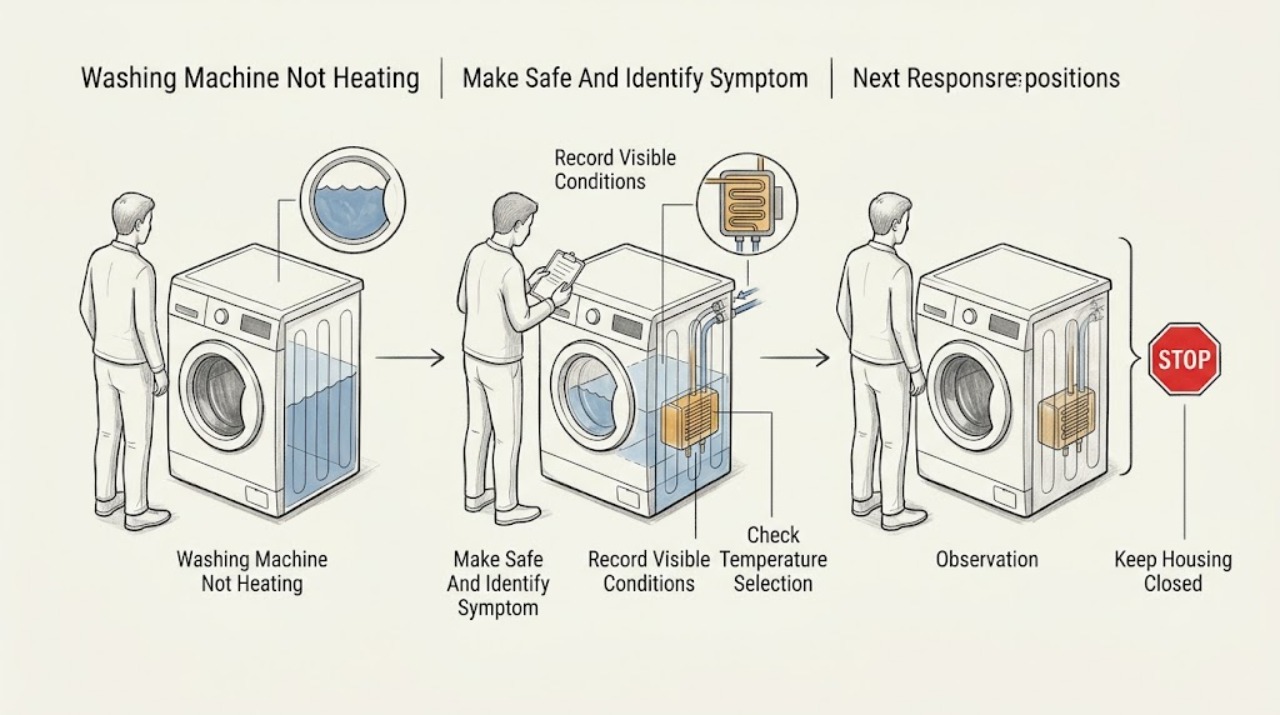
Work through in order
Diagnostic checks
Use only checks that match the exact appliance or system and its official guide.
-
Check 1
Pause the washer using its normal control and wait until the drum stops. From a dry, safe position, note whether the water is merely cooler than expected or actually scalding, whether a temperature or error code is shown, and whether there is leaking water near electrical parts, smoke, burning odor, arcing, a hot or damaged cord or outlet, or a breaker trip.
Expected result: The washer is stable with a temperature complaint only, or a water, burn, fire, or electrical warning is present.
Next step: For a hazard, stop and arrange qualified appliance or electrical service. Otherwise record the model, cycle, temperature selection, and stage before changing settings.
Stop if: Do not touch hot water, wet electrical equipment, exposed wiring, or a damaged cord; do not restart after smoke, arcing, burning odor, or a repeat trip.
Why this matters
Why: A temperature-only complaint allows low-risk setting and supply checks. Scalding water, smoke, burning odor, arcing, a leak near electrical parts, or a trip is not a heating adjustment problem.
-
Check 2
Record the Whirlpool model, top-load or front-load configuration, selected cycle, temperature option, Steam or Sanitize option if present, load type, estimated time, and any code or flashing indicator; use the exact owner's manual to determine whether that model has an internal heater.
Expected result: The model documents a heated or Steam cycle, the selected cycle is not documented as heated, or the heating capability and code cannot be confirmed.
Next step: Use the exact model manual and temperature guidance for the selected cycle. If the feature or code is unclear, stop guessing and arrange model-specific service or support.
Stop if: Do not assume a heater exists, transfer an error-code meaning across models, or select a high-temperature cycle solely to force a test.
Why this matters
Why: Whirlpool's guidance limits internal-heater behavior to applicable heated cycles, Sanitize, or Steam options. A cooler ordinary wash may be normal for its programmed temperature and does not prove a heater failure.
-
Check 3
Compare the selected wash or rinse temperature with the fabric-care label and the exact Whirlpool manual. Confirm that a cold, tap-cold, cool, warm, hot, low-temperature, delicate, or energy-saving choice is intentional and that the washer is not still in an initial sensing or fill phase.
Expected result: A lower-temperature or gentle cycle is active, a heated or Sanitize/Steam cycle is active, or the selected option does not explain the result.
Next step: Use an appropriate warm or hot option only when safe for the fabric and documented by the model. If a documented heated cycle remains cold or stalls, continue to supply and service checks.
Stop if: Do not use a hotter cycle on incompatible fabrics, handle hot water, or run a long Sanitize/Steam cycle to reproduce a suspected fault.
Why this matters
Why: Whirlpool states that wash temperatures vary by cycle and that the washer can regulate incoming hot and cold water. A low-temperature cycle can be working correctly even when the water feels cooler than a previous machine.
-
Check 4
If the selected cycle calls for warm or hot water and there is no hazard, check the nearest sink from a safe position to see whether household hot water arrives normally before starting another load; consider whether several loads were run in quick succession or the water heater is far from the washer.
Expected result: The nearby sink also has delayed or insufficient hot water, hot water is normal at the sink, or the water is dangerously hot or the area is unsafe.
Next step: Allow household hot water to recover and follow the model's normal procedure. If the sink is normal but the washer remains cold on a documented heated setting, continue to hose and error checks or arrange service.
Stop if: Do not handle scalding water, alter water-heater controls, or continue if there is leaking water, steam injury risk, or electrical exposure.
Why this matters
Why: Whirlpool identifies distance from the water heater and repeated loads as reasons for cooler initial or later washer temperatures. Normal hot water at the sink makes a hose, inlet, sensing, or model-specific appliance path more plausible but does not prove a failed part.
-
Check 5
With the washer stopped and the water area dry, visually confirm that the hot inlet hose is connected to the hot supply and the cold inlet hose to the cold supply, both household valves are open, and neither visible hose is kinked; do not disconnect a hose unless the exact manual permits it and the water is safely isolated.
Expected result: The hot and cold hoses are reversed, one supply is closed, a hose is kinked, an inlet leaks, or the visible connections are correct and dry.
Next step: If a connection is visibly wrong and the manual provides a safe correction, close the water supplies before any hose work, correct it without cross-threading, reopen slowly, and check for leaks. Otherwise arrange service.
Stop if: Do not loosen a pressurized or hot hose, remove an inlet screen by force, work in standing water, or continue after a leak or damaged fitting.
Why this matters
Why: Whirlpool states that reversed or missing hot/cold connections can produce incorrect temperatures or prevent proper operation. Correct visible routing can be checked, but it does not rule out an internal inlet valve, screen, sensor, or heater issue.
-
Check 6
Record any complete temperature, fill, or control code and the stage at which it appears, then compare it only with the exact Whirlpool model documentation; do not use a code list from another washer.
Expected result: A code explicitly concerns water temperature or supply, a fill or inlet code appears, the code returns after the documented user check, or no code is displayed.
Next step: Follow only the low-risk action documented for the exact model, record the result, and arrange qualified service if the code returns or the washer remains outside its documented behavior.
Stop if: Do not guess an error meaning, probe sensors, test live wiring, or order a heater or valve from the code alone.
Why this matters
Why: A code can direct a model-specific hose, supply, sensing, or reset path, but it does not by itself identify a heater or valve part. A returning code needs service rather than repeated resets.
-
Check 7
Only if the exact model documents an internal heater for the selected cycle and all safety checks are clear, observe one short, normal cycle segment from outside the machine; note whether the estimated time extends, a heater/Steam indicator appears, the cycle advances, or the washer stops without progress.
Expected result: The cycle progresses with a longer estimate, the heater or Steam option is not active, the cycle stalls or repeats, or the washer displays a code or abnormal temperature.
Next step: Allow only documented normal operation when the cycle is safe. If the cycle stalls or behaves abnormally, stop, record the stage and code, and arrange qualified service.
Stop if: Do not run repeated heated cycles, touch hot water or elements, open the cabinet, or continue after smoke, burning odor, leak, arcing, or excessive heat.
Why this matters
Why: Whirlpool explains that heated or Steam cycles can take longer because heating time depends on incoming water temperature and load. A longer estimate alone is not a heating failure; a stall, recurring code, or abnormal temperature needs service diagnosis.
-
Check 8
Only when the washer is cool enough to handle, dry, free of leaks or electrical damage, and the exact Whirlpool guidance permits it, perform one documented control reset by disconnecting power for the model-specified period; do not repeatedly cycle power.
Expected result: The temperature code or stalled state clears and the washer behaves normally, the condition returns, or the washer will not power or fill normally.
Next step: Record the before-and-after code and cycle state. If the issue returns or the washer remains abnormal, leave it off and provide the model and evidence to qualified Whirlpool service.
Stop if: Do not reset a wet or damaged washer, hold a breaker on, repeat resets, or re-energize after smoke, arcing, a hot outlet, or a trip.
Why this matters
Why: A reset can clear a transient control state but does not establish that an inlet valve, temperature sensor, internal heater, wiring, or control is healthy. A recurring condition requires service.
-
Check 9
Prepare a service note with the Whirlpool model and configuration, cycle and temperature, whether the cycle was heated or Steam-capable, household hot-water result, hose routing, complete code, stage, estimated-time behavior, one reset result, and any leak, hot-water, smoke, odor, or electrical symptom.
Expected result: The model and temperature behavior are documented, or the model, heating capability, code, or supply condition remains unknown.
Next step: Use Whirlpool's model-specific manual and service route or a qualified appliance technician. State unknown details rather than naming a failed heater or valve.
Stop if: Do not order or replace a heater, inlet valve, temperature sensor, control board, hose, or fuse from cool laundry or a generic code alone.
Why this matters
Why: A precise record prevents a technician from assuming that every Whirlpool washer has an internal heater and helps separate household supply, programmed temperature, inlet, sensing, and heater paths.
Use your observations
Decision map
Find the observation that best matches what you see, then follow the next safe action.
-
PATH 01Safety boundary
What you see
Water is scalding, leaking near electrical parts, there is smoke, burning odor, arcing, a hot or damaged cord or outlet, or a repeated breaker trip.
Do this next
Stop the washer, avoid wet electrical equipment, and arrange qualified appliance or electrical service. Isolate water or power only when it can be done safely.
Why this path and its safety boundary
Why it matters: The immediate issue is burn, water, fire, or electrical safety, not a temperature-setting problem.
Safety stop: Do not touch hot water, stand in water near equipment, open panels, hold a breaker on, or restart to reproduce the symptom.
-
PATH 02Safety boundary
What you see
The model and selected cycle document a lower-temperature or energy-saving wash, and there is no error or safety symptom.
Do this next
Use the warmest cycle that is safe for the fabric and documented by the model, then monitor normal operation without opening the machine.
Why this path and its safety boundary
Why it matters: Cooler water can be normal for the programmed cycle; temperature alone does not prove that the washer has a failed heater.
Safety stop: Stop if a documented heated cycle remains cold, the cycle stalls, a code appears, or a leak, hot-water, smoke, odor, or electrical symptom occurs.
-
PATH 03Safety boundary
What you see
The nearby sink also has delayed or insufficient hot water, the water heater is far from the washer, or several loads were run in quick succession.
Do this next
Allow the household hot-water supply to recover and follow Whirlpool's normal cycle guidance. If the washer remains cold when household hot water is available, continue with model-specific checks.
Why this path and its safety boundary
Why it matters: The household supply can explain cooler initial or later washer water without an appliance heater fault.
Safety stop: Do not change water-heater safety controls or handle scalding water as an appliance test.
-
PATH 04Safety boundary
What you see
The hot and cold hoses are reversed, a supply valve is closed, a hose is kinked, or a visible connection leaks.
Do this next
Follow the exact manual to isolate water and correct only an obvious visible routing issue; reopen slowly and check for leaks. Arrange service for damaged fittings, inlet screens, valves, or unknown connections.
Why this path and its safety boundary
Why it matters: Incorrect or restricted incoming water can produce a wrong temperature or prevent proper washer operation, but it does not identify an internal heater.
Safety stop: Do not loosen hot or pressurized hoses, force screens, or work in standing water.
-
PATH 05Safety boundary
What you see
The exact model documents a heater for the selected Sanitize, heated, or Steam cycle, but the cycle stalls, repeats, reports a temperature fault, or never reaches its documented behavior.
Do this next
Stop repeated heated-cycle tests, record the code and stage, and arrange qualified Whirlpool service using the exact model documentation.
Why this path and its safety boundary
Why it matters: The issue may involve incoming water, sensing, an inlet valve, the model-specific heater, controls, or another safety path; the symptom does not identify a part.
Safety stop: Do not open the cabinet, test live wiring, touch hot elements, or replace an internal heater or sensor based on the symptom alone.
-
PATH 06Safety boundary
What you see
A temperature or fill-related code returns after one safe, documented reset or the washer remains abnormal.
Do this next
Leave the washer off and provide the model, code, cycle, hose arrangement, water temperature behavior, and reset result to qualified service.
Why this path and its safety boundary
Why it matters: The problem is not established as a transient control state and needs model-specific diagnosis.
Safety stop: Do not repeat resets, guess the code meaning, or order a heater, sensor, or valve from the code alone.
Helpful context
Understand the symptom
Not every Whirlpool washer heats water internally
The words “not heating” can mean that a warm or hot wash feels cooler than expected, or that a model with a documented heated or Steam cycle never reaches its target. Whirlpool's guidance says temperature is controlled from incoming water and sensed in the tub on many washers. Its long-cycle guidance specifically limits the internal-heater statement to selected heated, Sanitize, or Steam cycles. Use the exact model manual before calling for a heater or assuming one exists.
Check the home water supply before the appliance
A distant water heater, several consecutive loads, or reversed hot and cold hoses can make the washer appear not to heat. Whirlpool also notes that even a cold selection may be adjusted by the washer to reach its programmed temperature. Verify the cycle and visible supply arrangement from a safe, dry position; do not disconnect a pressurized hose or disturb an energized appliance as a temperature test.
Temperature and safety faults need a model-specific boundary
A temperature code or a heated cycle that never progresses may involve sensing, inlet valves, wiring, or a model-specific heater. Do not infer a failed heater from cool laundry alone and do not open the cabinet. Hot water, a leak, or electrical damage changes the task to safe isolation and qualified service, especially when water could contact the washer's electrical parts.
Safety boundary
Stop conditions
- Stop immediately for scalding or uncontrolled hot water, leaking water near electrical parts, smoke, burning odor, electrical arcing, a hot or damaged cord or outlet, or a repeated breaker trip.
- Do not assume every Whirlpool washer has an internal heater; do not select a heated or Steam cycle solely to force a test.
- Do not disconnect hot or pressurized hoses, open a wet electrical area, test live wiring, touch hot elements, or remove cabinet panels.
- Do not alter water-heater safety controls, repeatedly reset the washer, guess a temperature code, or replace a heater, sensor, valve, or control from the symptom alone.
- Leave the washer off and arrange qualified service when a documented heated cycle stalls, a temperature or fill code returns, hoses and household hot water are correct but the washer remains cold, or the heating capability cannot be confirmed safely.
When checks do not resolve it
Need a professional?
Arrange qualified Whirlpool appliance service when an exact-model heated, Sanitize, or Steam cycle remains cold or stalls after household hot water, cycle selection, and visible hose checks are correct; when a temperature or fill code returns after one safe documented reset; when the washer leaks, trips, smokes, or has electrical damage; or when the model's heating capability cannot be confirmed. Do not test live wiring or assume a heater exists.
Safety scope: This article supports safe setting review, household hot-water observation, visible hose and valve checks, model-authorized accessible checks, and one documented reset only. It does not authorize handling scalding water, opening hot or pressurized lines, live electrical testing, cabinet removal, or internal heater or sensor replacement.
Common questions
FAQ
Does every Whirlpool washer have an internal water heater?
No. Whirlpool's heated-cycle guidance applies to selected heated, Sanitize, or Steam cycles and applicable models. Many temperature complaints concern incoming hot/cold water and cycle programming. Check the exact model manual before assuming a heater exists.
Why is my Whirlpool washer's hot cycle only warm?
Whirlpool identifies reversed hoses, a distant water heater, using many loads quickly, and cycle-specific temperature control as possible explanations. Check the cycle and visible hose routing, and confirm household hot water is available without handling scalding water.
Why does my Whirlpool washer add time on a heated or Steam cycle?
On applicable front-load models, Whirlpool says heating time depends on incoming water temperature, load size, and load type, so the estimated time can extend. Excess suds and imbalance can also add time. A stall or recurring code is different and needs service.
Can reversed washer hoses make the water temperature wrong?
Yes. Whirlpool says the hot and cold hoses should connect to the matching supplies. Check routing visually and isolate water before any hose work that the exact manual permits. Do not loosen hot or pressurized connections.
When should I call for a Whirlpool washer that is not heating?
Arrange service when a documented heated or Steam cycle remains cold after household hot water and visible hose checks, a temperature or fill code returns, the model's heating capability is uncertain, or there is a leak near electrical parts, smoke, burning odor, arcing, scalding water, or a repeated trip.
Read the exact guide
Official sources
- Getting Cold Water when Warm or Hot was Selected - Product Help | WhirlpoolWhirlpool · Official Whirlpool Product Help guide tagged for top-load and top-load HE washers; model-specific behavior varies.
- Water Not Hot or Not Warm Enough - Product Help | WhirlpoolWhirlpool · Official Whirlpool Product Help page for top-load washers; exact model and cycle instructions control other configurations.
- Not Starting - Washer - Product Help | WhirlpoolWhirlpool · Official Whirlpool Product Help page for top-load washers; use the exact owner's manual for other models.
- Selecting the Correct Cycle for the Clothes being Washed - Product Help | WhirlpoolWhirlpool · Official Whirlpool Product Help guide with front-load and top-load tags; exact model and garment-care label control.
- Checking the Fill Hoses if the Washer is not Filling - Product Help | WhirlpoolWhirlpool · Official Whirlpool Product Help guide for front-load and top-load washer supply checks; exact model instructions control hose work.
- Long Cycles on a Front Load WasherWhirlpool Corporation · Official Whirlpool front-load washer guidance; the internal-heater statement applies only to documented heated or Steam-capable models and cycles.
Community feedback
Share a repair observation
Share a plain-text repair observation. Accepted observations are published automatically; this page may take a moment to update.