
On this page
Start here
Quick answer
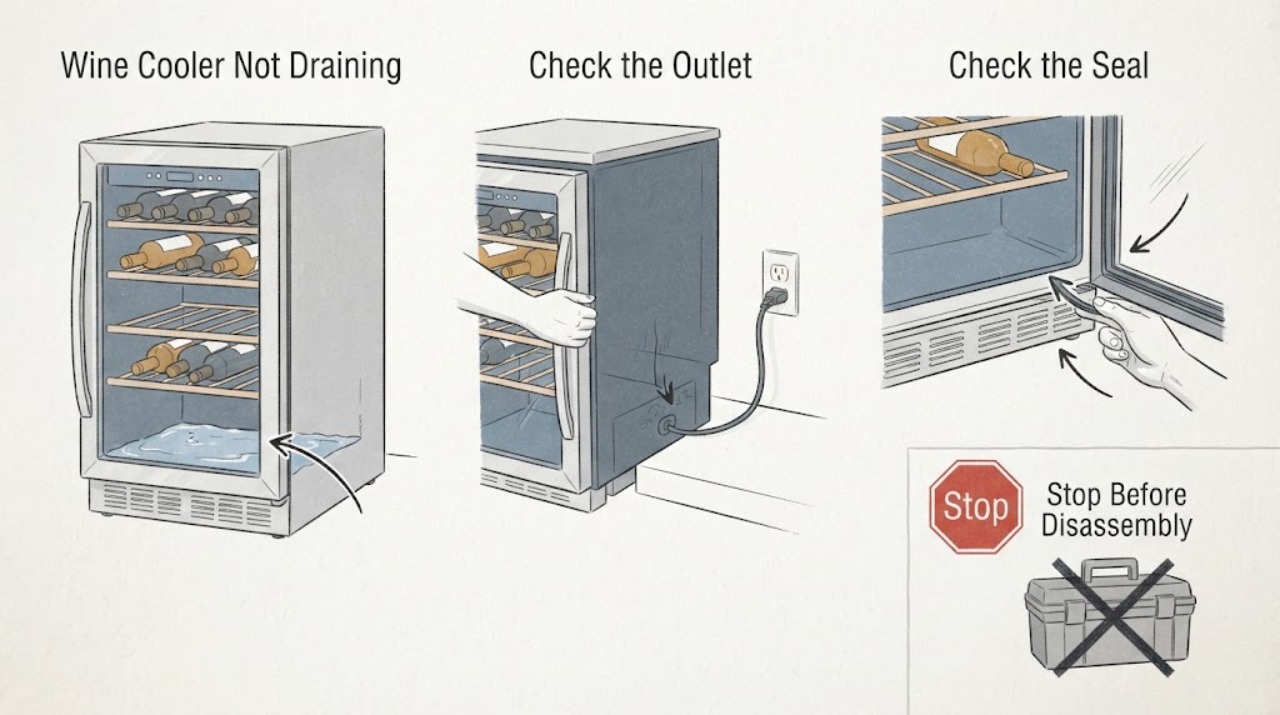
A wine cooler that is not draining usually has water from normal defrost that cannot reach or evaporate from the drain pan because the door stayed open, frost is excessive, the unit is not level, or the drain path is obstructed. Check the door seal and closure, keep bottles from touching the back wall, reduce repeated openings, and wipe accessible water. Do not chip ice or remove panels; persistent pooling or water near electrics needs service.
Work through in order
Diagnostic checks
Use only checks that match the exact appliance or system and its official guide.
-
Check 1
Unplug the wine cooler if water is near the plug or electrical parts; wipe standing water from the floor and inspect whether the cabinet, cord, or outlet is wet or damaged.
Expected result: Water reaches electrics, the floor, or a damaged cord/outlet.
Next step: Keep it disconnected and arrange appliance/electrical service; protect wine using safe temporary storage.
Stop if: Do not energize a wet or damaged appliance.
Why this matters
Why: The immediate risk is electrical and property damage, not just a blocked drain.
-
Check 2
Check that the door closes fully, the gasket contacts the cabinet, and bottles or racks are not holding it open; inspect the seal for gaps or damage.
Expected result: The door was ajar or the seal does not close evenly.
Next step: Restore clear door closure, reposition bottles, and monitor after a normal defrost period; replace a damaged seal through model-specific service.
Stop if: Do not force a warped door or pierce the gasket.
Why this matters
Why: Warm humid air can increase frost and defrost water until the drain pan overflows.
-
Check 3
Look at the inside back wall for frost or bottles touching it, and confirm the cooler sits level and has the model’s required ventilation clearance.
Expected result: Frost is heavy, bottles touch the evaporator wall, or the unit is tilted/enclosed.
Next step: Move bottles away from the back, restore level/clearance if user-accessible, and allow normal defrost; do not scrape the evaporator.
Stop if: Stop if ice is solidly bonded, the liner is cracked, or internal panels must be removed.
Why this matters
Why: These conditions can increase meltwater or stop it from following the intended back-wall drain path.
-
Check 4
After the unit is dry and the door issue is corrected, observe where new water appears during one cycle: back-wall channel/pan area, front edge, or underneath the cabinet.
Expected result: Water follows the back-wall path and evaporates, or it pools repeatedly in the cabinet/floor.
Next step: Arrange model-specific service for repeat pooling or any leak location that cannot be reached safely.
Stop if: Do not pour tools, chemicals, or boiling water into the drain path.
Why this matters
Why: Normal defrost water should travel to the trough and pan; repeated overflow suggests a blocked drain path, pan, seal, level, or refrigeration fault.
Use your observations
Decision map
Find the observation that best matches what you see, then follow the next safe action.
-
PATH 01Next step
What you see
The door was left open and frost/water reduces after full closure
Do this next
Keep the door closed, avoid back-wall contact, and monitor the next normal cycle.
Why this path and its safety boundary
Why it matters: Excess humid air and defrost overflow are more likely than a failed drain component.
-
PATH 02Next step
What you see
Frost is heavy and bottles touch the back wall, but the door seal is sound
Do this next
Reposition bottles and allow normal defrost; use service if ice or pooling persists.
Why this path and its safety boundary
Why it matters: Airflow/evaporator contact and defrost load can explain the water pattern.
-
PATH 03Next step
What you see
Pooling recurs with a closing door, clear bottle clearance, and dry electrics
Do this next
Stop improvised drain clearing and arrange appliance service.
Why this path and its safety boundary
Why it matters: A drain trough/pan, level, seal, or refrigeration issue remains possible and is not safely confirmed from outside.
Helpful context
Understand the symptom
How to read the result
A wine cooler that is not draining usually has water from normal defrost that cannot reach or evaporate from the drain pan because the door stayed open, frost is excessive, the unit is not level, or the drain path is obstructed. Check the door seal and closure, keep bottles from touching the back wall, reduce repeated openings, and wipe accessible water. Do not chip ice or remove panels; persistent pooling or water near electrics needs service.
When checks do not resolve it
Need a professional?
Arrange appliance service for recurring pooling after door/seal, bottle-clearance, level, and safe defrost checks, or immediately for water near electrics, a damaged liner, or a wet/damaged cord or outlet.
Common questions
FAQ
Is some water on the back wall of a wine cooler normal?
GE says cycle-defrost wine chillers can collect frost and water on the back wall, which should run into a drain trough and pan. Pooling or overflow is the abnormal sign.
Can I chip away the ice to make the wine cooler drain?
No. Avoid scraping the evaporator or pouring hot water; correct door and bottle placement and use service for bonded ice or recurring pooling.
Read the exact guide
Official sources
- Wine Chiller Water Pooling at the Back of the UnitGE Appliances · wine cooler drain pan and water pooling
- Wine Chiller - Frost, Ice Build-Up, Water Running Down the Inside Back WallGE Appliances · wine cooler defrost drain path and drain pan
Community feedback
Share a repair observation
Share a plain-text repair observation. Accepted observations are published automatically; this page may take a moment to update.