
On this page
Start here
Quick answer
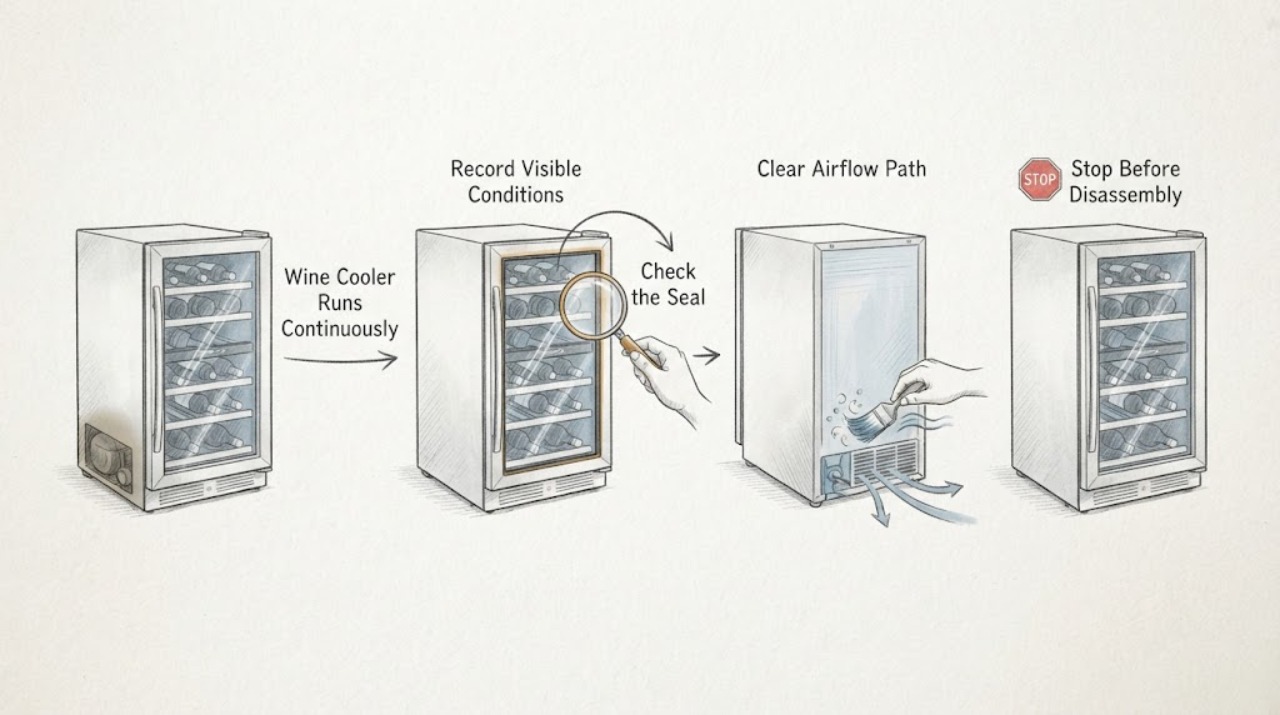
A wine cooler may run for a long initial pull-down or in a warm room, but continuous running with poor temperature control calls for checks of temperature setting, door seal, airflow, frost, and ambient conditions. Do not access refrigerant or sealed-system components; those require qualified service.
Work through in order
Diagnostic checks
Use only checks that match the exact appliance or system and its official guide.
-
Check 1
Check the temperature result rather than sound alone: record the set point, cabinet temperature, and whether bottles were recently loaded or the door was open for a long time.
Expected result: Record the visible result of this check and whether the reported symptom changes.
Next step: If the result is normal, continue to the next check; if it is abnormal, correct only the documented condition or stop for service.
Why this matters
Why: This result separates an accessible operating condition from a fault that requires model-specific diagnosis.
-
Check 2
Inspect the door and gasket: close the door fully, check for a dirty or folded seal, and make sure shelves or bottles are not preventing closure.
Expected result: Record the visible result of this check and whether the reported symptom changes.
Next step: If the result is normal, continue to the next check; if it is abnormal, correct only the documented condition or stop for service.
Why this matters
Why: This result separates an accessible operating condition from a fault that requires model-specific diagnosis.
-
Check 3
Check ventilation externally: verify the condenser intake and exhaust are not blocked by dust, cabinetry, or a wall, and compare the installation with the model’s clearance requirements.
Expected result: Record the visible result of this check and whether the reported symptom changes.
Next step: If the result is normal, continue to the next check; if it is abnormal, correct only the documented condition or stop for service.
Why this matters
Why: This result separates an accessible operating condition from a fault that requires model-specific diagnosis.
-
Check 4
Look for frost, unusual heat, or a fan that never moves air; if the cooler still runs continuously after the load and airflow are normal, stop before sealed-system work.
Expected result: Record the visible result of this check and whether the reported symptom changes.
Next step: If the result is normal, continue to the next check; if it is abnormal, correct only the documented condition or stop for service.
Why this matters
Why: This result separates an accessible operating condition from a fault that requires model-specific diagnosis.
Use your observations
Decision map
Find the observation that best matches what you see, then follow the next safe action.
-
PATH 01Next step
What you see
The cooler was just loaded, the room is warm, or the door was open frequently, and the temperature is moving toward the set point.
Do this next
Keep the door closed, restore clearance, and monitor the cabinet temperature through one stabilization period.
Why this path and its safety boundary
Why it matters: Extended pull-down demand is more likely and can be normal for the installation.
-
PATH 02Next step
What you see
The cabinet remains warm, the gasket leaks, airflow is restricted, or the evaporator is iced.
Do this next
Correct only the accessible seal, loading, clearance, or documented defrost condition, then retest.
Why this path and its safety boundary
Why it matters: Heat load, air leakage, condenser restriction, or frost can make the compressor run longer without proving compressor failure.
-
PATH 03Next step
What you see
Temperature remains wrong with clear airflow and a sound seal, or the compressor/fan makes abnormal repeated starts.
Do this next
Unplug if overheating or damaged wiring is present and arrange qualified refrigeration service.
Why this path and its safety boundary
Why it matters: A sensor, fan, control, voltage, compressor, or refrigerant problem becomes more likely.
Helpful context
Understand the symptom
Use the ordered checks below to separate normal operating states from a fault for this appliance.
When checks do not resolve it
Need a professional?
Stop for smoke, burning odor, damaged cord, water near power, excessive cabinet heat, or a suspected sealed-system leak. Disconnect safely and arrange qualified refrigeration service.
Common questions
FAQ
Is a wine cooler supposed to cycle off?
Compressor models generally cycle as they reach temperature, but initial cooling and warm ambient conditions can lengthen run time. Use cabinet temperature and the manual’s operating behavior to judge it.
Can I add refrigerant myself?
No. Refrigerant and sealed-system work requires qualified service and the model’s specified equipment.
Why does a built-in cooler run hot?
Restricted exhaust clearance can trap heat. Verify the installation type and the manufacturer’s clearance requirements before suspecting a control fault.
Read the exact guide
Official sources
- Wine Coolers Frequently Asked QuestionsVinotemp · wine cooler clearance, compressor cycling, and installation conditions
- Wine & Beverage Coolers: Troubleshooting Solutions GuideVinotemp · wine cooler long-running, airflow, temperature, seal, voltage, and refrigeration troubleshooting
Community feedback
Share a repair observation
Share a plain-text repair observation. Accepted observations are published automatically; this page may take a moment to update.