
On this page
Start here
Quick answer
Treat the code and the number of failed cooking zones as separate clues. First photograph or write the complete display exactly as shown, identify whether the cooktop is gas, radiant electric, or induction, and find the matching manual; code meanings and reset intervals are model- and region-specific. With the surface cool and controls dry, remove objects or liquid from a touch-control area, clear a control lock if the manual permits, and for induction confirm a centered, correctly sized magnetic pan with food or liquid. If one zone fails while the other zones work, a localized element, sensor, cookware-detection, or connection fault is more likely; if every zone fails or the code appears across the panel, power, overheating, shared control, communication, or supply faults become more likely. Perform only the single model-authorized power cycle, then stop if the code returns, the cooktop will not cool, a breaker trips, gas odor or abnormal flame appears, or there is smoke, arcing, a hot surface, or damaged wiring. Do not open the cooktop or choose a control board from the code alone.
Before you begin
Safety first
- Keep the cooktop off for gas odor, abnormal flame, smoke, burning or electrical odor, arcing, uncontrolled heating, damaged glass or wiring, water near controls, or repeated breaker trips. Do not open the appliance or bypass protective controls.
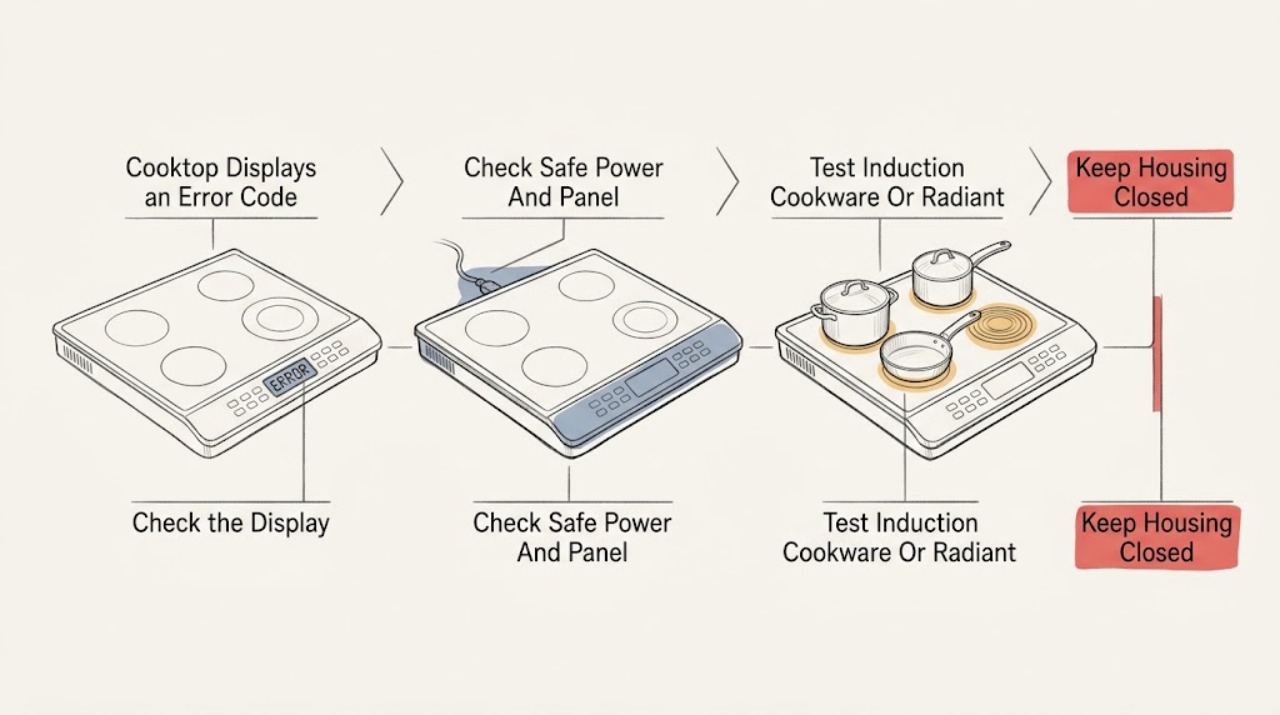
Work through in order
Diagnostic checks
Use only checks that match the exact appliance or system and its official guide.
-
Check 1
With the cooktop stopped, photograph or transcribe every character and symbol exactly as displayed. Record the model from its rating label or manual and identify gas, radiant electric, or induction operation; note whether one zone or all zones fail and whether the surface is still hot.
Expected result: The code is complete and listed for the exact model, the code is incomplete or absent from the manual, one zone is affected, or all zones and the panel are affected.
Next step: Use only the matching manual or manufacturer support page. Keep the cooktop off and arrange service for an unlisted code, a code that returns, or any code paired with a safety symptom.
Stop if: Do not guess the code, use a code table for another model, or touch the surface if its temperature is uncertain.
Why this matters
Why: Exact code and appliance type determine whether the next check concerns pan detection, a stuck touch input, temperature protection, a localized element, or a shared power/control path. An unlisted or misread code cannot be safely decoded by appearance.
-
Check 2
From a dry, safe position, check whether the cooktop has a normal display and whether its dedicated breaker or supply has tripped. With power off and the surface cool, remove objects, food, liquid, or soil from the touch-control area and leave the area dry; do not remove the glass or access wiring.
Expected result: The display is blank, every zone failed after a power event, the breaker has tripped, the touch area was wet or obstructed, or the panel remains normal but a code persists.
Next step: Restore a tripped breaker only once when there is no visible damage or hazard. Dry and clear the control area, then follow the manual's safe command. If the breaker trips again, the panel stays blank, or the code remains, leave the cooktop off and arrange qualified service.
Stop if: Stop for a hot or scorched receptacle, smoke, sparks, arcing, damaged wiring, a burning smell, or water near electrical parts; do not reset again.
Why this matters
Why: A blank panel or all-zone failure makes a shared supply, power, control, or communication issue more plausible. A wet or obstructed touch area can create a stuck-button or false-input condition. A clean, powered panel with a persistent code needs the exact code path rather than a generic reset.
-
Check 3
If the manual identifies an induction pan-detection or zone error, remove the empty pan and use one pan that is magnetic, suitable for the zone size, and centered, with food or liquid in it. If it is a radiant element, use only the model's safe operating check and observe whether normal heat cycling occurs; never touch the glass to test temperature.
Expected result: The induction zone recognizes the pan and heats, the pan remains undetected, the radiant element cycles normally, one zone never heats, or all zones remain unavailable.
Next step: Use the correct cookware or normal setting only if the code clears and no safety sign exists. If the zone remains cold, the code returns, or all zones fail, stop testing and arrange model-specific service.
Stop if: Do not use an empty pan to force a test, place cookware over controls, touch a possibly hot surface, or remove an element cover.
Why this matters
Why: Correct induction cookware can explain a zone that will not activate, while normal radiant cycling is not itself a fault. Persistent failure of one zone after the appropriate external test points toward a localized element, sensor, or connection issue; all-zone failure shifts concern to shared power, controls, or protection.
-
Check 4
If the code appeared during or after heating, turn the controls off and let the cooktop cool as the exact manual directs. Check only visible ventilation or clearance conditions and whether the control area is being covered; do not cover vents or continue heating to reproduce the error.
Expected result: The code clears after normal cooling, the panel switches off from excessive heat, a cooling fan runs, the code returns as soon as heating begins, or the surface remains unexpectedly hot.
Next step: Follow the model's cooling and clearance instructions once. If the cooktop cannot cool, the code returns, or heating cannot be controlled, keep it off and arrange qualified service.
Stop if: Stop for uncontrolled heating, a hot surface that does not cool as expected, smoke, burning odor, or a cooling fan or vent that presents a hazard.
Why this matters
Why: Some induction controls protect electronics from excessive temperature and can shut down. A code that returns after cooling suggests a ventilation, sensor, power, or control fault; persistent heat or uncontrolled operation is not a routine code condition.
-
Check 5
Only when the cooktop is cool and no gas, fire, electrical, or water hazard exists, perform at most one reset exactly as the model instructions specify. This may mean using Power or disconnecting the dedicated supply for the documented interval; restore power from a safe dry location and observe before trying one normal zone.
Expected result: The code clears and every zone works, only the previously failed zone remains unavailable, all zones remain unavailable, or the same or a new code returns.
Next step: Stop after the one documented attempt if the code or failure returns. Give service the model, full code, cooktop type, failed-zone pattern, heat state, and reset result; do not order a board by code alone.
Stop if: Do not repeatedly cycle power, open the cooktop, bypass a safety control, or restart after smoke, arcing, gas odor, uncontrolled heat, or a breaker trip.
Why this matters
Why: A one-time recovery can clear a transient control state but does not prove that the board, element, sensor, or wiring is sound. A localized repeat and an all-zone repeat require different technician checks, while any recurring code needs the exact code retained.
Use your observations
Decision map
Find the observation that best matches what you see, then follow the next safe action.
-
PATH 01Safety boundary
What you see
The complete code is not listed for the exact model, or it returns after the manual's visible check and one authorized reset.
Do this next
Leave the cooktop off and arrange qualified service with the exact code, model, cooktop type, timing, and failed-zone pattern.
Why this path and its safety boundary
Why it matters: A generic code interpretation is unsafe; the condition may involve a sensor, communication path, power stage, or control fault.
Safety stop: Do not substitute a code from another brand, region, or model family.
-
PATH 02Safety boundary
What you see
The panel and other zones work normally, but one zone or one part of a multi-zone element stays unavailable after the model-appropriate cookware or heat check.
Do this next
Stop using the failed zone and arrange service. Continue using other zones only if the manual permits and there is no recurring code, unusual heat, odor, or electrical symptom.
Why this path and its safety boundary
Why it matters: A localized element, sensor, pan-detection area, harness, or zone control is more likely than a complete household power failure.
Safety stop: Do not open the glass, swap internal zone wires, or keep testing a zone that sparks, overheats, or trips power.
-
PATH 03Safety boundary
What you see
Every zone is unavailable, the display is blank or shows a shared error, or the breaker trips when the cooktop is energized.
Do this next
Check the dedicated supply only from a safe position and once. If the display remains blank, the breaker trips again, or the error returns, leave the cooktop off and obtain qualified electrical or appliance service.
Why this path and its safety boundary
Why it matters: A shared supply, installation, overheating, control, communication, or protection issue is more plausible than a single element failure.
Safety stop: Stop for a hot panel, scorched wiring, smoke, sparks, arcing, or burning odor; do not re-energize to test.
-
PATH 04Safety boundary
What you see
An induction zone shows a pan-detection indication and begins working with a centered, correctly sized magnetic pan containing food or liquid.
Do this next
Use cookware that the exact manual approves and monitor normally. If the same error occurs with known-suitable cookware, stop that zone and arrange service.
Why this path and its safety boundary
Why it matters: The original event was consistent with cookware detection or an empty-pan protective condition, not proof of a failed control board.
Safety stop: Do not heat an empty pan or place metal objects on an induction control area.
-
PATH 05Safety boundary
What you see
A stuck-button, continuous-beep, lock, or control error appears while liquid, soil, or an object is on the touch area, and the condition clears after the cool panel is cleaned and dried as directed.
Do this next
Keep the control area clear and dry and use the exact lock procedure. If the code or unresponsive panel returns, arrange service for the user interface and control path.
Why this path and its safety boundary
Why it matters: The touch interface was receiving an unintended input or was locked; this pattern does not establish an electronic board failure.
Safety stop: Never spray cleaner into the panel, cover the controls, or remove the touch surface.
-
PATH 06Safety boundary
What you see
The code appears during heating, the unit shuts down from heat, or the cooktop remains hot, smokes, smells electrical, sparks, or shows abnormal flame behavior.
Do this next
Turn controls off, keep clear, and isolate the dedicated supply only from a safe dry location if possible. For gas odor or abnormal flame, follow the home's emergency gas procedure; otherwise obtain qualified service without restarting.
Why this path and its safety boundary
Why it matters: The cooktop may be protecting its electronics, or continued operation may create fire, shock, burn, or gas risk.
Safety stop: Do not reproduce the error, touch hot glass, relight a gas burner, or operate switches near a gas leak or smoke.
Helpful context
Understand the symptom
Record the code before clearing it
A code such as a letter-number combination, an underlined symbol, or a residual-heat display is not universal across brands. Photograph the whole display and note which zone is selected, whether the surface is hot, whether the code appears immediately or after heating, and whether one zone or every zone is unavailable. Use the exact model manual or manufacturer support page. A familiar-looking code from another cooktop is not a safe substitute.
The failed-zone pattern changes the likely path
If one zone fails while the remaining zones heat normally, start with that zone's cookware, element behavior, or localized sensing and connection path. If all zones fail or the display itself shows the error, check safe household power, control-area conditions, lock state, overheating, and shared electronics. A zone that cycles on and off while maintaining temperature may be normal for radiant heat; an element that never heats after the model's safe test is different from normal cycling.
Induction and radiant cooktops need different checks
Induction zones need a compatible magnetic pan that is centered and appropriate for the zone; an empty pan can also trigger a protective shutoff. A radiant element can cycle visibly on and off to regulate heat. Gas cooktops add flame, ignition, and gas-supply hazards and should not be treated as though they have an induction pan-detection code. Confirm the appliance type before acting on a code.
A control board is not confirmed by an error code
The code may arise from a touch interface, cookware detection, temperature protection, a single heating element, a shared power path, or communication between controls. A technician must compare the code, failed-zone pattern, wiring, sensors, and model service information before identifying a board or element. Keep the cooktop closed and de-energized for internal diagnosis.
Safety boundary
Stop conditions
- Stop immediately for gas odor, abnormal flame, smoke, burning or electrical odor, sparks, arcing, a hot or scorched plug or wiring, or a breaker that trips again. Keep clear and obtain qualified or emergency help as appropriate.
- Stop for uncontrolled heating, a surface that remains unexpectedly hot, a damaged glass surface, water near electrical controls, or a cooling or ventilation condition that cannot be corrected safely.
- Do not open the cooktop, remove the glass, probe energized wiring, bypass a lock or temperature protection, swap internal zone connections, or use a different model's code instructions.
- Use one model-authorized reset at most. Do not keep trying zones after a returning code, and do not select a control board, element, sensor, or harness from the code alone.
Only after diagnosis
Potential parts
- main control board or power-control module
Consider this only after a qualified diagnosis confirms a shared control or power-module fault from the exact code, failed-zone pattern, and model service tests.
Control modules are model- and revision-specific. Do not select one by code, appearance, or a symptom shared with a zone or interface fault. - radiant element or induction coil and zone sensor
Consider this only when one zone remains unavailable and service confirms a localized element, coil, sensor, or zone connection fault.
Zone components vary by cooktop type, position, wattage, and model. Confirm exact model and diagnosis before any part decision. - touch-control or user-interface assembly
Consider this only when the panel remains unresponsive or produces a recurring stuck-input condition after the control area is clean, dry, unlocked, and correctly powered.
Touch panels and connectors are model-specific and can be adjacent to hot or energized parts. Use qualified service procedures. - temperature sensor, thermal protector, harness, or connector
Consider this category only when service evidence links a returning heat, sensor, communication, or zone code to that exact component.
Electrical and thermal protection components require exact model documentation and de-energized installation; no generic fit is implied.
When checks do not resolve it
Need a professional?
Arrange qualified appliance service when an exact code is unlisted or returns, one zone stays unavailable after the model's cookware and operating checks, all zones fail, the display remains blank, the breaker trips, or the control panel cannot be used. Provide the exact model, cooktop type, complete code, which zones fail, whether the surface was hot, the visible checks, and one reset result. Treat gas odor or abnormal flame, smoke, arcing, uncontrolled heat, water near electrics, and burning odor as immediate safety issues.
Safety scope: Keep the cooktop off for gas odor, abnormal flame, smoke, burning or electrical odor, arcing, uncontrolled heating, damaged glass or wiring, water near controls, or repeated breaker trips. Do not open the appliance or bypass protective controls.
Common questions
FAQ
Does a cooktop error code always mean the control board is bad?
No. Depending on the exact model and type, a code can relate to cookware detection, a wet or stuck touch control, excessive heat, a single zone, shared power, a sensor, communication, or the control board. Record the code and failed-zone pattern, follow the model's external checks, and have service confirm the failed part before replacement.
Why does one cooktop zone fail while the others work?
A single-zone pattern makes a localized element, coil, sensor, cookware-detection area, or zone connection more likely than a complete supply failure. For induction, try only compatible, centered cookware with food or liquid; for radiant elements, distinguish normal cycling from an element that never heats. If the zone remains unavailable or the code returns, stop using it and arrange service.
Why do all cooktop zones fail with an error code?
All-zone failure or a blank panel shifts attention toward shared power, a breaker, overheating protection, the touch interface, communication, or common control electronics. Check power and a clear, dry control area only from a safe position, then use one model-authorized reset at most. A returning code or repeated breaker trip needs qualified service.
Can I reset a cooktop error code?
Only if the exact model guidance allows it and there is no heat, gas, smoke, water, or electrical hazard. Follow one documented power-cycle procedure, observe the cooktop, and stop if the code returns. Repeated resets can hide the failure and do not repair a zone, sensor, wiring, interface, or control board.
Read the exact guide
Official sources
- F0EA - Induction CooktopWhirlpool · Whirlpool induction F0EA code page; the exact model's code and installation instructions control any other cooktop.
- One burner on the Samsung cooktop does not workSamsung Electronics · Samsung support examples for localized burner failure; exact cooktop model and type control the test.
- Samsung Cooktop FAQsSamsung Electronics · Samsung FAQ guidance; settings and procedures vary by model and cooktop type.
- Meaning of the error codes displayed on your Samsung cooktopSamsung Electronics · Samsung Canada cooktops; the page expressly notes that settings and options can differ in other countries, so the exact model manual takes precedence.
- Beeping or Audio Tones - Induction CooktopWhirlpool · Whirlpool induction support example; exact controls and code behavior vary by model.
- Error Code or Indicator LightWhirlpool · Whirlpool induction cooktop category index; listed codes and procedures are not universal across brands or models.
Community feedback
Share a repair observation
Share a plain-text repair observation. Accepted observations are published automatically; this page may take a moment to update.