
On this page
Start here
Quick answer
If a dishwasher is not cleaning dishes, let it cool and isolate power with the model's safe instruction before reaching inside. Check the accessible spray-arm holes for food or mineral blockage, turn each arm gently by hand, and look for dish or rack interference. A cracked, loose, or wobbling arm supports a model-matched spray-arm path; clear arms with a loaded removable filter, standing water, or weak spray across arms shift concern toward filtration or the circulation-pump path. Inspect only a filter the model identifies as removable. Do not remove the bottom pump cover or perform live testing; call a qualified appliance technician when safe isolation or internal diagnosis is required.
Before you begin
Safety first
- Do not reach into a hot or energized dishwasher, open electrical panels, remove the bottom pump cover, touch the circulation pump, force a spray-arm retainer, or run a live access test. If power is hardwired or cannot be isolated safely, stop.
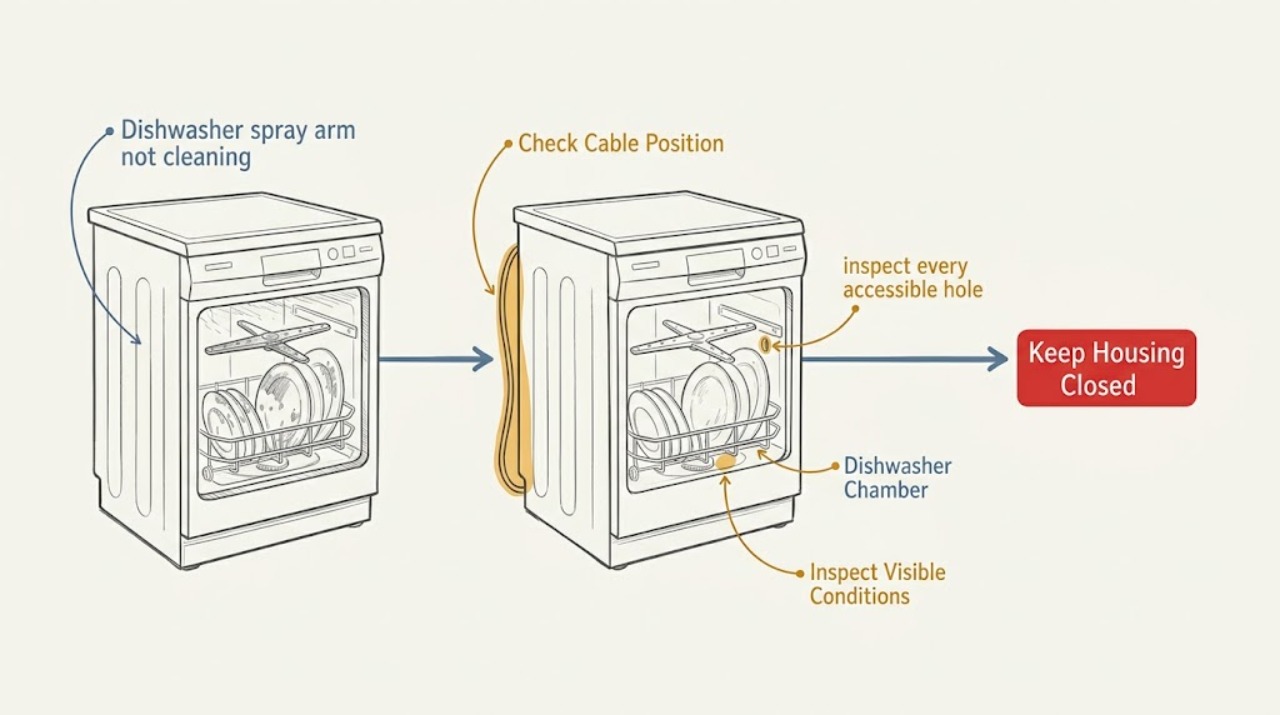
Work through in order
Diagnostic checks
Use only checks that match the exact appliance or system and its official guide.
-
Check 1
Finish or cancel the current cycle, let the dishwasher cool, and use the model's normal safe power-isolation instruction before removing the lower rack or reaching toward an accessible spray arm. If the appliance is hardwired or you cannot isolate power without opening an electrical enclosure, stop at the closed-door checks.
Expected result: You can confirm a cool, de-energized appliance and reach only the rack and spray-arm surfaces described by the manual, or you cannot safely establish that condition.
Next step: With power safely isolated, continue only with the removable-rack and spray-arm checks below. Do not remove a bottom pump cover, reach into the pump, or perform a live cycle test.
Stop if: Stop immediately for a hot appliance, exposed wiring, standing water near electrical parts, a hardwired isolation problem, or any access that requires a panel, force, or live testing.
Why this matters
Why: A safe, de-energized starting point permits a limited inspection; uncertainty about power, heat, or access is a service boundary rather than a reason to probe farther.
-
Check 2
With power isolated and the rack out only if the model permits, inspect every accessible hole in the upper, middle, and lower spray arms. Rinse or brush the arm externally with water and a soft brush only as the model manual allows; do not enlarge holes or poke into the arm with a sharp object.
Expected result: Food or mineral deposits visibly block some holes, or the holes look open and the arm has no external obstruction.
Next step: If deposits are present, clean the accessible arm and repeat the hole inspection after it is dry. If the holes are clear, do not buy a part yet; check whether the arm rotates and whether dishes interrupt its path.
Stop if: Stop if cleaning would require solvents, sharp tools, force, removal of a concealed manifold, or access below the filter or pump area.
Why this matters
Why: Blocked openings can leave parts of the load without spray. Clear openings make a blocked-hole explanation less likely and move the check to rotation, loading, arm condition, and circulation.
-
Check 3
Gently turn each accessible spray arm by hand while the dishwasher is de-energized, then slide the racks through their normal travel and look for tall dishes, utensils, or a detergent cup touching the arm. Do not force a tight arm or bend it.
Expected result: An arm turns freely, turns but catches a dish or rack, or has resistance even with an empty path.
Next step: Rearrange only the item that contacts the arm and retest its hand rotation. If resistance remains with the path clear, inspect the mount and arm condition without removing the pump assembly, then use the service boundary.
Stop if: Stop for a cracked mount, sharp edge, seized part, movement that needs force, or any attempt to test rotation with the machine powered.
Why this matters
Why: A load or rack obstruction explains a repeatable contact point; resistance with a clear path suggests debris at the mount, a seized support, or a damaged arm rather than ordinary loading.
-
Check 4
Inspect the accessible spray arm body and its center attachment for a split seam, crack, loose cap or retaining nut, missing end piece, or wobble. Compare the arm's seating with the model manual; do not glue, drill, or force a fastener.
Expected result: The arm is intact and seated, visibly cracked or split, loose or wobbling, or cannot be identified confidently from the model instructions.
Next step: Photograph the finding and record the complete model number. Treat a replacement spray arm as conditional on exact model compatibility; if the arm is intact, continue to the removable-filter and circulation-path check.
Stop if: Stop if the arm will not seat without force, the retainer is damaged, the model instruction is unavailable, or access would expose the pump, heater, or wiring.
Why this matters
Why: A crack, loose attachment, or missing piece can divert spray and supports a model-matched spray-arm diagnosis. An intact arm shifts attention away from the arm itself and toward filter, circulation, water-delivery, or loading causes.
-
Check 5
After safe isolation, inspect only the filter that the model identifies as user-removable from the tub, and note whether residue, standing water, or a history of weak spray remains after the arm holes and path are clear. Do not remove a pump cover or bottom pump body.
Expected result: The removable filter is visibly loaded, the tub retains water, spray has been weak across more than one arm, or the filter and water path look clear.
Next step: Clean only a genuinely removable filter according to the manual and reassess the symptom on a normal cycle. If the filter is clear but spray remains weak, or if pump access/testing is required, provide the observations to a qualified appliance technician instead of opening the bottom assembly.
Stop if: Stop for water near electrical parts, a filter that needs force or unknown tools, a concealed pump cover, unusual grinding, burning odor, or any live electrical or circulation test.
Why this matters
Why: A loaded filter or retained water can restrict circulation or drainage and makes a circulation-pump or filter path more plausible; clear arms with weak spray still do not prove a failed pump without model-specific testing.
Use your observations
Decision map
Find the observation that best matches what you see, then follow the next safe action.
-
PATH 01Safety boundary
What you see
Are spray-arm holes visibly blocked?
Do this next
Clean the accessible arm only as the model manual permits, then verify the openings again; if cleaning does not restore coverage, continue to rotation and water-delivery checks.
Why this path and its safety boundary
Safety stop: Do not use sharp tools, solvents, or a concealed-arm removal procedure you cannot verify.
-
PATH 02Safety boundary
What you see
Does an accessible arm turn freely with the racks and dishes clear?
Do this next
For contact, rearrange the interfering item and verify hand rotation again. For resistance with a clear path, stop forcing it and request diagnosis of the mount or arm; do not open the bottom pump.
Why this path and its safety boundary
Safety stop: Stop for seized parts, sharp edges, or any powered rotation test.
-
PATH 03Safety boundary
What you see
Is the spray arm cracked, split, loose, missing a piece, or wobbling?
Do this next
Use the complete model number to confirm a compatible spray arm before purchase or installation. If intact, shift the diagnosis toward loading, filter, circulation, or water delivery rather than replacing the arm by symptom alone.
Why this path and its safety boundary
Safety stop: Do not glue, drill, force the retainer, or remove a concealed manifold.
-
PATH 04Safety boundary
What you see
Are the arm holes and rotation clear, but the removable filter is loaded, water remains in the tub, or multiple arms have weak spray?
Do this next
Clean only a model-approved removable filter and reassess. If weak spray or retained water persists, arrange qualified appliance service for circulation-pump and water-delivery diagnosis; the arm alone is not proven faulty.
Why this path and its safety boundary
Safety stop: Do not remove a bottom pump cover, touch the pump, or perform live testing.
-
PATH 05Safety boundary
What you see
Does poor cleaning persist after accessible holes, rotation, loading, and removable-filter checks are normal?
Do this next
Limit further troubleshooting, record the model and observations, and call a qualified appliance technician.
Why this path and its safety boundary
Safety stop: Stop before opening panels, bypassing safeguards, or testing energized parts.
Helpful context
Understand the symptom
Start with the spray path
When dishes remain dirty, first decide whether the accessible spray arm can actually pass water and rotate through an unobstructed path. A blocked hole, dish contact, cracked arm, dirty removable filter, and circulation-pump problem can look similar, so a spray arm that looks clean does not by itself clear the rest of the water path.
Safe access only
Let the dishwasher cool and isolate power using the model's normal safe instruction before removing a rack or reaching inside. Keep the inspection to removable racks, accessible spray arms, and a genuinely user-removable filter. Do not remove the bottom pump cover, open electrical panels, run a live access test, or force a retainer.
What changes the next step
Blocked holes or dish contact support a loading or spray-arm correction. A crack, loose seating, or wobble supports a model-matched arm replacement. Clear arms with standing water, residue in the removable filter, or weak spray across arms point toward circulation or filtration; that path needs model-specific service when it goes beyond the removable filter.
Only after diagnosis
Potential parts
- dishwasher spray arm
Consider this only when the accessible arm is cracked, split, loose, missing a piece, or cannot seat correctly after loading and debris checks.
Match the complete dishwasher model and the exact upper, middle, or lower arm position; confirm the manufacturer part reference and installation instructions before purchase. - dishwasher filter
Consider this only when the model-approved removable filter is damaged or cannot remain seated after cleaning; residue alone calls for cleaning guidance, not automatic replacement.
Match the complete model and filter shape/position. Do not substitute a filter or remove a pump cover because dishes are dirty. - dishwasher circulation pump
Consider this only after spray-arm holes, rotation, loading, and the removable filter are normal but multiple arms remain weak or water circulation is abnormal and a technician confirms the path.
This is an internal, model-specific part. Confirm the complete model, revision, diagnosis, and service instructions; do not open the bottom pump assembly as a user check.
When checks do not resolve it
Need a professional?
Call a qualified appliance technician when an arm remains seized, damaged, or loose; when multiple arms have weak spray; when water remains after a cycle; when the removable filter does not explain the symptom; or when diagnosis would require the bottom pump, electrical parts, force, or live testing.
Safety scope: Do not reach into a hot or energized dishwasher, open electrical panels, remove the bottom pump cover, touch the circulation pump, force a spray-arm retainer, or run a live access test. If power is hardwired or cannot be isolated safely, stop.
Have this ready
- Provide the complete model number, which spray arm is affected, whether holes are blocked, whether each arm turns freely by hand, any dish contact, cracks or wobble, filter condition, standing water, weak-spray history, unusual noise or odor, and photos made only from a safe position.
Common questions
FAQ
How can I check a dishwasher spray arm safely?
Let the dishwasher cool, isolate power with the model's normal safe instruction, remove a rack only if the manual permits, inspect the accessible holes, and turn the arm gently by hand. Check for dish or rack contact without forcing the arm.
What does it mean if the spray arm will not turn?
First look for a tall dish, utensil, or rack obstruction. If the path is clear but the arm still resists, a mount or damaged-arm issue is more plausible; stop forcing it and do not test rotation with power on.
Could a dirty filter or circulation pump cause the same poor cleaning?
Yes. If the arm holes and rotation are normal but several arms have weak spray, the removable filter is loaded, or water remains, the problem may be in filtration or circulation. Clean only a model-approved removable filter; bottom-pump diagnosis is a technician boundary.
When is a spray-arm replacement reasonable?
Only after inspection finds a crack, split, missing piece, loose seating, or wobble and the replacement matches the complete model and the correct arm position. Dirty dishes alone do not identify the spray arm as the failed part.
When should I stop and call an appliance technician?
Stop if you cannot isolate power safely, find hot water or exposed wiring, smell burning, hear unusual grinding, see a damaged or seized arm, or need to open the bottom pump or perform a live test. Also call when poor cleaning persists after the safe arm, loading, and removable-filter checks.
Read the exact guide
Official sources
- Spray Arm Not Working - DishwasherWhirlpool Product Help · Whirlpool dishwasher guidance; the exact model manual controls which spray arms and filters are removable.
Community feedback
Share a repair observation
Share a plain-text repair observation. Accepted observations are published automatically; this page may take a moment to update.