
On this page
Start here
Quick answer
Stop the GE dryer and wait until the drum is completely stationary and cool enough to approach. GE says coins, paper clips, buttons, or zippers can scrape or rattle in the drum, while an object at the drum front seal or worn or loose drum slides can create metal scraping that needs service. Check only accessible areas with power safely disconnected: the empty drum, the lint-filter opening, the level and external cabinet, and the load that triggered the sound. If scraping continues with an empty drum, the drum binds, clothing is catching or damaged, or there is smoke, sparking, burning odor, abnormal heat, or a tripped breaker, discontinue use and arrange qualified service. Do not reach into a moving drum, open the cabinet, force a resistant drum, lubricate parts, or run repeated tests.
Before you begin
Safety first
- Owner checks end at stopping the dryer, safe external observation, de-energized visual inspection of accessible drum and lint-filter areas, and model-approved external leveling or clearance checks. A qualified professional must handle cabinet or drum access, front seal, slides, belt, rollers, bearing, motor, blower, wiring, gas, internal vent, and safety-device work.
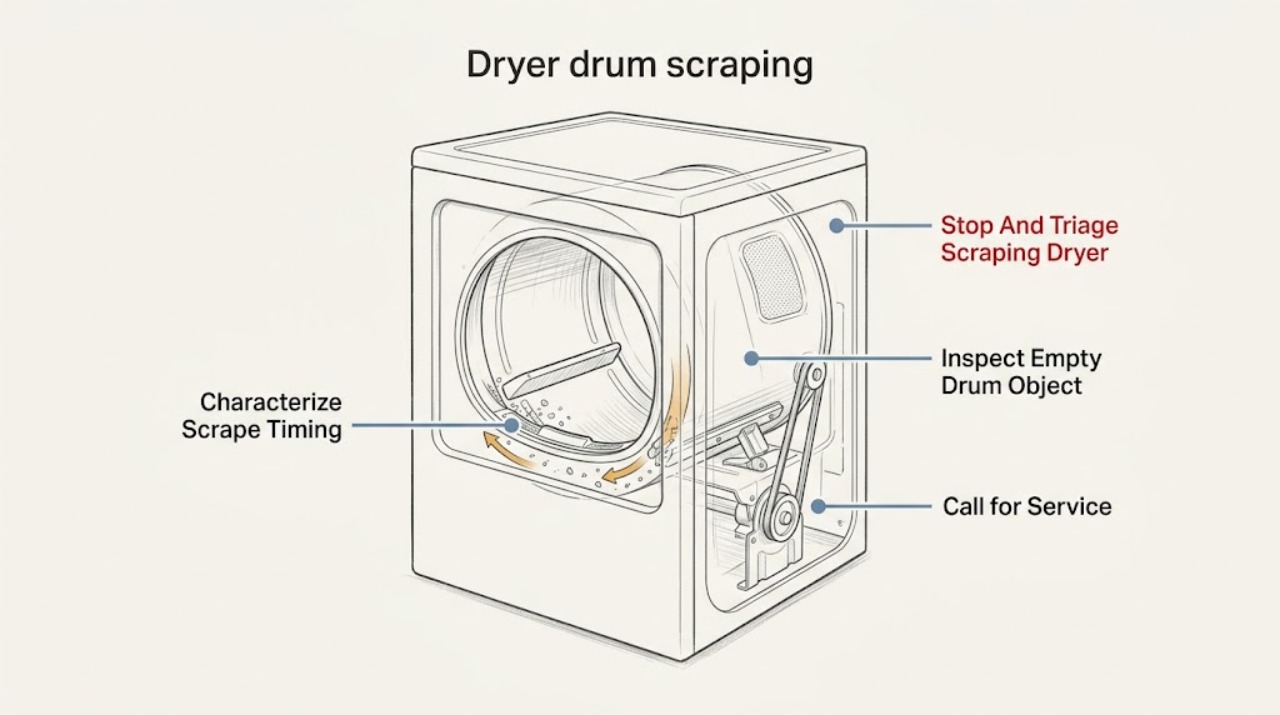
Work through in order
Diagnostic checks
Use only checks that match the exact appliance or system and its official guide.
-
Check 1
Stop the dryer and observe from a safe position. Wait for the drum to stop completely; if it is running hot, do not touch the door, drum, cabinet, cord, or lint path until it is safe. Note any smoke, sparks, burning smell, gas odor, unusual heat, damaged cord, or breaker trip without restarting the dryer.
Expected result: The dryer is cool and stationary with no hazard; the scrape occurred only during operation; or a hazard sign is present.
Next step: Keep the dryer off for any hazard. Leave and contact emergency help from a safe location for an active fire, smoke, or gas emergency; otherwise arrange qualified appliance service. Continue only with safe, de-energized checks when no hazard is present.
Stop if: Stop immediately for smoke, flames, active arcing, gas odor, exposed wiring, a hot cabinet, damaged cord, repeated breaker trips, or any need to touch a moving or hot part.
Why this matters
Why: A cool, stationary appliance permits limited visual checks. Smoke, sparks, burning odor, gas odor, abnormal heat, or a tripped breaker can indicate an electrical, combustion, fire, or overheating risk rather than an ordinary drum noise.
-
Check 2
Without putting hands near a running drum, write down when the sound occurs: only for a few seconds at startup, only with clothes, continuously while the drum rotates, once per revolution, or during a heat portion of the cycle. If an audio note is made, do it from a safe position and do not run a second cycle solely to record it.
Expected result: The noise disappears after startup; follows a garment or loose object; repeats at the same drum position; continues with an empty drum; or appears with heat, thumping, humming, or chirping.
Next step: Use the pattern to choose the branch below, but do not identify a failed internal part from sound alone. Persistent, empty-drum, or heat-related scraping should remain out of service pending qualified diagnosis.
Stop if: Stop rather than reproduce the sound if the drum binds, the cabinet heats unusually, clothing is damaged, or the sound accompanies smoke, odor, sparks, or a breaker trip.
Why this matters
Why: A brief startup sound or load-dependent rattle is different from a persistent metal scrape. A repeating point in rotation or an empty-drum scrape makes the front seal, slides, drum support, or another mechanical clearance issue more likely; a heat-related change makes continued operation inappropriate.
-
Check 3
With the appliance safely de-energized and the drum stopped, remove the load and look around the visible drum surface, baffles, door opening, and front edge for a coin, paper clip, fastener, zipper piece, or other loose object. Remove only an object plainly reachable without reaching through a narrow gap or touching a sharp edge; do not pry, force the drum, or remove panels or seals.
Expected result: A loose object is visible and safely reachable; the object is trapped at the front edge; the drum surface or baffle is damaged; or nothing is visible.
Next step: Remove only the plainly reachable loose object, then leave the dryer off if scraping returns. Have service remove a trapped object or inspect damage; a clear drum with persistent scraping points toward an internal clearance or support diagnosis.
Stop if: Stop for a sharp edge, trapped object, damaged baffle or drum, a resistant drum, or any need to remove the front seal, cabinet, filter housing, or other component.
Why this matters
Why: GE identifies coins and paper clips as foreign objects that can make a scraping or rattling sound, and buttons and zippers can scrape as they roll. A trapped object, damaged drum, or no visible object does not justify reaching into the seal or dismantling the dryer.
-
Check 4
With power safely disconnected, remove the lint filter and look down into its opening for a visible foreign object. Keep fingers out unless the object is plainly reachable and the exact model permits it; if you must reach into an opening, protect against sharp edges and do not probe blindly with a tool. Reinstall the lint filter before any future use.
Expected result: An object is visible below the filter; the opening has a sharp or damaged edge; the filter is missing or damaged; or the opening is clear.
Next step: Remove only a loose, plainly reachable object without probing or disassembly. Replace a damaged filter with the exact model-approved part, and call service for a trapped object, damaged housing, or continued scrape.
Stop if: Stop for a sharp or damaged opening, a trapped object, a missing filter that cannot be safely replaced, or any need to remove the blower housing or cabinet.
Why this matters
Why: GE specifically lists foreign objects below the lint filter as a noise check and warns that the opening edges can be sharp. A missing or damaged filter is also a safety and lint-containment concern; a clear opening does not rule out an object at the drum front seal or an internal support fault.
-
Check 5
Inspect the removed load for torn fabric, snags, black marks, loose hardware, or a sheet or garment that was caught at the drum edge. Also look from outside at the dryer's level, solid floor, and cabinet clearance; do not move a heavy dryer or tighten inaccessible fasteners while connected. Compare the symptom with the load history rather than running another risky cycle.
Expected result: Damage or catching is present; the scrape occurred only with one item or hardware; the dryer rocks or touches another object; or clothing and cabinet clearance look normal.
Next step: Remove the offending item from service and do not keep testing a load that catches. Correct only an obvious, safe external clearance issue according to the exact manual; arrange service for clothing damage, persistent scraping, or an internal clearance concern.
Stop if: Stop for repeated snagging, torn or black-marked clothing, cabinet contact that cannot be safely corrected, rocking, or any need to access the drum edge, belt, slides, rollers, or cabinet interior.
Why this matters
Why: GE says items should not catch on the lint filter, sensor rods, or under the drum edge and recommends service when they do. Leveling and a solid, secure floor can prevent cabinet movement, but a stable exterior does not prove internal drum clearance is correct.
-
Check 6
Record the full GE model and serial information, electric or gas configuration, the sound description and timing, whether the drum is empty, any visible object, filter-opening condition, load or clothing damage, level and clearance observations, and any heat, odor, smoke, spark, or breaker event. Do not remove panels or run a second cycle to improve the record.
Expected result: The scrape is gone after a plainly reachable object was removed; it persists with an empty drum; the drum binds or catches clothes; or the appliance has a heat or electrical symptom.
Next step: Keep the dryer unused for persistent, empty-drum, binding, clothing-damaging, or hazardous symptoms and provide the record to a qualified GE appliance servicer. Ask the servicer to inspect the drum clearance, front seal/slides, belt, support rollers or bearing, motor, blower path, cabinet, and safety condition as applicable to the exact model.
Stop if: End owner troubleshooting when diagnosis requires cabinet or drum access, belt or roller work, motor or blower access, electrical measurement, gas work, or replacement of a safety device.
Why this matters
Why: Recovery after removing a safe loose object is different from an empty-drum scrape, binding, or clothing-catching pattern. Persistent metal scraping may involve the front seal, drum slides, or other drive/support components that the external checks cannot confirm.
Use your observations
Decision map
Find the observation that best matches what you see, then follow the next safe action.
-
PATH 01Next step
What you see
The scrape or rattle occurs only with a particular load, and a coin, paper clip, button, zipper, or other loose hardware is visible and safely reachable; the empty drum and clothing show no damage.
Do this next
Remove only the plainly reachable object, keep the lint filter installed, and stop using the dryer if the noise returns, clothing catches, or the drum edge is damaged. Arrange service for a trapped object or persistent scrape.
Why this path and its safety boundary
Why it matters: A loose object or garment hardware is more likely than a confirmed drive-part failure. GE lists these objects as causes of rattling or scraping, but removal does not prove that a hidden object or drum clearance issue is absent.
-
PATH 02Next step
What you see
The drum scrapes continuously or at the same point in rotation with the load removed, and no safe loose object is visible in the drum or lint-filter opening.
Do this next
Discontinue use and arrange qualified GE appliance service for internal inspection. Do not force the drum, add lubricant, remove the front panel, or order a part based only on the sound.
Why this path and its safety boundary
Why it matters: A front-seal, drum-slide, drum-support, belt, roller, bearing, or cabinet-clearance problem becomes more likely, but the sound cannot identify which component failed. GE specifically directs service when foreign material at the front seal or worn or loose drum slides cause metal scraping.
-
PATH 03Next step
What you see
Fabric is caught at the lint filter, sensor area, or drum edge, or loads show tears, snags, or black marks together with the scraping sound.
Do this next
Stop using the dryer and arrange service; save a damaged item and a photo of the location if safe. Do not pull fabric through a gap or dismantle the drum to free it.
Why this path and its safety boundary
Why it matters: The drum clearance or an adjacent component may be contacting laundry. GE treats clothing catching around these areas as a repair-service symptom rather than a routine loading adjustment.
-
PATH 04Next step
What you see
Scraping is accompanied by abnormal heat, a burning smell, smoke, sparks, a gas odor, lint near heat, exposed wiring, or a breaker that trips.
Do this next
Keep the dryer off; leave for active smoke, fire, or gas danger and seek emergency assistance from a safe location as appropriate. Otherwise arrange qualified appliance, electrical, gas, or vent service before use.
Why this path and its safety boundary
Why it matters: Safety and fire or combustion risk takes priority over diagnosing drum noise. A dryer with a hazard symptom should not be restarted to see whether the scrape improves.
-
PATH 05Next step
What you see
The sound is a brief startup squeak that disappears, or an external rattle that changes when the level, floor, or cabinet clearance is corrected; there is no empty-drum scrape, catching, heat, or hazard.
Do this next
Follow the exact model's leveling and installation guidance and monitor without repeated test cycles. If the sound continues, returns after heating, or becomes a metal scrape, stop use and arrange service.
Why this path and its safety boundary
Why it matters: A transient startup sound or external vibration is less suggestive of the persistent metal-scrape path. GE still says continued or abnormal noise should not be ignored if it returns.
Helpful context
Understand the symptom
A scraping sound is different from normal tumbling
GE describes the ordinary sound of the drum turning and a short start-up squeak as normal in some dryers. A metal scrape that continues, repeats with rotation, or changes into thumping, humming, or a heat-related squeak is not something to diagnose by running many more cycles. Record when it happens—at startup, only with a load, continuously, or at one point in each rotation—then stop the appliance for the safe checks below.
Keep owner checks to accessible, de-energized areas
A visual inspection can find a coin or fastener, but it cannot establish that drum slides, rollers, a belt, a bearing, or a motor is sound. Disconnect power before maintenance or cleaning as the model instructions require; simply turning a selector to Off may not isolate every dryer. Never reach into a moving drum, and treat a hot, damaged, smoking, sparking, or gas-odor appliance as a stop condition.
When clothing is caught, service is the safer next step
GE says clothes or sheets should not catch on the lint filter, sensor rods, or under the drum edge. Tears, snags, or black marks mean the drum clearance or an adjacent component may need repair. Do not pull fabric through a narrow gap or remove the drum edge, baffle, front panel, belt, or seal as a home repair unless the exact model manual explicitly makes that task owner-approved.
Safety boundary
Stop conditions
- Stop immediately for smoke, flames, sparks, burning odor, gas odor, abnormal heat, exposed wiring, lint near heat, damaged cord, clothing damage, or a breaker that trips; leave and seek emergency help from a safe location when appropriate.
- Never reach into a moving drum, touch hot parts, force or spin a resistant drum, probe blindly below the lint filter, remove a front seal or cabinet, release a belt, oil rollers, or bypass a door switch or thermal safety device.
- Do not operate the dryer with the lint filter missing, do not run repeated cycles to reproduce a scrape, and do not use a similar model's disassembly procedure as proof of safe access for this GE model.
- If a gas dryer has a disconnected or uncertain outdoor exhaust, gas odor, or combustion concern, keep it off and obtain qualified gas/appliance and vent service before operation.
- Call qualified GE appliance service when scraping persists with an empty drum, clothing catches, the drum binds, a front-seal or slide issue is suspected, or diagnosis requires cabinet, drum, belt, roller, motor, blower, electrical, gas, or internal vent access.
Only after diagnosis
Potential parts
- GE dryer drum front glide, slide, or seal
Consider this only when qualified inspection finds wear, looseness, trapped material, or contact at the front drum edge after safe object and load checks.
Confirm the exact GE model, front-support design, material, mounting, and manufacturer fit information; a scraping sound alone does not establish this part. - GE dryer drum support roller, bearing, or rear support
Consider this only when qualified diagnosis finds a worn, seized, loose, or damaged drum-support component and rules out a loose object and cabinet contact.
Verify exact model, support layout, shaft or bearing style, mounting, and service instructions; do not order by appearance or reach into the cabinet. - GE dryer drive belt or idler
Consider this only after a technician confirms belt or idler damage, misalignment, or contact; GE's noise description does not by itself prove a belt fault.
Confirm exact model, belt path, idler configuration, tension, and manufacturer fit information before any replacement. - GE dryer drive motor or blower component
Consider this only when qualified testing localizes the sound or heat symptom to the motor or blower after drum clearance, load, object, belt, and support checks.
Verify exact model, motor or blower configuration, connectors, ratings, and service procedure; humming, scraping, or heat does not identify this part alone.
When checks do not resolve it
Need a professional?
Arrange qualified GE appliance service when the scraping persists after safe visual checks, occurs with an empty drum, repeats at one rotation point, catches or damages clothing, makes the drum bind, or requires access to the front seal, slides, belt, rollers, bearing, motor, blower, wiring, or cabinet. Treat smoke, sparks, burning or gas odor, abnormal heat, exposed wiring, lint near heat, and repeated breaker trips as urgent safety conditions.
Safety scope: Owner checks end at stopping the dryer, safe external observation, de-energized visual inspection of accessible drum and lint-filter areas, and model-approved external leveling or clearance checks. A qualified professional must handle cabinet or drum access, front seal, slides, belt, rollers, bearing, motor, blower, wiring, gas, internal vent, and safety-device work.
Common questions
FAQ
Why is my GE dryer drum scraping?
A coin, paper clip, button, zipper, or another loose object can scrape as it rolls. GE also identifies foreign material at the drum front seal and worn or loose drum slides as causes of metal scraping that need service. A persistent empty-drum scrape cannot be diagnosed to one part by sound alone.
Is a scraping sound from a GE dryer normal?
The normal sound of the drum turning and a brief startup squeak can occur, but persistent metal scraping is not a sound to ignore. Stop the dryer, perform only safe visual checks, and call service if it continues or returns.
Can a zipper or button make a GE dryer scrape?
Yes. GE says buttons and zippers can rattle or scrape as they roll around the drum. Remove the load only after the drum stops, inspect for loose hardware, and stop using the dryer if the noise continues with an empty drum or clothing is damaged.
Can a coin get below the GE dryer lint filter?
GE lists foreign objects below the lint filter as a noise check. With power safely disconnected, look into the opening, but treat its edges as potentially sharp and do not probe blindly or disassemble the housing. Have service remove a trapped object.
What if my GE dryer scrapes only when clothes are inside?
Check the load for loose hardware, a sheet, or an item that catches at the drum edge. If the scrape stops after a plainly reachable object is removed, monitor carefully; if fabric catches, tears, or the sound returns, keep the dryer off and arrange service.
Why does my GE dryer scrape once every rotation?
A repeating point in rotation makes a drum-edge, front-seal, slide, support, or another clearance issue more likely, but it does not identify the failed component. Stop operating the dryer and have a qualified technician inspect it rather than forcing the drum or removing panels.
Can I spray lubricant on a GE dryer drum or rollers?
Do not add lubricant as a guess. It can contaminate laundry, hide a worn support, or introduce a fire concern. Persistent scraping should be diagnosed against the exact model by a qualified servicer.
What if my GE dryer is scraping and damaging clothes?
Stop using it. GE says items should not catch around the lint filter, sensor rods, or under the drum edge; tears, snags, or black marks indicate a repair-service symptom. Save a damaged item and tell the technician where it caught if that can be done safely.
Should I run my GE dryer empty to test the scraping?
Do not run repeated cycles to reproduce a scrape. If the sound already persists with an empty drum, that is a reason for service, not a test to continue. Never repeat a test after smoke, odor, sparks, abnormal heat, or a breaker trip.
When should I call a technician for a GE dryer scraping sound?
Call when scraping persists after a safe visual check, occurs with an empty drum, repeats at one rotation point, catches clothing, makes the drum bind, or requires front-seal, slide, belt, roller, motor, electrical, gas, blower, or cabinet access. Treat smoke, sparks, burning or gas odor, abnormal heat, and breaker trips as urgent.
Read the exact guide
Official sources
- Dryer - NoisesGE Appliances · Official GE Appliances support article for dryer noise; exact model procedures and configuration control any additional checks.
- Washers & DryersGE Appliances · Official GE Appliances support hub; use the exact model/serial information to select applicable instructions and service.
- Important Safety InformationGE Appliances · Official GE dryer safety instructions in an older manual; the exact current model manual takes precedence for model-specific procedures.
- Dryer - Clothes Catching Around Filter, Sensor or DrumGE Appliances · Official GE Appliances support article for dryer clothing-catching symptoms; location and service procedure vary by model.
Community feedback
Share a repair observation
Share a plain-text repair observation. Accepted observations are published automatically; this page may take a moment to update.