
On this page
Start here
Quick answer
An oven door-lock error code is model-specific: it may reflect a hot or intentionally locked oven, a latch or door-switch position problem, wiring, or a control fault. Record the exact code and model, let the oven cool, and check that no self-clean cycle or control-lock feature is active. Inspect only the visible door and latch area for an obvious obstruction; never force the latch or door. If the model manual permits a power reset, follow its exact cool-down and power-isolation instructions once, then watch whether the code returns. A code that persists, a door that stays locked or will not latch, a tripped breaker, damaged wiring, smoke, or a burning smell requires the oven to remain off and qualified appliance service.
Before you begin
Safety first
- A trained appliance technician should diagnose or replace the door-latch assembly, door switch, wiring harness, control, thermal interlock, and other internal parts, and should handle any hot, energized, locked, or damaged oven condition.
Work through in order
Diagnostic checks
Use only checks that match the exact appliance or system and its official guide.
-
Check 1
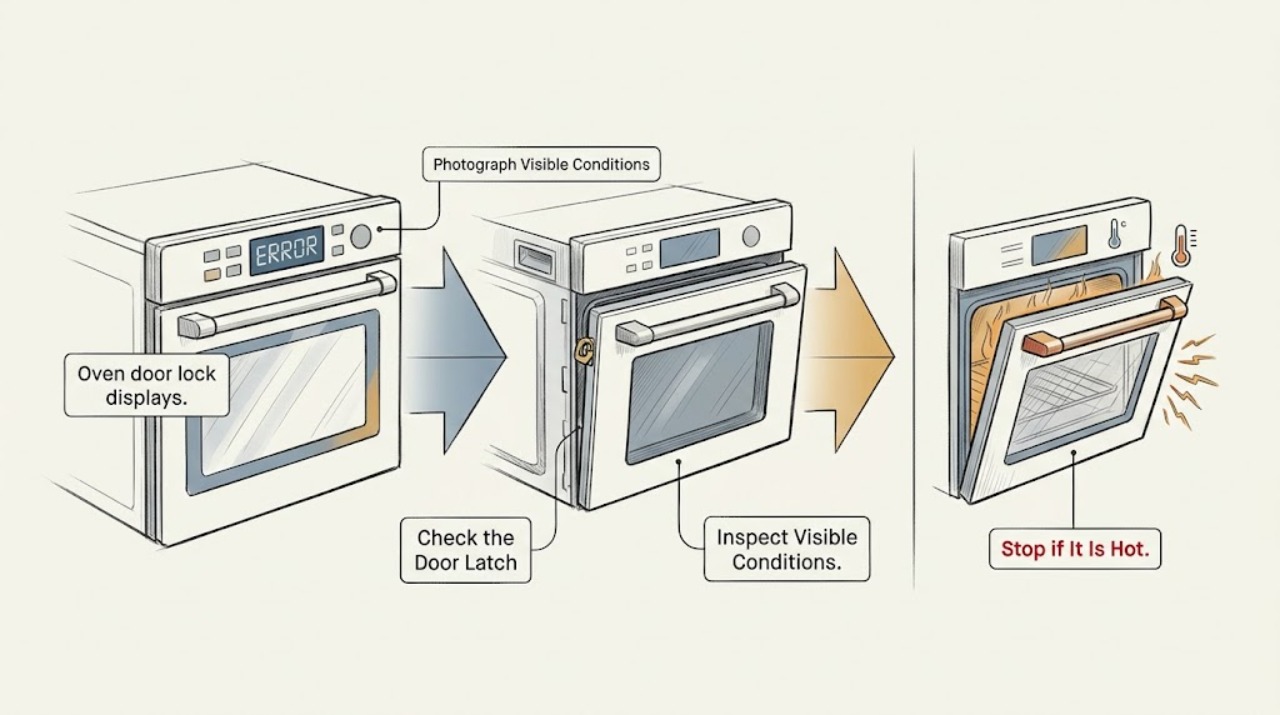
Photograph the full displayed code, note whether the oven was hot or running self-clean, and record the oven model and serial information from its label or owner's manual.
Expected result: The code is a documented door-lock code for the exact model, the display is a control-lock or normal status message, or the code is not listed in the model manual.
Next step: Use only the exact model manual or manufacturer support page. If the code is unlisted, the model cannot be identified, or the manual gives no safe user step, keep the oven off and arrange qualified appliance service.
Why this matters
Why: A model-specific entry can define the safe reset and likely circuit area. A control-lock or normal status message may not be a component failure. An unlisted code cannot be safely decoded by comparing it with another brand or model.
-
Check 2
Let the oven cool fully, confirm that self-clean is not active, and check the visible door, latch, gasket, and door edge for food, rack, foil, or other obvious interference without forcing the latch or removing panels.
Expected result: The oven is still hot or in a self-clean sequence, the latch is visibly held in the locked position, an obstruction is present, the door does not close or align, or the visible area is clear.
Next step: Allow the oven to cool and follow the manual's normal unlock/cancel procedure. Remove only a loose, clearly accessible obstruction when the oven is cool; if the latch remains stuck, the door will not close, or the cause is not visible, stop and call for service.
Why this matters
Why: Heat or an active cleaning sequence can explain an intentional lock state. A visible obstruction or door misalignment can prevent the latch from reaching its expected position. A clear exterior does not rule out an internal latch, switch, wiring, or control fault.
-
Check 3
If the exact model's support instructions permit a power reset, isolate the oven's power for the specified interval with the appliance cool, restore power once, and observe the display before selecting any cooking or cleaning cycle.
Expected result: The code clears and the door returns to normal, the code returns immediately, the code returns after a door-lock attempt, or the breaker trips or will not remain on.
Next step: Do not repeat resets or run self-clean to test the lock. Keep the oven off and arrange qualified service for a returning code or electrical symptom; retain the code photo and reset timing for the technician.
Why this matters
Why: A code that clears once may have been transient, but it does not prove the latch circuit is healthy. Immediate or repeated return supports a latch, door switch, wiring, lock-position, or electronic-control fault. A tripping breaker adds an electrical safety concern.
-
Check 4
With the oven cool and the door open or normally closed as the manual directs, check only the normal door movement and visible latch position; do not bypass a door switch or test live wiring.
Expected result: The door opens and closes normally, the latch will not move, the latch moves but the code remains, the door will not latch, or the door is locked and cannot be released by the documented method.
Next step: Leave the appliance unused and do not force or disassemble the lock. Arrange appliance repair to test the latch assembly, door switch, associated wiring, and control using the exact model's procedure.
Why this matters
Why: Normal movement with a persistent code keeps the sensor, wiring, or electronic control in consideration. A stuck or mispositioned latch or a door that will not close points to a mechanical or alignment problem. An unreleased locked door is a service and lockout issue.
-
Check 5
After a qualified repair or an explicitly model-approved reset that cleared the code, verify the door's normal movement and the oven's basic operation only as the manual specifies, without starting self-clean as a diagnostic experiment.
Expected result: The code stays cleared and the door operates normally, the code reappears during heating or locking, the latch does not release after cooling, or a new electrical or heat-related symptom appears.
Next step: Stop using the oven and report the exact cycle and symptom if any code or abnormal behavior returns. Do not continue cycling power or operating the appliance until qualified service confirms it is safe.
Why this matters
Why: A stable display and normal door movement support a resolved fault but do not justify bypassing safety checks. Recurrence during a specific cycle points to a remaining interlock, control, temperature, or wiring issue; heat, smoke, or electrical symptoms require immediate shutdown.
Use your observations
Decision map
Find the observation that best matches what you see, then follow the next safe action.
-
PATH 01Next step
What you see
The oven was hot or in self-clean, the display matches an intentional lock/control state, and the door unlocks normally after cooling and the documented cancel or unlock procedure.
Do this next
Record the model-specific procedure and resume ordinary cooking only after the door and display behave normally. Do not use self-clean as a repeated test of the latch.
Why this path and its safety boundary
Why it matters: An expected thermal or control-lock state is more likely than a failed door-lock component.
-
PATH 02Next step
What you see
A model-approved power reset clears the code, the door moves normally, and the code does not return during the next normal operation.
Do this next
Monitor without repeated resets and keep the code/model record. Stop using the oven and arrange service if the same code returns or the door behavior changes.
Why this path and its safety boundary
Why it matters: A transient control or lock-position state is possible, but one successful reset does not prove that an intermittent latch, switch, or wiring issue is gone.
-
PATH 03Next step
What you see
The door-lock code returns after the documented reset, the latch will not move or release, the door will not close, or the code appears during every lock attempt.
Do this next
Keep the oven off and do not force the door, run self-clean, bypass the interlock, or repeatedly cycle power. Arrange qualified appliance service with the code, model, temperature, and timing details.
Why this path and its safety boundary
Why it matters: A persistent latch assembly, door switch, wiring, lock-position, or electronic-control fault is more likely than a false display; the exact failed part cannot be selected from a generic code.
-
PATH 04Next step
What you see
The breaker trips, wiring appears damaged, the oven shows overheating or smoke, the door remains locked while hot, or the display cannot be cleared and the appliance cannot be safely isolated.
Do this next
Stop using the oven and keep clear of hot or damaged components. Arrange qualified appliance service; use emergency assistance if smoke, fire, or an immediate electrical hazard is present.
Why this path and its safety boundary
Why it matters: The fault may involve electrical, thermal, or door-containment hazards beyond a user reset.
Helpful context
Understand the symptom
Treat the code as a clue, not a universal diagnosis
The same-looking door-lock symptom can have different codes and meanings across oven families. Some manufacturers describe a code as a fault somewhere in the lock circuit, while others identify a possible latch, switch, wiring, or lock-position problem. Photograph the display and model label before resetting anything, and use the owner's manual for that exact oven. Do not order a latch, switch, or control board from the code alone.
Make sure the oven is cool and not intentionally locked
A door may stay locked during or after self-clean, or a control-lock feature may be active. Let a hot oven cool naturally and follow the model's unlock instructions. Look at the visible latch and door edge for an obvious obstruction, but do not pry, bend, push a motorized latch, or defeat a safety interlock. A lock that cannot return to its normal position is a service issue, not a reason to force the door.
Use one model-approved reset, then reassess
Whirlpool, Frigidaire, GE, and Samsung support pages show that a power reset may clear some false or transient codes, but the required interval and follow-up differ by model. If the manual permits a reset, isolate power only as instructed, keep the oven cool, restore power once, and observe the display. A returning code means the reset did not repair the underlying latch, switch, wiring, or control problem.
Keep the oven out of service when the lock fault persists
Do not use bake, broil, or self-clean with a persistent door-lock code, an unsecured door, or a latch that is stuck. The appliance may be unable to control heat or door position safely. A technician can test the latch mechanism, door switch, harness, control, and model-specific interlock without guessing at a part or defeating the lock.
Safety boundary
Stop conditions
- Do not force or pry an oven door, manually defeat the latch or door switch, run self-clean to test a fault, or remove panels to probe live wiring.
- Keep the oven off and arrange qualified appliance repair when the code returns after the exact model's reset, the latch will not move or release, the door will not close, the breaker trips, or wiring appears damaged.
- If the oven is overheating, smoking, burning, sparking, or presenting an immediate electrical or fire hazard, isolate it only if safe to do so, leave the area as appropriate, and use emergency help rather than troubleshooting.
When checks do not resolve it
Need a professional?
Safety scope: A trained appliance technician should diagnose or replace the door-latch assembly, door switch, wiring harness, control, thermal interlock, and other internal parts, and should handle any hot, energized, locked, or damaged oven condition.
Common questions
FAQ
What does an oven door-lock error code mean?
It means the control detected a condition in the model's door-lock or related circuit, but the exact cause varies. Depending on the manufacturer and model, it may involve an intentional hot/self-clean lock, latch position, door switch, wiring, or electronic control. Use the exact model manual rather than translating a code from another oven.
Can I reset an oven door-lock error code?
Only when the exact model's instructions permit it. Manufacturer guidance commonly starts with turning the oven off and may specify a particular power-isolation interval, but a reset can clear a transient display without fixing a latch, switch, wiring, or control fault. If the code returns, stop using the oven and arrange service.
Why is my oven door locked when there is no error code?
The oven may still be hot after self-clean, or a control-lock feature may be active. Let it cool and follow the model's normal unlock procedure. Do not force the latch; if it will not release after the documented steps, use qualified service.
Does a door-lock code mean I need a new latch?
Not automatically. A door-lock code can cover a latch assembly, door switch, wiring, lock position, or control circuit, and some displayed messages are intentional lock states. The exact model diagnosis must identify the failed part and verify the door's mechanical operation before a replacement is selected.
Can I use the oven if the door-lock code cleared after a reset?
Only if the exact manual allows normal operation, the oven is cool, the door opens and closes and latches normally, and the code does not return. Do not run self-clean as a test. Stop immediately if the code reappears, the latch behaves abnormally, the breaker trips, or heat/smoke is present.
Read the exact guide
Official sources
- Range & Wall Oven - 'LOC DOOR' Flashes in the DisplayGE Appliances · GE ranges and wall ovens displaying LOC DOOR; procedures vary by motorized or manual latch and exact model
- Check out the information codes on my ovenSamsung · Samsung ovens covered by the UK support guide; code names and procedures vary by model and region
- Oven Error Codes and Alarms GuideFrigidaire · Frigidaire standard ranges and wall ovens covered by the guide; exact model behavior may vary
- Wall Ovens and Ranges - Oven Door has Been Locked AccidentallyGE Appliances · GE wall ovens and ranges with an accidentally locked door; exact unlocking behavior depends on model and temperature
- F5 E1 - Error Code - RangeWhirlpool Product Help · Whirlpool ranges carrying the F5 E1 code; do not generalize the code to other models or brands
- Range & Wall Oven - Oven Error, Fault or Function CodesGE Appliances · GE ranges and wall ovens with electronic controls; the code list is not complete for all past and present models
Community feedback
Share a repair observation
Share a plain-text repair observation. Accepted observations are published automatically; this page may take a moment to update.