
On this page
Start here
Quick answer
Water associated with a refrigerator defrost drain usually means melted frost is not reaching the drain pan normally. Ice, frost, or debris can block the drain and make water overflow into the freezer or fresh-food compartment, but a leak from the rear supply line, a door-seal condensation problem, a full or cracked drain pan, or a spill can look similar. Move food away from the water, protect the floor, and disconnect power if you need to inspect a wet area. Use only a model-appropriate, natural-thaw procedure: never use a hair dryer, boiling water, sharp tool, or hand inside an opening. If the leak continues after a complete natural defrost, the drain is hidden behind a panel, the pan or tubing is damaged, food cannot be kept safely cold, or water reaches wiring, stop and arrange qualified refrigerator service.
Before you begin
Safety first
- Owner checks are limited to safe water containment, food protection, external observation, model-approved power isolation, flashlight inspection of already accessible areas, and natural thawing exactly as instructed. A qualified technician must handle hidden drain access, panel or cabinet removal, tubing disconnection, electrical testing, defrost components, sealed-system work, and unsafe appliance movement.
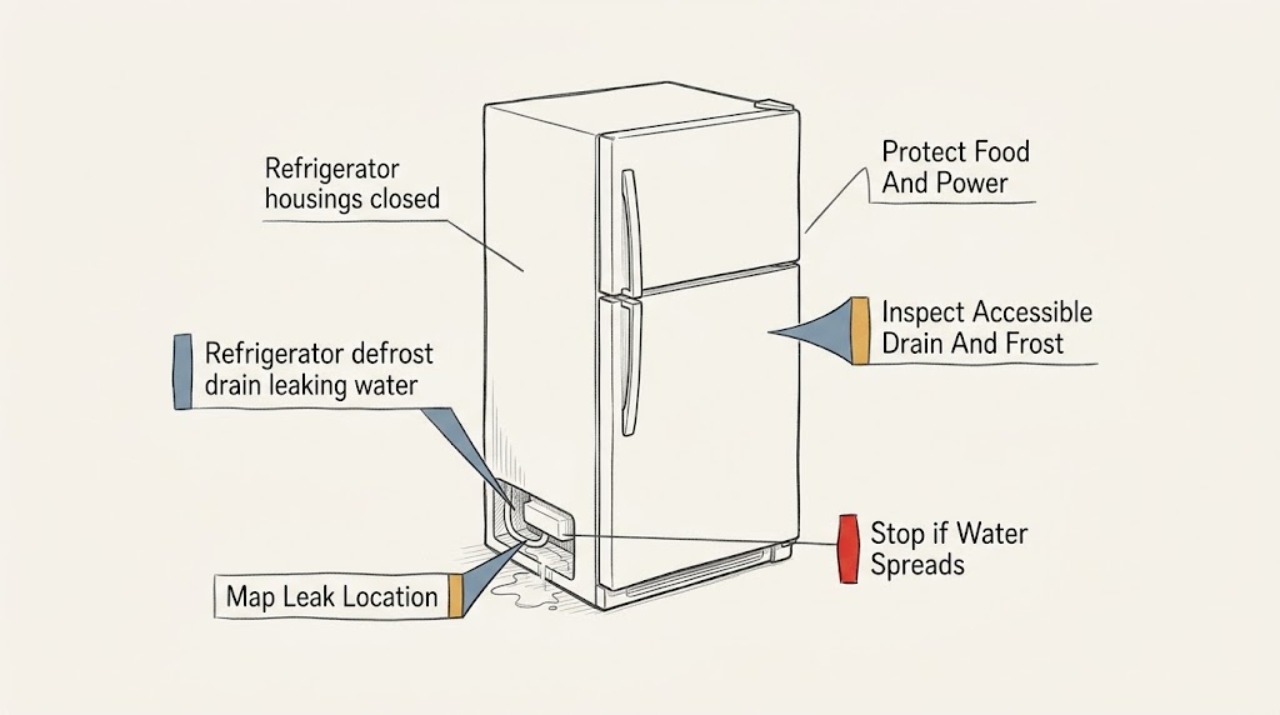
Work through in order
Diagnostic checks
Use only checks that match the exact appliance or system and its official guide.
-
Check 1
With the refrigerator operating normally and without moving panels, use a dry towel to trace where fresh water first appears: freezer floor or rear wall, fresh-food compartment, front underside, rear underside, or a nearby container. Check whether the puddle grows during or after a defrost period, but do not deliberately add water to test it.
Expected result: Record the first wet location, whether ice or frost surrounds it, whether the leak is continuous or intermittent, and whether the water is coming from the appliance or a spill.
Next step: Keep the refrigerator level and continue only with the matching visual check below. If the source cannot be distinguished, stop moving the unit and arrange service rather than guessing at a drain repair.
Stop if: Stop immediately for water at an electrical connection, exposed wiring, an unstable appliance, a large or rapidly spreading leak, or any need to reach behind an energized unit.
Why this matters
Why: Water with frost at a freezer drain area makes a blocked defrost path more likely. A rear or underside leak makes the drain pan or water-supply line more likely, while a one-time wet spot away from the appliance may be a spill. A fresh-food ceiling or drawer puddle can still be overflow from a freezer drain.
-
Check 2
Move perishable food to another safe, cold location before an extended inspection. Put dry towels around the base. If a natural-thaw check is appropriate for the model, disconnect the refrigerator from power only from a dry, safe position and leave the doors open; do not reach through standing water to operate a plug or switch.
Expected result: Confirm that food is protected, the floor is contained, power is safely disconnected when required, and the appliance can remain open without creating a slip or electrical hazard.
Next step: Request service if safe power isolation, food storage, or water containment is not possible. Do not restart the refrigerator while water remains at electrical connections or while the area is unsafe.
Stop if: Do not use a hair dryer, heat gun, boiling water, sharp pick, chemical cleaner, or open flame; do not touch wet wiring or remove covers while power is connected.
Why this matters
Why: A controlled, unpowered thaw reduces the chance of contact with energized wet areas and lets frost melt without concentrating heat on plastic. If power cannot be safely isolated or food cannot be kept cold, an owner-level thaw is not appropriate.
-
Check 3
With power disconnected and the model manual available, look only at the drain opening or drain area that is already accessible without removing a cover. Use a flashlight to note visible ice, frost, food residue, or standing water; keep hands and sharp tools out of the opening and do not force a blockage.
Expected result: Record a clearly visible ice or debris obstruction, an open and dry-looking drain, a drain hidden behind a panel, damaged plastic, or a view that is blocked by the appliance design.
Next step: If the manual permits natural thawing, continue to the complete-thaw check. Otherwise, or if the obstruction is not plainly accessible, leave power off and arrange qualified service.
Stop if: Stop if inspection would require prying, piercing, disassembling a panel, reaching into a fan or drain opening, or applying heat or boiling water.
Why this matters
Why: Visible frost or debris supports a restricted defrost path, but an apparently open surface does not rule out an iced or obstructed tube farther inside. A hidden drain or damaged plastic requires model-specific access or service rather than improvisation.
-
Check 4
If the manufacturer's instructions for the exact refrigerator allow it, keep the unit unplugged with the doors open long enough for frost to melt completely, using towels to contain meltwater. LG's general guidance uses at least 24 hours and notes that conditions can make it take longer; follow the exact manual if it differs. Do not accelerate the thaw with a hair dryer or boiling water.
Expected result: After the thaw period, record whether the frost and pooled water have gone, whether the leak stopped, and whether the drain area remains blocked or inaccessible.
Next step: Dry the interior and surrounding floor. Restore power only when the area is dry and the model instructions permit it; if the leak persists or returns, schedule refrigerator service instead of repeating improvised thaw cycles.
Stop if: Stop and call service if the leak is heavy, the refrigerator cannot keep food safely cold, water reaches electrical parts, or the thaw would require moving an unsafe or built-in appliance.
Why this matters
Why: A leak that stops after complete natural thawing is consistent with an ice-related restriction, but recurrence indicates the drain path may still be blocked or another component may be involved. A leak that never stops points away from a simple ice plug or toward a pan, supply line, or structural issue.
-
Check 5
From a dry, safe position, inspect only the externally visible rear and underside for a full or cracked drain pan, a loose or damaged water-supply tube, or a wet connection. Use the owner's manual to identify owner-accessible parts; do not pull the refrigerator farther than its anti-tip and service instructions allow, and do not disconnect tubing or remove a cover.
Expected result: Record a pan that is full or cracked, a tube with a kink or crack, moisture at a fitting, no external wetness, or an area that cannot be viewed safely.
Next step: If a pan or line is visibly damaged, keep the unit off or water supply isolated only according to the manual and arrange appliance or plumbing service. Do not treat tightening or replacing a fitting as universal across models.
Stop if: Stop for a damaged cord, wet outlet, water near wiring, a built-in unit that cannot be moved safely, or any need to disconnect a pressurized line or dismantle the sealed cabinet.
Why this matters
Why: A full pan can indicate evaporation or drainage trouble; a crack or rear line leak can produce floor water without a blocked defrost drain. A dry exterior does not clear a concealed drain tube or internal leak.
-
Check 6
After the interior and floor are dry and the owner's manual permits reconnection, restore power and observe without adding water or operating dispensers unnecessarily. Check the floor and compartment at intervals during normal operation and the next defrost period; keep food stored safely while temperature recovers.
Expected result: Record no recurrence, water returning from the same drain area, water appearing at the rear line or pan, new frost, abnormal cooling, or a leak that grows quickly.
Next step: Document the location, timing, frost pattern, and model information for a qualified technician. Keep the refrigerator off if water reaches electrical parts or if operation is unsafe.
Stop if: Stop the observation for a rapid leak, water at electrical parts, burning odor, unusual electrical noise, loss of cooling, or food that cannot remain safely cold.
Why this matters
Why: No recurrence after a complete safe thaw supports an ice-related event, but recurrence makes a concealed restriction, drain-pan problem, door-seal moisture issue, or other component more likely. A continuing leak or cooling change needs diagnosis rather than repeated resets.
-
Check 7
Prepare a service handoff with the refrigerator brand and model if safely visible, the first wet location, freezer or fresh-food symptoms, frost pattern, whether a complete natural thaw changed the leak, pan or rear-line observations, door-seal condition, and any recent installation or movement. Do not remove panels or parts to collect more information.
Expected result: Confirm that the record contains external observations and dates, not an assumed failed part or a test performed with heat, chemicals, sharp tools, or unsafe power handling.
Next step: Arrange qualified refrigerator service when the leak persists, returns, is hidden, or requires panel, drain-tube, electrical, or sealed-system access. Follow the technician's model-specific procedure for any repair.
Stop if: Stop all owner troubleshooting when the next step requires electrical testing, cabinet or panel removal, tubing disconnection, drain-tube access, sealed-system work, or moving an unsafe appliance.
Why this matters
Why: The pattern helps a technician distinguish a frozen or concealed defrost drain from a pan, supply-line, seal, leveling, or other appliance issue and prevents unnecessary part guessing.
Use your observations
Decision map
Find the observation that best matches what you see, then follow the next safe action.
-
PATH 01Next step
What you see
Water first appears in the freezer or fresh-food compartment, frost or ice surrounds the drain area, and the leak stops after the exact model permits a complete natural thaw.
Do this next
Treat this as evidence of an ice-related drain restriction, not proof that the drain is permanently repaired. If water returns during a later defrost, request service for the concealed drain path or the cause of recurring ice. Do not use concentrated heat or boiling water.
-
PATH 02Next step
What you see
The drain is behind a panel, the opening looks clear but water continues, the complete natural thaw does not stop the leak, or the leak returns soon after thawing.
Do this next
Leave the refrigerator safe and arrange model-qualified service. A hidden tube, drain heater or other defrost component, or an internal blockage may need access that should not be improvised.
-
PATH 03Next step
What you see
Water is first found at the rear or underside, the drain pan is full or cracked, or an externally visible supply tube or fitting is wet or damaged without a freezer drain frost pattern.
Do this next
Keep water contained and request appliance or plumbing service. Isolate a water supply only if the owner's instructions identify a safe, accessible shutoff; do not disconnect tubing or assume a fitting can be tightened safely.
-
PATH 04Next step
What you see
There is little or no freezer-drain frost, the door does not close or seal evenly, moisture is concentrated around the door or fresh-food area, or the appliance is overfilled or poorly leveled.
Do this next
Remove items that obstruct the door, clean and visually inspect the seal, and verify placement only within the owner's leveling instructions. If moisture or leaking persists, request service; do not assume the defrost drain is the cause.
-
PATH 05Next step
What you see
Water reaches a plug, cord, outlet, controls, or wiring; the leak is rapid; cooling is lost; the unit is unstable; or perishable food cannot be kept safely cold.
Do this next
Keep clear, do not touch wet energized parts, and arrange appropriate appliance or electrical help from a safe location. Protect or discard food according to applicable food-safety guidance and do not restore power merely to reproduce the leak.
Helpful context
Understand the symptom
Why a defrost-drain leak happens
During automatic defrost, frost melts and the water is meant to travel through a drain opening to a pan, where it can evaporate. If ice, frost, or debris blocks that path, water may pool on the freezer floor, drip into the fresh-food compartment, or reach the floor. A drain-pan overflow or crack, a rear water-supply connection, a door that is not sealing, or an ordinary spill can produce a similar puddle. The puddle location and whether frost is present are clues, not proof that the drain itself is the failed part.
Make the area safe before looking
Keep people away from the water and move perishable food to another safe, cold location if the refrigerator will be open or unplugged. Place dry towels around the base. If water is near a plug, cord, outlet, control, or other electrical connection, do not touch the wet area while energized; disconnect power only if that can be done without reaching through water, otherwise keep clear and seek help. Do not remove a rear or interior panel just to find the drain, and do not use heat, boiling water, chemicals, or sharp objects to force a path open.
A natural thaw is the limited owner-level drain check
For a model whose instructions permit it, a complete natural thaw can remove an ice plug without exposing plastic parts to concentrated heat. That does not prove the underlying drain path is clear or that a recurring blockage has been repaired. A leak that returns after the frost has fully melted may require access behind a cover, clearing of a concealed tube, or diagnosis of another component; those are service decisions unless the owner's manual expressly describes a safe owner procedure for that model.
Safety boundary
Stop conditions
- Do not use a hair dryer, heat gun, boiling water, open flame, sharp probe, chemical cleaner, or improvised tool to clear or thaw the defrost drain.
- Do not remove panels, disconnect tubing, access fans or wiring, perform electrical tests, or move a built-in or unstable refrigerator unless a qualified professional and the model instructions make the procedure appropriate.
- Stop if water reaches electrical parts, the leak is rapid, the appliance is unstable, cooling is lost, the floor is unsafe, or food cannot be kept safely cold; arrange appropriate service.
Only after diagnosis
Potential parts
- defrost drain or drain-tube component
Consider this category only if service confirms a blocked, damaged, or recurring concealed drain path after separating ice, pan, door-seal, and supply-line causes.
Confirm the exact refrigerator model, drain routing, defrost design, approved service procedure, and fit information before sourcing any component. - refrigerator drain pan
Consider a pan only when inspection confirms it is cracked, displaced, or unable to contain defrost water; a full pan alone does not prove the pan is defective.
Verify model-specific dimensions, mounting, evaporation design, and manufacturer-approved replacement information before replacement. - defrost-system or drain-heater component
Consider this category only when qualified diagnosis confirms recurring ice at the drain or a failed defrost-related component; a single leak is not enough evidence.
Electrical and defrost components require model-specific identification and qualified testing; do not infer compatibility from appearance. - refrigerator water-supply tubing or fitting
Consider this category only when water is traced to the rear supply line or fitting rather than the defrost path and service confirms the damaged connection.
Verify tubing material, connector type, shutoff arrangement, model installation requirements, and local plumbing requirements before replacement.
When checks do not resolve it
Need a professional?
Call qualified refrigerator service when the drain is hidden, the leak persists or returns after a complete model-appropriate natural thaw, the pan or tubing is damaged, cooling changes, or the next check requires removing panels, accessing a concealed drain tube, electrical testing, or moving a built-in or unstable appliance. Seek electrical help for water at a plug, outlet, cord, control, or wiring. Stop immediately for rapid spreading water, an unsafe floor, an unstable unit, burning odor, exposed wiring, or food that cannot remain safely cold.
Safety scope: Owner checks are limited to safe water containment, food protection, external observation, model-approved power isolation, flashlight inspection of already accessible areas, and natural thawing exactly as instructed. A qualified technician must handle hidden drain access, panel or cabinet removal, tubing disconnection, electrical testing, defrost components, sealed-system work, and unsafe appliance movement.
Have this ready
- Provide brand and model if safely visible, first wet location, freezer or fresh-food symptoms, frost pattern, timing relative to defrost, natural-thaw result, pan and rear-line observations, door-seal and leveling observations, cooling status, and recent installation or movement.
Common questions
FAQ
Why does a blocked defrost drain make water leak inside a refrigerator?
Automatic defrost melts frost into water that should travel through a drain to a pan. Ice, frost, or debris can block that path, allowing water to pool in the freezer or spill into the fresh-food compartment. A pan, door seal, supply line, or spill can look similar, so location matters.
Can I pour hot water into the defrost drain?
Do not use boiling water or concentrated heat. Manufacturer guidance warns that hot air or boiling water can deform or damage plastic parts. If the exact manual allows owner troubleshooting, use a complete natural thaw; otherwise arrange service.
Should I unplug the refrigerator for a defrost-drain leak?
An extended natural thaw generally requires power disconnection, food protection, open doors, and towels, but only do this from a dry, safe position and when the model instructions permit it. Do not reach through water to operate a plug or switch, and do not restart while electrical areas are wet.
How long should a refrigerator defrost naturally?
LG's general support guidance says to leave the doors open for at least 24 hours and notes that conditions can make it take longer. The exact owner's manual controls. Do not shorten the time with a hair dryer, heat gun, or boiling water.
What if the leak returns after the refrigerator defrosts?
Recurrence suggests a concealed drain blockage, a defrost-related problem, a damaged pan, a door-seal or condensation issue, or another component. Keep the area safe and request qualified service instead of repeating improvised thawing or clearing.
How can I tell whether the leak is the refrigerator water line instead of the defrost drain?
Trace where water first appears without moving unsafe panels. A rear or underside wet spot at a supply tube or fitting points toward the water line; freezer or fresh-food water with frost near the drain points toward defrost drainage. A dry exterior does not rule out a concealed drain problem.
Is water in the defrost drain pan always a fault?
Some water in the pan during or after defrost can be normal because melted frost is routed there. A full, overflowing, cracked, or repeatedly wet pan, especially with floor water, requires the drain path and evaporation area to be assessed.
When is a refrigerator water leak urgent?
Stop immediately for rapid spreading water, an unsafe floor, water at a plug, outlet, cord, control, or wiring, exposed wiring, an unstable unit, loss of cooling, or food that cannot remain safely cold. Keep clear and arrange appropriate appliance or electrical help.
Read the exact guide
Official sources
- How to Check the Water Supply LineWhirlpool Product Help · Whirlpool installation support used to distinguish rear supply-line leaks from internal defrost drainage; exact model installation instructions govern.
- How to Troubleshoot Water Leaking from the Ceiling or Pooling on the Floor in Your LG Top Freezer RefrigeratorLG USA Support · LG general top-freezer guidance used for the defrost-water mechanism and safety limits; the exact refrigerator manual governs.
- What should I do if I suspect my Samsung fridge/freezer is leaking water?Samsung UK Support · Samsung support guidance used for general leak-source differentiation; exact model access and instructions govern.
- What should I do when water leaks from the drain tray of the refrigerator?Samsung UK Support · Samsung support guidance used for drain-tray mechanism and escalation; it is not a universal repair procedure for every refrigerator.
Community feedback
Share a repair observation
Share a plain-text repair observation. Accepted observations are published automatically; this page may take a moment to update.