
On this page
Start here
Quick answer
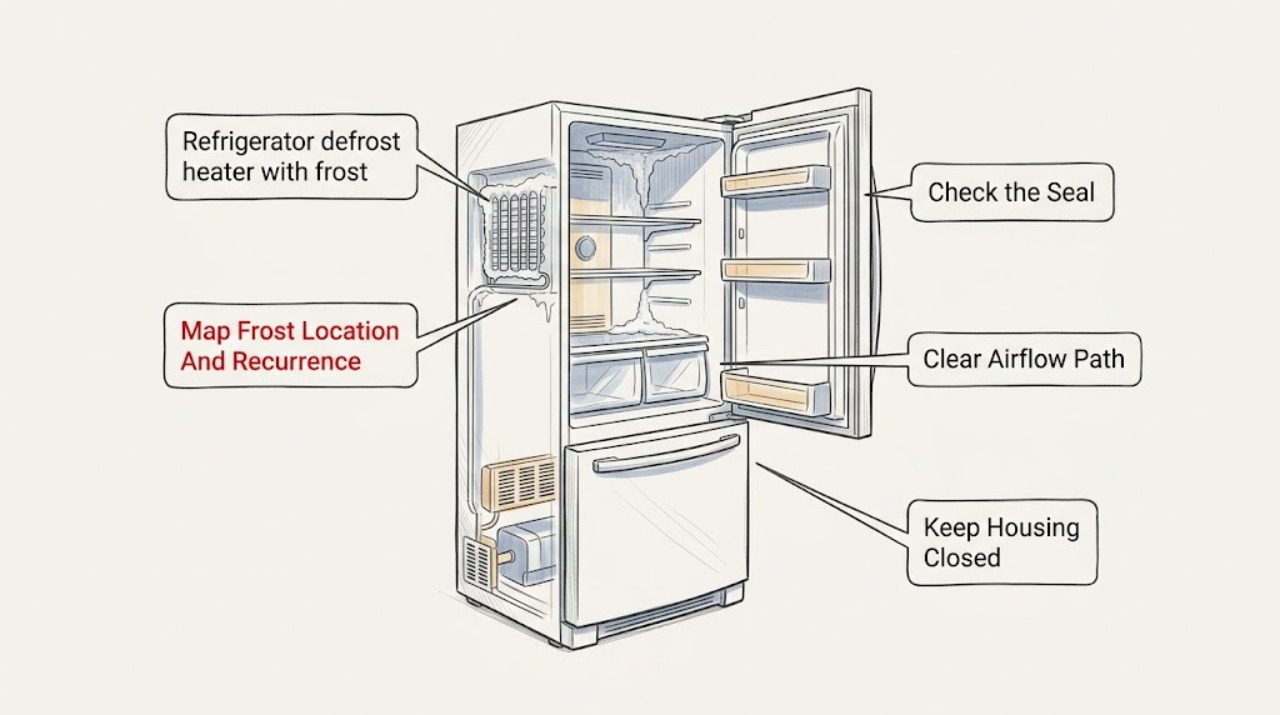
Frost around a refrigerator's evaporator or defrost-heater area does not by itself prove that the heater has failed. In an automatic-defrost refrigerator, the heater periodically melts frost from the evaporator; heavy or recurring frost usually means the defrost cycle, door seal, airflow, moisture entry, or drain needs attention. First note where the frost is located and whether it returns after a complete, model-approved defrost. Check the door gasket, door closure, food placement, and visible vents without removing panels. If frost quickly returns, cooling is weak, the freezer drain is blocked, or a defrost fault repeats, unplug and protect the food only as the owner's instructions allow, then arrange qualified appliance service. Do not test the heater with live power, puncture ice, remove evaporator covers, or replace a defrost part based only on the frost pattern.
Before you begin
Safety first
- This article supports observing the frost pattern, checking visible seals and vents, correcting food placement, and performing only a model-approved natural defrost with power disconnected. It does not authorize cabinet or evaporator-cover access, live electrical testing, direct-heat ice removal, safety bypass, sealed-system work, or internal part replacement.
Work through in order
Diagnostic checks
Use only checks that match the exact appliance or system and its official guide.
-
Check 1
With the doors open only as long as needed, photograph or note the frost location without removing interior covers. Check whether it is a thin, even layer, a dense sheet on the rear wall or evaporator-cover area, a ridge around the door opening, or ice collecting at the freezer floor or drain area. Record whether it returns after a complete normal defrost or power restoration.
Expected result: Note the compartment, side, and height of the frost; whether vents are blocked; whether food or packaging is frozen into it; whether water pools or refreezes below; and whether cooling or airflow has weakened.
Next step: Use the door-and-moisture or recurring-defrost branch, then perform only the visible seal, loading, and vent checks before considering a complete manual defrost permitted by the product instructions.
Stop if: Do not pull off an evaporator cover, pry ice from tubing, scrape with a sharp tool, or continue if wiring, a panel, or the liner is damaged.
Why this matters
Why: A thin temporary layer can occur during normal operation. Frost at the door edge makes a seal or moisture-entry problem more likely; a broad rear-wall or evaporator-area sheet, blocked vents, repeated frost, or ice at the floor makes a defrost, airflow, or drain problem more likely.
-
Check 2
Inspect the visible freezer and refrigerator door gaskets and the closing path. Remove food or bins that prevent the door from closing, wipe residue from the gasket with the product-approved method, and make sure shelves and drawers are seated so the door can close evenly.
Expected result: Look for a gasket gap, a compressed or dirty section, an object holding the door open, frost concentrated along one edge, or humid air entering around the seal. After correction, check whether the door closes fully and the frost pattern stops spreading.
Next step: Correct only the visible loading, seating, or cleaning issue and monitor according to the owner's guidance. Arrange service if the gasket is torn, remains loose, or frost continues despite a complete seal.
Stop if: Do not glue, heat, stretch, or replace a gasket without confirming the exact model procedure, and do not force a door against a damaged hinge or cabinet.
Why this matters
Why: A poor seal allows warm, moist air in and can create recurring frost even when the defrost heater is operating. If the gasket closes evenly but thick frost returns behind the cover, a seal alone is less likely to be the cause.
-
Check 3
Check only the visible air vents and drain outlet area for food, packaging, or ice obstruction. Keep food in sealed containers, let hot food cool before loading, avoid overpacking the freezer, and note whether meltwater reaches the drain pan or instead pools and refreezes inside.
Expected result: Record blocked vents, uncovered moist food, water or ice at the freezer bottom, a drain opening that is visibly obstructed, or a return of frost after the obstruction is removed.
Next step: Move only the plainly blocking items, keep moisture contained, and use the manual's safe defrost procedure if ice blocks the accessible drain. If the drain refreezes or the symptom returns, arrange service.
Stop if: Do not insert wire, metal, or sharp tools into the drain, pour boiling water onto liners or wiring, or remove a drain pan or interior panel unless the manual explicitly allows it.
Why this matters
Why: Blocked vents or overpacking can reduce circulation and make frost appear uneven. Moist food and warm loads add water that can freeze. Water that backs up and refreezes suggests a blocked drain or defrost-water path rather than a spray-on frost problem.
-
Check 4
If heavy ice is blocking airflow and the owner's instructions permit a manual defrost, move food to safe cold storage, disconnect the refrigerator from power, open the doors, place towels for meltwater, and allow the ice to melt naturally. Dry the compartments and reconnect only as the instructions direct; do not use sharp tools or an open heat source.
Expected result: Record whether all frost melts, whether the drain accepts meltwater, whether airflow and cooling return after restart, and how soon the same frost pattern comes back. A temporary improvement followed by rapid recurrence is important evidence.
Next step: Follow the product's stabilization and food-safety guidance, then monitor one normal operating period. If the frost returns, cooling remains poor, or a defrost error reappears, leave internal diagnosis to an appliance technician.
Stop if: Do not energize the appliance while water is near electrical parts, use a knife, ice pick, hair dryer, heat gun, or flame, or repeatedly force a manual-defrost cycle as a repair.
Why this matters
Why: Full melting can restore airflow temporarily but does not prove the heater or defrost controls are healthy. Rapid recurrence after a complete defrost makes a defrost-system, drain, seal, or airflow fault more likely and calls for service.
-
Check 5
Arrange qualified appliance service when frost returns after a complete approved defrost, blocks cooling airflow, produces a repeated defrost indication, causes water to refreeze, or requires access behind an interior panel. Give the technician the frost map, seal and vent observations, recurrence timing, and any safe display or sound information.
Expected result: Provide the refrigerator model, frost location, whether the door seal closes, whether the drain backed up, whether a full defrost helped and for how long, and any displayed fault. Do not remove covers or test the heater to obtain more evidence.
Next step: Keep the refrigerator in a safe state and have the technician test the defrost circuit and related airflow and drainage, then verify normal frost clearance and cooling before returning it to service.
Stop if: Do not access energized wiring, measure heater resistance, bypass a thermal fuse or thermostat, or replace an internal defrost part without qualified service and model documentation.
Why this matters
Why: The technician must distinguish a defrost heater from a thermostat or sensor, thermal fuse, timer or adaptive control, fan or airflow issue, drain problem, door seal, or another model-specific fault. Frost alone cannot select the replacement part.
Use your observations
Decision map
Find the observation that best matches what you see, then follow the next safe action.
-
PATH 01Safety boundary
What you see
Frost is concentrated along a door edge or around stored food, the door was not closing fully, the gasket is dirty or compressed, or humid air and uncovered or warm food were present.
Do this next
Clear the closing path, clean and inspect the gasket, seal moist food, and monitor according to the owner's instructions. Arrange service if the gasket cannot seal or frost continues after the seal is correct.
Why this path and its safety boundary
Why it matters: Moisture entry is more likely than a failed defrost heater; the frost is forming from air leakage or added moisture.
Safety stop: Do not heat or reshape the gasket, force the hinge, or disassemble the door to correct a suspected seal problem.
-
PATH 02Safety boundary
What you see
A broad or thick frost sheet covers the rear wall or evaporator-cover area, airflow is weak or blocked, and the same pattern returns after a complete approved defrost.
Do this next
Arrange qualified appliance service and report the temporary improvement and recurrence. Do not remove the evaporator cover or test the heater.
Why this path and its safety boundary
Why it matters: A recurring automatic-defrost, fan, airflow, drain, or control fault is more likely; the frost pattern does not identify the heater alone.
Safety stop: Do not chip ice, apply direct heat, bypass a defrost safety, or keep operating if cooling is failing and food cannot be kept safe.
-
PATH 03Safety boundary
What you see
Frost or ice accumulates at the freezer bottom, meltwater backs up, or the drain area refreezes after a defrost.
Do this next
Use only the model-approved natural defrost and accessible drain guidance, then arrange service if the water path does not remain clear or the ice returns.
Why this path and its safety boundary
Why it matters: A blocked or restricted defrost-water path is more likely than scale or surface frost alone; the blockage can also reduce cooling if ice reaches vents.
Safety stop: Do not probe the drain with metal, pour boiling water into the appliance, remove hidden panels, or operate with water near electrical components.
-
PATH 04Safety boundary
What you see
Frost is light and temporary, the doors seal, vents are clear, cooling is normal, and the frost clears during normal automatic operation or after a permitted defrost.
Do this next
Keep doors closed promptly, avoid uncovered moist or hot food, maintain clear vents, and monitor for heavy or recurring buildup.
Why this path and its safety boundary
Why it matters: Normal moisture and automatic-defrost behavior are more likely than a failed heater, so an internal part replacement is not justified from this observation.
Safety stop: Arrange service if the frost becomes thick, blocks airflow, recurs rapidly, or is accompanied by warm compartments, water leakage, or an error indication.
Helpful context
Understand the symptom
Frost on the defrost-heater area is a symptom, not a heater diagnosis
The heater sits near the evaporator so it can melt frost during the automatic-defrost cycle. A light, temporary frost layer can be normal, but a thick layer that blocks vents, covers the evaporator, or returns soon after defrost means the appliance is not clearing or preventing frost normally. Door leakage, humid air, blocked drainage, and a failed defrost component can look similar from the inside.
Use location and recurrence to narrow the cause
Frost concentrated around a door edge or one wall points first to air leakage, moisture, or food placement. Frost behind an evaporator cover, a blocked cold-air path, or water that refreezes at the freezer bottom points to a defrost or drainage problem. The visible pattern cannot identify a heater, sensor, fuse, timer, or control board, so internal parts remain conditional until a technician tests the exact model.
Protect the refrigerator while deciding whether service is needed
Keep doors closed while arranging a safe plan for the food. If the owner's instructions permit a complete manual defrost, remove food, disconnect power, open the doors, protect the floor from meltwater, and let the ice melt naturally before drying and reconnecting. Never chip at the evaporator with a knife or ice pick, use a flame or heat gun, or open the sealed or electrical compartments.
Safety boundary
Stop conditions
- Do not test the defrost heater, sensor, fuse, wiring, or control with energized equipment unless you are a qualified appliance technician using the model documentation.
- Do not use a knife, ice pick, metal tool, flame, heat gun, or other direct heat to remove frost; puncturing an evaporator or liner can cause major damage.
- Do not remove evaporator covers, bypass a thermal fuse or defrost control, or replace a heater based only on the visible frost pattern.
- Stop if water reaches electrical parts, the liner or tubing is damaged, a door or hinge cannot seal, or cooling is failing enough to threaten food safety.
- Arrange qualified appliance service when heavy frost returns after a complete approved defrost, a drain refreezes, cooling or airflow is impaired, or a defrost fault repeats.
Only after diagnosis
Potential parts
- refrigerator defrost heater
Consider this part only after qualified testing confirms that the heater is open, damaged, or otherwise the failed element in the defrost circuit; frost buildup alone is not enough.
Match the complete refrigerator model and the manufacturer's service information; installation and electrical testing require qualified appliance service. - refrigerator defrost sensor, thermostat, or thermal fuse
Consider this category only when qualified diagnosis identifies a failed temperature-sensing or safety component rather than a door, drain, airflow, or heater problem.
These components are model-specific safety parts; confirm exact fit and approved replacement procedure before ordering or installing. - refrigerator door gasket
Consider this only when the gasket is torn, deformed, or fails to seal after visible cleaning and correct door loading, and the leak is confirmed as the source of recurring frost.
Confirm the exact door configuration and model fit; a gasket replacement will not correct frost caused by an internal defrost or drain fault.
When checks do not resolve it
Need a professional?
Arrange qualified appliance service when frost returns quickly after a complete, model-approved defrost, blocks vents or cooling airflow, causes water to refreeze, or appears behind an interior cover. Call promptly for a repeated defrost error, damaged liner or tubing, water near electrical components, a door that cannot seal, or compartments that are no longer maintaining safe temperatures. Do not test or replace the defrost heater from the frost pattern alone.
Safety scope: This article supports observing the frost pattern, checking visible seals and vents, correcting food placement, and performing only a model-approved natural defrost with power disconnected. It does not authorize cabinet or evaporator-cover access, live electrical testing, direct-heat ice removal, safety bypass, sealed-system work, or internal part replacement.
Common questions
FAQ
Does frost on the defrost heater mean the heater is bad?
No. The heater is positioned to melt frost from the evaporator during an automatic-defrost cycle, so visible frost does not identify a failed heater. Heavy or recurring frost can also come from a door seal, moisture, blocked drain, airflow problem, sensor, thermal fuse, or control. A technician must test the defrost circuit for an exact model.
Why does frost keep returning after I defrost the refrigerator?
A manual defrost can restore airflow temporarily without correcting the cause. If the door is sealed and food and vents are normal, rapid recurrence makes an automatic-defrost, drain, fan, or control fault more likely. Record how long the improvement lasts and arrange appliance service instead of repeatedly chipping ice or changing parts by guesswork.
Can a bad door gasket cause frost near the defrost heater?
A poor gasket can admit warm, humid air that freezes on cold interior surfaces and may eventually spread toward the evaporator area. Check for objects blocking closure, residue, compressed sections, and visible gaps. If the gasket seals correctly but thick frost returns behind a cover, the gasket is not proven to be the cause.
Can I remove the frost with a knife or hair dryer?
Do not use a knife, ice pick, metal scraper, flame, heat gun, or other direct heat. Sharp tools can damage the refrigerator, and direct heat or water can damage liners and electrical parts. If the manual permits a complete defrost, disconnect power, open the doors, protect against meltwater, and let the ice melt naturally according to the model instructions.
When should a refrigerator with frost buildup be serviced?
Arrange service when heavy frost returns after a complete approved defrost, blocks vents, causes weak cooling, produces a repeated defrost indication, or makes water refreeze at the freezer floor. Internal heater, sensor, fuse, control, fan, and drain diagnosis requires model-specific access and testing.
Read the exact guide
Official sources
- [LG refrigerator frost build-up] There is frost build-up and icicles in the freezer compartmentLG USA Support · LG general refrigerator frost guidance; product images and procedures can differ by model.
- LG Refrigerator - Troubleshooting Ice Buildup in an LG RefrigeratorLG USA Support · LG guidance for refrigerator ice buildup; exact drain access and defrost procedures vary by model.
- Refrigerator - Automatic Defrost SystemGE Appliances · GE's general explanation of full-size automatic-defrost refrigerators; cycle details and components vary by model.
Community feedback
Share a repair observation
Share a plain-text repair observation. Accepted observations are published automatically; this page may take a moment to update.