
On this page
Start here
Quick answer
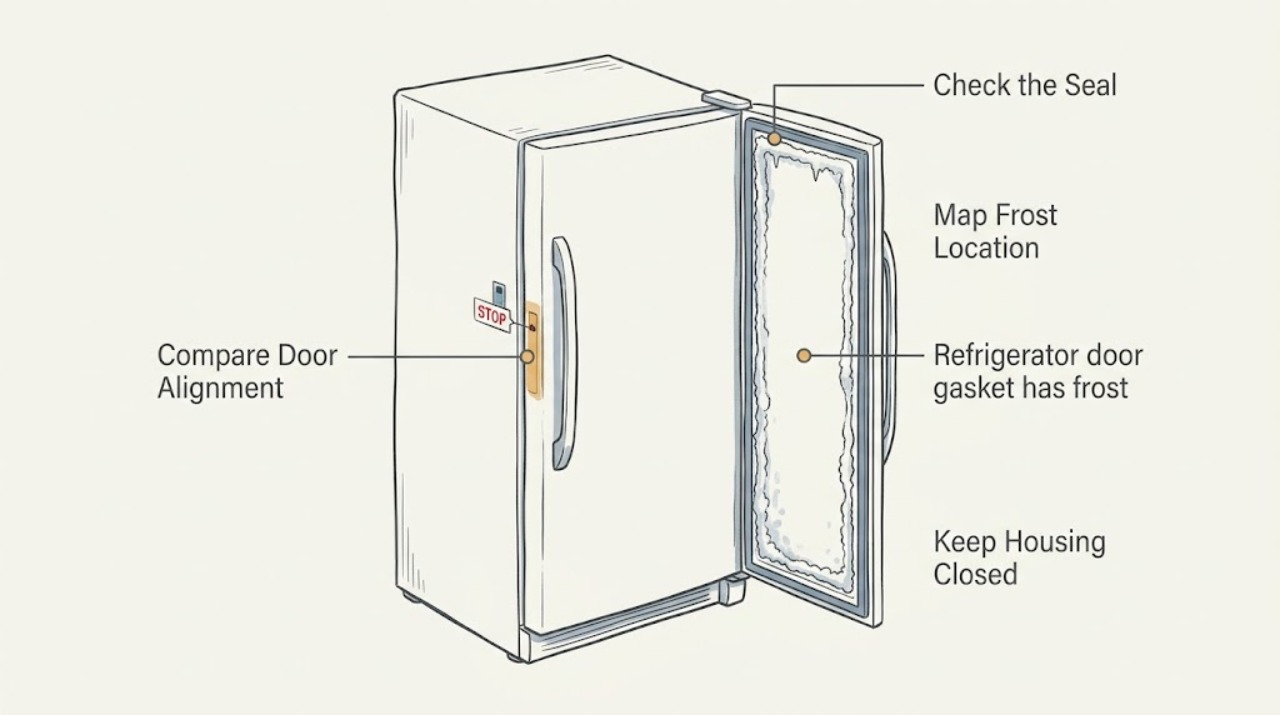
Frost on or beside a refrigerator door gasket usually means warm, humid air is entering through a gap, but the gasket may not be the only cause. With the door closed, note whether the frost is only around the seal or also on the rear wall, shelves, or vents. Check for food or drawers holding the door open, clean and inspect the accessible gasket, and make sure internal air vents are not blocked. Do not chip frost with a knife, screwdriver, or other sharp object, and do not remove panels or replace a defrost part based on frost alone. If the gasket is torn, warped, loose, or still does not seal after an obstruction is removed, or frost returns quickly after model-approved defrosting, arrange appliance service and protect temperature-sensitive food.
Work through in order
Diagnostic checks
Use only checks that match the exact appliance or system and its official guide.
-
Check 1
Without removing panels or food that is frozen in place, note exactly where frost appears: on the gasket face, along the cabinet edge, at one corner, around the entire door, on the rear interior wall, or around an air vent.
Expected result: Record a narrow strip at one gasket gap; frost around the whole perimeter; frost on the rear wall or shelves; frost near a vent; or only a small amount after a long door opening.
Next step: Use the pattern to guide the next checks. If frost is extensive, food is softening, or the compartment is warming, minimize door opening and arrange appliance service rather than repeatedly scraping the ice.
Stop if: Do not chip or pry frost, remove an evaporator or rear panel, or use a heat gun or open flame.
Why this matters
Why: A localized gasket-edge pattern makes a seal gap, obstruction, or door alignment more likely. Frost across the compartment or near the rear wall or vents makes humidity, airflow, temperature, or defrost causes more relevant; location alone does not identify a failed part.
-
Check 2
Open the door briefly and inspect the entire accessible gasket and the cabinet surface it contacts. Wipe visible food residue or dirt with the cleaner and soft-cloth method specified by the owner manual; do not pull the gasket from its channel or use a sharp tool on frozen sections.
Expected result: Record a clean, flexible, continuous gasket; dirt or residue; a folded or displaced section; a split, brittle, or warped section; or frost preventing the gasket from contacting the cabinet.
Next step: Remove only surface residue and allow the door to close normally. If the gasket is damaged, pulled out, or cannot contact the cabinet evenly, stop forcing the door and arrange model-specific service or gasket replacement.
Stop if: Do not stretch, glue, heat aggressively, cut, or remove the gasket, and do not close the door against a thick ice ridge or blocked package.
Why this matters
Why: Dirt, folds, displacement, or damage can leave a gap through which humid air enters and freezes. A gasket that looks intact but has a persistent gap may reflect door alignment, hinge, leveling, or cabinet issues rather than a gasket-only failure.
-
Check 3
Check shelves, drawers, packages, the ice chute, and door bins for anything holding the door open. From the front, observe whether the door sits squarely, closes fully, and contacts the gasket all around without lifting, rubbing, or needing a push.
Expected result: Record a clear, square door that closes by itself; a package or drawer obstruction; a door that springs back or sags; one corner with a gap; or an ice chute or shelf that does not return to its normal position.
Next step: Remove only an obvious movable obstruction and close the door normally. If the door remains uneven, rubs, sags, or leaves a gap, arrange appliance service rather than adjusting hinges or forcing the door.
Stop if: Do not loosen hinge hardware, lift a heavy door, bend the gasket, or force an ice-bound door closed.
Why this matters
Why: An obstruction or door not closing completely can admit humid air and create frost even when the gasket rubber is undamaged. A sagging door, persistent corner gap, or hinge or cabinet misalignment can keep a new gasket from sealing.
-
Check 4
With the refrigerator operating normally and the door open only briefly, verify that food and containers are not blocking the internal air vents. Note recent long or frequent door openings, warm food loading, unusually humid room conditions, or a temperature-control change.
Expected result: Record clear vents and ordinary door use; blocked vents; frequent or prolonged openings; a large recent warm-food load; or frost and condensation that increase with humidity.
Next step: Move only an obvious item away from a vent, reduce unnecessary door-open time, and follow the owner's manual for temperature settings. If frost continues or cooling is unstable, request service instead of setting the appliance colder without a diagnosis.
Stop if: Do not dismantle vents, cover a sensor, change sealed-system settings, or place hot objects against the gasket or airflow path.
Why this matters
Why: Blocked vents can reduce circulation and contribute to moisture and frost problems. Frequent openings and warm humid air can create some frost even without a failed gasket, while a persistent edge gap still points back to sealing or alignment.
-
Check 5
If frost is substantial, read the exact owner manual for an approved defrost or cleaning procedure and note whether the refrigerator has a user-accessible defrost mode. Do not remove interior panels, use sharp objects, or apply direct high heat.
Expected result: Record that the manual provides a user defrost procedure; no user procedure is provided; frost is blocking a drawer or vent; frost returns soon after an approved defrost; or food temperature is rising.
Next step: Follow only the model-approved procedure and protect perishable food. If no safe procedure is provided, frost is inaccessible, or it returns quickly, leave panels closed and arrange appliance service.
Stop if: Never chip ice, use an open flame or heat gun, puncture a liner, unplug a wet appliance, or remove a rear or evaporator panel as a homeowner.
Why this matters
Why: A manual-approved defrost may remove accumulated ice, but quick recurrence or frost behind a panel makes an airflow or defrost-system fault more likely. Rising food temperature means the issue is no longer cosmetic and needs prompt attention.
-
Check 6
Prepare an appliance service request with the refrigerator model if visible without moving the unit, the compartment affected, frost location and extent, gasket condition, door and vent observations, recent installation or moving, temperature changes, and the result of any model-approved defrost.
Expected result: Confirm that the record contains external observations only and that no gasket channel, hinge, liner, evaporator cover, heater, fan, wiring, or sealed-system part was disturbed.
Next step: Arrange qualified appliance service for a damaged gasket, persistent edge gap, extensive or recurring frost, unstable temperatures, blocked internal frost, or food warming. Ask the technician to verify the seal and the frost's underlying cause.
Stop if: Stop homeowner troubleshooting when the next step requires panel removal, electrical testing, defrost-heater or fan access, hinge adjustment, or sealed-system work.
Why this matters
Why: This record helps separate a door-seal or alignment problem from humidity, airflow, defrost, fan, temperature-control, or sealed-system symptoms without guessing at a part.
Use your observations
Decision map
Find the observation that best matches what you see, then follow the next safe action.
-
PATH 01Next step
What you see
Frost is concentrated at one gasket section or cabinet edge, and a dirty, folded, displaced, obstructed, or visibly damaged seal is found.
Do this next
Clean only the accessible seal surface or remove an obvious door obstruction. If the gasket remains damaged or the gap persists, arrange model-specific gasket or door-alignment service; do not glue or heat the gasket.
Why this path and its safety boundary
Why it matters: A local air leak at the door seal is more likely than a compartment-wide defrost failure.
-
PATH 02Next step
What you see
The gasket looks continuous, but the door sags, springs back, rubs, sits unevenly, or leaves a repeatable corner gap after packages and drawers are clear.
Do this next
Avoid forcing the door or loosening hinges and request appliance service. Continued operation with a gap can admit humid air and increase frost and food-temperature problems.
Why this path and its safety boundary
Why it matters: Door alignment, hinge, leveling, or cabinet geometry is more likely than a gasket-only problem.
-
PATH 03Next step
What you see
Frost is light or intermittent, the gasket closes evenly, vents are clear, and the pattern follows prolonged or frequent door opening, warm loading, or humid conditions.
Do this next
Minimize door-open time, let food cool as the manual directs, keep the gasket and vents clear, and monitor. Call for service if frost becomes heavy, spreads, returns quickly, or temperatures rise.
Why this path and its safety boundary
Why it matters: Moisture entering during normal use is more likely than a failed gasket, although a recurring edge patch still deserves monitoring.
-
PATH 04Next step
What you see
Frost covers the rear wall, shelves, vents, or much of the compartment, or it remains after the door seal and obstructions appear normal.
Do this next
Follow only the exact model's approved defrost guidance and do not remove panels. Arrange appliance service if frost is extensive, returns, blocks airflow, or affects food temperature.
Why this path and its safety boundary
Why it matters: Airflow, temperature-control, humidity, or defrost-system causes are more likely than a door gasket alone.
-
PATH 05Next step
What you see
Frost returns soon after an approved defrost, the gasket and door appear sealed, food is warming, or the appliance has unusual fan or operating behavior.
Do this next
Keep the doors closed as much as practical, protect perishable food, and obtain qualified appliance diagnosis. Do not purchase or install a heater or fan without model-specific confirmation.
Why this path and its safety boundary
Why it matters: An internal defrost, evaporator fan, temperature-control, or sealed-system fault becomes more likely and cannot be selected from frost appearance alone.
Helpful context
Understand the symptom
Frost at the gasket is an air-leak clue, not a part diagnosis
A door gasket is meant to keep warm room air out. If the door is blocked, the gasket is dirty or distorted, or the door is not closing squarely, humid air can enter and freeze at the cold edge. A thin patch at one gap is different from frost across the compartment or rear panel. The broader pattern can involve blocked vents, frequent door opening, temperature settings, or an internal defrost or airflow fault.
Start with the door, gasket, and airflow path
Look for a package, shelf, drawer, ice chute, or other item preventing the door from closing completely. Inspect the gasket around its full perimeter for dirt, folds, cracks, gaps, or a section pulled out of its channel, and check that food is not blocking the internal vents. Clean only the accessible seal with the method in the owner's manual; do not use a sharp tool to remove ice or pull the gasket out to experiment.
When frost returns, the refrigerator may need an internal diagnosis
If the door closes and the gasket looks sound but frost returns, the pattern may involve an air-circulation restriction, temperature-control setting, defrost system, or another component. A defrost heater or evaporator fan cannot be selected safely from the presence of frost alone. Follow the exact model instructions for any approved defrost or cleaning procedure, and use service when the frost is extensive, cooling is unstable, or food temperature is not safe.
Safety boundary
Stop conditions
- Do not chip or pry frost, puncture the liner, use a knife, screwdriver, heat gun, or open flame, or remove evaporator and rear panels.
- Do not pull out, glue, cut, aggressively heat, or stretch the gasket, and do not loosen hinges or force a door that is blocked by ice or misaligned.
- Stop and arrange service for water near electrical parts, damaged wiring, smoke, burning odor, an unstable appliance, extensive frost, or food warming beyond safe storage conditions.
Only after diagnosis
Potential parts
- refrigerator door gasket
Consider this only when the exact model's gasket is visibly damaged, displaced, or unable to seal after obstructions and surface dirt are addressed, and the door alignment is confirmed.
Confirm the exact refrigerator model, door position, gasket profile, and installation method; do not infer fit from appearance or brand alone. - refrigerator defrost heater
Consider this only after a qualified technician confirms a defrost-system fault from recurring compartment-wide frost; frost at the gasket alone does not identify a heater failure.
Confirm the exact model, heater design, electrical specification, and approved replacement through the technician or manufacturer. - refrigerator evaporator fan motor
Consider this only when service diagnosis confirms an evaporator fan or airflow fault associated with widespread frost, temperature imbalance, or unusual fan behavior.
Confirm the exact model, fan assembly, voltage, rotation, mounting, and manufacturer-approved fit; do not access the fan through an ice-covered panel.
When checks do not resolve it
Need a professional?
Call qualified appliance service when the gasket is torn, warped, loose, or cannot seal; the door sags or remains misaligned; frost is extensive, compartment-wide, behind a panel, or quickly returns; vents are blocked by inaccessible ice; or food temperature is rising. Promptly protect perishable food and seek service for a refrigerator that cannot maintain safe cooling.
Have this ready
- Provide the refrigerator model if safely visible, affected compartment, frost location and extent, gasket and door observations, vent condition, recent move or installation, temperature changes, manual-approved defrost result, and any unusual sound, odor, water, or food-warming symptom. State that no panels or internal components were disturbed.
Common questions
FAQ
Why is there frost around my refrigerator door gasket?
A gap, dirty or warped gasket, blocked door, or misalignment can let warm humid air enter and freeze. Frequent door openings and blocked internal vents can also contribute. Check the seal and door externally before assuming a part has failed.
Is frost on the gasket always a bad seal?
Not always. A small amount after prolonged opening or humid conditions may be moisture-related, but a recurring strip at one gap, a door that does not close squarely, or a damaged gasket makes a sealing problem more likely.
Can I scrape the frost off with a knife?
No. Sharp objects can puncture the liner or cooling components. Follow only the exact model's approved defrost procedure, and use service when frost is behind a panel, extensive, or quickly returns.
Should I replace the door gasket first?
Only after confirming the exact model and finding a damaged, displaced, or persistently unsealing gasket. A sagging door, blocked vent, humidity pattern, or compartment-wide frost may require a different diagnosis, so do not select a part from frost alone.
When does frost buildup require refrigerator service?
Arrange service when the gasket or door cannot seal, frost returns quickly after an approved defrost, frost blocks vents or is behind a panel, temperatures are unstable, food is warming, or the refrigerator has unusual fan, water, odor, or electrical symptoms.
Read the exact guide
Official sources
- Cooling issues with Samsung refrigerator or freezerSamsung · Samsung refrigerator troubleshooting used for the general relationship between clean seals and frost near the door; exact model maintenance instructions govern.
- Doors Not Closing ProperlyWhirlpool · Whirlpool refrigerator door guidance used for door and gasket observation; model-specific hinge and leveling procedures remain outside this article.
- Refrigerators / Freezer - Frost Build UpFrigidaire · Frigidaire refrigerator guidance used for general frost causes and external checks; no brand-specific temperature or part fit is generalized.
- Preventing Frost or Ice Crystals on FoodWhirlpool · Whirlpool full-size refrigerator guidance used for general frost and door-seal mechanisms; exact model controls settings and service procedures.
- Use and Care GuideWhirlpool · Whirlpool owner-guide safety instructions used for general warnings; the user's exact refrigerator manual controls applicability.
- Frosting in the Freezer Section - Side by Side RefrigeratorWhirlpool · Whirlpool side-by-side guidance used for general frost-pattern branching; freezer layout and controls vary by model.
Community feedback
Share a repair observation
Share a plain-text repair observation. Accepted observations are published automatically; this page may take a moment to update.