
On this page
Start here
Quick answer
Frost around a refrigerator evaporator fan can block airflow and make the fan rub, stop, or become noisy. Warm moist air from a door that does not seal, blocked vents, or a heavy load can create frost, while frost that returns after a complete defrost can indicate an unresolved door-seal, defrost, sensor, fan, wiring, or control-board problem. First document where the frost is and check door closure, gasket condition, and accessible vents. If the model manual permits a manual defrost, unplug the refrigerator, protect the floor and food, let the ice melt naturally, and never use a hair dryer or other heat source. If frost returns, the fan remains stopped, cooling is poor, water leaks, or internal panels are frozen in place, stop and arrange qualified refrigerator service rather than removing the evaporator cover or forcing the fan.
Before you begin
Safety first
- This article supports accessible door, gasket, vent, frost, and food-protection observations plus a model-approved natural defrost. A qualified technician must handle evaporator-cover access, fan, defrost, sensor, drain, wiring, control-board, and refrigerant-system work.
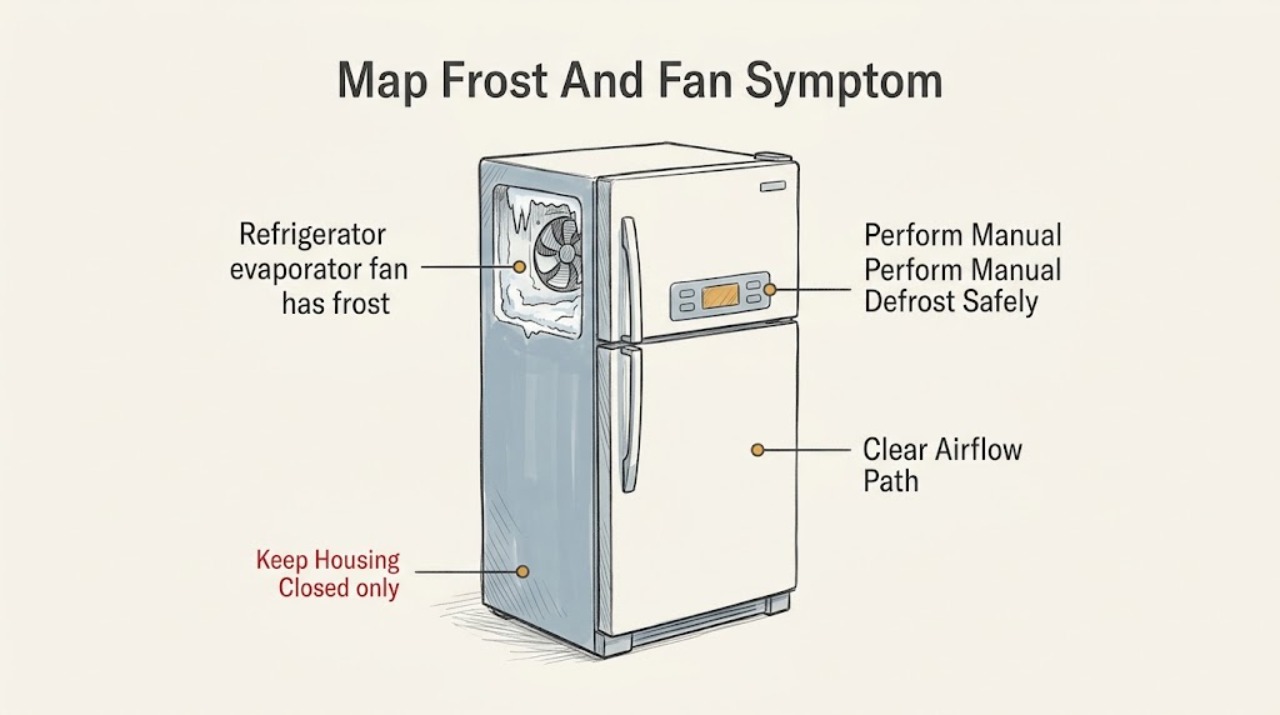
Work through in order
Diagnostic checks
Use only checks that match the exact appliance or system and its official guide.
-
Check 1
From the refrigerator compartments and without removing panels, record where frost or ice is visible, whether the fan is noisy or stopped, whether the noise changes when a door is opened, and whether one compartment is warmer than expected.
Expected result: Frost may be a light layer, a thick cover over the rear panel or vent, or concentrated around the evaporator-fan area; note poor airflow, fan rubbing, unusual noise, or warm and frozen spots.
Next step: Photograph the pattern, protect food if cooling is impaired, and continue only with accessible door, gasket, and vent checks.
Stop if: Stop if food is warming, water is reaching electrical parts, smoke or a burning odor appears, or an internal cover is frozen in place.
Why this matters
Why: A heavy localized buildup can obstruct the fan and airflow. Frost at a door edge or vent suggests an air-entry or airflow issue, while thick frost that returns after defrost makes a defrost, sensor, fan, wiring, or control problem more likely.
-
Check 2
Check that each refrigerator door closes fully, no package holds it open, the accessible rubber gasket is clean and seated, and food does not block the visible supply or return vents; do not pull on a torn gasket or move a frozen panel.
Expected result: Look for a visible gap, a dirty or split gasket, a displaced seal, an overloaded shelf, or packages directly in front of vents.
Next step: Remove only the obstruction that can be moved without force, clean and dry an intact gasket with the care method in the manual, and observe whether the door closes evenly.
Stop if: Stop for a damaged seal, misaligned door, exposed wiring, a leak, or any need to remove hinges, panels, or trim.
Why this matters
Why: Warm humid air entering through a door gap or restricted air path can promote frost and reduce cooling. A gasket that is torn or will not seat needs service rather than a temperature-control change.
-
Check 3
If the model manual permits manual defrosting and heavy ice is preventing normal airflow, remove perishables, place towels around the appliance, unplug it, prop the doors open, and allow the ice to melt naturally; do not chip the evaporator or use a hair dryer or other heat source.
Expected result: The ice may melt fully with water captured by towels, remain trapped behind a panel, or be accompanied by a fan that stays seized or a drain that overflows.
Next step: Dry the interior and floor, restore power only according to the manual, and record whether the fan and cooling recover after the ice is gone.
Stop if: Do not use heat, sharp tools, boiling water, force, or electrical equipment near meltwater; stop for a leak, damaged cord, inaccessible ice, or unsafe food temperatures.
Why this matters
Why: A complete natural defrost can restore temporary airflow, but it does not establish that the defrost system or air seal is working. Ice that cannot be safely reached or water that cannot be controlled needs professional handling.
-
Check 4
After the refrigerator has returned to normal operation, observe the door seals, vents, fan sound, compartment temperatures, and frost pattern over subsequent normal use without removing internal covers or repeatedly forcing defrost cycles.
Expected result: Frost may stay gone, return around a door or vent, return over the evaporator or fan, or be accompanied by renewed rubbing, poor cooling, or water in the cabinet.
Next step: Request service for returning frost or fan interference and provide photos and the time to recurrence; do not keep treating the symptom with repeated improvised defrosts.
Stop if: Stop using the refrigerator if cooling is unsafe, the fan is seized, water reaches electrical parts, or frost blocks the door or compartment.
Why this matters
Why: Frost that remains absent after correcting an air-entry or airflow issue supports a usage or seal cause. Frost that returns around the fan or evaporator suggests the original condition remains and may involve the defrost system, sensor, fan, drain, wiring, or control board.
-
Check 5
Compile the model number, frost location, door and vent observations, defrost method, time until recurrence, fan behavior, cooling result, and any fault indication for a qualified refrigerator technician; do not remove the evaporator cover or test internal components.
Expected result: The remaining pattern may be recurring evaporator ice, a fan that remains stopped, a defrost or sensor symptom, a drain problem, an air-seal issue, or a control-board or wiring issue.
Next step: Arrange qualified appliance service when frost returns, the fan stays stopped or noisy, cooling remains poor, or internal access is needed.
Stop if: Do not open the rear cover, disconnect a fan or sensor, measure live circuits, bypass a defrost control, or order a part solely from the frost pattern.
Why this matters
Why: These patterns help a technician distinguish the fan motor from the defrost heater, thermistor or sensor, drain, wiring, control board, and enclosure seal. The visible frost alone cannot identify which part needs replacement.
Use your observations
Decision map
Find the observation that best matches what you see, then follow the next safe action.
-
PATH 01Safety boundary
What you see
Frost is near a door edge or vent, a package holds the door open, the gasket is dirty but intact, or a vent is blocked, and the fan clears after correcting the accessible condition.
Do this next
Keep the door seal clean and fully seated, keep the visible air path open, and observe whether frost stays gone.
Why this path and its safety boundary
Why it matters: Warm air entry or restricted airflow is more likely than a failed evaporator fan motor.
Safety stop: Request service for a torn seal, misaligned door, recurring frost, or any water or cooling problem.
-
PATH 02Safety boundary
What you see
The fan noise stops when the door is opened or the fan area shows ice, and the fan is rubbing or unable to rotate normally.
Do this next
Use only the model-approved natural defrost procedure, then request service if the ice or noise returns.
Why this path and its safety boundary
Why it matters: Ice buildup is interfering with the evaporator fan; the ice is a symptom and the original cause may remain.
Safety stop: Do not use a hair dryer, heat source, sharp tool, or force to free the fan or evaporator.
-
PATH 03Safety boundary
What you see
A complete safe defrost restores airflow and cooling, and frost does not return after the door and vent condition is corrected.
Do this next
Keep doors closing fully, avoid blocking vents, and follow the model manual's normal operation and defrost guidance.
Why this path and its safety boundary
Why it matters: A temporary air-entry, loading, or defrost-interval condition is more likely, but continued monitoring is needed.
Safety stop: Arrange service if frost returns, cooling drops, or fan noise resumes.
-
PATH 04Safety boundary
What you see
The evaporator or fan frosts again after a complete natural defrost, even though the door and visible vents appear clear.
Do this next
Leave internal panels in place and arrange qualified refrigerator service with the recurrence timing and photos.
Why this path and its safety boundary
Why it matters: The underlying air seal, defrost system, sensor, drain, fan, wiring, or control board may still be malfunctioning.
Safety stop: Do not repeat improvised defrosts indefinitely, bypass controls, or replace the fan or board without diagnosis.
-
PATH 05Safety boundary
What you see
The ice is gone or not visibly accessible, but the evaporator fan remains stopped or noisy and the freezer or fresh-food compartment cools poorly.
Do this next
Keep the refrigerator doors closed as much as practical, protect perishables, and arrange prompt appliance service.
Why this path and its safety boundary
Why it matters: A fan motor, obstruction behind a cover, control, sensor, defrost, or wiring issue is possible; airflow and food safety are compromised.
Safety stop: Do not reach behind the cover, force the fan, or run the appliance with a seized fan and worsening temperatures.
-
PATH 06Safety boundary
What you see
Meltwater overflows, reaches electrical parts, the cord or outlet is wet or damaged, or the refrigerator shows smoke, burning odor, or sparking.
Do this next
Stop using the refrigerator if it can be done without contacting the hazard, keep clear, protect the area from spread, and arrange prompt qualified appliance or electrical service; use emergency procedures for active smoke or fire.
Why this path and its safety boundary
Why it matters: This is an appliance and electrical safety boundary, not a routine frost cleanup.
Safety stop: Do not touch wet electrical parts, use a heat source, open panels, or restore power to damaged equipment.
Helpful context
Understand the symptom
Frost at the fan is an airflow symptom, not a fan-only diagnosis
Ice can physically restrict an evaporator fan and the airflow that moves cold air through the compartments. A door gap, damaged gasket, warm food, frequent openings, blocked vents, or a defrost system that does not clear the evaporator can all lead to the same visible symptom. Note the location and pattern of frost before assuming the fan motor has failed.
Check the air path and door seal before opening anything
Look for packages pressing against vents, a door that does not close fully, a dirty or torn gasket, or a compartment overloaded enough to hold the door open. Frost near a vent or back wall can itself block airflow. These are ordinary-use observations; do not remove the evaporator cover or reach behind a frozen panel.
A natural defrost can remove ice, but it does not prove the cause is fixed
Samsung's guidance for a fan hitting ice describes removing perishables, protecting the floor with towels, unplugging the refrigerator, propping doors open, and allowing the ice to melt. It specifically warns against using a hair dryer or another heat source. If the fan noise or frost returns after the ice is fully gone, service is needed to correct the underlying cause.
Automatic-defrost refrigerators should not keep building heavy ice
GE explains that automatic-defrost models melt frost from the evaporator during a defrost cycle. Heavy frost or ice accumulation means the appliance needs a technician's assessment. A service document may list the evaporator fan, thermistor or sensor, defrost parts, control board, and wiring as separate diagnostic paths; that does not make internal testing a homeowner task.
Protect food and stop when cooling or water control is compromised
Move perishable food to safe cold storage before a prolonged defrost and monitor for water around the appliance. If the refrigerator cannot hold safe temperatures, water reaches electrical parts or flooring, the fan stays stopped, or frost returns quickly, keep the unit off or minimize use as appropriate and arrange qualified appliance service.
Safety boundary
Stop conditions
- Do not chip, pry, or force ice from the evaporator, fan, or rear cover, and do not reach behind a frozen panel.
- Do not use a hair dryer, heat gun, boiling water, sharp tool, or other heat source to speed defrosting.
- Do not remove internal covers, disconnect the evaporator fan or sensor, bypass defrost controls, or measure live circuits as a homeowner check.
- Stop for water near electrical parts, a wet or damaged cord or outlet, smoke, burning odor, sparks, unsafe food temperatures, or a seized fan with worsening cooling.
- Arrange qualified refrigerator service when frost returns after a complete safe defrost, the fan remains stopped or noisy, cooling is poor, or the cause is uncertain.
Only after diagnosis
Potential parts
- evaporator fan motor
Consider this only when a qualified diagnosis confirms that the fan motor is seized, noisy, electrically failed, or otherwise defective after ice and defrost causes are addressed.
Match the exact refrigerator model, fan assembly, connector, mounting, and airflow direction; do not force or substitute a motor by appearance. - evaporator cover or gasket
Consider this only when the installed cover or seal is damaged, misaligned, or confirmed by a technician to permit frost around the fan.
Match the exact cabinet, cover geometry, seal, sensor placement, and model instructions; do not remove a frozen cover as a first check. - defrost sensor or thermistor
Consider this only after qualified testing identifies a failed or mispositioned defrost sensor or thermistor as the cause of recurring evaporator frost.
Confirm the exact model, sensor type, connector, placement, and service procedure; do not substitute a sensor from a similar-looking refrigerator. - refrigerator control board
Consider this only after a qualified diagnosis separates a control-board fault from the fan, defrost system, sensor, drain, and wiring.
Match the exact model revision, connectors, configuration requirements, and approved service instructions; do not replace a board solely from a frost pattern.
When checks do not resolve it
Need a professional?
Arrange qualified refrigerator service when evaporator frost returns after a complete natural defrost, the fan remains stopped or noisy, cooling is poor, the door gasket is damaged, the ice is inaccessible, or a defrost, sensor, drain, wiring, or control-board fault is suspected. Stop using the appliance and escalate promptly for water near electrical parts, a damaged cord or outlet, smoke, burning odor, sparks, or unsafe food temperatures.
Safety scope: This article supports accessible door, gasket, vent, frost, and food-protection observations plus a model-approved natural defrost. A qualified technician must handle evaporator-cover access, fan, defrost, sensor, drain, wiring, control-board, and refrigerant-system work.
Common questions
FAQ
Why does frost build up around a refrigerator evaporator fan?
Warm moist air from a door gap, blocked vents, heavy loading, or a defrost problem can create ice around the evaporator fan. The ice can restrict airflow or make the fan rub, but recurring frost can also involve the fan, sensor, drain, wiring, or control board.
Can I manually defrost a refrigerator with ice around the fan?
If the model manual permits it, protect food and the floor, unplug the refrigerator, prop the doors open, and let the ice melt naturally. Do not chip the evaporator or use a hair dryer, heat gun, boiling water, or other heat source.
Will defrosting permanently fix an evaporator fan that is blocked by frost?
It may restore airflow temporarily, but it does not prove the original cause is fixed. If frost or fan noise returns after a complete safe defrost, arrange service to assess the door seal, defrost system, sensor, fan, drain, wiring, and controls.
Should I remove the evaporator cover to clear the frost?
No. Leave a frozen or stuck internal cover in place. Removing it can damage seals, wiring, sensors, or the evaporator. A qualified technician should handle internal access and determine whether the fan, defrost parts, sensor, or control board needs repair.
When should I call for refrigerator frost and fan service?
Call when frost returns, the fan stays stopped or noisy, cooling is poor, a gasket is damaged, the ice is inaccessible, or water reaches electrical parts. Stop using the appliance and escalate promptly for smoke, burning odor, sparks, a wet cord or outlet, or unsafe food temperatures.
Read the exact guide
Official sources
- Refrigerator - Automatic Defrost SystemGE Appliances · GE Appliances general automatic-defrost guidance; the installed model's manual and qualified service control diagnosis.
- Frost forms in the Samsung freezer, refrigerator, or ice bucketSamsung · Samsung consumer guidance for frost in refrigerator and freezer compartments; model-specific operation and service instructions control.
- Understanding the different noises coming from your Samsung refrigeratorSamsung · Samsung consumer guidance for a refrigerator fan hitting ice; the installed model manual controls defrost details and service decisions.
- How to Check the Air Vents for Blockage-Ensuring Proper Air FlowWhirlpool · Whirlpool general refrigerator airflow guidance; vent locations and controls vary by model.
- Service Pointer - W11329116C- Refrigerator Evaporator Clogged With IceWhirlpool · Whirlpool technical service pointer for specified refrigeration products; its cover and control-board procedures are for service personnel and are not a general homeowner repair guide.
Community feedback
Share a repair observation
Share a plain-text repair observation. Accepted observations are published automatically; this page may take a moment to update.