
On this page
Start here
Quick answer
Frost that covers a refrigerator vent or the freezer's rear panel can reduce the cold-air path and create warm or frozen spots. First protect the food, record where the frost is, and check from inside for packages against the rear wall or in front of vents and for a door or gasket that is not closing. Warm humid air from a door left open, a poor gasket seal, blocked vents, or hot food can create frost; once frost is on a vent, it can block airflow even after food is moved. Clear light frost only by the model manual; for heavy ice, unplug or use the manufacturer's defrost procedure and never use a hair dryer, knife, heat gun, or sharp tool. If frost returns after a complete safe defrost, airflow remains low, a fan is noisy or stopped, or temperatures are unsafe, arrange refrigerator service for the defrost system, fan, sensor, drain, gasket, or sealed system rather than repeatedly scraping ice.
Before you begin
Safety first
- This article supports safe observation, food repositioning, gasket cleaning, vent clearance, and manual-approved defrost only. A qualified technician handles evaporator covers, fan, defrost heater, thermistors, drain, controls, wiring, sealed-system diagnosis, and refrigerant work.
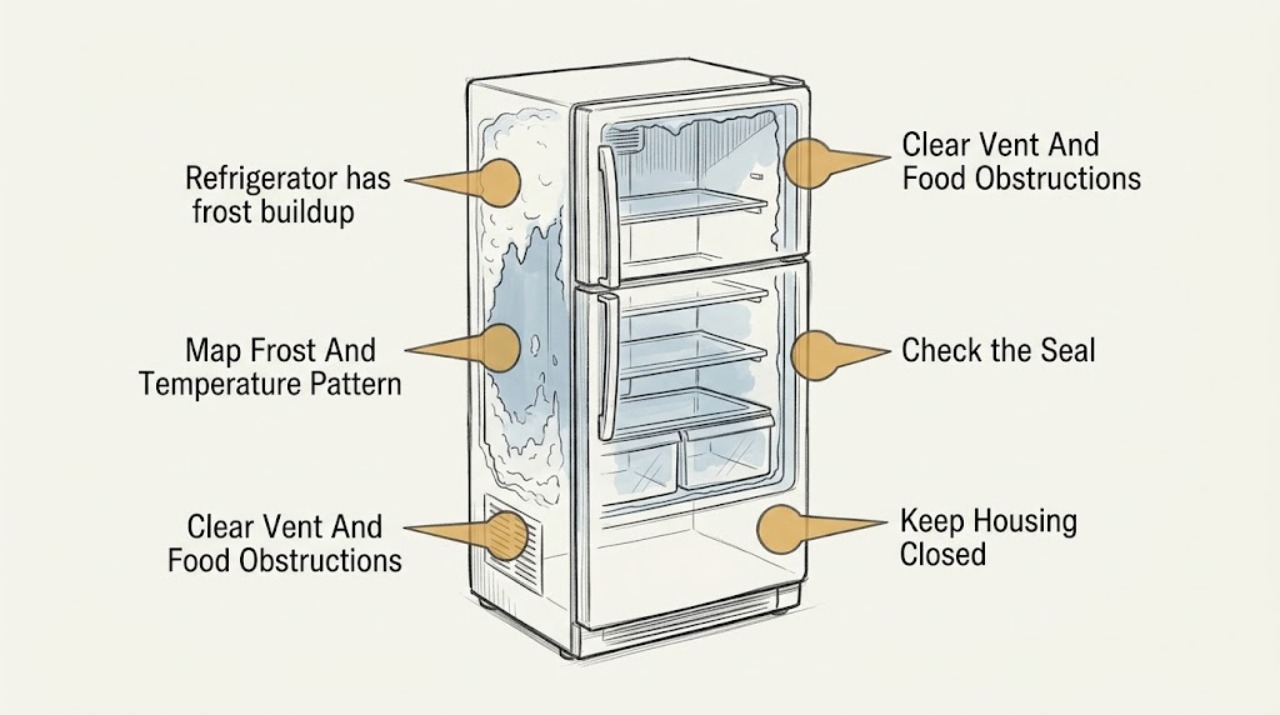
Work through in order
Diagnostic checks
Use only checks that match the exact appliance or system and its official guide.
-
Check 1
From a safe position, map the frost and airflow symptom in both compartments before moving large amounts of food; note the rear panel, each vent, shelves, door area, and the location of warm or frozen items.
Expected result: Record whether frost is light or a thick sheet, limited to a vent or rear panel, spread across one compartment, around the door opening, or accompanied by a silent, noisy, or intermittent fan; note warm spots and food near vents.
Next step: Photograph the pattern and protect perishable food while performing only the accessible vent, door, and gasket checks.
Stop if: Stop opening the appliance further for a cracked liner, exposed wiring, leaking water near electrical parts, unsafe food temperatures, or ice that cannot be reached without force.
Why this matters
Why: Frost concentrated on an air path can directly explain reduced airflow, while frost at a gasket or door edge points toward moisture entry. A broad or quickly returning rear-panel ice sheet with poor cooling makes defrost, fan, sensor, drain, or sealed-system service more likely.
-
Check 2
Locate the model-specific supply and return vents and move packages away from them and the freezer or refrigerator rear wall, preserving the manual's required clearance; do not chip frost off a vent.
Expected result: Record whether a package was directly against a vent or rear wall, whether air becomes perceptible after only a light frost is wiped as the manual permits, and whether the same vent remains blocked by ice.
Next step: Keep vents unobstructed and monitor temperature; use the model's defrost procedure for heavy frost rather than inserting a tool into the vent.
Stop if: Do not remove a vent grille, insert a knife or screwdriver, pour water into a vent, or store food where it can block the airflow path.
Why this matters
Why: Whirlpool and Samsung identify blocked vents and food against the rear wall as causes of restricted circulation, moisture, frost, and local freezing or warming. If the vent remains ice-blocked after food is moved, the frost itself must be safely cleared and may indicate a recurring fault.
-
Check 3
Inspect the refrigerator and freezer door gaskets from the outside, wiping away food residue with the manual-approved method, and check that no package, drawer, hinge-side obstruction, or uneven loading prevents full closure.
Expected result: Record a gasket that is dirty, torn, split, warped, detached, not contacting the cabinet, or wet with condensation; note whether the door springs open, leaves a visible gap, or closes fully after the obstruction is removed.
Next step: Keep the door fully closed and arrange a model-specific gasket or hinge assessment if the seal is damaged, misaligned, or cannot close without force.
Stop if: Do not heat, stretch, glue, cut, or replace a gasket by appearance alone, and do not force a door, hinge, drawer, or liner into alignment.
Why this matters
Why: Whirlpool and Samsung associate poor door sealing or doors left open with warm humid air entering and frost formation. A damaged or persistently unseated gasket can keep creating frost and reduce airflow even after one defrost.
-
Check 4
Review the recent moisture load: long or frequent door openings, uncovered or hot food, overloaded shelves, or items packed directly in front of vents; change only the safe loading behavior allowed by the manual.
Expected result: Record whether frost started after a door was left open, a warm load was added, high-humidity conditions, a move, or a sudden increase in stored food; note whether the problem is isolated to the affected compartment.
Next step: Keep doors closed as much as practical, cool food as the model or food-safety guidance requires, and leave air paths clear; continue to the safe defrost decision when ice already blocks airflow.
Stop if: Do not leave doors open to test, place hot containers against vents, or keep perishable food in a compartment that cannot maintain safe temperature.
Why this matters
Why: Warm humid air and hot food can add moisture that freezes, while overcrowding can restrict the air path. A one-time event that does not recur after proper loading supports a moisture or obstruction cause; frost that returns under normal use points toward a seal, defrost, fan, drain, or control issue.
-
Check 5
Decide whether the frost is light enough for the model manual's surface-cleaning method or heavy enough to require the full power-off and defrost procedure; plan for meltwater and food storage before disconnecting power.
Expected result: Classify the frost as a thin removable layer, a vent or fan visibly blocked by ice, a thick rear-panel sheet, or ice that cannot be safely reached; note whether the manual specifies an automatic or manual defrost process.
Next step: Use only the manual-approved defrost method, let ice melt without tools or forced heat, dry the compartments, and allow normal operation before evaluating airflow; call service if the frost returns.
Stop if: Do not use a hair dryer, heat gun, open flame, knife, screwdriver, ice pick, salt, or boiling water, and do not energize the refrigerator with wet electrical areas.
Why this matters
Why: Heavy frost can itself stop airflow, but unsafe scraping or heating can damage the liner, evaporator, wiring, or appliance. Samsung says heavy buildup that cannot be cleared by hand needs defrosting and warns against a hair dryer; model manuals determine the exact process.
-
Check 6
After the safe defrost or loading correction, monitor the vents, temperatures, and fan sound during normal operation without removing interior panels; record the time until airflow and cooling stabilize according to the owner manual.
Expected result: Record whether airflow returns, the same frost location reforms, the fan is silent or grinding, one compartment remains warm, food freezes near a vent, or the refrigerator runs unusually long.
Next step: Keep the appliance operating only if it maintains safe temperatures without hazardous symptoms and arrange appliance service for recurrence, poor cooling, fan abnormality, leaks, or inaccessible ice.
Stop if: Stop and disconnect power only as the manual permits for a clearly identified appliance when there is smoke, burning odor, arcing, damaged wiring, water near electrical parts, or a tripped breaker; do not repeatedly reset it.
Why this matters
Why: Restored airflow without recurring frost supports a moisture or loading cause. Rapid frost return, persistent reduced airflow, fan noise or silence, and uneven temperatures make a defrost heater, thermistor, fan, drain, door seal, control, or sealed-system problem more likely.
Use your observations
Decision map
Find the observation that best matches what you see, then follow the next safe action.
-
PATH 01Safety boundary
What you see
Frost is light or localized, packages were against the rear wall or vent, and airflow improves after safe repositioning.
Do this next
Keep the model-specific vents and return paths clear, avoid loading against the rear wall, and monitor for recurring frost or temperature drift.
Why this path and its safety boundary
Why it matters: Food placement and blocked circulation are more likely contributors than a failed defrost component.
Safety stop: Do not pry vent covers, chip ice, or treat temporary airflow improvement as proof that recurring frost is resolved.
-
PATH 02Safety boundary
What you see
Frost or condensation is concentrated near the door edge, the door was left open, or the gasket is dirty, torn, split, or not contacting the cabinet.
Do this next
Remove obstructions, clean the gasket as directed, verify full closure, and arrange a model-specific gasket or hinge assessment for damage or persistent gaps.
Why this path and its safety boundary
Why it matters: Warm humid air entering through the door seal is more likely to be adding the moisture that freezes; blocked airflow may be a consequence rather than the initial fault.
Safety stop: Do not heat, stretch, glue, cut, or force the gasket or door into alignment.
-
PATH 03Safety boundary
What you see
A thick frost sheet or ice blocks the vent, evaporator area, or rear panel, and airflow is reduced or one compartment is warming.
Do this next
Use the exact owner-manual defrost and power procedure, protect food and meltwater, and let the appliance dry before restarting; call service when ice is inaccessible or returns.
Why this path and its safety boundary
Why it matters: The ice is now an airflow obstruction and needs a complete safe defrost; its return after defrost would point to a recurring fault.
Safety stop: Do not use a hair dryer, heat gun, flame, sharp tool, salt, or boiling water, and do not remove the evaporator cover as a user step.
-
PATH 04Safety boundary
What you see
The refrigerator is fully and safely defrosted, vents and gasket are corrected, but frost quickly returns, airflow stays low, or the fan is noisy or silent.
Do this next
Arrange qualified appliance service and provide the frost map, recurrence interval, temperatures, fan sound, door-seal observations, and model information.
Why this path and its safety boundary
Why it matters: A defrost heater, thermistor, control, fan, drain, sealed-system, or persistent seal problem is more likely than a one-time loading event.
Safety stop: Do not repeat manual defrosts indefinitely, run with the fan obstructed by ice, or open panels to test a heater, sensor, wiring, or sealed system.
-
PATH 05Safety boundary
What you see
Frost began after a long-open door, hot or uncovered food, high humidity, moving, or a large loading event and does not recur after normal use resumes.
Do this next
Keep food covered or cooled as appropriate, reduce unnecessary door opening, maintain clearance, and monitor the affected compartment for recurrence.
Why this path and its safety boundary
Why it matters: A temporary humidity load is more likely than a hardware failure, provided airflow and temperatures return to normal after safe frost removal.
Safety stop: Do not use a warm or frost-blocked compartment for perishable food if safe temperatures cannot be maintained.
-
PATH 06Safety boundary
What you see
There is smoke, burning odor, arcing, damaged wiring, water near electrical parts, a tripped breaker, a cracked liner, or frost that cannot be safely cleared.
Do this next
Stop using the refrigerator as appropriate, isolate power only from a safe known disconnect, protect food if possible, and arrange qualified appliance service.
Why this path and its safety boundary
Why it matters: The issue has crossed into electrical, water, food-safety, or appliance-damage risk and is not a vent-clearing task.
Safety stop: Do not touch wet wiring, repeatedly reset a breaker, use heat or sharp tools, or remove internal panels.
Helpful context
Understand the symptom
Find out whether the frost is blocking the air path
Cold air normally moves between the freezer and fresh-food compartment through model-specific supply and return vents. Frost on a vent or rear panel can reduce that path and cause a warm shelf, a frozen item near one vent, or longer run times. Start with a non-contact map: note the compartment, rear wall or vent location, thickness and spread of frost, warm or frozen spots, and fan sound. Do not pry the rear panel or dig through ice to reach a hidden fan.
Correct moisture entry and blocked vents before blaming the defrost system
Whirlpool and Samsung both identify doors left open, frequent openings, damaged or dirty gaskets, hot food, packages against the rear wall, and blocked vents as frost contributors. Move only food that can be safely handled, leave the vents clear according to the model manual, clean the gasket surface, and confirm the door closes without a package in the way. If the frost is heavy, the food temperature is unsafe, or the frost returns after those corrections, a defrost, fan, sensor, drain, or sealed-system diagnosis is needed.
Defrost without heat, sharp tools, or repeated scraping
Light frost may be wiped with a damp cloth and dried when the manual permits it. Samsung advises a full defrost for heavy buildup that cannot be cleared by hand and warns against using a hair dryer. Use the exact manual's power and defrost procedure, protect the floor from meltwater, and allow the appliance to return to its normal operating condition before judging airflow. If the rear cover, fan, drain, wiring, or evaporator remains hidden behind ice, stop at the safe boundary and call service.
Safety boundary
Stop conditions
- Do not use a hair dryer, heat gun, open flame, knife, screwdriver, ice pick, salt, boiling water, or chemical product to remove frost.
- Do not remove evaporator covers, fan guards, wiring, sensors, defrost heaters, or control panels as a user test.
- Stop for smoke, burning odor, arcing, damaged wiring, water near electrical parts, a tripped breaker, cracked liner, or an appliance that has been wet internally.
- Do not keep perishable food in a compartment that cannot maintain safe temperature, and do not leave doors open to reproduce frost.
- Arrange service when heavy frost returns after a complete manual-approved defrost, airflow remains reduced, the fan is abnormal, or the door gasket cannot seal.
Only after diagnosis
Potential parts
- refrigerator door gasket
Consider this category only when inspection confirms a torn, split, warped, detached, or persistently unseated gasket is allowing moisture entry after obstructions and cleaning are addressed.
Confirm the exact refrigerator model, door configuration, gasket profile, and installation method; do not stretch, heat, glue, or select a seal by appearance alone. - evaporator fan motor or blade
Consider this category only after qualified diagnosis confirms reduced airflow is caused by a failed or damaged fan rather than ice obstruction, defrost, control, or loading.
Confirm the exact model, fan assembly, blade direction, connector, and service procedure; internal fan access requires power isolation and model-specific expertise. - defrost heater, thermistor, or control
Consider this category only when recurring frost after a complete safe defrost and clear airflow leads a qualified technician to confirm a defrost-system or sensing fault.
Confirm exact model, part specification, wiring, sensor placement, and diagnostic result; do not replace a defrost part from frost appearance alone.
When checks do not resolve it
Need a professional?
Arrange qualified refrigerator service when heavy frost blocks the air path, frost returns quickly after a complete model-approved defrost, a fan is silent or noisy, one compartment stays warm, the door gasket or hinge cannot seal, the defrost drain or rear panel is inaccessible, temperatures are unsafe, or smoke, odor, arcing, water near electrical parts, or breaker trips occur. Provide the frost map, door and vent observations, food-loading history, fan behavior, temperatures, model, and recurrence interval.
Safety scope: This article supports safe observation, food repositioning, gasket cleaning, vent clearance, and manual-approved defrost only. A qualified technician handles evaporator covers, fan, defrost heater, thermistors, drain, controls, wiring, sealed-system diagnosis, and refrigerant work.
Common questions
FAQ
Why does frost reduce refrigerator airflow?
Frost can cover a supply or return vent and reduce the cold-air path between freezer and refrigerator compartments. That can create warm shelves, frozen items near a vent, longer run times, and uneven temperatures.
What should I check before defrosting a frosted refrigerator?
Map the frost location, move food away from model-specific vents and the rear wall, check that doors close fully, and inspect the gaskets for dirt or damage. If frost is heavy and blocks airflow, use only the exact manual's defrost procedure.
Can a bad refrigerator door gasket cause frost buildup?
Yes. A dirty, torn, split, warped, or unseated gasket can let warm humid air enter and freeze. Remove door obstructions and clean the gasket as instructed; arrange a model-specific gasket or hinge assessment if the seal remains open.
Can I use a hair dryer or knife to remove refrigerator ice?
No. Samsung warns against using a hair dryer, and sharp tools or forced heat can damage the liner, evaporator, wiring, or sealed system. Use the model-approved defrost method and let ice melt without tools or improvised heat.
Why does frost come back after I defrost the refrigerator?
Returning frost can result from a door-seal problem, blocked airflow, fan issue, defrost heater or sensor fault, drain problem, control issue, or another model-specific condition. If it returns quickly after a complete safe defrost, arrange appliance service rather than repeatedly scraping it.
When is reduced refrigerator airflow urgent?
Arrange prompt service when food temperatures are unsafe, a thick ice sheet blocks the fan or vent, the fan is silent or grinding, frost rapidly returns, the door cannot seal, or there is smoke, burning odor, arcing, water near electrical parts, or a tripped breaker.
Read the exact guide
Official sources
- Frost forms in the Samsung freezer, refrigerator, or ice bucketSamsung US · Samsung refrigerator guidance used for general frost and airflow safety; the installed refrigerator's manual controls the exact defrost and power procedure.
- How to Check the Air Vents for Blockage-Ensuring Proper Air FlowWhirlpool Product Help · Whirlpool refrigerator airflow guidance; vent locations, clearances, controls, and service boundaries are model-specific.
- Frost accumulate in Samsung Refrigerator or FreezerSamsung Singapore · Samsung regional refrigerator guidance used for general frost mechanisms; model-specific parts and procedures differ.
- Frosting in the Freezer Section - RefrigeratorWhirlpool Product Help · Whirlpool refrigerator guidance used for general frost and airflow mechanisms; exact compartment layout and controls vary by model.
Community feedback
Share a repair observation
Share a plain-text repair observation. Accepted observations are published automatically; this page may take a moment to update.