
On this page
Start here
Quick answer
A thin film of frost or condensation on a refrigerator's cold rear wall can occur during normal cooling or after a defrost cycle, but frost that covers the wall, returns quickly, blocks vents, or accompanies warm food needs attention. Check that food is not touching the rear wall, vents are clear, doors close fully, and the gasket is clean and intact. Store hot or moist food in sealed containers and reduce unnecessary door opening. For heavy buildup, use only the defrost procedure in the exact model manual; never chip ice with a sharp tool, use a hair dryer or other heat source, or pour hot water into the appliance. If frost returns after safe external corrections, or a fan is noisy/not running, arrange qualified appliance service.
Before you begin
Safety first
- Owner checks are limited to safe food rearrangement, accessible gasket cleaning, visible vent and door inspection, model-approved light wiping or manual defrost, and documentation. A qualified professional must handle internal panels, fans, defrost heaters and sensors, drain access, live electrical testing, controls, compressors, refrigerant circuits, and model-specific part replacement.
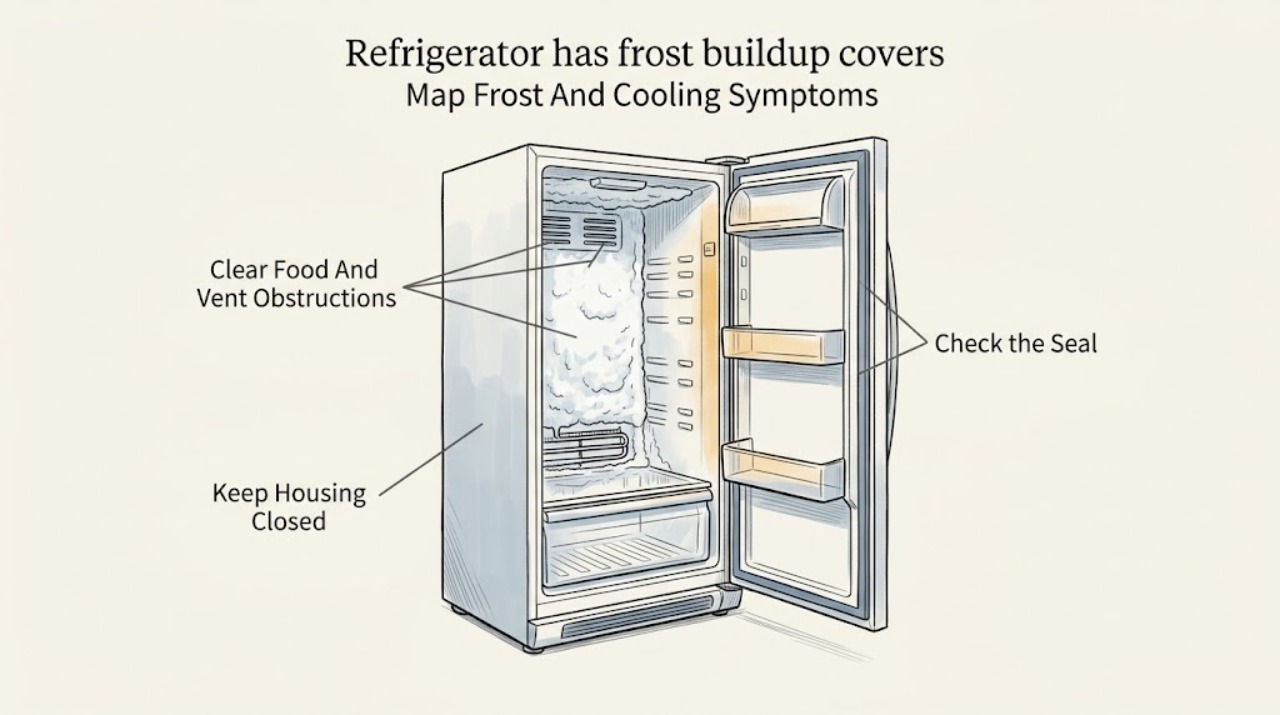
Work through in order
Diagnostic checks
Use only checks that match the exact appliance or system and its official guide.
-
Check 1
From inside the refrigerator, photograph the rear wall and note whether the frost is light or thick, uniform or localized, touching food, covering an air vent, or accompanied by water, unusual noise, or warm food. Do not scrape the frost to expose the wall.
Expected result: There is only a light film; hard frost covers much of the wall; frost is concentrated around a vent or door edge; food is against the rear wall; or cooling is weak or uneven.
Next step: Continue with external door, food, and vent checks only when the interior is safe. Keep food from touching the wall and arrange service if frost is heavy, recurrent, or paired with poor cooling.
Stop if: Stop if the liner is cracked or punctured, wiring is exposed, water is near electrical parts, frost surrounds a fan or hidden panel, or checking the area would require a sharp tool or panel removal.
Why this matters
Why: Light, temporary frost can occur on a cold rear wall. Heavy or recurring frost, blocked vents, a localized edge pattern, and poor cooling make warm-air entry, blocked airflow, or a defrost or fan fault more likely.
-
Check 2
Move containers away from the rear wall and leave the visible air vents unobstructed. Remove packages that press against the door or keep drawers and shelves from seating correctly. Let hot food cool before storing it and seal high-moisture food in containers or bags.
Expected result: A package was against the rear wall; a vent was blocked; the compartment was overfilled; hot or uncovered food was present; or the frost remains despite clear spacing.
Next step: Keep a clear path around vents and the rear wall and observe the appliance under normal use. If frost continues to spread or cooling remains uneven, proceed to the door-seal check and prepare for service.
Stop if: Stop if moving food exposes a sharp ice edge, damaged liner, leaking container near electrical parts, or a hidden fan or panel that would need to be opened.
Why this matters
Why: Direct contact with the cold wall and restricted airflow can create local frost and uneven temperatures. Hot or uncovered food adds moisture that can freeze. Persistence after correction points away from food placement alone.
-
Check 3
Close the refrigerator door normally and inspect the accessible gasket all the way around for dirt, gaps, tears, splits, compression, or a package holding the door open. Clean the gasket and the mating surface with the mild method in the model manual, then dry it; do not pull out or replace the gasket as a trial.
Expected result: The door does not close fully; a shelf or package interferes; the gasket is dirty; the gasket is torn or no longer seals; or the door and gasket appear sound.
Next step: Remove the obstruction or clean the accessible seal, then monitor under normal door use. If the gasket is damaged, the door is misaligned, or frost returns despite a sound seal, request qualified service.
Stop if: Stop if the door is sagging, glass or liner is damaged, the gasket cannot be safely cleaned, or correction would require door removal, hinge adjustment, or wiring access.
Why this matters
Why: A door gap admits warm humid air, which can freeze on the rear wall. A dirty gasket may be serviceable with cleaning, while a damaged or distorted seal needs the correct model part and installation rather than adhesive or improvised packing.
-
Check 4
If the frost is heavy and the exact model manual permits manual defrost, protect the food, disconnect power using the manual's procedure, leave the doors open as directed, and let the ice melt naturally. Place towels where meltwater can be contained. Never chip the ice, use a knife or pick, use a hair dryer or other heat source, or pour hot water into the compartment or drain.
Expected result: The frost melts completely and does not return; frost remains in a hidden area; meltwater does not drain normally; or frost returns soon after the appliance stabilizes.
Next step: Restore operation only according to the exact model manual after the compartment is dry. If the frost returns, cooling is abnormal, or drainage is blocked, stop repeated defrost cycles and call appliance service.
Stop if: Stop if the manual is unavailable, the ice cannot melt without tools or heat, water reaches electrical components, the liner is damaged, or a hidden panel or drain must be opened.
Why this matters
Why: A complete manual defrost can temporarily restore airflow when ice itself is blocking a vent. Frost that remains hidden, drainage that does not behave normally, or rapid recurrence suggests a seal, fan, defrost, sensor, drain, or control problem rather than a simple surface issue.
-
Check 5
After safe external corrections, observe whether the refrigerator reaches its normal temperature, whether airflow is present at accessible vents, and whether the fan makes rubbing, clicking, or no sound when the model normally calls for circulation. Do not remove the rear mechanical cover or reach into a fan.
Expected result: Cooling returns; airflow is weak or absent; the fan is noisy or stops; food remains warm; or frost returns while the door seal and food arrangement are normal.
Next step: Record the temperature behavior and sound without touching the equipment. Arrange qualified appliance service for persistent frost, weak cooling, or abnormal fan behavior; do not bypass a fan or defrost control.
Stop if: Stop if a fan blade, evaporator, wiring, rear cover, compressor area, or sealed refrigeration component would need to be accessed.
Why this matters
Why: A fan obstruction, frost around a fan, defrost-system fault, sensor or control issue, or another sealed refrigeration problem becomes more likely when normal airflow and sealing corrections do not resolve the frost. Absence of an audible fan alone is not a universal diagnosis because fan operation varies by mode and model.
-
Check 6
Record the refrigerator model and serial information from a safely visible label or paperwork, frost location and thickness, door-seal condition, food and vent arrangement, recent power interruption or cleaning, whether a manual defrost was performed, and the time until frost returned. Take photos before changing anything.
Expected result: Frost returns after a complete safe defrost; the pattern is limited to one area; cooling is weak; water leaks; an alert appears; or the cause remains uncertain.
Next step: Give the record to the manufacturer or a qualified appliance technician and keep food safely stored elsewhere if temperatures are not maintained. Do not keep repeating a risky manual-defrost or power-cycle experiment.
Stop if: End owner troubleshooting when diagnosis requires an internal panel, live electrical test, fan or heater test, refrigerant work, drain access, control-board access, or an unverified replacement part.
Why this matters
Why: Recurrence, localized frost, warm food, water, an alert, or uncertainty makes an internal air-seal, fan, defrost, drain, sensor, or control diagnosis more likely. The model number is essential because defrost procedures, parts, and normal behavior differ.
Use your observations
Decision map
Find the observation that best matches what you see, then follow the next safe action.
-
PATH 01Next step
What you see
Frost is localized where food touches the rear wall or where an air vent is blocked, and the door seals normally.
Do this next
Rearrange food to clear the wall and vents, seal moist food, and observe normal operation. Escalate if frost spreads or returns after the arrangement stays clear.
Why this path and its safety boundary
Why it matters: Cold-surface contact and restricted circulation are more likely than an immediate sealed-system failure.
-
PATH 02Next step
What you see
Frost follows a door edge or one side, a package prevents complete closure, or the gasket has a gap, dirt, tear, or split.
Do this next
Remove the obstruction or clean the accessible gasket. Have a technician replace a damaged gasket or correct door alignment; do not improvise a seal.
Why this path and its safety boundary
Why it matters: Warm humid air entering through the door is more likely, and the pattern may continue until the obstruction or seal issue is corrected.
-
PATH 03Next step
What you see
Only a light film or droplets appear, the rear wall is not covered, food stays at normal temperature, and moisture follows a recent defrost, power restoration, or humid period.
Do this next
Wipe only as the model manual permits, keep food sealed and doors closed promptly, and monitor. Request service if the frost becomes heavy, blocks vents, or persists with poor cooling.
Why this path and its safety boundary
Why it matters: Normal condensation or temporary moisture is possible, especially while the cabinet returns to stable operation.
-
PATH 04Next step
What you see
A complete safe defrost clears the wall but frost returns quickly, or frost remains around a vent or hidden fan while the door seal and food placement are normal.
Do this next
Keep food safely stored, document the recurrence, and arrange qualified appliance service. Do not remove panels or test heaters and sensors yourself.
Why this path and its safety boundary
Why it matters: A defrost, fan, drain, sensor, control, or air-seal problem is more likely than surface moisture alone. Repeating defrost without diagnosis only masks the fault.
-
PATH 05Next step
What you see
Frost covers the rear wall while food is warm, airflow is weak, a fan is abnormal, water leaks, an alert appears, or the liner and electrical area are damaged.
Do this next
Move perishable food to safe cold storage, keep clear of damaged or wet equipment, and request prompt qualified appliance service. Use emergency help for smoke, sparking, or fire.
Why this path and its safety boundary
Why it matters: The appliance may not be maintaining safe food temperature or may have an internal or electrical fault; frost is a symptom rather than a safe repair target.
Helpful context
Understand the symptom
First decide whether the frost is light or obstructive
The rear wall is a very cold surface, so a small amount of condensation or frost may be normal on some models. A wall covered in hard frost, frost spreading to vents or food, repeated ice after clearing, or frost with poor cooling is not something to ignore. Before moving food, note whether the frost is uniform or concentrated around a door edge, vent, or one area; that pattern helps separate moisture entry from an airflow or defrost problem.
Warm air and blocked airflow are the safe first checks
Warm, moist room air freezes when it enters the cabinet. Check for packages preventing the door from closing, a dirty or damaged gasket, frequent or prolonged door opening, hot food, uncovered moist food, and food pressed against the rear wall or vents. Correct only the accessible food arrangement and gasket surface. Do not remove an interior panel to reach a fan, evaporator, heater, sensor, or drain.
Defrost without damaging the liner or controls
For light frost, follow the model manual's approved wiping method and dry the surface. Heavy buildup may require a full manual defrost using the exact model procedure, with food protected and the appliance disconnected only as directed. Do not use a knife, ice pick, awl, hair dryer, heat gun, open flame, or hot water inside the refrigerator. If frost is too hard to clear safely, stop and request service.
Safety boundary
Stop conditions
- Do not use a knife, ice pick, awl, screwdriver, hair dryer, heat gun, open flame, or other heat source to remove frost; do not pour hot water into the refrigerator or defrost drain.
- Stop if water reaches electrical parts, the liner is punctured or cracked, wiring is exposed, the appliance smokes or sparks, or the compressor or rear mechanical area is damaged.
- Do not remove rear or evaporator covers, reach into fans, test live circuits, access sealed refrigeration tubing, or bypass defrost, fan, temperature, or alarm controls.
- Stop repeated manual-defrost or power-cycle attempts when frost returns, food stays warm, a fan is abnormal, water leaks, or the exact model procedure is unavailable.
- Arrange qualified appliance service when a damaged gasket, blocked internal drain, fan, heater, sensor, control, or refrigeration system is suspected; store perishable food safely while temperatures are uncertain.
Only after diagnosis
Potential parts
- refrigerator door gasket
Consider this only when a qualified diagnosis confirms the gasket is torn, split, permanently deformed, or unable to seal after cleaning and closure checks.
Confirm the exact refrigerator model, door configuration, gasket profile, and installation procedure before ordering; do not choose a seal by appearance. - refrigerator evaporator fan motor
Consider this only after a technician confirms that the fan is not operating or is damaged and rules out frost obstruction, wiring, sensor, and control causes.
Verify the exact model, fan assembly, connector, voltage, and airflow direction; do not reach through a panel or substitute a generic motor. - refrigerator defrost sensor or heater
Consider this only when recurring heavy frost persists after the air-seal and food checks and a qualified technician identifies a failed defrost component.
Defrost components vary by model and control system; confirm the diagnosis, exact part identity, connectors, and manufacturer fit information before ordering. - refrigerator defrost drain component
Consider this only when a technician confirms a blocked, damaged, or model-specific drain component associated with frost or meltwater symptoms.
Confirm the exact model, drain route, tray arrangement, and approved clearing or replacement method; do not pour hot water or insert tools into a hidden drain.
When checks do not resolve it
Need a professional?
Call a qualified appliance technician when frost covers the rear wall after food and door-seal corrections, returns soon after a complete safe defrost, blocks vents, causes weak or uneven cooling, surrounds a fan, or appears with water, a fault alert, or abnormal noise. Call promptly if food is not staying cold. Stop and obtain emergency help for smoke, sparking, fire, exposed conductors, or water contacting electrical equipment.
Safety scope: Owner checks are limited to safe food rearrangement, accessible gasket cleaning, visible vent and door inspection, model-approved light wiping or manual defrost, and documentation. A qualified professional must handle internal panels, fans, defrost heaters and sensors, drain access, live electrical testing, controls, compressors, refrigerant circuits, and model-specific part replacement.
Common questions
FAQ
Is frost on the rear wall of a refrigerator normal?
A light film or droplets can be normal on some models and after a defrost cycle. Frost that covers the wall, blocks vents, returns quickly, or comes with warm food is not a normal wait-and-see symptom.
Why does frost build up on the refrigerator back wall?
Warm humid air, a door that does not seal, hot or uncovered food, blocked vents, and packages against the wall are common contributors. Recurring heavy frost after those checks can indicate a fan or defrost problem.
Can food touching the rear wall cause frost?
Yes. Food against a very cold rear surface can frost locally and obstruct air circulation. Move packages away from the wall and vents, then monitor; persistent frost needs further diagnosis.
Can a bad refrigerator door gasket cause frost on the back wall?
Yes. A gap or damaged gasket lets warm moist air enter and freeze. Check closure and clean the accessible seal; a torn or distorted gasket should be replaced using the exact model procedure.
How do I remove heavy frost from a refrigerator safely?
Use only the exact model manual's manual-defrost procedure. Protect food, disconnect power only as directed, and let ice melt naturally. Never chip frost, use a hair dryer or heat source, or pour hot water inside.
Why does frost return after I defrost the refrigerator?
Fast recurrence suggests that warm air is still entering or that airflow, fan, defrost, drain, sensor, or control operation needs diagnosis. Do not keep repeating defrost cycles without arranging service.
Should I use a hair dryer to melt refrigerator frost?
No. Manufacturer guidance warns against hair dryers and sharp tools because they can damage the refrigerator or create a safety hazard. Let frost melt according to the model manual or call service.
What if the refrigerator fan is noisy or not running with frost?
Frost around a fan or an abnormal fan can restrict circulation and needs qualified diagnosis. Do not remove the panel or reach into the fan; record the sound and keep food safely cold elsewhere if needed.
Can a blocked defrost drain cause refrigerator frost?
A blocked drain can cause meltwater to refreeze and may accompany ice or leaks, but the exact symptom depends on the model. Do not pour hot water or insert tools into a hidden drain; request model-specific service.
When should I call a refrigerator technician for rear-wall frost?
Call when frost covers the wall, returns after a safe complete defrost, blocks vents, weakens cooling, surrounds a fan, or appears with water, alerts, or abnormal noise. Call promptly if food is not staying cold.
Read the exact guide
Official sources
- Why is food freezing in the Samsung refrigerator compartment?Samsung Electronics · Samsung official support guidance used only for the relationship between the cold rear wall, food contact, and airflow; exact model storage and temperature guidance remain controlling.
- Frost forms in the Samsung freezer, refrigerator, or ice bucketSamsung Electronics · Samsung official support guidance used for general frost mechanics and safe consumer checks; exact refrigerator model instructions remain controlling.
- Refrigerator & Freezer - Ice on Freezer WallGE Appliances · GE Appliances official guidance used to support general frost causes and the professional boundary; its frost-free freezer context does not establish behavior for every refrigerator model.
- LG Refrigerator - How to Remove Dust/Debris from the Rear of My RefrigeratorLG Electronics USA · LG official guidance used only for the warning not to disassemble the rear mechanical cover and for the professional boundary around fan and compressor-area access.
- Why does my refrigerator have condensation, frost or a leak?Samsung Electronics · Samsung official regional support guidance used for general external checks and the warning not to pour hot water into the drain; exact model procedures remain controlling.
- LG Refrigerator - Troubleshooting Frost or Moisture Buildup In Your LG RefrigeratorLG Electronics USA · LG official support guidance used for general moisture and frost mechanisms; the page states that guidance may differ by model, so exact manual procedures govern.
Community feedback
Share a repair observation
Share a plain-text repair observation. Accepted observations are published automatically; this page may take a moment to update.