
On this page
Start here
Quick answer
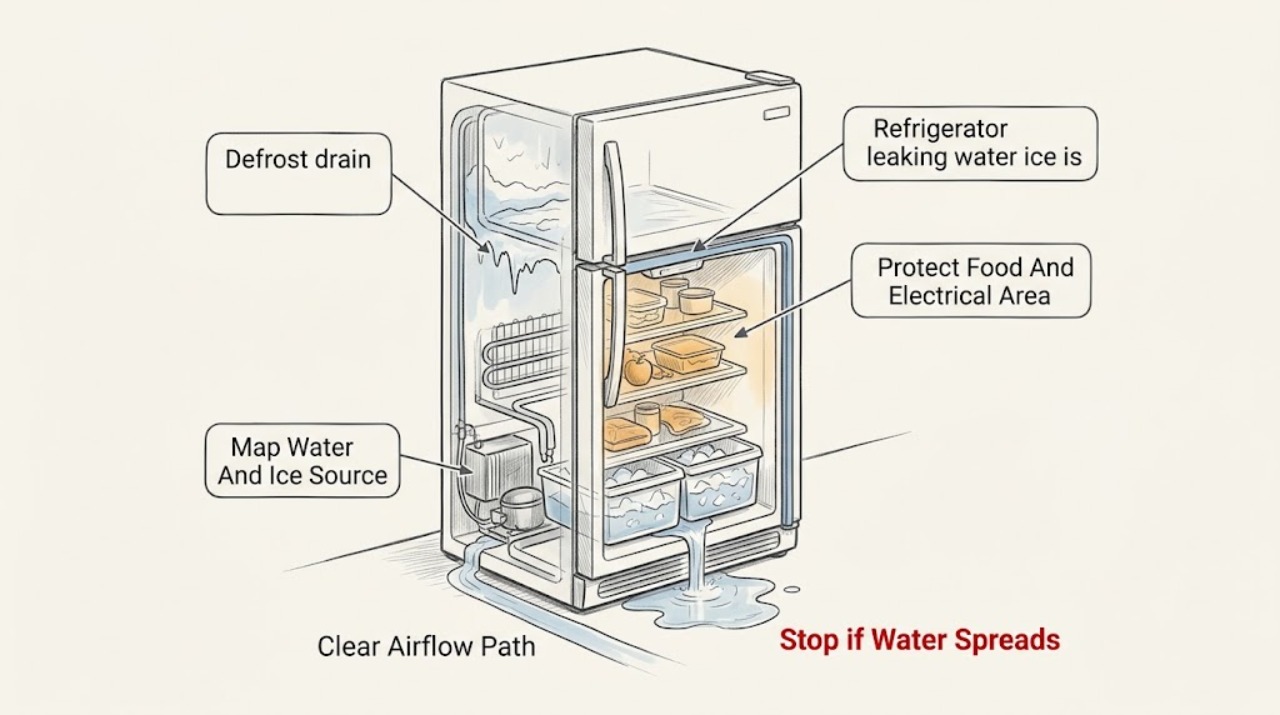
When a refrigerator is leaking and ice is present, the water may be meltwater that cannot reach the drain pan because ice or debris blocks the defrost drain, or it may come from a door seal, ice maker, water connection, or another source. Move perishable food to safe cold storage, contain water from a dry position, and inspect only accessible door, food, vent, and visible tubing areas. For heavy ice, follow the exact model manual's defrost procedure; never chip ice, use a knife, hair dryer, open flame, or boiling water. If the leak reaches electrical parts, the refrigerator is warm, water returns after a complete safe defrost, or the source is hidden, stop and arrange qualified appliance service.
Before you begin
Safety first
- Owner checks are limited to safe food relocation, water containment from a dry position, visible food, vent, door, gasket, and tubing checks, model-approved defrost, and documentation. A qualified professional must handle internal panels, drain or fan access, defrost heaters and sensors, water-line disconnection, live electrical testing, controls, compressors, refrigerant circuits, and model-specific parts.
Work through in order
Diagnostic checks
Use only checks that match the exact appliance or system and its official guide.
-
Check 1
Move perishable food to a working refrigerator, cooler, or other safe cold storage. From a dry position, contain floor water with towels and check whether water is near an outlet, cord, control, or other electrical part. Do not step into standing water or touch wet electrical equipment.
Expected result: Food is warming; water is only inside a dry compartment; water is pooling on the floor; water is near electrical equipment; or smoke, sparking, or a burning odor is present.
Next step: Keep clear of wet electrical equipment and request qualified help; use emergency services for fire or active sparking. Otherwise, protect food and contain water without moving the refrigerator or opening panels.
Stop if: Stop immediately for smoke, sparks, burning odor, exposed wiring, a wet outlet or cord, rapidly spreading water, or any need to pull a wet appliance or touch energized parts.
Why this matters
Why: Warm food creates a food-safety concern, while water near electrical parts or smoke and arcing create a shock or fire hazard. A small interior puddle still needs source tracing because ice can conceal an active drain or supply issue.
-
Check 2
Photograph the ice and water before changing anything. From outside the cabinet panels, note whether water appears under freezer drawers, below the fresh-food compartment, at a door edge, around the ice maker or dispenser, beneath a visible water tube, or under the appliance. Do not remove covers, bins that conceal wiring, or rear panels to trace it.
Expected result: Ice is below a freezer compartment; water is dripping from the ceiling or pooling under fresh-food drawers; a door edge is wet; a visible water connection is wet; or the source is hidden.
Next step: Record the pattern and continue with food, vent, and door checks. If a supply connection leaks, keep clear and arrange appliance or plumbing service rather than tightening it while wet or pressurized.
Stop if: Stop if tracing requires moving the appliance, opening a rear or evaporator cover, disconnecting a water line, reaching behind a fan, or contacting wet electrical parts.
Why this matters
Why: Ice below a freezer and water entering the fresh-food compartment fit a blocked defrost-drain pattern. A door-edge path suggests a seal or closure issue; a wet supply connection suggests water-system service. A hidden source cannot be safely diagnosed by continued wiping.
-
Check 3
Move food away from the rear wall and visible air vents, remove packages that keep a door or drawer from closing, and seal wet or uncovered food. Let hot food cool before storage. Do not use a package, cloth, or tool to block or scrape ice from a vent.
Expected result: A package was against the rear wall; a vent was blocked; the compartment was overfilled; hot or uncovered food was present; or ice and water continue despite clear spacing.
Next step: Keep vents and the rear wall clear and observe whether water and ice reduce under normal operation. If the leak continues or ice remains, inspect the accessible door seal and prepare for a safe defrost or service call.
Stop if: Stop if clearing food exposes sharp ice, damaged liner, water near electrical parts, or a hidden fan, drain, or panel that would need access.
Why this matters
Why: Blocked circulation and moisture from food can increase ice and interfere with defrost water movement. Persistence after correction makes a door seal, drain, fan, defrost, or water-system issue more likely than food placement alone.
-
Check 4
Inspect the accessible door and drawer gasket for dirt, gaps, tears, splits, compression, or a package preventing closure. Clean the seal using the exact model manual's mild method and dry it. Do not remove a gasket, adjust hinges, or force a distorted door back into alignment.
Expected result: The door does not close fully; the gasket is dirty; the gasket is damaged; frost follows one edge or corner; or the door and seal appear sound.
Next step: Correct only an obvious obstruction or accessible dirt, then monitor. If the gasket is torn, the door is misaligned, or ice and leakage recur with a sound seal, request qualified appliance service.
Stop if: Stop if the door is sagging, glass or liner is damaged, the gasket is permanently deformed, or correction requires door removal, hinge work, wiring access, or contact with hard ice.
Why this matters
Why: A door gap admits warm humid air, which can freeze and later produce meltwater. Cleaning or removing an obstruction may help, but a damaged gasket or misalignment needs the correct part or service; it will not be fixed by repeatedly defrosting.
-
Check 5
If the exact model manual allows a full manual defrost, move food, disconnect power as directed, open the doors, place towels around the base, and let the ice melt naturally. Wipe the compartment dry only after all ice has melted. Never use a knife, ice pick, awl, hair dryer, heat gun, open flame, or hot water, and never pour liquid into a hidden drain.
Expected result: Ice melts and the leak stops; water drains normally afterward; water still backs up; ice remains in a hidden area; or ice and leakage return soon after cooling stabilizes.
Next step: Reconnect and restore operation only according to the exact manual once the compartment is dry. If water persists, ice returns, cooling is weak, or the manual procedure is unavailable, keep food safe and call service.
Stop if: Stop if the manual is unavailable, ice cannot melt without tools or heat, water reaches electrical parts, the liner is damaged, or a panel, fan, heater, sensor, or drain must be opened.
Why this matters
Why: A complete defrost can temporarily restore drainage when ice blocks the drain, but continued backup or rapid recurrence points to a deeper drain blockage, defrost, fan, seal, sensor, or control issue. Drying the symptom does not prove the repair.
-
Check 6
Record the model and serial information from a safely visible label, the ice location and thickness, where water first appeared, door-seal condition, food and vent placement, any ice maker or dispenser connection, the manual-defrost procedure used, and how soon the leak or ice returned. Take photos without opening panels.
Expected result: The leak returns after defrost; the refrigerator remains warm; a fan is noisy or absent; a water connection leaks; an alert appears; or the cause remains uncertain.
Next step: Give the record to a qualified appliance technician or manufacturer support and keep perishables safely stored. Do not repeat defrost cycles, power cycles, or water-line adjustments to reproduce the symptom.
Stop if: End owner troubleshooting when diagnosis requires an internal panel, drain access, fan or heater test, live electrical work, water-line disconnection, sealed refrigeration access, or an unverified replacement part.
Why this matters
Why: Recurrence, warm food, abnormal fan behavior, a water-line leak, an alert, or uncertainty indicates that the accessible moisture checks did not resolve the underlying condition. The exact model controls safe service access and replacement choices.
Use your observations
Decision map
Find the observation that best matches what you see, then follow the next safe action.
-
PATH 01Next step
What you see
Ice is present below the freezer or water appears in the fresh-food compartment or on the floor, and a complete model-approved defrost temporarily stops the leak.
Do this next
Request service if water or ice returns, if the drain is hidden, or if clearing it would require tools, hot water, or panel access. Keep food safely cold while waiting.
Why this path and its safety boundary
Why it matters: Meltwater backing up behind ice or debris in the defrost-drain path is more likely than a simple spill, but a temporary improvement does not prove the drain is clear.
-
PATH 02Next step
What you see
Ice or water follows a door edge, a gasket has a gap or damage, or packages prevent full door closure.
Do this next
Remove only an obvious obstruction or clean the accessible gasket. Arrange service for a damaged seal, misalignment, or recurrence after the correction; do not improvise a gasket repair.
Why this path and its safety boundary
Why it matters: Warm humid air entering through the seal is more likely and can create recurring ice and meltwater.
-
PATH 03Next step
What you see
Water first appears around a visible ice-maker or dispenser tube, fitting, or supply area rather than below the freezer or at a door edge.
Do this next
Do not tighten or disconnect a wet pressurized line. Keep the area dry and obtain qualified appliance or plumbing service, isolating the water supply only if safely accessible and the model installation permits.
Why this path and its safety boundary
Why it matters: A water-supply, valve, ice-maker, or connection problem is more likely than defrost meltwater; ice nearby may be secondary to the leak.
-
PATH 04Next step
What you see
Ice is localized at food, a rear wall, or a vent, and improves after food is sealed, moved, or the airflow path is cleared while the door seals.
Do this next
Maintain clear vents and sealed food, then monitor under normal use. Escalate if ice spreads, leakage continues, or cooling becomes uneven.
Why this path and its safety boundary
Why it matters: Moisture from food or blocked circulation is more likely than an immediate internal component failure, although water returning from melted ice still needs observation.
-
PATH 05Next step
What you see
Leakage or ice returns after a complete safe defrost, the refrigerator is warm, a fan is abnormal, water reaches electrical parts, or the source remains hidden.
Do this next
Store food safely, keep clear of wet or damaged equipment, and arrange prompt qualified service. Use emergency help for smoke, sparking, or fire.
Why this path and its safety boundary
Why it matters: A defrost, drain, fan, sensor, control, water-system, or sealed refrigeration fault is more likely than a surface ice issue, and continued operation may damage food or equipment.
Helpful context
Understand the symptom
Protect food and separate meltwater from an active leak
Water with visible ice often follows a defrost path: frost melts, but a blocked drain lets water back up or overflow. It can also be a separate water-supply or door-seal issue. Move perishable food to another safe cold location, keep towels on the floor only from a dry position, and do not reach behind panels or into wet electrical areas. A leak that stops after ice melts is not proof that the drain or defrost system is healthy.
Find where the water first appears
Note whether water is in the refrigerator compartment, under drawers, in the freezer, below the appliance, around an ice maker or water dispenser, or near a door edge. Look for a blocked vent, packages against a cold wall, a door that does not close, or a visible supply tube. Ice under a freezer or water inside the fresh-food compartment can fit a blocked defrost-drain pattern, while a stream from a fitting needs a different service path.
Defrost only with the model-approved method
If the exact manual permits a manual defrost, move food, disconnect power as directed, open the doors, contain meltwater, and let ice melt naturally. Some manufacturers specify a long open-door defrost for a fully blocked drain, but the time and procedure vary by model. Do not use a sharp tool, hair dryer, heat gun, open flame, or hot water, and do not pour anything into a hidden drain. If you are not comfortable protecting food or water from the defrost, request service.
Safety boundary
Stop conditions
- Do not chip or pry ice with a knife, ice pick, awl, screwdriver, or other sharp object; do not use a hair dryer, heat gun, open flame, or hot water to speed defrosting.
- Stop for smoke, sparking, burning odor, exposed wiring, water at an outlet or cord, a wet control area, or any need to move a wet appliance; leave and obtain emergency or qualified help as appropriate.
- Do not remove rear or evaporator covers, reach into fans, open a hidden drain, disconnect a water line, test live circuits, access sealed refrigeration tubing, or bypass a defrost, fan, temperature, or leak alert.
- Stop repeated manual-defrost or power-cycle attempts when water or ice returns, food stays warm, cooling is weak, a fan is abnormal, or the exact model procedure is unavailable.
- Call a qualified appliance technician for recurring leaks, persistent ice, a blocked internal drain, damaged gasket, water-system leak, fan, heater, sensor, control, or sealed-system concern; keep perishables safely cold while temperatures are uncertain.
Only after diagnosis
Potential parts
- refrigerator door gasket
Consider this only when a qualified diagnosis confirms that a damaged or permanently distorted gasket is allowing warm air in and causing recurring ice or water.
Confirm the exact refrigerator model, door configuration, gasket profile, and installation method before ordering; do not choose a seal by appearance. - refrigerator defrost drain component
Consider this only when a technician confirms that a drain component is blocked, damaged, or incorrectly routed and is responsible for recurring meltwater.
Verify the exact model, drain route, tray arrangement, and approved clearing or replacement method; do not insert tools or pour hot water into a hidden drain. - refrigerator defrost sensor or heater
Consider this only after recurring ice is confirmed and a qualified technician identifies a failed defrost sensor or heater rather than a seal, airflow, or drain issue.
Defrost components vary by model and control system; confirm diagnosis, part identity, connectors, and manufacturer fit information before ordering. - refrigerator ice-maker water valve or tubing
Consider this only when a technician confirms that the visible leak originates at the ice-maker or dispenser water path and the appliance configuration uses that component.
Verify the exact model, tubing and connector arrangement, water pressure requirements, and installation procedure; do not disconnect a wet pressurized line.
When checks do not resolve it
Need a professional?
Call a qualified appliance technician when water leaks with heavy or recurring ice, a complete model-approved defrost does not restore drainage, water returns from a hidden area, the door seal is damaged, the refrigerator remains warm, a fan is abnormal, or an ice maker or water connection leaks. Call promptly if food is warming. Stop and seek emergency help for smoke, sparking, fire, exposed conductors, or water contacting electrical equipment.
Safety scope: Owner checks are limited to safe food relocation, water containment from a dry position, visible food, vent, door, gasket, and tubing checks, model-approved defrost, and documentation. A qualified professional must handle internal panels, drain or fan access, defrost heaters and sensors, water-line disconnection, live electrical testing, controls, compressors, refrigerant circuits, and model-specific parts.
Common questions
FAQ
Why is my refrigerator leaking water when ice is present?
Ice can block a defrost drain so meltwater backs up, or a door gap, blocked vent, ice-maker line, or another fault can create both ice and water. Map where water first appears and arrange service if it returns.
Can a blocked defrost drain cause water inside the refrigerator?
Yes. Ice or debris can prevent defrost water from reaching the drain pan, allowing it to overflow into the refrigerator or onto the floor. A complete model-approved defrost may help temporarily, but recurrence needs service.
Should I unplug a leaking refrigerator with ice?
If the area is dry and the exact model manual directs it, power can be disconnected for a manual defrost. Do not touch a wet cord, outlet, or control; if water reaches electrical parts, keep clear and obtain qualified help.
How do I melt refrigerator ice safely?
Use only the exact manual's defrost procedure and let ice melt naturally. Move food and contain water. Never chip ice, use a knife, hair dryer, heat source, open flame, or hot water.
Can a bad door gasket cause ice and water?
Yes. A damaged or poorly closing gasket lets warm humid air in, creating frost that later melts or blocks airflow. Clean an accessible gasket and remove obstructions; replace a damaged seal through qualified service.
What if water is leaking from the ice maker or dispenser line?
Treat it as a water-system leak rather than assuming it is defrost water. Do not tighten or disconnect a wet pressurized line; isolate water only if safely accessible and permitted by the installation, then request appliance or plumbing service.
Can food against the rear wall cause ice and leaking water?
Food against the cold wall or a blocked vent can create localized ice and uneven airflow. Move food away, clear visible vents, and seal moist food. Persistent ice or leakage needs further diagnosis.
Why does the leak return after I defrost the refrigerator?
The underlying drain blockage, defrost fault, fan, seal, sensor, control, or water connection may remain. Do not keep repeating defrost cycles; document how quickly ice and water return and call service.
Can I pour hot water into the defrost drain?
No. Hot water can damage internal parts and does not safely diagnose a hidden blockage. Follow the model manual or have a technician inspect and clear the drain.
When is a refrigerator ice-and-water leak urgent?
Keep food safely cold and call promptly if the refrigerator is warm, water returns, a fan is abnormal, or a water connection leaks. Treat smoke, sparking, exposed wiring, or water near electrical parts as an emergency hazard.
Read the exact guide
Official sources
- Why does my refrigerator have condensation, frost or a leak?Samsung Electronics · Samsung official regional support guidance used for general frost and leak source distinctions and safe drain boundaries; exact model instructions remain controlling.
- Why is food freezing in the Samsung refrigerator compartment?Samsung Electronics · Samsung official support guidance used only for the relationship between a cold rear wall, food contact, and blocked airflow; it does not establish a model-specific leak diagnosis.
- LG Refrigerator - Troubleshooting Ice Buildup in an LG RefrigeratorLG Electronics USA · LG official support guidance used for ice-related drainage behavior and safe defrost boundaries; its all-model notice means exact model instructions remain controlling.
- LG Refrigerator - How to Remove Dust/Debris from the Rear of My RefrigeratorLG Electronics USA · LG official support guidance used only to support the boundary against rear-cover and mechanical-compartment access during a leak or ice diagnosis.
- How to Troubleshoot Water Leaking from the Ceiling or Pooling on the Floor in Your LG Top Freezer RefrigeratorLG Electronics USA · LG official support guidance used for the general relationship between ice, defrost drainage, and leakage; the page states that model details can differ, so the exact refrigerator manual governs.
- Frost forms in the Samsung freezer, refrigerator, or ice bucketSamsung Electronics · Samsung official support guidance used for general warm-air, vent, gasket, food-placement, and safe-frost principles; exact refrigerator model procedures govern.
- Refrigerator & Freezer - Ice on Freezer WallGE Appliances · GE Appliances official guidance used for general frost and service decisions; its frost-free freezer context does not establish behavior for every refrigerator model.
Community feedback
Share a repair observation
Share a plain-text repair observation. Accepted observations are published automatically; this page may take a moment to update.