
On this page
Start here
Quick answer
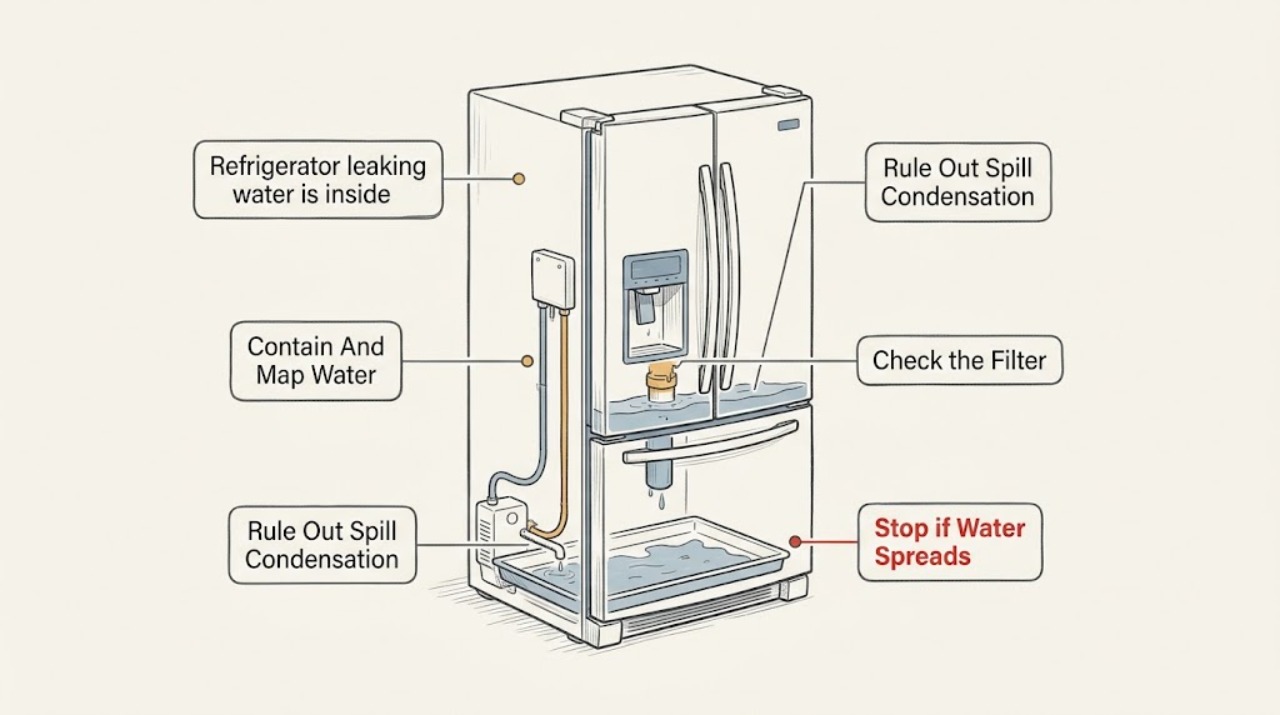
Protect the floor first, then locate the highest wet point rather than assuming the puddle started underneath. If the refrigerator has a dispenser or ice maker, close its household water shutoff when a supply-line leak is suspected; unplug the refrigerator only when water or inspection conditions make that safe and food can be kept cold elsewhere. Water inside the fresh-food section or beneath drawers often follows a blocked or iced defrost drain, while water near the filter, dispenser, ice maker, rear tubing, or shutoff points to the water system. Spills, condensation, a door left ajar, an unlevel cabinet, and a cracked drain pan are other possibilities. Clean only accessible parts described by the exact model manual. If the source is hidden, the leak continues, water reaches electrical components, the filter housing or tubing is cracked, the floor is being damaged, or thawing and basic checks do not resolve it, stop using the water system and arrange appliance service.
Before you begin
Safety first
- This article covers containment, location mapping, owner-manual checks, accessible filter handling, and visual supply-line inspection only. Qualified service is required for sealed panels, drain or evaporator access, tubing repairs, electrical components, refrigerant systems, and heavy-appliance movement.
Work through in order
Diagnostic checks
Use only checks that match the exact appliance or system and its official guide.
-
Check 1
Dry the visible water, protect the floor, and trace the highest wet point from the fresh-food compartment, freezer, doors, dispenser, filter area, rear tubing, and beneath the cabinet without moving the refrigerator yet.
Expected result: Record whether the first wet point is inside a compartment, under a drawer, around a filter or dispenser, at the ice maker, behind the refrigerator, or only on the floor.
Next step: Use the location and timing to choose the matching branch. If water is spreading toward electrical parts, the floor is being damaged, or the source cannot be contained, stop using the refrigerator water system and arrange service.
Stop if: Do not reach into wet electrical areas, tip or slide a heavy refrigerator alone, or keep dispensing water while the source is unknown.
Why this matters
Why: The first wet point separates a spill or condensation event from a defrost-drain, ice-maker, filter, dispenser, supply-line, or drain-pan path. A floor-only puddle may have traveled from another appliance or a hidden rear leak.
-
Check 2
Inspect containers, shelves, door seals, and the ice-maker door or tray for a spill, crack, condensation, frost, or a door that was not fully closed; do not dismantle the ice maker.
Expected result: Record whether a container is open or cracked, warm food or humid air is present, the door seal is obstructed, the ice tray or bin has unusual ice, or the compartment is dry after cleanup.
Next step: Correct only the obvious container, door, or storage issue and monitor one normal cooling and defrost period. If water returns without a spill or condensation explanation, continue with drain and water-system checks.
Stop if: Do not chip ice with a sharp tool, force a frozen door or tray, or use heat near plastic liners and wiring.
Why this matters
Why: A spill, condensation, or melted ice can produce interior water without a plumbing leak. Recurring water in the same compartment after these sources are removed points toward drainage, ice-maker, filter, or door-sealing service.
-
Check 3
If the wet point is near the filter or dispenser, use the exact model instructions to inspect whether the filter is fully seated, its seal or O-rings are present, and the dispenser area is dry; close the water shutoff before any permitted filter handling if the manual requires it.
Expected result: Record whether the leak began after filter replacement, the filter is cracked or loose, seals are displaced, the housing is damaged, or water appears only after dispensing.
Next step: Re-seat or replace the filter only as the exact manual permits and test without repeated dispensing. If the housing, filter, seal, or tubing is damaged, stop the water supply and arrange service.
Stop if: Do not force the filter, use an unverified filter or seal, crack the housing, or continue using a pressurized dispenser leak.
Why this matters
Why: An incorrectly seated or damaged filter, seal, or housing can leak at the filter area. A dispenser drip may be normal for a short period after use, but a continuing leak indicates the filter, tubing, valve, or dispenser path needs attention.
-
Check 4
If water is under drawers, on the freezer floor, or beneath the cabinet without a supply-line trigger, consult the exact model manual for an accessible defrost-drain or drain-pan check; do not remove sealed panels or apply direct heat.
Expected result: Record whether water or ice returns at the drain opening, the freezer floor, the rear interior, or the bottom pan, and whether the refrigerator is visibly out of level.
Next step: Perform only the manual-approved accessible cleaning or leveling check. If the drain is inaccessible, the pan is damaged, water returns, or ice is extensive, stop and arrange appliance service.
Stop if: Do not drill the drain, use a heat gun or open flame, remove evaporator covers, or tip the refrigerator to reach a pan.
Why this matters
Why: A recurring interior pool after defrost is consistent with a restricted drain path; a bottom puddle can also involve a full, cracked, displaced, or poorly positioned drain pan or an unlevel cabinet. Hidden ice or drain access requires model-specific service.
-
Check 5
If water is behind or beneath the refrigerator, close the household water shutoff and inspect only accessible supply tubing, fittings, filter connections, and the refrigerator inlet for moisture, cracks, or a displaced tube; avoid pulling the cabinet farther than the installation allows.
Expected result: Record whether the leak stops with the water supply closed, a line or fitting is cracked or wet, the filter was recently changed, or water still appears with the water system isolated.
Next step: Leave the water supply closed for a line or fitting leak and arrange qualified repair. If water continues, keep the floor dry and provide the timing and location record to an appliance technician.
Stop if: Do not tighten unknown fittings aggressively, cut tubing, disconnect a line under pressure, open rear panels, or touch wet electrical components.
Why this matters
Why: A leak that stops when the supply is closed supports the water line, fitting, filter, dispenser, or ice-maker circuit. Water that continues with the supply isolated points toward defrost water, drain pan, condensation, or another source.
Use your observations
Decision map
Find the observation that best matches what you see, then follow the next safe action.
-
PATH 01Safety boundary
What you see
The wet point is a shelf, container, door edge, or ice bin, and the area stays dry after correcting a spill, open door, warm-food condensation, or ice-maker position.
Do this next
Clean the area, correct the storage or door issue, and monitor without opening panels.
Why this path and its safety boundary
Why it matters: A use or condensation event is more likely than a plumbing or defrost fault.
Safety stop: Do not ignore recurrent water in the same location or chip ice with a sharp tool.
-
PATH 02Safety boundary
What you see
Water begins after filter replacement or dispensing and is wet around the filter, housing, dispenser, or nearby door tubing.
Do this next
Close the water shutoff when needed, follow the exact manual to re-seat the filter, and arrange service for a damaged housing, seal, or continuing leak.
Why this path and its safety boundary
Why it matters: An incorrectly seated filter, displaced seal, damaged housing, or dispenser water path is plausible.
Safety stop: Do not force the filter, continue dispensing, or use an unverified replacement part.
-
PATH 03Safety boundary
What you see
Water returns inside the refrigerator or freezer after frost or defrost, often under drawers or on the freezer floor, without a dispensing or supply-line trigger.
Do this next
Use only an accessible drain procedure in the exact manual; arrange service for hidden ice, inaccessible panels, recurring water, or a damaged pan.
Why this path and its safety boundary
Why it matters: A blocked or iced defrost drain or drain-pan path is more likely than a pressurized water-line leak.
Safety stop: Do not drill the drain, use direct heat, or remove evaporator panels as a generic fix.
-
PATH 04Safety boundary
What you see
Water appears behind or beneath the cabinet and stops when the household refrigerator water shutoff is closed.
Do this next
Leave the water supply closed, keep the refrigerator dry and powered only when safe, and arrange appliance or plumbing service for the wet or damaged connection.
Why this path and its safety boundary
Why it matters: The supply line, fitting, shutoff, filter, inlet, dispenser, or ice-maker circuit is implicated.
Safety stop: Do not pull the refrigerator alone, cut tubing, disconnect pressurized fittings, or touch wet electrical parts.
-
PATH 05Safety boundary
What you see
Water continues after the refrigerator water shutoff is closed, or the source is beneath the cabinet with no visible supply-line leak.
Do this next
Keep the floor protected, inspect nearby plumbing for a separate source, and arrange appliance service if the refrigerator itself remains the source.
Why this path and its safety boundary
Why it matters: Defrost water, drain pan, condensation, an external leak, or a hidden appliance fault is more likely than the dispenser line.
Safety stop: Do not open sealed panels, tip the cabinet, or keep operating with water near electrical parts.
-
PATH 06Safety boundary
What you see
Water returns after permitted checks, the filter housing or pan is cracked, the floor or cabinet is being damaged, or the leak cannot be safely located.
Do this next
Stop using the refrigerator water system, disconnect power only when safe and food can be protected, and arrange qualified appliance service.
Why this path and its safety boundary
Why it matters: The fault exceeds routine user maintenance and continued operation may worsen appliance or property damage.
Safety stop: Do not continue testing, use direct heat, remove panels, or handle wet electrical components.
Helpful context
Understand the symptom
Find the leak's path before moving the refrigerator
Dry the visible water and place absorbent material around the edges. Look for the highest wet point: a shelf or container, filter area, dispenser, ice maker, freezer floor, door edge, rear tubing, or the bottom of the cabinet. Water can travel along a liner, door seal, or floor, so the location of the puddle is not necessarily the failed part.
Separate defrost water from supply water
Water inside the refrigerator or freezer that returns after a defrost cycle makes a drain blockage or drain-pan path plausible. Water that appears after dispensing, ice making, filter replacement, or movement of the refrigerator makes the filter, tubing, fitting, or valve path more plausible. A spill, condensation, warm food, or door left open can mimic a leak.
Use model instructions and stop before hidden appliance work
Filter removal, drain access, leveling, and rear-line inspection vary by model. Use the owner manual for ordinary-access steps and model-specific parts. Do not remove rear panels, thaw with a heat gun, force a filter, tip the cabinet, or work around wet electrical components. Persistent or concealed leakage needs a qualified appliance technician.
Safety boundary
Stop conditions
- Do not touch wet electrical components, tip or slide a heavy refrigerator alone, or continue dispensing water while the source is unknown.
- Do not drill a defrost drain, use a heat gun or open flame, chip ice with sharp tools, or remove sealed panels as a generic fix.
- Do not force filters, cut tubing, disconnect pressurized fittings, or aggressively tighten unknown connections.
- Stop for water near wiring, a cracked filter housing or drain pan, floor or cabinet damage, a large or hidden leak, or a source that cannot be contained.
- Arrange qualified appliance service when permitted filter, drain, storage, and accessible supply checks do not resolve the leak.
Only after diagnosis
Potential parts
- model-specific refrigerator water filter and seal
Consider this category only when the exact model's filter or seal is cracked, missing, incorrectly seated, or confirmed to be the leak source.
Confirm the refrigerator model, filter design, seals, and installation direction; do not force a filter or substitute an unverified seal. - model-specific refrigerator water line or fitting
Consider this category only when inspection or qualified diagnosis confirms a cracked line, damaged fitting, or failed connection after the water supply is isolated.
Confirm tubing size, fitting design, routing, and model requirements; pressurized-line repair should be performed by qualified service. - model-specific defrost drain or drain pan
Consider this category only when the exact model's diagnosis confirms a damaged pan or drain component rather than a spill or accessible blockage.
Confirm the refrigerator model and access procedure; do not remove sealed panels or use heat to reach the component.
When checks do not resolve it
Need a professional?
Arrange appliance service when water returns after correcting a spill or performing the exact manual's accessible filter or drain check, the source is hidden, the filter housing, tubing, or drain pan is damaged, or water reaches electrical components or damages the floor. Close the refrigerator water shutoff for a supply-line leak. Disconnect power only when safe and food can be protected, and do not move a heavy refrigerator alone.
Safety scope: This article covers containment, location mapping, owner-manual checks, accessible filter handling, and visual supply-line inspection only. Qualified service is required for sealed panels, drain or evaporator access, tubing repairs, electrical components, refrigerant systems, and heavy-appliance movement.
Common questions
FAQ
Why is water inside my refrigerator?
Common paths include a spill or condensation, a blocked or iced defrost drain, an ice-maker or dispenser leak, or a filter and seal problem. Find the highest wet point and use the exact model manual before opening anything.
Why is water underneath my refrigerator?
A rear supply line, fitting, shutoff, filter, drain pan, defrost drain, or water from another nearby appliance can create a floor puddle. Close the refrigerator water shutoff when a supply leak is suspected and inspect only accessible areas.
Can a water filter cause a refrigerator leak?
Yes. An incorrectly seated, cracked, or poorly sealed filter or a damaged housing can leak near the filter or dispenser. Follow the exact model instructions and stop using the water system if the housing or tubing is damaged.
How do I know if the defrost drain is blocked?
Water that returns inside after frost or defrost, especially under drawers or on the freezer floor, makes a drain-path problem plausible. Use only an accessible procedure in the owner manual; do not drill, apply direct heat, or remove sealed panels.
When should I call an appliance technician for a refrigerator leak?
Call when the source is hidden, water returns after permitted checks, a filter housing, tube, or pan is cracked, water reaches electrical parts, the floor is being damaged, or the leak continues after the water supply is isolated.
Read the exact guide
Official sources
- Leaking at the Bottom - Side by Side RefrigeratorWhirlpool Product Help · Whirlpool side-by-side refrigerator support; other configurations require their own model-specific procedures.
- How to Fix a Refrigerator That Is Leaking WaterWhirlpool · Whirlpool consumer guidance used for general refrigerator leak mechanisms; the exact installed model manual controls access and repair.
- LG Refrigerator - How to Troubleshoot a Leak Inside the FridgeLG USA Support · LG refrigerator support guidance used for general leak-source distinctions; exact model access and part fit vary.
- [LG Refrigerator] Troubleshooting Water LeaksLG USA Support · LG all-model leak guidance used for general source mapping; the exact refrigerator manual controls repair access.
- Water Inside of RefrigeratorWhirlpool Product Help · Whirlpool top-freezer refrigerator support; use the installed model's instructions for a different configuration.
Community feedback
Share a repair observation
Share a plain-text repair observation. Accepted observations are published automatically; this page may take a moment to update.