
On this page
Start here
Quick answer
A washer that appears stuck while its controls still respond may be extending the cycle to balance a load, absorb water, reduce suds, heat water, or complete a drain and spin step. First record the displayed phase and whether the washer is filling, tumbling, draining, spinning, or simply pausing. Check the selected options, door or lid closure, load distribution, accessible water taps and inlet hoses, and the drain hose for an obvious kink. If the tub is full, the pump is abnormal, the washer will not advance through the same phase, an error code returns, or the controls respond but the machine does not perform the selected operation, stop the cycle and arrange qualified appliance service. Use only one model-approved reset after documenting the symptom; do not force the door, reach into a moving tub, open panels, or repeatedly restart a stuck washer.
Before you begin
Safety first
- This article supports observing the cycle phase, reviewing selected options, checking load distribution, inspecting accessible taps and hoses, and using one model-approved reset when safe. A qualified professional must handle internal pump, valve, motor, lock, sensor, heater, control, wiring, live tests, standing-water hazards, and forced-door situations.
Work through in order
Diagnostic checks
Use only checks that match the exact appliance or system and its official guide.
-
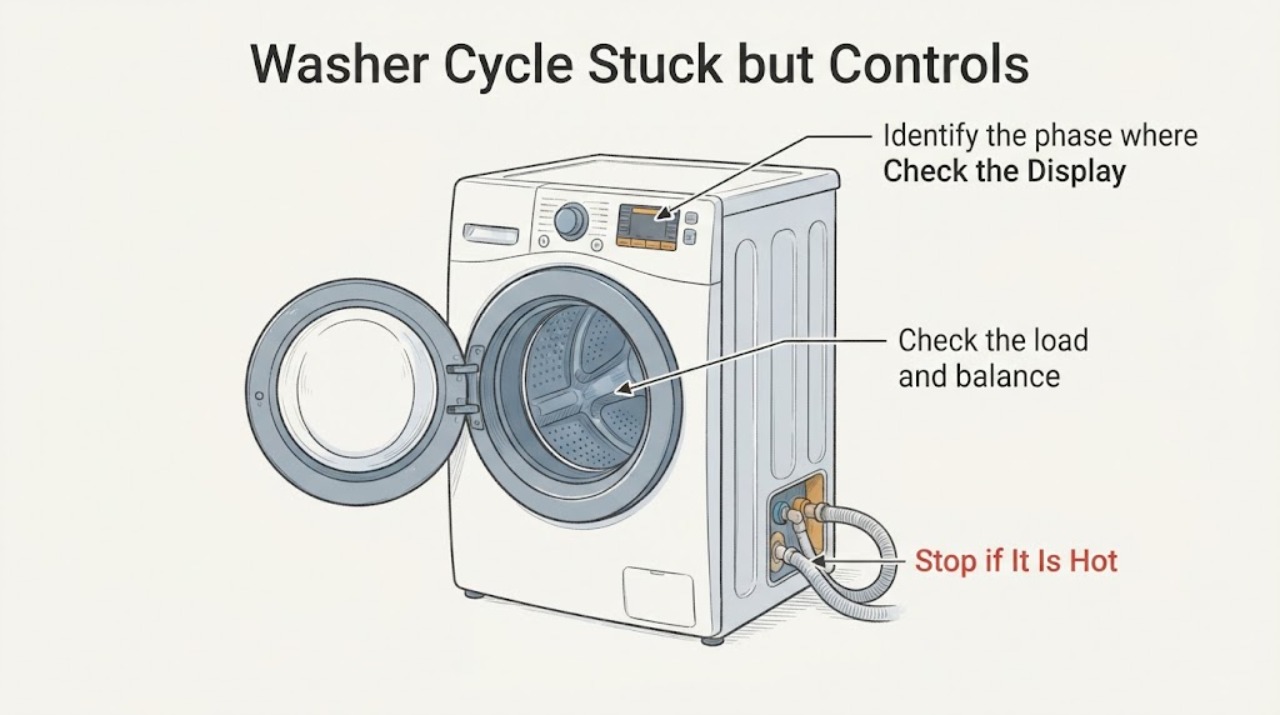
Identify the phase where the washer stops advancing
Record the remaining-time display, selected cycle and options, and whether the washer is filling, tumbling, heating, rinsing, draining, or spinning. Listen only from outside the cabinet for normal water flow, periodic tumbling, drain-pump operation, or repeated attempts to advance; do not open the door or lid while the tub is moving.
Expected result: The time changes occasionally; the washer is still sensing or tumbling; it remains in fill, drain, or spin; it pauses after water enters; or it shows a code or warning.
Next step: Use the phase-specific checks below. If the tub is full, the washer is leaking, or the door or lid is unsafe, stop the cycle and arrange service.
Stop if: Do not force the door or lid, reach into the tub, or keep restarting without recording the phase and display.
Why this matters
Why: A changing timer or periodic activity can be normal recalculation. A stationary phase with no corresponding water or drum activity points toward a supply, drain, balance, lock, motor, sensor, or control issue. The code and phase determine the next model-specific check.
-
Check cycle options, pause state, and control timing
Review the selected course and visible options for soak, wash-only, delay, pause, add-item, or control-lock states using the washer's manual. If the controls respond, cancel or change only the documented option; do not repeatedly press Start/Pause or select a new cycle while the tub is full or moving.
Expected result: Soak or wash-only is selected; Pause or Add Item is active; a delay is counting; a control lock is shown; or no option explains the pause.
Next step: Follow the model's normal option-cancel instruction once. If the washer still does not advance through the selected phase, document the result and continue with external water, load, and drain checks.
Stop if: Do not bypass a lid or door lock, force a cycle change, or open the control panel to inspect buttons or wiring.
Why this matters
Why: Some courses intentionally pause before draining or spinning, and a pause control can stop advancement even though the display and buttons work. An unexplained pause keeps a water-path, balance, door or lid, motor, sensor, or control fault in consideration.
-
Check the load and balance without reaching into a moving tub
When the tub has stopped and the door or lid is safely unlocked, observe whether laundry is tightly bunched, the load is very heavy or bulky, or excess suds are visible. Redistribute or reduce the load only as the model instructions allow, then use the washer's documented rinse or spin option once if no water, lock, or electrical hazard is present.
Expected result: The load is bunched to one side; a single bulky item is present; suds are excessive; the load is normal but the tub will not balance; or the washer resumes after redistribution.
Next step: Use a smaller or better-distributed load only as a documented observation. If the same phase repeats or the washer will not spin, stop and arrange service.
Stop if: Do not open a locked door, reach into a moving tub, overload another cycle, or add unapproved chemicals to force the washer to advance.
Why this matters
Why: An imbalance, heavy fabric load, or excess suds can lengthen sensing, drain, or spin time and make the cycle look stuck. If the washer cannot balance a normal load or repeatedly stops, a leveling, suspension, drain, motor, or control problem remains possible.
-
Check external water supply during a fill delay
If the washer is waiting for water, check from a dry, safe position that the accessible water taps are open and the inlet hoses are not visibly kinked, crushed, frozen, or pulled tight. Do not disconnect hoses or remove inlet filters unless the exact model manual provides a safe procedure and the washer is isolated from power and water.
Expected result: A tap is closed or partly open; a hose is kinked or crushed; the area is frozen; the hose and taps look normal; or the washer fills after an accessible condition is corrected.
Next step: Correct only a clearly accessible tap or hose position under the model instructions, then make one documented retry. If filling remains slow or the code returns, arrange appliance service.
Stop if: Do not disconnect pressurized hoses, reach behind a wet appliance, use heat on frozen plumbing, or open the inlet valve or control area.
Why this matters
Why: Restricted water entry can keep a washer in fill or sensing and can prevent the cycle from advancing even while the controls respond. Normal external supply shifts attention toward an inlet valve, filter, pressure sensor, control, or wiring fault.
-
Check external drain conditions during a drain or spin delay
If the tub is trying to drain or never reaches spin, look behind the washer for an obvious drain-hose kink or crushing and note whether water is moving through the drain. Follow the exact manual for any owner-accessible pump-filter check only when the washer is safely powered down and water release can be controlled; otherwise stop at the external inspection.
Expected result: The drain hose is kinked; water drains after an accessible hose issue is corrected; the tub remains full; the pump is silent, humming, or unusually noisy; or the drain path looks normal but the cycle remains stuck.
Next step: Leave the washer off when water remains or the drain does not recover after the model-approved external check, and arrange service. Do not start another full cycle to clear the tub.
Stop if: Do not tip the washer, reach into standing water near power, force a filter, or disassemble the pump or drain assembly.
Why this matters
Why: A restricted drain can prevent the washer from moving to spin or completing the cycle. Standing water, abnormal pump behavior, or a returning drain symptom points toward a pump, filter, sensor, hose, or control fault.
-
Use one model-approved reset and document the result
After recording the phase and checking only obvious external conditions, follow the exact washer manual for one power reset or documented cycle restart. Restore power only when there is no leak, standing water hazard, burning odor, damaged cord, or unsafe lock condition, then observe whether the same phase completes.
Expected result: The cycle completes; the timer remains unchanged; the same code returns; a different code appears; or the washer remains full, locked, or unresponsive.
Next step: Stop resetting and arrange qualified appliance service when the condition returns, the washer remains full or locked, or the model guide calls for service.
Stop if: Do not factory-reset repeatedly, clear the diagnostic history, or keep operating through a returning error or safety symptom.
Why this matters
Why: A one-time recovery can indicate a transient control or sensing state. A repeated phase or code indicates an unresolved inlet, drain, balance, lock, motor, sensor, heater, or control fault rather than a timer that merely needs more resets.
Use your observations
Decision map
Find the observation that best matches what you see, then follow the next safe action.
-
PATH 01Next step
What you see
The timer changes occasionally, the washer continues sensing or tumbling, no code appears, and the load or selected cycle is heavy or extended.
Do this next
Allow the selected cycle to continue while monitoring from outside. Arrange service if the same phase repeats indefinitely or the behavior occurs with every normal load.
Why this path and its safety boundary
Why it matters: Normal time recalculation, load sensing, suds reduction, heating, or balance attempts are more likely than a completely stalled control.
-
PATH 02Next step
What you see
The washer is in a soak or wash-only course, or Pause/Add Item is active, and controls respond normally.
Do this next
Follow the model's normal option-cancel or continuation instruction once. If the washer still does not advance, use the phase-specific service path.
Why this path and its safety boundary
Why it matters: The selected course or pause state is more likely to explain the apparent stall than a failed timer.
-
PATH 03Next step
What you see
The washer remains in fill or sensing, the tub does not reach its expected water level, and a tap or inlet hose is closed, kinked, restricted, or frozen.
Do this next
Correct only the accessible tap or hose condition under the manual and make one retry. If filling remains slow or the code returns, arrange service for the inlet path or control.
Why this path and its safety boundary
Why it matters: A water-supply restriction is more likely than a drain or spin fault.
-
PATH 04Next step
What you see
The washer has water in the tub, cannot drain, repeatedly redistributes the load, or never advances into spin.
Do this next
Keep the washer off if water remains or the problem repeats, document the pump, hose, load, and lock observations, and arrange qualified appliance service.
Why this path and its safety boundary
Why it matters: A drain restriction, pump, load-balance, lid or door lock, motor, sensor, or control problem is more likely than a display-only timer issue.
-
PATH 05Safety boundary
What you see
The controls respond but the washer performs no corresponding fill, drain, tumble, or spin action, or the same code returns after one model-approved reset.
Do this next
Stop the affected cycle and arrange qualified appliance service with the exact model, phase, code, water state, load, and reset result.
Why this path and its safety boundary
Why it matters: An inlet valve, pump, motor, lock, sensor, wiring, or control fault remains possible and cannot be safely separated by more button presses.
Safety stop: Do not open panels, test live components, bypass a lock, or replace a control part solely from the symptom.
Helpful context
Understand the symptom
A timer that does not change is not always a stalled washer
Modern washers can recalculate the remaining time while sensing the load, waiting for water, reducing suds, heating, balancing, draining, or spinning. The useful distinction is whether the tub or water path is still making progress. If the display changes or the washer periodically advances, allow the selected cycle to finish. If the same phase continues with no water movement, no drain, no spin, or a returning code, the symptom is more likely a fault.
Selected options can intentionally pause the sequence
A soak or wash-only course can leave water in the tub until the selected operation is complete, and a Pause or Add Item control can keep the tub from spinning. Control response alone does not prove that the washer is malfunctioning. Check the selected course and visible pause or delay state before assuming the timer or main control has failed.
The next safe check depends on the phase
A fill delay points toward water supply, inlet hoses, filters, or a water-level decision. A drain or spin delay points toward the drain path, pump, load balance, lid or door lock, or motor system. A dry-feeling pause with controls still active may be normal sensing or time recalculation. Work from the observed phase and stop at external checks when water, moving parts, electrical damage, or an internal component is involved.
Safety boundary
Stop conditions
- Stop the washer for leaking water, smoke, burning odor, damaged power wiring, unusual electrical noise, an unsafe or stuck door or lid, standing water near power, or a tub that will not drain.
- Do not force the door or lid, reach into a moving tub, tip the washer, open live panels, test live wiring, bypass a lock, or disassemble a pump, valve, motor, sensor, heater, or control.
- Do not repeatedly press Start/Pause, repeatedly reset the washer, clear a returning code, or start another full cycle to hide a drain, fill, balance, or lock problem.
- Use only the exact model manual for soak, wash-only, pause, delay, filter, and reset procedures; controls responding does not prove that the selected course is advancing normally.
- Arrange qualified appliance service when the same phase remains stuck, a code returns, the tub stays full or locked, no corresponding machine activity occurs, or external load, water, and drain checks do not restore normal progression.
Only after diagnosis
Potential parts
- washer drain pump or pump filter
Consider this category only when qualified diagnosis identifies a drain restriction, failed pump, or damaged filter after safe external hose and water checks.
Confirm the complete washer model and technician diagnosis; do not choose a pump from a stuck-cycle symptom alone. - washer water inlet valve or inlet filter
Consider this category only when taps and accessible inlet hoses are normal but qualified testing identifies restricted or failed water entry.
Confirm the exact washer model, hose arrangement, and approved component before ordering. - washer door or lid lock assembly
Consider this category only when the cycle cannot advance because qualified diagnosis confirms a failed lock after the door or lid area is clear.
Confirm the complete model and lock configuration; do not bypass or replace the lock as a trial. - washer control board or cycle sensor
Consider this category only after normal load, water, drain, option, and reset checks are exhausted and qualified diagnosis identifies a control or sensor fault.
Confirm the exact model and diagnostic result; control and sensor replacement require model-specific service.
When checks do not resolve it
Need a professional?
Arrange qualified appliance service when the washer remains in the same phase after one model-approved reset, the timer never advances with no corresponding tub or water activity, a code returns, the tub stays full or the door or lid remains locked, or a fill, drain, balance, motor, sensor, valve, or control fault is possible. Stop immediately for leaking water, smoke, burning odor, damaged wiring, unusual electrical noise, standing water near power, or an unsafe door or lid.
Safety scope: This article supports observing the cycle phase, reviewing selected options, checking load distribution, inspecting accessible taps and hoses, and using one model-approved reset when safe. A qualified professional must handle internal pump, valve, motor, lock, sensor, heater, control, wiring, live tests, standing-water hazards, and forced-door situations.
Common questions
FAQ
Why is my washer cycle stuck if the controls still respond?
The washer may be recalculating time, sensing a heavy or unbalanced load, reducing suds, waiting for water, draining, or pausing because of the selected course. Check the actual phase and machine activity before treating the timer as failed.
How can I tell whether a washer is really stuck?
Record the phase and watch for corresponding filling, tumbling, draining, or spinning from outside the cabinet. Occasional timer changes or periodic activity can be normal; an unchanged phase with no activity, a returning code, standing water, or an unsafe lock needs service.
Can soak or pause make a washer look stuck?
Yes. LG notes that a Pause/Add Item state can keep the tub from spinning, and a Soak or wash-only course can stop without draining until that operation is complete. Check the selected course and follow the exact model instruction once.
What should I check if the washer is stuck while filling?
Check that the accessible water taps are open and the inlet hoses are not visibly kinked, crushed, frozen, or pulled tight. If filling remains slow or a code returns after one model-approved retry, the inlet path, valve, sensor, or control needs service.
What if the washer is stuck with water in the tub?
Do not start another full cycle. Check only for an obvious external drain-hose kink and follow the exact manual for a safe, owner-accessible filter procedure. If water remains, the pump is abnormal, or the drain symptom returns, leave the washer off and arrange service.
Should I reset a washer that is stuck?
Only after recording the phase and checking for water, lock, leak, odor, and electrical hazards, and only once using the exact model instructions. A reset may clear a transient state but cannot repair a fill, drain, balance, lock, motor, sensor, or control fault. Stop if the same symptom returns.
When should I call service for a washer cycle that will not advance?
Call when the same phase remains stuck, the timer never advances with no machine activity, a code returns, the tub stays full or locked, the washer cannot fill, drain, balance, or spin, or an internal pump, valve, lock, motor, sensor, or control fault is possible. Stop immediately for leaking water, smoke, burning odor, damaged wiring, or standing water near power.
Read the exact guide
Official sources
- LG Washer - Cycle Time Does Not ChangeLG USA Support · Official LG USA washer troubleshooting guidance used for general cycle-progression interpretation; exact model controls cycle behavior and options.
- [LG Top Load Washer] Error Code ListLG USA Support · Official LG USA error-code library used for phase-specific examples; error meanings and safe procedures vary by washer model.
- [LG washing machine washing] The tub does not spin after water is supplied.LG USA Support · Official LG USA washer guidance used for a wash-stage pause or soak condition; exact model course names and controls vary.
- LG Washer - Troubleshooting Fills Too Slow / Does Not FillLG USA Support · Official LG USA washer guidance for external water-supply checks; exact model instructions control filter access and hose handling.
Community feedback
Share a repair observation
Share a plain-text repair observation. Accepted observations are published automatically; this page may take a moment to update.