
On this page
Start here
Quick answer
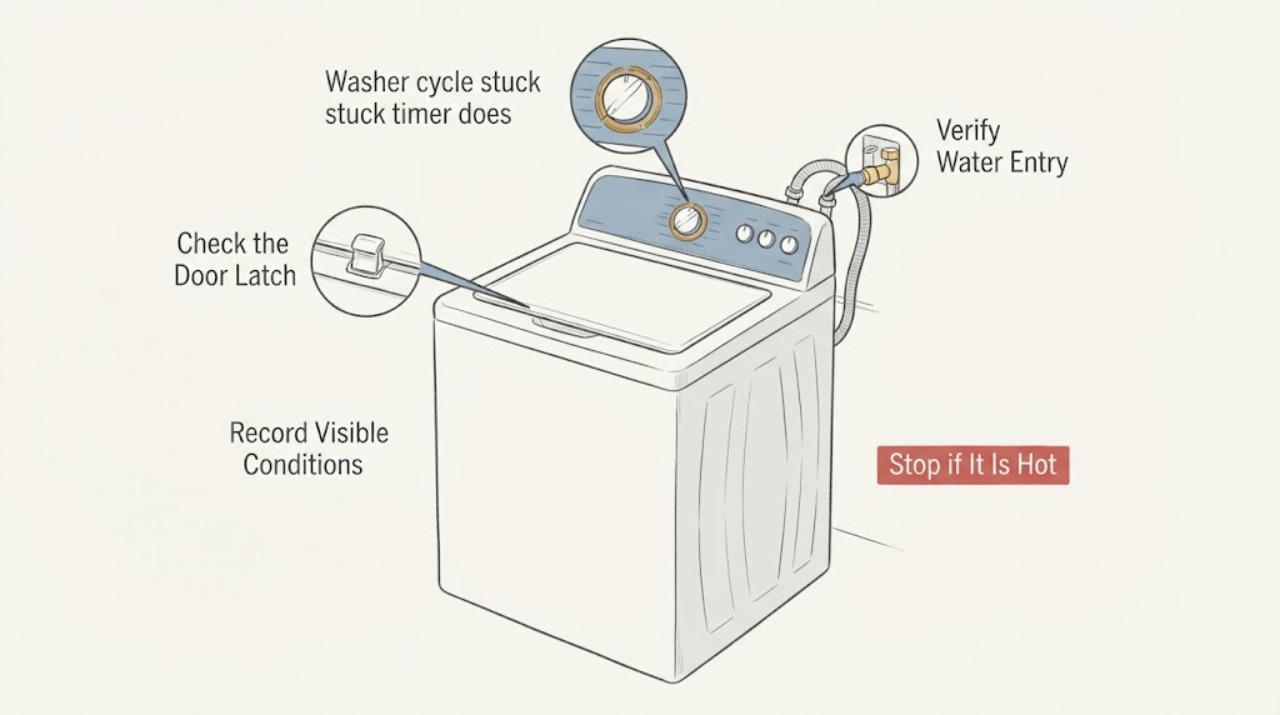
A washer timer that does not advance may be waiting for a normal condition rather than failed: the displayed time is an estimate and can hold while the machine balances a load, heats water, or reduces excessive suds. It can also stop progressing when the lid or door is not latched, water is not entering, the washer cannot drain, an unbalanced load prevents spin, or a control fault interrupts the cycle. Note the stage where it pauses, the display or indicator pattern, whether the tub contains water, and whether the lid or door is locked. Check the model-approved lid or door closure, both water supplies, drain path, load distribution, and detergent use from ordinary access. A single model-approved cancel or power reset can clear a temporary control interruption, but a recurring stall, abnormal noise or smell, leaking, a lock that will not release, or a washer that cannot fill or drain needs qualified appliance service.
Work through in order
Diagnostic checks
Use only checks that match the exact appliance or system and its official guide.
-
Check 1
Without opening a moving or locked lid or door, note the selected cycle, the displayed time or indicator, the exact point where progress appears to stop, whether the basket is moving, and whether water is entering, heating, draining, or sitting in the tub.
Expected result: Record whether the display changes later, whether the washer makes intermittent sensing or balancing movements, whether an error or lock indicator appears, and whether the stall happens at the same stage on another approved cycle.
Next step: Follow the matching lid or door, water, drain, balance, detergent, or control-reset check rather than assuming the timer itself has failed.
Stop if: Do not reach into the basket, force a locked lid or door, or keep operating the washer if there is smoke, burning odor, unusual electrical noise, or leaking.
Why this matters
Why: A changing display or intermittent balancing, heating, or suds-management activity can be a normal extension of the estimate. A silent repeat at one stage, an error, or no fill or drain activity points toward an unmet gate condition or a fault.
-
Check 2
With the washer stopped and the area dry, close the lid or door firmly and inspect the visible latch area for clothing, lint, detergent buildup, or an obstruction; use only the model's normal closure and lock indicators.
Expected result: Note whether the lock indicator engages, the machine resumes, a lid or door error remains, the latch looks damaged, or the washer fills but refuses to advance while the lid or door remains open or unlatched.
Next step: Clear only visible debris from ordinary access as the model guide permits. If the latch will not engage or the error returns, leave the cycle stopped and arrange service.
Stop if: Do not bypass, tape, hold, or defeat the lid or door lock, and do not open a locked lid or door by force.
Why this matters
Why: A washer that resumes after proper closure was waiting for its safety gate. An obstruction, damaged latch, or persistent lock error can prevent cycle progression even when other controls respond.
-
Check 3
If the stall occurs during fill, verify from a dry position that both household water valves are open, the visible inlet hoses are connected and not kinked, and the washer's display is not waiting for a water-related warning.
Expected result: Note whether water enters both expected temperature lines, enters slowly or not at all, a hose connection drips, or a code or indicator identifies a fill problem.
Next step: Correct only an obviously closed valve or accessible hose kink if it can be done safely and without disturbing a leaking connection; use the model guide and request service for a continuing fill fault or leak.
Stop if: Do not remove hoses, open the cabinet, or keep the water supply on when a hose, valve, or connection is leaking.
Why this matters
Why: No or slow water entry can leave the washer waiting before wash or rinse advances. A kinked hose, closed valve, visible leak, or persistent fill warning points to the supply path or inlet system rather than a timer display problem.
-
Check 4
If the washer pauses before or during spin, observe whether water remains in the tub, the drain pump runs, the drain hose discharges normally, or the basket repeatedly attempts to redistribute the load; when the model permits safe opening after motion stops, redistribute a single bulky item or an obviously uneven load.
Expected result: Record a slow or incomplete drain, water backing up at the household drain, repeated balance-correction movements, severe vibration, or a load that is evenly distributed but still will not advance.
Next step: Use the model's drain or load-balance procedure for a safe correction. Arrange service when the washer cannot drain, the household drain backs up, vibration is severe, or the cycle remains stuck with a balanced load.
Stop if: Do not reach into a moving basket, place hands in standing water, tip or move the washer alone, or continue a cycle that leaks or vibrates violently.
Why this matters
Why: A drain restriction can keep the washer from reaching spin, while an uneven or bulky load can extend or interrupt final spin. If drain and balance conditions are normal but the same stage repeats, a lock, sensor, motor, pump, or control issue becomes more likely.
-
Check 5
After the washer is safely stopped, inspect for unusually heavy suds and review the detergent type, amount, additives, and any bulk-dispenser setting against the appliance maker's instructions.
Expected result: Note persistent foam, an Sd, 5d, or SUD-style warning where applicable, extra detergent added while a bulk dispenser was enabled, or a cycle that eventually resumes after repeated water additions.
Next step: Use only the specified HE detergent and amount, follow the model's cleaning or empty-cycle guidance, and request service if suds remain or the cycle repeatedly stalls after the detergent issue is corrected.
Stop if: Do not add unapproved chemicals, mix cleaners, or run repeated full loads to force a suds-locked washer to advance.
Why this matters
Why: Excess suds can place the washer in a suds-management lock and extend the cycle, so a constant time display does not by itself prove a failed timer. Incorrect dispenser concentration or extra detergent can make the condition recur.
-
Check 6
Once the washer is safely stopped and the lid or door state and water level are understood, use the exact Owner's Manual Cancel or Reset procedure once; if that manual permits a power cycle for the symptom, follow it without opening panels or accessing wiring.
Expected result: Record whether the control responds, the display clears, the lid or door releases normally after the safe procedure, the cycle completes once, or the same stage and symptom return.
Next step: Leave the washer out of service and arrange qualified appliance repair; provide the model, cycle, stage, display code, water level, lock state, and results of the external checks.
Stop if: Do not remove panels, test energized components, bypass a lock, or continue operating the washer when the fault repeats or a safety symptom is present.
Why this matters
Why: A one-time recovery after a model-approved reset supports a temporary control interruption. A repeat stall, unresponsive controls, recurring lock or drain issue, or a cycle that stops with water still present needs diagnosis rather than repeated resets.
Use your observations
Decision map
Find the observation that best matches what you see, then follow the next safe action.
-
PATH 01Safety boundary
What you see
The displayed time holds while the washer is sensing, intermittently balancing, heating a selected cycle, or managing visible suds, then eventually changes or completes.
Do this next
Allow the approved cycle to finish if there is no leak, abnormal noise, smell, or unsafe condition; reduce recurrence with the model's load and detergent guidance.
Why this path and its safety boundary
Why it matters: The timer may be displaying a revised estimate rather than being stuck. Bulky or uneven loads, heating requirements, and suds management can all extend the displayed time.
Safety stop: Stop and arrange service if the same stage never resolves, the washer repeatedly stalls, or a safety symptom appears.
-
PATH 02Safety boundary
What you see
The washer fills or pauses but the lid or door remains unlatched, an obstruction is visible, or a lock indicator or related error remains.
Do this next
Close and clean the visible latch area only as the model guide allows. If the lock does not engage or the problem returns, leave the washer stopped and call a qualified technician.
Why this path and its safety boundary
Why it matters: The control may be waiting for its safety latch before it can wash, drain, rinse, or spin. Some models fill with the lid open but will not advance.
Safety stop: Do not defeat the lock, force the lid or door, or reach into a moving basket.
-
PATH 03Safety boundary
What you see
The timer stops at fill with little or no water entering, or stops before spin with water remaining, a slow drain, or household drain backup.
Do this next
Check accessible supply and drain conditions from a dry position, then use appliance or plumbing service for a continuing fill or drain fault, leak, or backup.
Why this path and its safety boundary
Why it matters: The washer is more likely waiting for a water-entry or drain condition than for a timer replacement. Supply valves, hoses, drain path, pump, or household plumbing need to be separated by observation.
Safety stop: Do not remove hoses or open the pump or cabinet while water is present or a leak is active.
-
PATH 04Safety boundary
What you see
The pause occurs near spin with repeated redistribution attempts or heavy vibration, or the washer shows heavy foam and a suds-related warning.
Do this next
Use the model-approved load redistribution or detergent correction once, then observe an approved cycle. Request service if the balanced, correctly dosed washer still stalls.
Why this path and its safety boundary
Why it matters: An uneven or bulky load can delay final spin, while excess detergent can trigger a suds-management lock that adds water and time. Neither pattern alone proves the timer is defective.
Safety stop: Do not reach into a moving basket, add more detergent, or continue with severe vibration, leaking, or an unresolved warning.
-
PATH 05Safety boundary
What you see
The same stage freezes after the lid or door, supply, drain, load, and detergent checks are normal, or the controls remain unresponsive after one model-approved reset.
Do this next
Keep the washer out of service and arrange qualified diagnosis with the model, stage, display code, water level, lock state, and observed behavior.
Why this path and its safety boundary
Why it matters: A recurring stall makes a sensor, lock, actuator, motor, pump, timer, or control-board fault more likely, but the exact failed part cannot be selected from the time display alone.
Safety stop: Do not replace a timer or control board speculatively, open the cabinet, bypass a safety device, or test live wiring.
Helpful context
Understand the symptom
First decide whether the timer is stuck or the estimate is being revised
A time display is not a stopwatch. A washer may pause the displayed estimate while it senses a bulky or uneven load, heats water for a selected heated cycle, or manages excess suds. If the basket periodically moves, water temperature is changing, or the machine is slowly correcting a load, the unchanged display can be expected. A display that stays fixed while the washer is silent, shows an error, never fills or drains, or repeats the same point after a reset is more likely a fault or an unmet operating condition.
A washer cannot advance until each gate condition is satisfied
The machine may wait for a closed and latched lid or door, sufficient water flow, a completed drain, or a safe load balance before moving to the next stage. Check what the washer is doing at the pause instead of replacing a timer based only on the display. Do not bypass a lock or open a moving basket; the exact indicators and recovery steps vary by model, so use the Owner's Manual for the assigned washer.
Use one controlled recovery attempt, then document a repeat fault
After the safe external checks, use the model's Cancel or Reset procedure once. If the washer is empty or safely paused, the manual may permit a power cycle; do not interrupt power or open a locked door while water or motion creates a hazard. If the same stage freezes again, record the stage, code, sounds, water level, and lock state. That pattern helps a technician distinguish a supply, drain, balance, lock, or control problem without repeated trial cycles.
Safety boundary
Stop conditions
- Do not bypass or defeat a lid or door lock, open a locked appliance by force, or reach into a moving basket.
- Do not place hands in standing water, open panels, disconnect wiring, or test energized components as an ordinary-user check.
- Stop for leaking, smoke, burning odor, unusual electrical noise, a damaged cord or outlet, severe vibration, or water near electrical parts; leave the washer out of service and seek qualified help.
- Do not keep repeating cycles, adding detergent, or resetting the washer when the same stage stalls, an error returns, or the washer cannot fill or drain.
- Do not select a replacement timer, pump, lock, valve, or control board until the exact model and diagnostic result support that part.
Only after diagnosis
Potential parts
- lid or door lock assembly
Consider this only when the exact model shows a persistent lock fault or the latch cannot engage after visible obstruction and closure checks.
Confirm the exact washer model and manufacturer's fit information before ordering; do not bypass the lock. - water inlet valve or inlet hose
Consider this only when a fill-time stall is supported by a confirmed supply-path fault after household valves and visible hoses are checked.
Confirm the exact model, valve configuration, hose connections, and manufacturer's fit information before ordering. - drain pump or drain hose
Consider this only when the washer cannot drain and the household drain and visible hose are not the cause; internal pump work needs qualified diagnosis.
Confirm the exact model and whether the component is user-serviceable before ordering or attempting repair. - timer or electronic control
Consider this only after a repeat stall remains with normal lid or door, fill, drain, balance, and detergent conditions and a technician confirms the control fault.
Confirm the exact model, revision, and diagnostic result with the manufacturer or technician before ordering.
When checks do not resolve it
Need a professional?
Arrange qualified appliance repair when the timer or displayed time repeatedly stops at the same stage after the lid or door, supply, drain, load, detergent, and one model-approved reset check; when a lock will not engage or release normally; or when controls are unresponsive. Stop immediately for leaking, smoke, burning odor, severe vibration, unusual electrical symptoms, water near electrical parts, or any condition requiring panel access or a bypassed safety device. Use plumbing service when the household water supply or drain backs up independently of the washer.
Common questions
FAQ
Is a washer timer stuck if the displayed minutes do not change?
Not necessarily. The displayed time is an estimate and may hold while the washer balances a load, heats water, or manages excess suds. A repeat stall with no activity, an error, or no fill or drain progress needs troubleshooting.
Why does my washer fill but not advance?
Check whether the lid or door is fully closed and latched and whether a visible obstruction is preventing the lock. Some washers can fill with the lid open but will not advance until the safety lock condition is met.
Can an unbalanced load make the washer timer appear stuck?
Yes. A bulky or uneven load can make the washer repeatedly correct balance or extend final spin, leaving the displayed estimate unchanged for a while. Stop for service if the basket vibrates severely or a balanced load still stalls.
Can too much detergent stop a washer cycle from advancing?
Excess detergent or non-HE detergent can create suds that trigger a suds-management lock and add time. Use the specified detergent and amount; recurring stalls after correction need service.
Should I reset a washer whose timer does not advance?
Use the exact Owner's Manual Cancel or Reset procedure once after confirming the washer is safe and its water and lock state are understood. If the same stage returns, do not keep resetting or running cycles; document the behavior and arrange qualified diagnosis.
Read the exact guide
Official sources
- Lid Locking on a Top Load High Efficiency WasherWhirlpool Product Help · Manufacturer guidance that some washers will not advance with the lid open, and that visible obstruction, cleaning, model instructions, and qualified service matter.
- Stops Mid Cycle- WasherWhirlpool Product Help · Manufacturer troubleshooting guidance for flashing indicators, out-of-balance loads, reduced spin, longer cycles, and self-correction behavior.
- Not Starting or Not Operating - Front Load WasherWhirlpool Product Help · Manufacturer troubleshooting guidance for control lock, door closure, water valves, display states, Start operation, and a model-specific power cycle.
- Cycle Time is Not Advancing - Front Load WasherWhirlpool Product Help · Manufacturer troubleshooting guidance for estimated time, load balance, heated cycles, excessive suds, and bulk-dispenser settings; model behavior can vary.
Community feedback
Share a repair observation
Share a plain-text repair observation. Accepted observations are published automatically; this page may take a moment to update.