
On this page
Start here
Quick answer
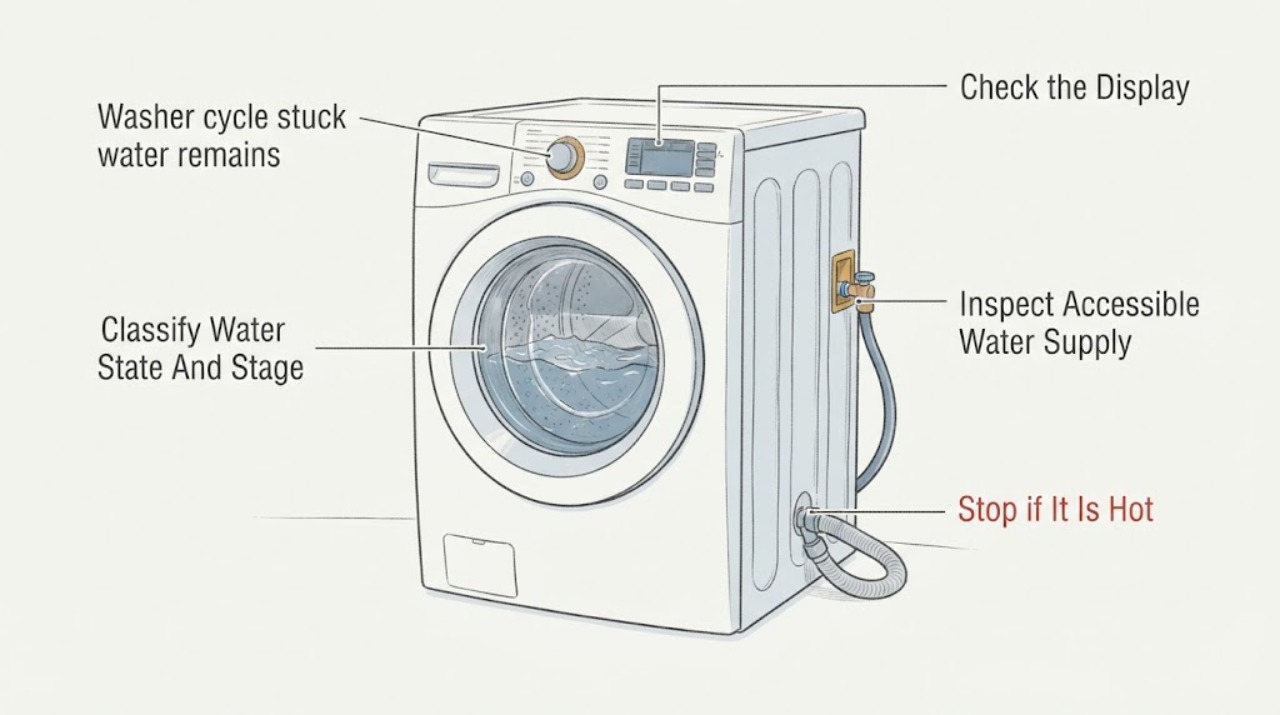
First separate a washer that has water left in the tub from one that never filled. If a completed cycle leaves water or very wet clothing, keep hands out of the tub, check the display and load, and use the model-approved Drain & Spin option only when the washer is stable and there is no leak or other hazard. A kinked or poorly routed drain hose, excess suds, or an unbalanced load can prevent a normal drain or spin; a pump, control, or blocked internal drain path may still need service. If the tub is empty because no water entered, check whether the cycle is paused or locked, confirm the accessible hot and cold supply valves are open, and look for an obvious kink in the inlet hoses without disconnecting anything. Do not bypass a lid or door lock, open a pump filter or hose with standing water, or reach into a moving washer. If the cycle repeatedly stalls, a lock stays engaged, water enters when it should not, the washer leaks, or the safe checks do not restore a complete cycle, stop using it and arrange qualified appliance service.
Work through in order
Diagnostic checks
Use only checks that match the exact appliance or system and its official guide.
-
Check 1
Stop or pause the washer using its normal controls and record whether water is visibly in the tub, the clothes are wet but the tub is empty, or no water ever entered; record the displayed stage or message before trying another cycle.
Expected result: Distinguish standing water, wet clothing after a failed spin, an empty tub with a no-water message, and a display that is paused or unresponsive.
Next step: Use the matching water-remains or water-absent branch below; save any code or message and do not reach into the washer while a lock is engaged.
Stop if: Stop and arrange service for a leak, burning smell, sparking, exposed wiring, uncontrolled filling, a door or lid that will not safely release, or any need to reach into moving or locked equipment.
Why this matters
Why: Standing water makes drain, suds, load-balance, or low-spin issues more likely. An empty tub with no fill makes supply, lock, inlet, siphoning, or control issues more likely. A lock or unresponsive display changes the safe boundary and should not be bypassed.
-
Check 2
With the washer stopped, check the display for pause, control-lock, lid-lock, door-lock, or water-supply messages and verify that the lid or door is closed in the ordinary way; do not force or bypass the lock.
Expected result: Note whether the controls respond, the lock indicator changes normally, the lid or door closes without an obstruction, and the washer resumes only when the normal control is pressed.
Next step: Follow only the exact model's normal unlock or control-lock procedure; if the lock remains engaged or the washer is unresponsive, leave it off and arrange service.
Stop if: Do not pry the lid or door, defeat a lock, remove panels, or reach into the tub to retrieve items.
Why this matters
Why: A control or lock state can make a cycle appear frozen and may prevent filling, draining, rinsing, or spinning. A lock that remains engaged, clicks repeatedly, or will not recognize a properly closed lid or door can indicate a lock, alignment, wiring, or control fault.
-
Check 3
For an empty tub or no-water message, check from a dry, stable position that the accessible hot and cold supply valves are open and that the inlet hoses have no obvious kink, crush, or sharp bend; do not disconnect a hose.
Expected result: Record whether both valves are open, a hose is visibly restricted, an anti-flood device or inlet area appears abnormal, or the supply path looks normal.
Next step: Correct only an obvious valve or hose-position issue that can be handled without releasing a connection; then follow the model's fill test. Refer repeated no-fill behavior to qualified service.
Stop if: Do not loosen fittings, pull the washer into an unsafe position, remove inlet screens, or work around water and power together.
Why this matters
Why: A closed valve or visibly restricted hose can explain insufficient incoming water. A normal-looking supply path does not prove that the inlet valve, screens, pressure sensing, or control is good, especially when the message repeats.
-
Check 4
For water remaining in the tub, inspect only the visible drain hose routing and accessible drain opening for an obvious kink, crushing, dislodgement, or blockage; keep the washer stopped and do not open a hose, pump filter, or panel with water present.
Expected result: Note whether the hose is pinched or displaced, the drain point is visibly blocked, the machine makes a drain sound without water leaving, or there is no drain response.
Next step: Correct only an obvious external routing issue when the manual permits it; otherwise keep the washer off and arrange service for standing water or an unresolved drain fault.
Stop if: Do not reach into the tub, remove a filter, disconnect a drain hose, or tip the washer to release water without the exact manual procedure and safe isolation.
Why this matters
Why: A restricted or incorrectly routed drain path can leave water behind. A hum with no flow or no drain response can also involve a pump, internal obstruction, wiring, or control and cannot be safely diagnosed by forcing the system open.
-
Check 5
If there is no leak or other hazard and the washer is unlocked, observe whether the load is tightly packed, visibly bunched to one side, or unusually sudsy; make only the load-size or detergent adjustment allowed by the model manual and never reach into a moving drum.
Expected result: Record whether the load is small and balanced, overloaded or bunched, or surrounded by persistent suds, and whether clothing remains wet because the spin was reduced or skipped.
Next step: Use the model-approved Drain & Spin or corrective load procedure only when safe; if the stall repeats, stop testing and provide the pattern to service.
Stop if: Do not open the door during motion, override a lock, add chemicals to chase suds, or continue a cycle that leaks or makes grinding or electrical noises.
Why this matters
Why: An off-balance or tightly packed load can cause a low or skipped spin, leaving wet clothing or water. Excess suds can interfere with draining and sensing. If the same symptom occurs with a suitable load, a mechanical, drain, sensor, or control fault becomes more likely.
-
Check 6
After recording the symptom and only when the washer is dry externally, stable, free of smoke or leak, and safe to control, perform at most the model-approved power reset; then document whether the same stage, water state, code, or sound returns.
Expected result: A complete cycle after one reset is different from a cycle that stalls again at filling, draining, locking, or spinning; note any repeat message or changed behavior.
Next step: Do not repeat resets as a substitute for diagnosis. Keep the washer off and arrange qualified appliance service for recurrence, standing water, a lock fault, a leak, or an unexplained no-fill condition.
Stop if: Do not reset a washer with active leaking, burning odor, sparking, flooding, a damaged cord, or an unsafe locked compartment.
Why this matters
Why: A reset can clear a temporary control state but does not establish that a pump, inlet valve, lock, sensor, or control is healthy. Recurrence at the same stage is useful diagnostic evidence and calls for service.
Use your observations
Decision map
Find the observation that best matches what you see, then follow the next safe action.
-
PATH 01Next step
What you see
The cycle reports complete or the washer stops after washing, but water remains or clothing is unusually wet; the load may be bunched, the washer may have used little or no spin, or the visible drain hose may be restricted.
Do this next
Keep the washer safe and use the exact model's Drain & Spin or water-removal procedure only when permitted. Do not open the pump or disconnect a hose with standing water; arrange service if water remains or the symptom returns.
-
PATH 02Next step
What you see
The washer reaches drain or spin, water is still present, and the drain hose is visibly kinked, displaced, or blocked at the accessible drain point, or the washer hums without a normal flow.
Do this next
Correct only an obvious external routing issue that the manual permits, then stop if the washer still will not drain. Do not force a pump, remove a filter, or tip the appliance; arrange qualified service.
-
PATH 03Next step
What you see
The tub is empty because no water entered, a no-water message appears, or the washer pauses early while the accessible supply valves and inlet hoses have not yet been confirmed.
Do this next
Check the normal control and lock state and the accessible supply valves and hose routing without disconnecting anything. If the message or no-fill behavior persists, keep the washer off and arrange service.
-
PATH 04Next step
What you see
The lid or door remains locked, the controls are unresponsive, water is uncontrolled or leaking, or there is smoke, burning odor, sparking, exposed wiring, a damaged cord, or a risk of flooding.
Do this next
Stop using the washer, keep people and pets away from the hazard, and arrange qualified appliance service. Use emergency help for active fire, shock, or immediate danger.
-
PATH 05Next step
What you see
A single safe reset or an appropriate load does not complete the cycle, or the washer repeatedly stalls at the same fill, lock, drain, rinse, or spin stage.
Do this next
Stop repeated test cycles, preserve the code and observations, and arrange qualified appliance service with the model information and symptom timeline.
Helpful context
Understand the symptom
Start by identifying what the washer is waiting for
A cycle that appears stuck is not one diagnosis. Note whether water is visibly in the tub, whether clothing is merely wet, whether the tub is empty because the washer never filled, and which stage or message is shown. A pause, control lock, lid/door-lock problem, water-supply problem, drain problem, or failed spin can all look like a frozen cycle. Save any displayed code before cycling power or changing the selection.
If water remains after the cycle
Keep the washer stopped while you look at the display, load, and accessible hose routing. A large or unbalanced load, too many suds, or a drain hose that is kinked or installed incorrectly can leave water and prevent a useful spin. Follow the exact owner's manual for any Drain & Spin selection and for safe water removal. Do not open a pump filter, disconnect a hose, or reach into the tub when standing water or an engaged lock is present unless the manual gives a model-specific safe procedure and the appliance has been made safe.
If the tub is empty because water is absent
An empty tub can mean the washer never received water, rather than that it drained correctly. Check that the intended cycle is selected and not paused by a control, lid, or door lock. From a dry, stable position, confirm both accessible supply valves are open and look for an obvious kink or crushed section in the inlet hoses. Do not loosen hose connections or remove inlet screens as a general step; use the model manual or a technician for work that can release water or expose internal parts.
Treat a repeated stall as a service symptom
One successful reset does not prove that the washer is repaired. A cycle that repeatedly stops at the same stage, a recurring no-water message, a lock that will not release, water that returns after a drain attempt, a leak, or a pump that only hums can require diagnosis of the inlet valve, lock, drain pump or path, pressure sensing, wiring, or control. Stop using the washer when water or electrical safety is uncertain and give the technician the stage, load, water level, sounds, message, and what changed after the safe checks.
Safety boundary
Stop conditions
- Stop using the washer for active leaking, uncontrolled filling, flooding risk, smoke, burning odor, sparking, exposed wiring, a damaged cord, shock, or grinding that suggests a failing mechanical part.
- Do not bypass a lid or door lock, pry open a locked compartment, reach into a moving drum, remove a pump filter or hose with standing water, tip the washer, or remove panels as a general troubleshooting step.
- A safe user check is limited to normal controls, visible load condition, and accessible valve or hose routing allowed by the exact model manual; internal electrical, pump, inlet-valve, sensor, structural, and water-release work belongs to qualified service.
Only after diagnosis
Potential parts
- washer drain pump
Relevant only if qualified diagnosis finds that the washer cannot drain because the pump is failed or obstructed and external routing is not the cause.
Match the exact washer model and manufacturer-approved part; do not infer fit from appearance or from a drain symptom alone. - washer water inlet valve
Relevant only when supply is available and a qualified test identifies an inlet-valve fault behind the no-fill symptom.
Confirm exact model, valve configuration, and approved replacement before ordering; a no-water message can also involve a lock, hose, sensor, or control. - washer lid or door lock assembly
Relevant only when the exact model's lock does not recognize a safely closed lid or door or will not release and qualified diagnosis confirms the assembly fault.
Use the exact model's approved lock assembly and do not bypass or substitute a lock. - washer control board or water-level sensor
Relevant only after supply, drain, load, lock, wiring, and simpler causes are checked and qualified diagnosis identifies a control or sensing fault.
Confirm the exact model and diagnostic evidence before replacement; a reset or recurring stage does not prove a board or sensor is defective.
When checks do not resolve it
Need a professional?
Arrange qualified appliance service when the washer repeatedly stalls, remains full after the safe drain procedure, shows a recurring no-water or lock message, will not release its lid or door normally, leaks, fills or drains unexpectedly, makes an abnormal pump or motor sound, or has a normal-looking external supply and drain path but still fails. Keep it off for electrical, flooding, or lock hazards and provide the model, stage, water state, code, load, sounds, and results of the safe checks.
Common questions
FAQ
Why is my washer stuck with water still inside?
An off-balance or tightly packed load, excess suds, or a restricted drain hose can leave water behind or reduce the spin. If the load and visible hose routing look normal and water remains, a pump, internal drain path, sensor, or control fault may need service. Keep hands out and do not open a filter or hose with standing water.
What should I check when the washer is empty but the cycle will not continue?
Confirm whether the washer is paused or showing a lock or no-water message. From a dry, stable position, check that the accessible hot and cold supply valves are open and that the inlet hoses are not visibly kinked. Do not disconnect hoses; recurring no-fill behavior needs qualified diagnosis.
Can I run Drain & Spin when water remains?
Only use the exact model's Drain & Spin procedure when the washer is stable, unlocked, free of leaks and other hazards, and the manual permits it. A completed Drain & Spin does not explain or repair a recurring drain fault; stop and arrange service if water remains or the symptom returns.
Could the lid or door lock make a washer cycle look stuck?
Yes. Applicable top-load washers require a lid lock for filling, draining, rinsing, and spinning, and a closed door or lock state can affect other models. Never bypass or pry a lock. If it will not recognize a normally closed lid or door or will not release, keep the washer off and arrange service.
Is a power reset a repair for a stuck washer cycle?
No. One model-approved reset can clear a temporary control state, but a repeated stall at the same fill, lock, drain, rinse, or spin stage is evidence for diagnosis rather than repeated resets. Record the water state, message, stage, sound, and result, then arrange qualified service.
When should I stop troubleshooting a washer that is stuck?
Stop for leaking, flooding risk, uncontrolled filling, smoke, burning odor, sparks, shock, exposed wiring, a damaged cord, abnormal grinding, or a lid or door that stays locked. Do not remove wet internal parts, tip the machine, or bypass a safety lock; arrange qualified service and use emergency help for active fire or immediate danger.
Read the exact guide
Official sources
- Won't Start - Has Power - WasherWhirlpool Corporation · Whirlpool washer start, control-lock, lid-lock, water-supply, reset, and service guidance
- No Water Detected - MessageWhirlpool Corporation · Whirlpool washer no-water-detected message and incoming-water checks
- Water Remains in Tub or Inside Washer - Front Load WasherWhirlpool Corporation · Whirlpool front-load washer water remaining and low/no-spin troubleshooting
- Not Draining - WasherWhirlpool Corporation · Whirlpool top-load washer drain troubleshooting
- Lid Locking on a Top Load High Efficiency WasherWhirlpool Corporation · Whirlpool top-load washer lid-lock operation and safe troubleshooting boundary
Community feedback
Share a repair observation
Share a plain-text repair observation. Accepted observations are published automatically; this page may take a moment to update.