
On this page
Start here
Quick answer
A washer that appears stuck may be holding its displayed time while it balances the load, heats water, handles excess suds, or waits for filling or draining. First record the displayed phase and whether the tub is filling, draining, or spinning; then make only safe visual checks of the load, lid or door, visible hose, water valves, and any leak. Do not force the lid or door, reach into a moving tub, open panels, remove a pump filter, or replace a control part based only on a frozen timer. If water remains, the machine repeatedly stops, a lock stays engaged, a leak or burning smell appears, or an electrical or internal part needs testing, stop using the washer and call an appliance technician with the observations and model information.
Work through in order
Diagnostic checks
Use only checks that match the exact appliance or system and its official guide.
-
Check 1
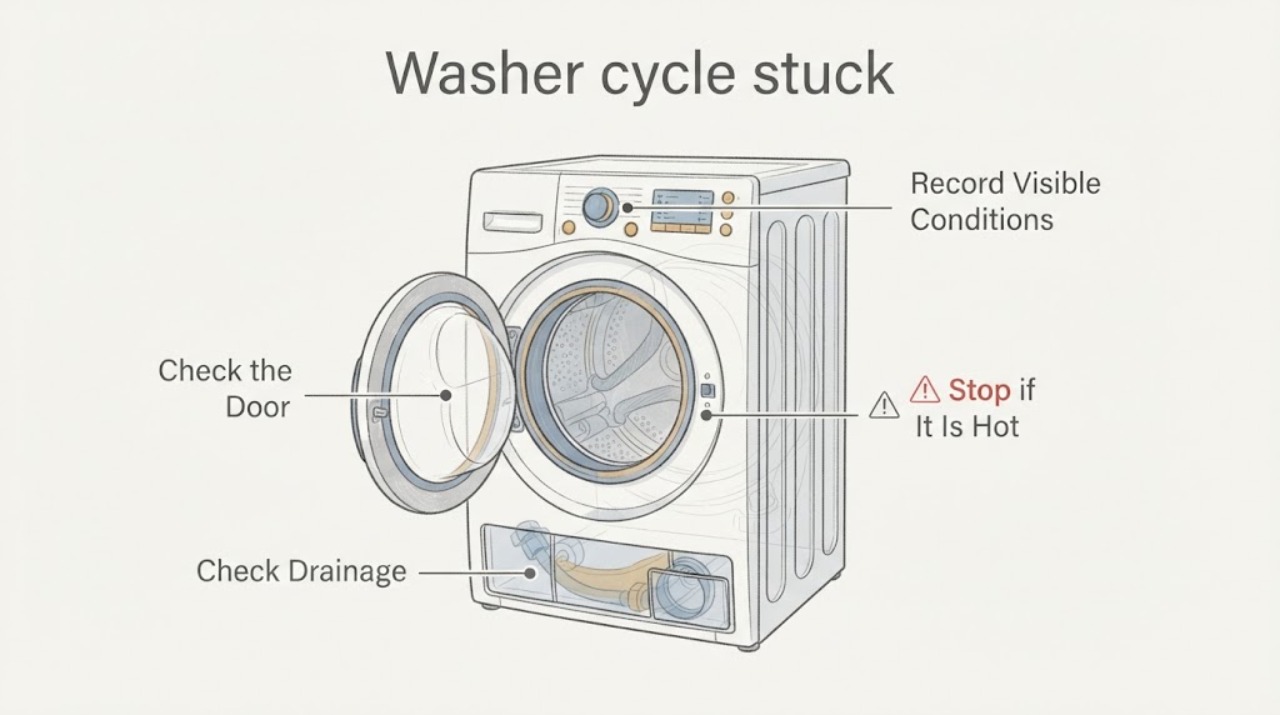
Without opening the cabinet or reaching into the tub, observe the washer's displayed cycle, phase, remaining-time behavior, sounds, and visible tub state for one normal observation period; note whether it is filling, washing, draining, or attempting to spin.
Expected result: The display may hold at one estimate while the washer tumbles, pauses, heats, balances, or shows a warning; the tub may be empty, partially full, full of suds, or full of water; the machine may be silent or repeatedly trying a phase.
Next step: Write down the exact display, phase, water level, and sound pattern before changing settings. Use the exact model manual for any displayed indicator, then continue with the matching external observation below.
Stop if: Stop if the washer leaks, smokes, smells burnt, sparks, becomes unusually hot, moves violently, or makes a harsh new sound. Keep clear and arrange service.
Why this matters
Why: A changing sound or mechanical phase with a stable estimate can be a normal recalculation or balancing delay. A silent machine with no phase change, a tub that stays full, or a repeated retry points to a separate fill, drain, lid or door, suds, or internal-control path.
-
Check 2
With the tub stationary, observe whether the lid or door is fully closed, whether clothing or a foreign object is visibly caught at the seal or strike area, and whether a lock indicator remains on; do not force, pry, defeat, or repeatedly slam the lid or door.
Expected result: The lid or door may be clearly closed with a normal indicator, visibly obstructed, not seated, or locked while water remains in the tub.
Next step: Record the lock or door indication and compare it with the model manual. If the closure is not clearly intact, leave the washer off and call for diagnosis rather than bypassing the lock.
Stop if: Stop for a locked door or lid, visible broken latch, exposed wiring, water pressing against the door, or any need to reach into the tub or defeat the lock.
Why this matters
Why: Many washers will not advance or spin unless the closure is recognized. A persistent lock with water present is a safety state, not permission to force the door; an obstruction, latch, lock, or control fault may need service.
-
Check 3
Look at the tub's visible water level and the accessible portion of the drain hose without disconnecting it or moving the washer; check only whether the hose is visibly kinked, crushed, leaking, or positioned contrary to the model instructions.
Expected result: The tub may be empty, partly or fully full, draining slowly, or showing standing water; the hose may look open and intact or visibly kinked, crushed, or leaking.
Next step: Keep water and power off if there is a leak, photograph the visible hose and water level, and use the model manual or an appliance technician for any drain-pump, filter, hose-disconnection, or internal inspection.
Stop if: Stop for a leak, hot water, a heavy full tub, a hose that must be disconnected, a need to tip or move the washer, or any attempt to open a pump filter or cabinet.
Why this matters
Why: Standing water or a failed drain phase keeps the washer from advancing to spin or completion. A visible hose problem can explain a drain symptom, but an unobstructed hose does not rule out a pump, filter, control, or internal blockage.
-
Check 4
From outside the washer, observe whether the load is visibly bunched, a single bulky item, unusually small or overloaded, or surrounded by excessive suds; do not reach into a moving tub and do not add chemicals to counter the symptom.
Expected result: The load may look evenly distributed with little suds, be concentrated on one side, contain a bulky item, exceed the drum's normal capacity, or produce persistent foam.
Next step: Record the load type and suds level. If the exact manual permits a pause and the tub is fully stopped and unlocked, follow only that model's load guidance; otherwise let a technician assess a recurring balance or suds condition.
Stop if: Stop for a moving tub, a locked lid or door, violent vibration, leaking suds, a heavy or tangled load that requires reaching in, or any need to dismantle the washer.
Why this matters
Why: An unbalanced or bulky load can cause repeated redistribution and a longer cycle. Excessive suds can also extend the cycle or prevent normal draining and spinning. If the machine is still moving, do not interrupt it by reaching inside.
-
Check 5
If the washer appears to be waiting for water, visually check that the accessible hot and cold supply valves are open and the inlet hoses are not visibly kinked, crushed, or leaking; do not disconnect hoses or remove inlet screens.
Expected result: Both valves may appear open and hoses intact, one valve may be closed, a hose may be kinked, or water may be leaking at a connection.
Next step: Record the valve positions and hose condition, then consult the model manual or call service for any flow, screen, valve, sensor, or wiring test. Do not loosen a connection as a test.
Stop if: Stop for any leak, wet electrical area, burst or swollen hose, inaccessible valve, or need to remove a hose, screen, panel, or cover.
Why this matters
Why: A washer cannot advance through a fill phase without the required water supply. A normal-looking supply does not prove that the inlet valves, screens, pressure sensing, or control are working, while a leak requires the washer to remain out of use.
Use your observations
Decision map
Find the observation that best matches what you see, then follow the next safe action.
-
PATH 01Next step
What you see
The display estimate holds, but the washer is still tumbling, filling, draining, heating, or balancing without a hazard.
Do this next
Treat the display as an estimate and observe the current phase without repeatedly restarting the cycle. If the phase eventually changes, record the delay and review load, option, water, and suds observations; if it never changes, use the unresolved-cycle service path.
-
PATH 02Next step
What you see
Water remains in the tub or the washer stops during draining or before spin.
Do this next
Stop using the washer if there is a leak or electrical risk. Do not open a pump filter, disconnect a hose, tip the machine, or open the cabinet; provide the water level, visible hose condition, and model details to an appliance technician.
-
PATH 03Next step
What you see
The washer appears to wait for water and a valve is closed or an inlet hose is visibly kinked, crushed, or leaking.
Do this next
Do not loosen the hose. If there is no leak and the model instructions clearly permit the external check, correct only the visible valve position or hose routing; otherwise leave the washer off and request service.
-
PATH 04Next step
What you see
The lid or door is not recognized as closed, remains locked, or water is present behind a locked door.
Do this next
Do not force, pry, bypass, or defeat the lock. Keep the washer out of use and call an appliance technician for the latch, lock, drain, and control diagnosis.
-
PATH 05Next step
What you see
The load is bunched or bulky, the washer repeatedly redistributes it, or excessive suds are visible.
Do this next
Do not reach into a moving or locked tub. Record the load and detergent observations and follow only the exact model's safe pause and load guidance; recurring balance or suds interruptions warrant service.
-
PATH 06Next step
What you see
The washer is silent or repeatedly retries a phase, the visible checks are normal, or the cycle never advances after the applicable model guidance.
Do this next
Stop repeated restarts and arrange appliance service. A drain pump, water-level sensor, lid or door circuit, wiring, or control board may be involved, but no part should be ordered until the model and diagnosis confirm it.
-
PATH 07Next step
What you see
There is a leak, burning odor, smoke, sparking, exposed wiring, violent movement, unusual heat, or a harsh mechanical sound.
Do this next
Stop controls and keep people away. If it can be done without touching a hazard, shut off water and power using accessible controls; do not approach wet electrical areas or open the washer. Seek qualified appliance service or emergency help appropriate to the danger.
Helpful context
Understand the symptom
A timer that pauses is not always a failed cycle
The time shown by a washer is usually an estimate, not a continuously decreasing stopwatch. Load size, selected options, water temperature and pressure, load balance, and suds can change the remaining time. A front-load cycle may also hold its display while it redistributes an unbalanced load or runs a longer heated phase. Treat the symptom as unresolved until you know whether the machine is progressing through a phase or has stopped with water, an empty tub, a locked lid or door, or a visible warning.
Use observations to separate the likely paths
A washer that will not advance can be waiting for water, unable to drain, repeatedly trying to balance the load, or stopping because a lid or door is not recognized as closed. Excess detergent suds can also prolong or interrupt a cycle. These symptoms overlap, so note the phase, sounds, water level, control display, and whether the machine is leaking instead of assuming that the timer, drain pump, sensor, or control board is the cause.
Keep the checks observation-only
Stay with external, low-risk checks that the exact model manual permits. Do not defeat a lid or door lock, open the cabinet, reach beneath a washer, disconnect hoses while pressurized, remove a pump filter with water present, or probe wiring. If the washer is wet, hot, smoking, sparking, or making a new harsh mechanical sound, turn it off if that can be done without contact with a hazard and arrange qualified service.
Safety boundary
Stop conditions
- Do not force, pry, bypass, tape, or defeat a washer lid or door lock, and never reach into a moving tub.
- Do not open panels, probe wiring, remove a pump filter, disconnect a hose, tip or move the washer, or replace a control, pump, or sensor based only on a frozen display.
- Stop for leaks, hot water, smoke, burning odor, sparks, exposed wiring, violent movement, unusual heat, or a harsh new mechanical sound; keep clear and arrange qualified service.
- If external observations do not establish normal progress, stop repeated restarts and call an appliance technician with the cycle phase, water level, lock state, sounds, load, suds, hose, and model observations.
Only after diagnosis
Potential parts
- washer control board
Consider this category only after a technician rules out normal time recalculation, load balance, suds, fill and drain conditions, lid or door sensing, wiring, and other causes and confirms a control fault.
Confirm the exact washer model, board revision, software or feature set, connectors, and manufacturer fit information before ordering; a frozen display alone does not establish compatibility or failure. - washer drain pump
Consider this category only when the washer stops with water or fails a drain test and a technician confirms the pump rather than the hose, filter, blockage, wiring, or control is responsible.
Match the exact washer model and pump configuration, and account for model-specific access and water-handling requirements; do not open the pump area as a homeowner test. - washer water level sensor
Consider this category only after a technician confirms that incorrect fill-level detection is preventing the cycle from advancing and rules out supply, hose, pressure, wiring, and control causes.
Confirm the exact model, sensor type, pressure connection, electrical interface, and manufacturer fit information before ordering; do not assume a no-fill or overfill symptom identifies this part.
When checks do not resolve it
Need a professional?
Call an appliance technician when the washer remains on one phase, repeatedly retries, stays full of water, will not recognize a lid or door, or has normal visible supply and load conditions but still will not finish. Call promptly for a leak, burning odor, smoke, sparking, exposed wiring, violent movement, unusual heat, or a harsh mechanical sound. Provide the washer brand and model if visible, cycle and option selected, displayed time or warning, phase where it stops, tub water level, lid or door lock state, sounds, load and suds observations, visible hose and valve condition, and safe photos. Do not open the cabinet or order an internal part before diagnosis.
Common questions
FAQ
Why is my washer timer stuck on one minute or one cycle phase?
The displayed time is often an estimate. The washer may be balancing the load, heating, handling suds, filling, draining, or recalculating. Note whether the tub and sounds are still progressing; if the machine is silent or repeatedly retries, arrange service rather than repeatedly restarting it.
Should I open the washer when the cycle is stuck?
Only follow the exact model's normal pause behavior, and never force a lid or door. A locked closure or water in the tub is a safety condition. Do not pry, bypass the lock, or reach into a moving tub; call an appliance technician if it stays locked or the cycle will not advance.
Can an unbalanced load keep a washer from finishing?
Yes. A bulky, bunched, very small, or overloaded load can cause repeated redistribution and a longer cycle. Observe from outside and follow only the model manual's safe pause and load guidance; do not reach into a moving or locked tub.
What does water left in the washer mean?
Standing water points to a drain-phase problem or a cycle that has not reached drain completion. Check only the visible water level and accessible hose for a kink or leak. Do not disconnect hoses, remove a pump filter, tip the washer, or open the cabinet.
Should I replace the washer timer, pump, or sensor?
Not based on a stuck display alone. A technician should distinguish estimated timing, balance, suds, fill, drain, closure, wiring, sensor, pump, and control faults before selecting a model-compatible part.
When should I stop using a washer that is stuck?
Stop for a leak, burning odor, smoke, sparks, exposed wiring, unusual heat, violent movement, a harsh mechanical sound, water that will not drain, or a lid or door that stays locked. Keep clear and arrange qualified appliance service.
Read the exact guide
Official sources
- Washer Not Draining or Spinning? Troubleshooting GuideWhirlpool Product Help · General Whirlpool washer troubleshooting; access, filters, and user-level checks vary by model.
- Cycle Time is Not Advancing - Front Load WasherWhirlpool Product Help · Whirlpool front-load guidance; other models may use different phases, indicators, and timing behavior, so the exact model manual governs.
- Not Spinning - WasherWhirlpool Product Help · Whirlpool top-load washer guidance; exact washer design and user-accessible checks vary by model.
Community feedback
Share a repair observation
Share a plain-text repair observation. Accepted observations are published automatically; this page may take a moment to update.