
On this page
Start here
Quick answer
A bad smell from a washer detergent dispenser is most often caused by trapped moisture, detergent or softener residue, a clogged siphon or insert, or odor elsewhere in the washer that is being noticed at the drawer. Remove power before cleaning an accessible drawer, remove its inserts only as the model manual allows, rinse and brush away residue, clean the housing, and dry the parts before reinstalling them. Use the correct detergent amount and compartment, then run the model-approved empty cleaning or rinse cycle. If the odor returns after the drawer, gasket, drain area, and documented washer-cleaning cycle have been addressed, or if there is a burning or sewage odor, standing water, a leak, mold that cannot be safely removed, or no safe user access, stop and arrange appliance or plumbing service.
Work through in order
Diagnostic checks
Use only checks that match the exact appliance or system and its official guide.
-
Check 1
Stop the washer, remove laundry, and switch it off before touching the detergent drawer. From a dry position, compare the odor at the drawer, its housing, the door gasket or lid area, the drum, and the nearby drain without opening the cabinet.
Expected result: The smell is strongest in the drawer; residue or standing water is visible; the gasket or drum is also musty; the drain smells like sewage; or the odor is burning, electrical, or accompanied by smoke.
Next step: For a cool, stable washer with a drawer-local odor, continue with the model manual's drawer access. For smoke or a burning/electrical smell, keep the washer disconnected and arrange urgent qualified service. For sewage odor or drain backup, stop using the washer and arrange plumbing evaluation.
Stop if: Do not reach into a powered washer, open the cabinet, dismantle a drain connection, or keep testing after smoke, burning odor, a leak, or water near electrical equipment.
Why this matters
Why: A drawer-local smell supports residue or moisture in the dispenser, while a drum, gasket, pump-filter, or drain smell can require a broader maintenance check. Burning, smoke, or sewage odor is not a normal drawer-cleaning issue.
-
Check 2
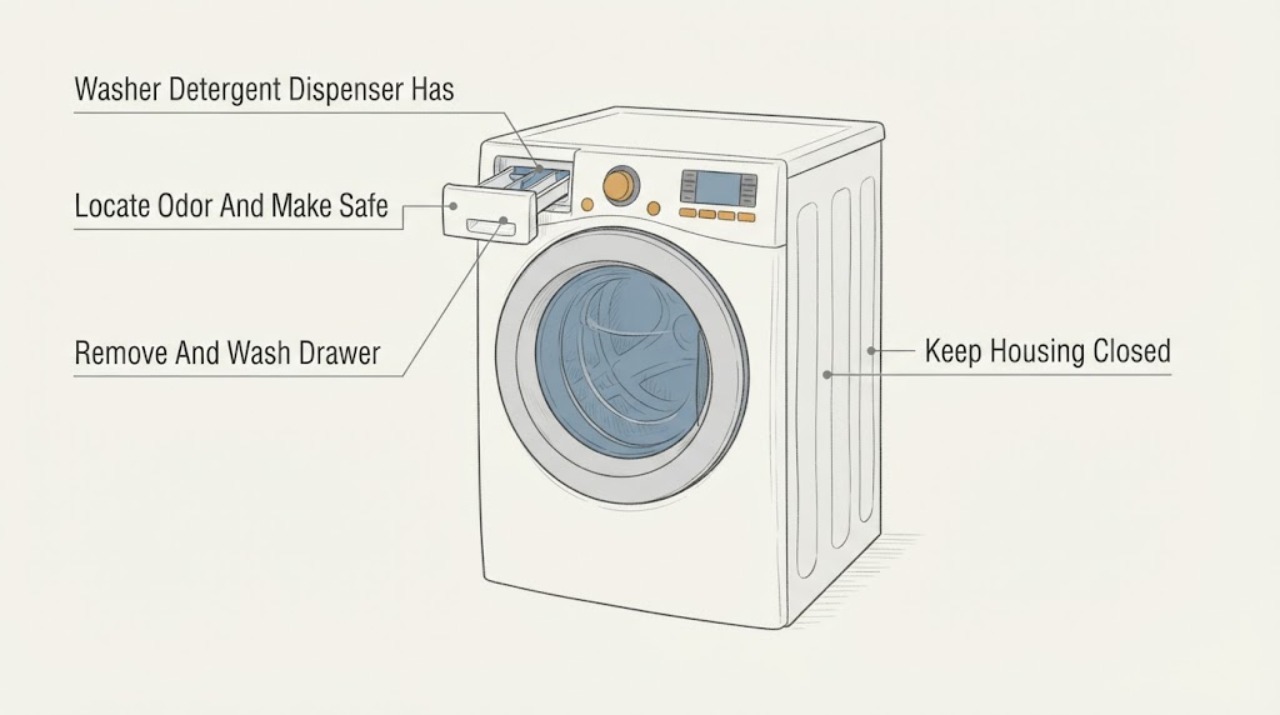
Follow the owner's manual to release and remove the detergent drawer, then remove only the inserts or siphon pieces the manual identifies. Wash the parts under running water, use a soft brush for residue, clean the drawer housing with mild soap and water, and dry everything before reinstalling it.
Expected result: The drawer contains softener or detergent residue, slime, discoloration, mineral scale, a blocked insert, or no unusual buildup; a part will not release; or the housing remains wet or dirty after cleaning.
Next step: Reassemble the inserts in their original positions and seat the drawer fully when the parts are clean and dry. If a part is stuck, cracked, missing, or still smells after cleaning, keep the washer out of service as needed and arrange model-specific appliance service.
Stop if: Do not pry a stuck insert, use sharp tools in water passages, put parts in a dishwasher without manual approval, or pour cleaner into hidden openings.
Why this matters
Why: Residue, scale, and trapped moisture can hold odor and restrict dispensing. A part that will not release or a housing that cannot be reached safely means the model-specific user procedure has ended, not that force is appropriate.
-
Check 3
Inspect the cleaned drawer's compartments, liquid-detergent guide, softener siphon, and MAX markings. Confirm each product is in the compartment intended by the manual, the inserts are seated, and the drawer is not overfilled; if the washer is visibly tilted, verify leveling only from the exterior.
Expected result: A siphon opening is blocked, an insert is missing or loose, product is above a MAX line or in the wrong compartment, thick residue remains, or the drawer and washer appear level and correctly assembled.
Next step: Correct only the documented insert position and product amount, then wipe the drawer dry. If the siphon will not clear with gentle hand cleaning or the drawer does not seat, stop and arrange service rather than forcing the valve or drawer.
Stop if: Do not exceed the MAX line, combine products in a compartment, force a siphon valve, or use a chemical treatment not approved for the model.
Why this matters
Why: A blocked siphon, incorrect insert, overfill, or wrong product can leave additive behind and recreate odor. Correct assembly and dosing make a continuing drawer smell more likely to be coming from moisture or contamination elsewhere.
-
Check 4
With the drawer reinstalled and the washer empty, run one model-approved rinse or other empty flush cycle without adding detergent, unless the owner's manual specifies another safe procedure. Watch for suds, poor draining, backflow, leaks, or an odor that remains after the cycle.
Expected result: The cycle drains normally with no suds and the smell is reduced; suds appear despite no added detergent; water drains slowly or backs up; the drawer leaks; or the odor is unchanged.
Next step: If the cycle succeeds, dry the drawer and washer and monitor. If suds remain, use only the model's approved rinse or cleaning guidance. For backflow, leaks, poor drainage, or a persistent odor, stop repeated cycles and arrange appliance or plumbing service as indicated.
Stop if: Do not run repeated cycles into a backing-up drain, add multiple cleaners, continue after a leak, or operate the washer if water reaches electrical equipment.
Why this matters
Why: No-suds drainage and a reduced odor support removable residue as the cause. Suds indicate detergent residue remains in the washer, while slow drainage, backflow, leakage, or an unchanged odor points beyond a simple drawer cleaning.
-
Check 5
If the drawer is clean but the smell remains, inspect the exposed door gasket or lid edge, drum, and—only on models with documented user access—the pump filter for lint, standing water, or foreign objects. Wipe accessible surfaces as the manual permits and leave the door or lid and drawer open to dry.
Expected result: The gasket or drum is damp or moldy, the pump filter contains debris, the drain hose or standpipe backs up, no related moisture is found, or the model provides no safe filter access.
Next step: Clean only the accessible area and filter procedure documented for the model, then allow the washer to dry. Arrange plumbing help for a backing-up standpipe or drain, and appliance service for inaccessible contamination, recurring odor, or an internal blockage.
Stop if: Do not open a concealed filter panel without the manual, reach into a pump, dismantle hoses, or scrape mold from inaccessible areas.
Why this matters
Why: Moisture and residue in another washer area can travel as odor to the dispenser. A blocked filter or external drain can retain water; no safe access or a persistent odor after accessible maintenance requires a model-specific service decision.
-
Check 6
If the manual provides a Clean Washer, Tub Clean, Self Clean, or equivalent cycle, run it with an empty washer and only the approved cleaner or chemical and placement. Record the model, detergent type and amount, drawer findings, other odor locations, drainage result, and whether the smell returns after the cycle.
Expected result: The odor clears and does not return; the odor returns after multiple model-approved cleaning cycles; mold or residue is extensive; a leak or drain problem appears; or the washer develops a burning smell or other fault.
Next step: Keep the drawer and door or lid open between uses, use the detergent amount and type specified for the washer, and monitor. Request appliance service for recurring odor, extensive or inaccessible mold, a damaged dispenser, or a fault; request plumbing service for drain backup or sewage odor.
Stop if: Do not improvise chemical mixtures, use a cleaner in the detergent drawer unless the manual says to, disassemble the cabinet, or keep using a leaking or electrically unsafe washer.
Why this matters
Why: A lasting improvement supports maintenance residue as the cause. Recurrence after documented cleaning suggests contamination in a concealed path, a drain or ventilation problem, or a component fault; burning or water damage is a safety stop.
Use your observations
Decision map
Find the observation that best matches what you see, then follow the next safe action.
-
PATH 01Next step
What you see
The smell is strongest at the drawer, visible residue or a blocked insert is removed, the drawer is reassembled correctly, and one empty flush has normal drainage with no suds.
Do this next
Dry the drawer after use, leave the drawer and door or lid open, use the correct product amount, and monitor for recurrence.
Why this path and its safety boundary
Why it matters: Detergent or softener buildup and trapped moisture were more likely than an internal washer failure.
-
PATH 02Next step
What you see
The drawer and housing are clean, but the gasket, drum, pump-filter area, or standing water has a similar odor or residue.
Do this next
Follow the model's documented gasket, filter, and washer-cleaning steps. Stop and arrange appliance service if access is concealed, contamination is extensive, or the odor persists after approved maintenance.
Why this path and its safety boundary
Why it matters: The dispenser was carrying or revealing an odor from another moisture-trapping area; a drawer replacement alone would not address the likely source.
-
PATH 03Next step
What you see
An empty rinse produces suds, the drawer is overfilled, the wrong compartment or product is being used, or residue returns quickly after cleaning.
Do this next
Correct the product, compartment, and amount according to the washer and detergent instructions, then use only an approved empty rinse or cleaning cycle. If residue persists with correct use, arrange service.
Why this path and its safety boundary
Why it matters: Excess or poorly dissolved detergent or softener remains a more likely source than a failed dispenser motor; the residue can spread into the tub and keep odor returning.
-
PATH 04Next step
What you see
The odor is sewage-like, the standpipe or sink backs up, the drain hose has backflow, or the washer drains slowly while the drawer itself is clean.
Do this next
Stop running cycles into the backing-up drain and arrange plumbing evaluation; keep the washer out of service if water can reach the floor or electrical equipment.
Why this path and its safety boundary
Why it matters: An external drain, hose-routing, or backflow problem is more likely than dispenser residue and can recontaminate the washer.
-
PATH 05Next step
What you see
The smell remains after the model-approved drawer and washer-cleaning steps, mold is inaccessible, the drawer is cracked or will not seat, or a burning smell, smoke, leak, or electrical fault appears.
Do this next
Disconnect power from a dry, safe location and arrange qualified appliance service. Use urgent service for smoke, burning odor, damaged wiring, or water near electrics; use plumbing service for sewage odor or drain backup.
Why this path and its safety boundary
Why it matters: A concealed contamination, damaged dispenser, appliance fault, or safety hazard remains possible; further consumer cleaning cannot establish the cause safely.
Helpful context
Understand the symptom
The drawer is a likely source, but confirm where the smell starts
A dispenser can retain detergent, fabric softener, water, and lint. That residue can smell musty and can restrict the drawer's siphons. A similar odor may actually come from a damp door gasket, pump filter, tub, or drain, so compare the smell at the drawer with the gasket and drum before assuming the drawer is the only problem.
Cleaning is model-specific at the edges
Many drawers release through a lever or latch and have removable inserts, but the release, automatic-dose cartridge, cleaning cycle, and pump-filter access differ. Use only the access and cleaning product described for the washer model. Never mix cleaning chemicals or put a removable part in a dishwasher unless the manual explicitly permits it.
A clean drawer should be left dry and observed
After cleaning, wipe the drawer and housing dry, leave the drawer and door or lid open when the washer is not running, and use the correct detergent amount. If an empty rinse produces suds or the odor quickly returns, residue may remain in the tub or drain path and the washer may need a model-approved clean cycle or professional diagnosis.
Safety boundary
Stop conditions
- Stop and disconnect power before removing an accessible dispenser drawer or touching a documented filter. Stop for smoke, burning or electrical odor, damaged cord, breaker trips, leaks, water near electrical equipment, sewage backflow, inaccessible mold, a stuck or cracked drawer, or an odor that remains after the model-approved cleaning path. Do not mix cleaners, force inserts or siphons, open the cabinet, probe a pump, exceed detergent or MAX-line guidance, or run repeated cycles into a backing-up drain.
Only after diagnosis
Potential parts
- detergent dispenser drawer or insert
Consider this only if the model-specific drawer or insert is cracked, missing, warped, cannot seat correctly, or remains unable to drain after cleaning and a technician confirms replacement is needed.
Drawer shape, release mechanism, inserts, and siphon layout vary by washer model; confirm the exact model and manufacturer fit information before selecting a part. - detergent dispenser siphon or valve insert
Consider this only when the documented cleaning does not restore the siphon or valve, and inspection confirms a damaged component rather than removable buildup.
Confirm the model-specific compartment, siphon, seal, and automatic-dose configuration; a generic insert may not drain or dispense correctly. - washer door gasket
Consider this only if a front-load washer's gasket is torn, permanently contaminated, or unable to seal after a technician confirms it is the odor source.
Gasket design and retaining hardware are model-specific; confirm the exact washer model and installation requirements before replacement.
When checks do not resolve it
Need a professional?
Arrange appliance service when the dispenser is damaged or inaccessible, the drawer will not seat, odor returns after the model-approved drawer and washer-cleaning cycles, mold or residue is concealed, the washer leaks, drains poorly, or a burning/electrical smell or fault appears. Arrange plumbing service for sewage odor, standpipe or sink backup, or drain backflow.
Have this ready
- Provide the washer brand and model, front-load or top-load style, detergent and softener types and amounts, exact odor description and locations, drawer and insert condition, cleaning cycles attempted, suds or drainage observations, photos from a dry position, and any leak or fault details.
Common questions
FAQ
Why does my washer detergent dispenser smell bad?
The usual causes are trapped moisture and detergent or softener residue in the drawer, inserts, or housing. A similar smell can come from the door gasket, drum, pump-filter area, or external drain and be noticed at the dispenser. Clean the documented removable parts, dry the housing, and compare the odor at those nearby areas before assuming the drawer is the only source.
How do I clean a smelly washer detergent drawer?
Switch the washer off, remove the drawer and only the inserts the owner's manual identifies, rinse the parts, brush away buildup, clean the drawer housing with the approved mild method, dry everything, and reinstall it fully. Do not force a stuck insert or put parts in a dishwasher unless the manual permits it.
Can too much detergent make the dispenser smell?
Yes. Excess detergent or softener can leave residue in the drawer and washer, and residue can hold moisture and odor. Use the product, compartment, and amount specified by the washer and detergent instructions, stay below the drawer's MAX line, and use an approved empty rinse or cleaning cycle if the manual recommends it.
Should I leave the detergent drawer open after washing?
Yes, when the washer design and location make that safe. Leaving the drawer and the door or lid open helps trapped moisture evaporate. Wipe accessible moisture after a cycle and remove laundry promptly. Keep the washer closed or out of service if opening it would expose a child, pet, or unsafe area.
What if the drawer is clean but the smell remains?
Check the door gasket or lid edge, drum, and any pump-filter access the model manual identifies. Look for moisture, residue, poor draining, or drain backflow. Run only the model-approved empty cleaning cycle. If the odor remains after documented maintenance or the source is concealed, arrange appliance service; sewage odor or drain backup calls for plumbing help.
Can I use bleach, vinegar, or another cleaner in the detergent drawer?
Do not improvise a chemical treatment or mix cleaners. Cleaning products and their placement vary by washer model, and some manufacturer procedures specifically keep cleaner out of the detergent dispenser. Follow the owner's manual for an approved product and cycle; if the manual is unclear, use plain water for removable parts and arrange service for persistent odor.
When should I call for service for a smelly detergent dispenser?
Call appliance service if the drawer is damaged, stuck, inaccessible, leaking, or still smells after the model-approved drawer and washer-cleaning steps, or if the washer develops a burning odor, smoke, or another fault. Call a plumber for a sewage smell, standpipe or sink backup, or drain backflow.
Read the exact guide
Official sources
- Samsung washing machine or laundry smells badSamsung Support · Official Samsung support describing empty cleaning cycles, detergent and softener residue, drawer and door drying, leveling and drain-hose checks, pump-filter odor, and service when odor remains.
- Removing Odors from the Interior of a WasherWhirlpool Product Help · Official Whirlpool maintenance guidance recommending an empty Clean Washer cycle, model-appropriate cleaner procedure, no added detergent or extra chemicals during that procedure, correct HE detergent amounts, and ventilation between uses.
- LG Washer - Troubleshooting Odor / BuildupLG Electronics · Official LG support linking detergent use and maintenance to odor, noting that cold-water detergent can build up, and identifying gasket, pump-filter, and tub-clean checks plus service when odor continues.
- How to Clean a Front Load Washer Dispenser (Drawer)Whirlpool Product Help · Official Whirlpool guidance explaining that detergent and additive buildup can clog the dispenser and harbor odor, with drawer, insert, running-water, soft-brush, housing-cleaning, and reinstallation steps.
Community feedback
Share a repair observation
Share a plain-text repair observation. Accepted observations are published automatically; this page may take a moment to update.