
On this page
Start here
Quick answer
A washer door boot seal can smell because its folds retain normal rinse water, lint, hair, detergent, or fabric-softener residue; closed-door moisture can then support mold or other odor-causing buildup. Empty the washer, inspect the seal fold, remove debris, clean it only with the exact manual's approved method, wipe it dry, and leave the door and dispenser open. Run the washer's approved empty tub-clean cycle if residue or odor remains, and check the applicable drain filter for retained debris or water. Do not mix cleaners, pour straight bleach on the seal, or use the washer if the seal is torn, leaking, or giving off a burning or electrical odor. Persistent odor after several proper cleanings, sewage or sulfur odor, or any leak needs qualified appliance or plumbing service.
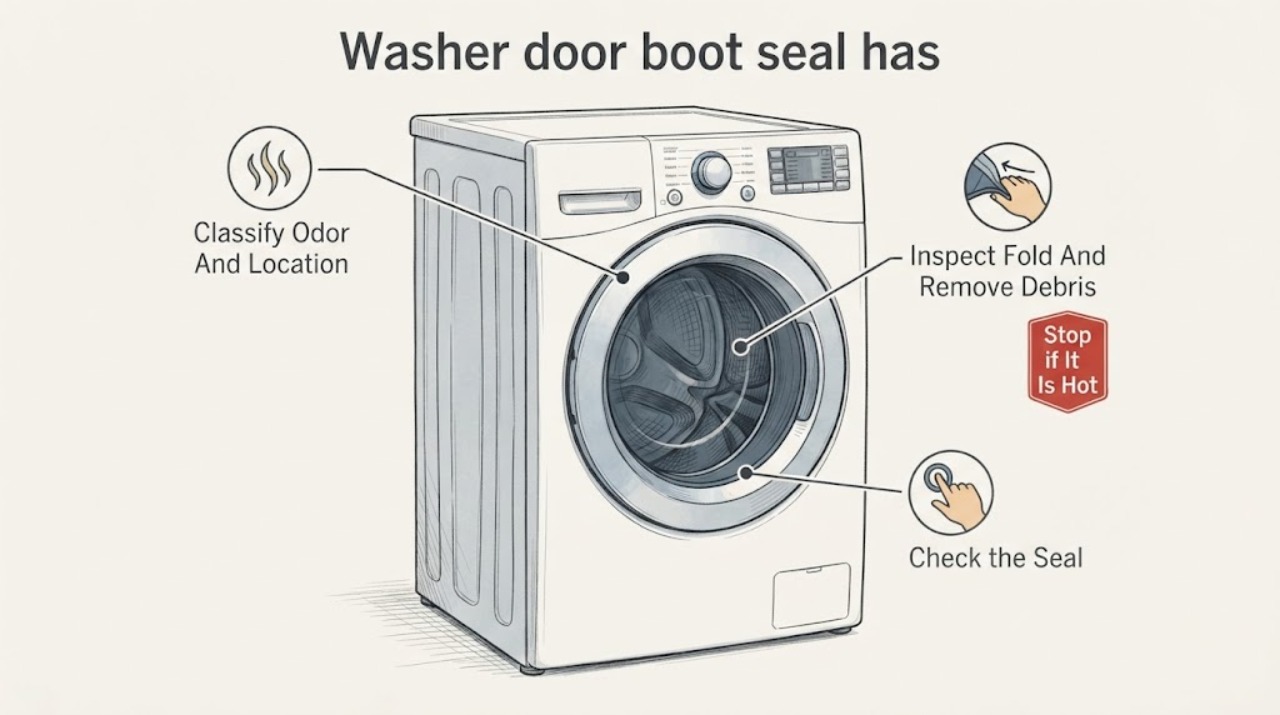
Work through in order
Diagnostic checks
Use only checks that match the exact appliance or system and its official guide.
-
Check 1
With the washer stopped and empty, open the door and identify where the odor is strongest: inside the boot fold, on the door glass, in the drum, at the lower service area, or behind the appliance. Note the odor character without putting your face into the opening.
Expected result: Record a localized musty or sour smell in the fold, odor throughout the drum, sewage or sulfur odor, burning or electrical odor, visible standing water, or no odor when the washer is empty.
Next step: Continue with ordinary cleaning only for a mild musty or residue odor. Stop using the washer for burning or electrical odor, smoke, a hot cord, or water near electrical parts; arrange qualified service and follow local emergency guidance when appropriate.
Stop if: Do not run another cycle to mask burning, electrical, smoke, strong sewage, or sulfur odor, and do not reach behind the machine while it is energized or wet.
Why this matters
Why: A fold-localized musty smell supports retained moisture or residue. An odor throughout the drum makes detergent, tub, or drain maintenance more relevant. Sewage or sulfur odor can involve the drain installation or trapped water, while burning or electrical odor is a safety issue rather than a cleaning task.
-
Check 2
Remove laundry, then gently pull back the accessible lip of the door boot seal and inspect the lowest fold and drain openings for lint, hair, coins, threads, detergent film, slime, or retained water. Remove only loose objects that can be lifted without tools or force.
Expected result: Record a clean and dry fold, visible debris, a film or mold-like deposit, pooled water, a split or stretched rubber, a foreign object that cannot be removed safely, or a fold that does not return to its sealing position.
Next step: Remove only loose debris, wipe the accessible area, and proceed to the model-approved cleaning step. Leave the washer off and request repair for a tear, a loose seal, a leak, or anything that requires detaching the boot.
Stop if: Do not pry the boot from its retaining ring, use a sharp tool, pull hard on the rubber, or operate the washer with a torn or displaced seal.
Why this matters
Why: Loose debris and moisture can directly explain a localized smell. A tear, distorted lip, or foreign object trapped under the seal can create a leak or prevent a watertight door seal and needs service rather than more scrubbing.
-
Check 3
Follow the exact washer manual's door-seal care method. Wearing suitable gloves, wipe the seal, the fold, and the door glass with the approved diluted cleaner or soft-cloth method; never use an undiluted chemical and never combine bleach with vinegar. Wipe away residue and dry the seal completely.
Expected result: After cleaning and drying, record whether the odor and visible residue improve, whether the smell returns while the fold is still damp, whether the rubber becomes sticky or discolored, or whether a leak appears at the door.
Next step: Repeat only the manual-approved cleaning schedule, remove laundry promptly, and leave the door open to dry. Stop cleaning and arrange repair if the odor remains after proper attempts, the rubber changes, or water leaks.
Stop if: Do not spray cleaner into the control panel, mix products, pour straight bleach on the boot, use abrasive tools, or continue if fumes or skin irritation develop.
Why this matters
Why: Improvement after debris removal and drying supports moisture or residue as the source. Odor that returns while water remains points toward drying, detergent, drain, or usage conditions. Rubber damage or a leak means the boot may no longer provide a reliable seal.
-
Check 4
If the seal is intact and the manual provides a Tub Clean, Self Clean, or equivalent cycle, run that cycle with an empty drum using only the cleaner and amount specified for the model. Do not add laundry, and wipe away remaining moisture from the door and boot when it finishes.
Expected result: Record whether the drum and seal smell clean afterward, residue or suds remain, the odor returns after the next load, an error appears, or water fails to drain fully.
Next step: Use the manual's maintenance interval and detergent guidance. If the odor persists after multiple correct empty cleaning cycles, stop trying stronger chemicals and request appliance service.
Stop if: Do not run a cleaning cycle with clothing, mix vinegar with bleach or another cleaner, or continue if the machine leaks, overheats, smokes, or produces a burning smell.
Why this matters
Why: Improvement after an empty cleaning cycle supports buildup in the tub or seal area. Persistent residue, suds, or retained water makes detergent amount, drain path, or pump-filter maintenance more relevant; an error or failure to drain needs a model-specific diagnostic.
-
Check 5
Inspect the detergent drawer and its cavity for sticky residue, then check the drain pump filter only if the washer manual identifies an owner-cleanable filter and the machine is off, cool, and safely drained. Use a shallow container for residual water and reinstall every cap or filter exactly as the manual shows.
Expected result: Record a clean drawer and filter, detergent or softener buildup, lint or foreign objects in the filter, standing water in the drum, a loose cap, an inaccessible filter, or water that is hot, foul, or excessive.
Next step: Clean only the user-serviceable parts specified by the manual, restore the filter and caps, and run one approved rinse or cleaning cycle. Request service when drainage remains poor, the filter cannot be safely accessed, or the odor is sewage-like.
Stop if: Do not open a filter while water may be hot, force a stuck cap, reach into moving parts, use drain chemicals in the washer, or leave a filter or cap loose.
Why this matters
Why: Drawer residue can feed odor around the tub, while a blocked filter or poor draining can leave water that keeps the door boot damp. A hot, foul, excessive, or unexplained water condition can indicate a drain or plumbing problem that cleaning the seal will not fix.
-
Check 6
After the next completed load, remove clothing promptly, wipe the door glass and boot dry—including under the lip—and leave the washer door and detergent drawer open where children and pets cannot enter. Use the detergent type and amount specified by the manual, then monitor the next few uses.
Expected result: Record a dry boot with no returning odor, moisture that remains despite wiping, odor that returns after one or several loads, a new door leak, a damaged seal, or a different burning, electrical, sulfur, or sewage smell.
Next step: Arrange qualified appliance service for recurrent odor, a damaged or leaking boot, persistent standing water, or an odor that is not clearly musty. Include the cleaning products, cycles, detergent use, and when the odor returns.
Stop if: Do not keep using the washer for smoke, burning or electrical odor, a hot plug or cord, a significant leak, or a door that cannot close and seal.
Why this matters
Why: A dry boot with no recurring odor supports a moisture and maintenance cause. Rapid recurrence despite correct cleaning and drying suggests hidden buildup, poor drainage, ventilation, or a deteriorated seal. A leak or hazardous odor requires service rather than continued maintenance cycles.
Use your observations
Decision map
Find the observation that best matches what you see, then follow the next safe action.
-
PATH 01Next step
What you see
The odor is mild and musty, strongest in the lower boot fold, and the fold contains water, lint, hair, or detergent film without a tear.
Do this next
Remove loose debris, use the exact manual's approved diluted cleaning method, dry the fold, and leave the door open after use.
Why this path and its safety boundary
Why it matters: Retained moisture and residue are more likely than a failed rubber component. The water can be normal after a cycle but becomes odorous when left to stagnate.
-
PATH 02Next step
What you see
The boot and glass are visibly slimy or stained, the detergent drawer is coated, suds remain in an empty cycle, or the odor returns shortly after cleaning.
Do this next
Clean the drawer and any owner-serviceable filter, run the model-approved empty tub-clean cycle, and request service if several correct cycles do not resolve it.
Why this path and its safety boundary
Why it matters: Buildup may extend beyond the visible seal into the drawer, tub, or drain path. Excess detergent, softener, poor draining, or a missed tub-clean cycle can keep feeding the odor.
-
PATH 03Next step
What you see
The boot has a split, hole, displaced lip, hardened or sticky area, trapped object that requires force, or water leaks from the door during a cycle.
Do this next
Keep the washer off, dry any safe-to-reach water, and arrange qualified appliance repair for inspection and model-specific seal replacement. Do not glue, clamp, or stretch the boot.
Why this path and its safety boundary
Why it matters: The seal may no longer maintain a reliable water barrier. Odor can be secondary to water entering places that do not dry, and additional operation can damage flooring or controls.
-
PATH 04Next step
What you see
The odor is sewage-like or sulfurous, standing water remains in the drum, drainage is slow, or the smell is strongest near the drain hose or standpipe rather than the boot.
Do this next
Use only the manual's safe filter and drain checks, then obtain qualified appliance or plumbing service if the odor, standing water, or slow drain persists.
Why this path and its safety boundary
Why it matters: The drain path, hose setup, pump filter, or household plumbing may be contributing. Cleaning the rubber alone will not correct an upstream odor or retained water problem.
-
PATH 05Next step
What you see
The smell is burning rubber, electrical, or hot plastic; smoke, a hot cord, sparking, or an error accompanies it.
Do this next
Stop the cycle and disconnect power only if the plug and floor are safe to reach; keep clear and arrange qualified appliance service. Follow local emergency guidance for smoke or fire.
Why this path and its safety boundary
Why it matters: This is not ordinary door-seal mildew. A motor, wiring, heater, drive, foreign object, or another energized component may be overheating.
Helpful context
Understand the symptom
Why the door boot seal smells first
The rubber boot has deep folds that can hold a small amount of water after a cycle. LG notes that water remaining in the gasket is normal because the seal is not emptied by a suction pump; if it stays there, it can stagnate and smell. Lint, hair, clothing threads, detergent, and softener residue can also remain in the fold, create a gap, or support mold-like buildup. A musty odor localized to the fold therefore points first to moisture and residue, not automatically to a failed rubber seal.
Clean the seal without damaging the rubber
Use the installed washer's care instructions before choosing a cleaner. Manufacturer guidance varies by model, but the safe pattern is to remove visible debris, wipe the fold and glass with a soft cloth, use only the approved diluted cleaning solution, rinse or wipe away residue, and dry the seal. Never combine bleach and vinegar or use undiluted bleach on the gasket. If the fold is torn, permanently blackened, sticky, or no longer seals, cleaning will not restore its water barrier.
A seal odor can be a symptom of a wider washer-maintenance issue
If the odor returns quickly after the boot is cleaned, inspect the detergent drawer, tub-clean requirement, and the drain filter on models that provide one. Poor draining can leave water in the drum, while excess detergent or softener can leave residue around the tub and seal. Remove laundry promptly, wipe the seal and door dry, and leave the door and dispenser open between uses. A sulfur, sewage, burning, or electrical smell is a different branch and should not be treated as ordinary gasket mildew.
Only after diagnosis
Potential parts
- washer door boot seal or gasket
Consider only if inspection or service confirms a torn, distorted, hardened, or leaking boot that cannot be restored by cleaning.
Confirm the exact washer model, door orientation, drain-port arrangement, retaining-ring design, and manufacturer fit information; do not substitute a generic seal by appearance. - drain pump filter or drain-path component
Consider only after qualified diagnosis links persistent standing water, poor draining, or recurring odor to a failed or damaged drain component rather than detergent residue or household plumbing.
Match the exact model and drain configuration, and have a technician confirm the failed component before replacement.
When checks do not resolve it
Need a professional?
Arrange qualified appliance service when a torn, displaced, hardened, or leaking door boot cannot seal; odor persists after several manual-approved cleanings and an empty tub-clean cycle; standing water or poor draining remains; or the odor is burning, electrical, sulfurous, or sewage-like. Stop immediately for smoke, sparking, a hot cord, significant water near electrical parts, or a door leak that can damage the floor.
Have this ready
- Give the technician the full model, front-load or combo configuration, odor character and location, cleaning product and cycles used, detergent and softener pattern, whether the boot was dry between loads, drain-filter and standing-water observations, leak location, and any smoke, heat, error, or cord symptoms.
Common questions
FAQ
Why does my washer door boot seal smell bad?
The fold can retain normal rinse water, lint, hair, detergent, or softener residue. If the door stays closed, that moisture can stagnate and support mold-like buildup. Inspect and clean the fold using the exact manual's approved method, then dry it and leave the door open.
Can I use bleach or vinegar on the washer door seal?
Use only the cleaner and dilution allowed by the washer manual. Never mix bleach with vinegar or another cleaner, never pour straight bleach on the rubber, and stop if fumes or rubber damage appear.
Should I replace the door boot seal because it smells?
Not for odor alone. Replace or repair it only when inspection or service confirms a tear, distortion, hardened rubber, persistent damage, or a door leak that cleaning cannot correct.
Why does the smell return after I clean the gasket?
Residue or retained water may also be in the detergent drawer, tub, pump filter, drain path, or household drain. Run the approved empty tub-clean cycle and check owner-serviceable drainage parts; persistent odor needs service rather than stronger chemicals.
Is a burning or sewage smell from the door seal an emergency?
Treat burning, electrical, smoke, or hot-plastic odor as a stop condition and arrange qualified appliance service. A sewage or sulfur smell, standing water, or slow drain may need appliance or plumbing diagnosis. Do not keep running cycles to cover the odor.
Read the exact guide
Official sources
- LG front load washing machine gasket: There are stains and mold in the door gasket.LG USA Support · Official LG front-load and washer-dryer-combo guidance used for general seal-cleaning logic; cleaner and access steps vary by model.
- Samsung washing machine or laundry smells badSamsung Support · Official Samsung guidance used for cross-brand odor branches; cycle names, chemical limits, and filter access are model-specific.
- LG Front load washing machine cleaning: How can I maintain the washing machine?LG USA Support · Official LG maintenance guidance used for owner-cleanable components; exact access and cleaning products depend on model.
- LG Washer - Troubleshooting Odor / BuildupLG USA Support · Official LG washer and washer-dryer-combo guidance used for maintenance branches; controls and filter access vary by model.
- LG Front Load Washing Machine - Odor GasketLG USA Support · Official LG guidance used to explain localized gasket odor; it does not establish a universal cleaner or repair procedure for every washer.
- LG Washer – Why is My Front Load Washing Machine Leaking?LG USA Support · Official LG leak guidance used for seal-damage escalation; front-load access and cleaning instructions vary by model.
Community feedback
Share a repair observation
Share a plain-text repair observation. Accepted observations are published automatically; this page may take a moment to update.