
On this page
Start here
Quick answer
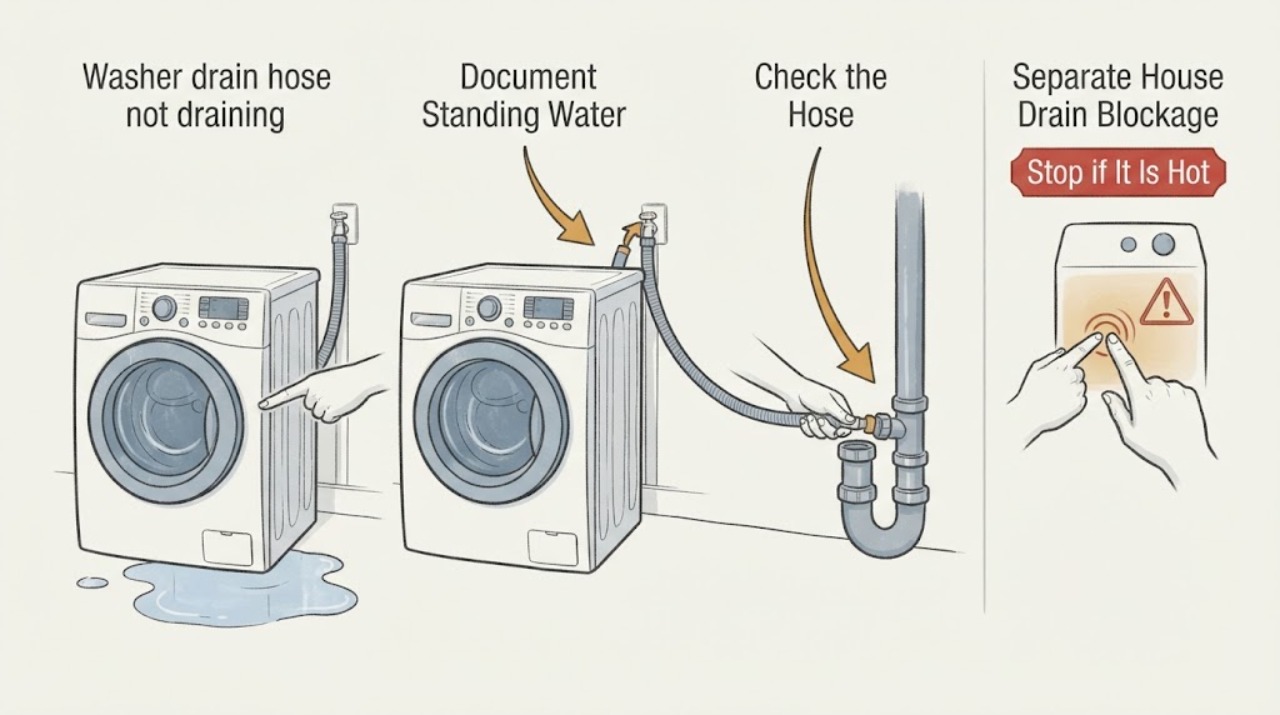
A washer drain hose that will not drain is most often kinked, crushed, routed incorrectly, clogged, frozen, or connected to a blocked household drain; a clogged pump filter or pump can create the same symptom. First switch the washer off, note whether water remains in the tub, and inspect the visible hose without moving the machine. Check the exact model's required hose loop, support, and clearance, and make sure the end is not submerged or sealed into the standpipe. If the model provides an external pump filter, clean it only with power and residual-water precautions from its manual. Do not tilt or drag the washer, disconnect an internal hose, reach into standing water near electricity, or force a connection. If the hose is clear and correctly routed but the washer still does not drain, or there is a leak, hot water, burning odor, repeated error, or breaker trip, leave it off and arrange qualified appliance or plumbing service.
Work through in order
Diagnostic checks
Use only checks that match the exact appliance or system and its official guide.
-
Check 1
Switch the washer off and observe the tub, floor, display, and visible drain outlet without opening a moving lid or door; record whether water remains, whether the floor is wet, and whether a drainage error is shown.
Expected result: Record an empty tub, standing water with no floor leak, standing water with a leak, slow drainage, a no-drain error, or no display/error information.
Next step: Keep the washer off and use the relevant hose, filter, or service branch. Do not run repeated cycles to force drainage.
Stop if: Stop immediately if water is near the power cord or outlet, the appliance is unstable, the water is hot, or flooding is increasing.
Why this matters
Why: Standing water confirms a drainage problem but does not distinguish a hose, household drain, filter, pump, or control fault. Water on the floor adds a leak and electrical-safety branch.
-
Check 2
From behind or beside the washer without pulling it, inspect the visible drain hose for kinks, crushing, sharp bends, a low pocket, a submerged end, a hose trapped under the appliance, or a route that does not match the exact installation guide.
Expected result: Record a smooth supported route, a kink or crushed section, the washer pressing on the hose, an end submerged in water, an unsupported or incorrect loop, or an inaccessible section.
Next step: Correct only an obvious external bend or loose support that can be reached without moving the washer, following the model guide. If the hose is crushed, split, or inaccessible, arrange service.
Stop if: Do not drag, tilt, lift, or disconnect the washer or hose to reach a hidden section.
Why this matters
Why: A restricted or incorrectly routed hose can stop or slow the drain flow; an accessible clear route makes a filter, internal hose, pump, or household drain issue more likely but does not prove it.
-
Check 3
If the exact model manual permits a controlled external check, compare where water goes when the drain hose is safely directed into an appropriate open container or laundry tub; do not let the hose whip, seal the drain opening, or perform this with an unsafe full tub.
Expected result: Record water leaving the hose normally, weak or absent flow from the hose, water backing up only at the standpipe/sink, or a result that cannot be observed safely.
Next step: Have a plumber clear or assess a blocked household drain. For weak hose flow, keep the washer off and follow the model's filter/service procedure rather than disconnecting internal hoses.
Stop if: Stop if water may spill near electricity, the container cannot safely hold the discharge, the hose connection is under tension, or the washer must be moved.
Why this matters
Why: Normal hose discharge with backup at the household drain points toward a clogged or undersized building drain. Weak or absent hose discharge points back toward a kink, clog, filter, pump, or washer control.
-
Check 4
Only when the exact model manual identifies an external user-accessible pump/debris filter, disconnect power as directed, prepare a shallow container and towels, and inspect or clean the filter without reaching into an unseen pump cavity.
Expected result: Record a clear filter, coins/hair/thread or other debris, a damaged seal or cap, a filter that will not turn normally, or residual water that cannot be controlled.
Next step: Remove only loose debris the manual says the user may remove, reinstall the filter securely, and perform one model-approved drain check. Arrange service if the filter is damaged, stuck, or the washer still does not drain.
Stop if: Do not force the filter, use tools inside the opening, run with the filter/cover removed, or continue if water is hot or uncontrolled.
Why this matters
Why: Debris at the filter can restrict drainage and make the pump work noisily; a clean filter with weak/no discharge shifts suspicion to the pump, internal hose, control, or another restriction.
-
Check 5
Consider whether the hose passes through a freezing area and inspect only its visible exterior for frost, a split, abrasion, crushed wall, or a loose connection; do not apply a torch, pour hot water into the washer, or disconnect the hose while full.
Expected result: Record no cold-weather exposure, visible frost, a damaged hose, a loose but accessible support, or no safe way to inspect the complete route.
Next step: Follow the exact model's safe thaw guidance or arrange service; replace a damaged hose only after the model and routing are confirmed. Do not resume operation while a split hose can flood the area.
Stop if: Do not use flame or high heat, force frozen fittings, pull on a brittle hose, or continue near standing water and electrical equipment.
Why this matters
Why: Freezing can stop flow and physical damage can collapse or leak the hose. A sound visible hose does not rule out an internal blockage or a frozen hidden section.
-
Check 6
Prepare a service handoff with the exact washer model, water level, error text, hose route and condition, household-drain result, filter/debris result if model-authorized, timing of the failure, and any leak, odor, heat, noise, or breaker symptom.
Expected result: Confirm that only external hose adjustments and model-authorized filter maintenance were performed, with no internal hose, pump, cabinet, wiring, or plumbing connection disturbed.
Next step: Arrange qualified appliance service for persistent no-drain symptoms or internal access; arrange plumbing service when the washer discharges but the household drain backs up.
Stop if: Stop all homeowner work when diagnosis requires moving the washer, disconnecting internal or pressurized parts, opening the cabinet, or testing live electrical components.
Why this matters
Why: These details help separate a hose installation/clog, household drain restriction, pump-filter obstruction, pump or internal hose fault, and electrical/control issue before parts are selected.
Use your observations
Decision map
Find the observation that best matches what you see, then follow the next safe action.
-
PATH 01Next step
What you see
The hose is kinked, crushed, trapped under the washer, routed incorrectly, submerged, or visibly clogged, and the washer has no electrical or flooding hazard.
Do this next
Correct only the visible route or support as the exact installation guide permits. Replace a damaged hose through qualified service or verified model instructions, then perform one controlled drain check.
-
PATH 02Next step
What you see
Water leaves the washer hose normally during a safe model-approved comparison, but backs up at the standpipe, sink, or laundry drain.
Do this next
Stop the cycle and arrange plumbing service to assess the household drain. Do not seal the opening or keep running cycles into a backup.
-
PATH 03Next step
What you see
The visible hose route is clear, the machine has standing water or weak discharge, and a model-provided external filter contains debris or cleaning does not restore flow.
Do this next
Leave the washer off and arrange qualified appliance diagnosis if one model-authorized filter check does not restore drainage. Do not open the cabinet or test the pump live.
-
PATH 04Next step
What you see
The hose is exposed to freezing conditions or has a split, abrasion, collapse, or loose connection, especially when the washer cannot drain and water remains.
Do this next
Keep the washer off, follow only the exact model's safe thaw or hose-replacement guidance, and arrange service if the hose is brittle, hidden, or under tension.
-
PATH 05Next step
What you see
No drainage is accompanied by a breaker trip, burning odor, hot cabinet, active leak, water near the outlet, repeated error, or no pump response after safe external checks.
Do this next
Keep the washer off and arrange qualified appliance/electrical service. Use emergency help for smoke, fire, shock, or uncontrolled flooding.
-
PATH 06Next step
What you see
Standing water remains but the model has no documented filter access, the filter is stuck, the hose is hidden, or a safe container/route cannot be established.
Do this next
Leave the washer off, protect the surrounding area without moving it, and arrange qualified appliance service.
Helpful context
Understand the symptom
Start at the hose route, not the pump
A hose can look connected while a kink behind the washer, a crushed section, an incorrect height, a submerged end, or a frozen section prevents flow. LG's drainage guidance separates hose installation from a blocked household drain: if water leaves the hose normally but backs up at the drain, the building drain is the likely next check. Hose dimensions and loop requirements vary by model, so the exact installation manual controls.
A drain-hose problem can be a pump symptom
If the hose route is sound but the washer only hums, drains slowly, or leaves water in the tub, the pump filter, pump inlet, internal hose, or pump may be restricted. LG provides a residual-water and pump-filter procedure for applicable models, but not every washer has the same access. Treat the filter as a model-authorized maintenance point, not permission to disassemble the pump or cabinet.
Do not confuse hose drainage with spin or load problems
A washer may stop spinning because water has not drained, but an unbalanced load, excess suds, or a leveling issue can also leave clothes wet. Whirlpool identifies small objects in the drain system as a possible pump blockage and distinguishes normal pump humming from other washer sounds. Record the water level and error state before assuming the hose is the only fault.
When the household drain is the real restriction
A washer may discharge correctly through its hose but fail when the hose is inserted into a clogged standpipe, sink, or laundry drain. Backflow, rising water, or drainage that works only with the hose disconnected points away from the washer hose and toward the building drain. Do not seal the drain opening with tape or improvise a connection; have a plumber assess a blocked or improperly installed household drain.
Safety boundary
Stop conditions
- Do not tilt or drag the washer, disconnect an internal or pressurized hose, open the cabinet, test live wiring, or reach into standing water near electrical equipment.
- Do not force a filter cap, use tools inside an unseen pump cavity, seal the standpipe, use flame/high heat to thaw a hose, or run the washer with a filter or cover removed.
- Stop immediately for leakage, hot water, water near the outlet or power cord, burning odor, smoke, breaker trip, shock, instability, or uncontrolled flooding; keep clear and arrange qualified or emergency help.
Only after diagnosis
Potential parts
- washer drain hose
Consider this only when inspection confirms the visible hose is split, crushed, frozen-damaged, incorrectly sized, or otherwise restricting flow after the routing is corrected.
Confirm the exact washer model, hose ends and diameter, routing, support, standpipe requirements, and manufacturer installation instructions before replacement. - drain-pump filter, cap, or seal
Consider this only when the exact model has an external user-accessible filter and inspection confirms a damaged filter, cap, or seal that causes leakage or cannot seat correctly.
Verify the exact model, filter housing, seal interface, and user-manual installation procedure before selecting a replacement. - washer drain pump assembly
Consider this only after qualified diagnosis confirms the pump or impeller cannot move water with the hose, filter, and inlet path clear.
Confirm the exact washer model, pump design, electrical connector, mounting, flow direction, and manufacturer-approved fit before selection or installation. - internal tub-to-pump drain hose
Consider this only when qualified service finds an internal hose collapse, obstruction, leak, or failed clamp after external hose and filter checks.
Confirm the exact model, hose shape, detergent/temperature duty, clamp type, routing, and access procedure before installation.
When checks do not resolve it
Need a professional?
Arrange qualified appliance service when the visible drain hose is clear and correctly routed but the washer still will not drain, when the pump filter is inaccessible or stuck, when an error returns, or when diagnosis requires internal hose, pump, cabinet, control, or wiring access. Arrange plumbing service when water exits the washer hose but backs up in the standpipe, sink, or household drain. Stop immediately for a leak, hot water, water near electrical equipment, burning odor, smoke, breaker trip, shock, unstable appliance, or uncontrolled flooding.
Have this ready
- Provide the exact model, water level, display/error text, hose route and condition, household-drain comparison if safely performed, filter/debris result if model-authorized, and any leak, odor, heat, noise, breaker, smoke, or flooding symptom.
Common questions
FAQ
Why is my washer drain hose not draining?
The hose may be kinked, crushed, incorrectly routed, clogged, frozen, or connected to a blocked household drain. A clogged pump filter or pump can create the same symptom, so check the visible hose route and the exact model's safe filter procedure before assuming the hose is the only fault.
How can I tell whether the washer or the household drain is blocked?
When the exact model permits a controlled comparison, water that leaves the washer hose normally but backs up at the standpipe or sink points toward the household drain. Weak or absent flow from the hose points back toward the washer's hose, filter, pump, or internal drain path.
Can I remove the washer drain hose to clear it?
Only follow the exact model's user instructions, and do not disconnect a full or pressurized connection, move the washer, or work near electricity. If the hose is hidden, under tension, damaged, or the tub contains uncontrolled water, leave the washer off and arrange service.
Should I clean the pump filter when the drain hose is not draining?
Only if the model provides an external user-accessible filter and its manual describes the procedure. Power and residual-water precautions are essential because water may spill and may be hot. A clear filter with continued no-drain symptoms requires qualified diagnosis.
When is a washer drainage problem urgent?
Stop using the washer for a leak, water near electrical equipment, hot water, burning odor, a hot cabinet, breaker trip, smoke, fire, shock, unstable appliance, or uncontrolled flooding. Keep it off and arrange qualified appliance or plumbing service; use emergency help for smoke, fire, shock, or flooding.
Read the exact guide
Official sources
- [LG Washing Machine] Water Not Draining (OE Error)LG USA Support · LG washer support article used for conditional filter and drain-path checks; exact model procedures vary.
- WASHER/DRYER USE AND CARE GUIDEWhirlpool · Whirlpool washer/dryer guide used for general safety and drain-path reasoning; exact model manual governs.
- LG washing machine - Whys is water not draining from my washer?LG USA Support · LG washer guidance used for general drain-hose triage; exact model installation instructions govern dimensions and access.
- LG Washer - Troubleshooting Washer Does Not Drain or Spin (Clothes Too Wet)LG USA Support · LG washer troubleshooting guidance used only for model-authorized filter access and drainage interpretation.
Community feedback
Share a repair observation
Share a plain-text repair observation. Accepted observations are published automatically; this page may take a moment to update.