
On this page
Start here
Quick answer
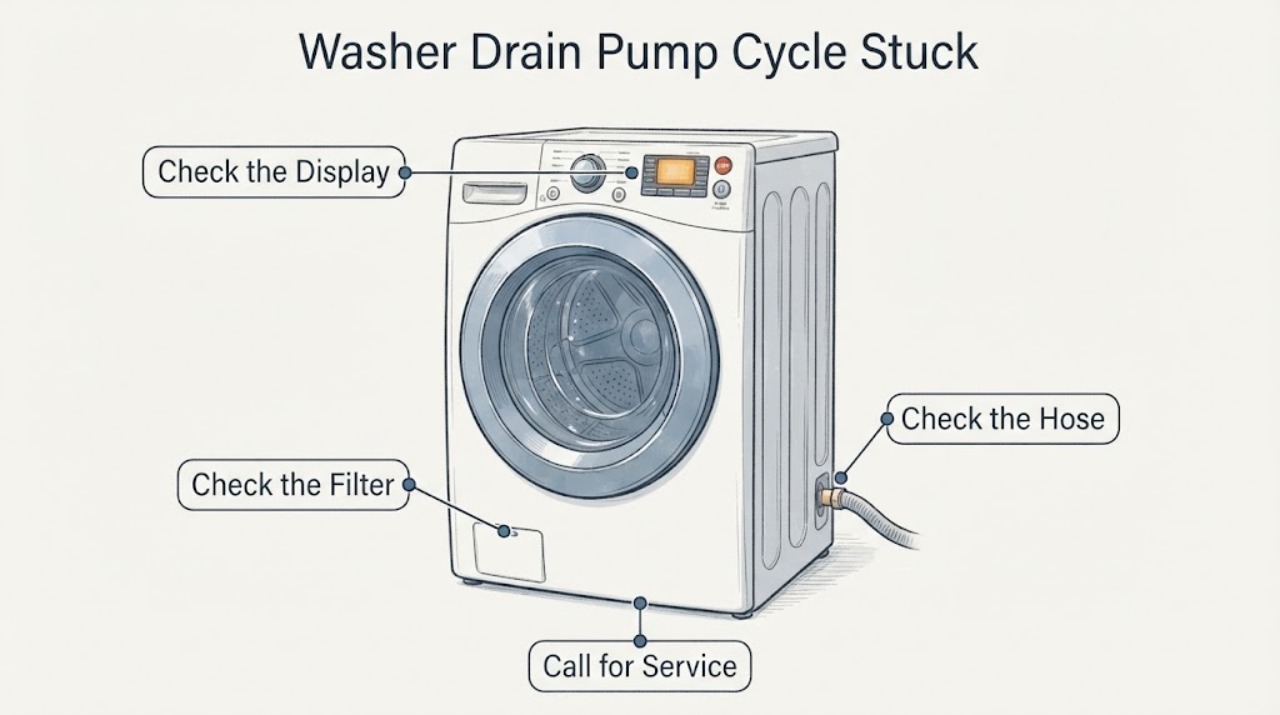
A washer that stays in a drain-pump portion of the cycle may be trying to remove water but not reaching its empty-level check. Stop the cycle, allow recently hot water to cool, and disconnect power before any filter check. Inspect the external drain hose for kinks, blockage, an airtight or incorrect standpipe connection, and a height outside the model manual's range. On a front loader, clean the pump filter only if the manual provides an accessible filter and its residual-water procedure. Then run one model-approved drain or spin test. A pump that hums without moving water, a pump that never engages, repeated drain errors, or a stuck cycle after the hose and filter are clear needs service; do not open the pump housing or test live wiring.
Before you begin
Safety first
- Internal pump, wiring, pressure-sensing, interlock, and control diagnosis should be performed by a qualified appliance technician with power and residual water made safe.
Work through in order
Diagnostic checks
Use only checks that match the exact appliance or system and its official guide.
-
Check 1
Press pause or cancel using the normal control, note the displayed time or code, and listen for whether the pump is running continuously, cycling on and off, humming briefly, or silent. If the last cycle used hot water, wait for the water to cool according to the model manual before opening any drain access.
Expected result: Water remains in the tub, the pump sound repeats, or the washer stops without any pump sound or water movement.
Next step: Record the code, water level, and sound pattern, then disconnect power before inspecting external drainage or an approved pump filter. Do not force a locked door or reach into moving equipment.
Stop if: Stop if water is hot, leaking onto electrical parts, the door is locked by water level, or the washer makes smoke, a burning odor, or a grinding sound.
Why this matters
Why: Repeated pump operation suggests the washer still senses water or cannot move it out; a silent pump or no movement may involve the pump, wiring, control, or a safety state and cannot be diagnosed from sound alone.
-
Check 2
With the washer off, inspect the visible drain hose from the washer to the standpipe, sink, or drain connection. Check for kinks, crushing, blockage, slipping, an airtight seal, an extension, or a standpipe height that does not match the installation instructions.
Expected result: The hose is kinked, blocked, sealed too tightly, inserted incorrectly, or routed too high; alternatively it is open, secure, and routed according to the manual.
Next step: Correct only an obvious external routing issue in line with the model manual, then run one model-approved drain or spin test. If water still does not leave, disconnect power and continue to the filter check or service decision.
Stop if: Do not pull hard on a secured hose, remove a rear retaining screw that the manual says to leave in place, or disconnect a water-filled hose without a residual-water plan.
Why this matters
Why: A routing or installation restriction can make a working pump appear stuck and can allow water to flow back into the washer. A clear, correctly routed hose shifts attention to the filter, pump, suds, sensor, or control.
-
Check 3
If the exact model is a front loader with an owner-accessible drain-pump filter, disconnect power, place a shallow container and towels, drain residual water using the model's auxiliary drain procedure, and inspect the filter for lint, coins, or other debris. Refit the filter and cap securely; do not disassemble the pump.
Expected result: The filter contains debris, the filter is clear, the auxiliary drain does not release water, or the model has no owner-accessible filter.
Next step: Remove only loose debris described by the manual, restore the filter seal, and run one approved test. If the filter is clear, inaccessible, damaged, or the problem returns, arrange service.
Stop if: Do not open the filter while powered, while water may be hot, or when the filter cap is stuck; do not reach into the pump cavity or use tools to force it.
Why this matters
Why: Debris can restrict the pump and explain a long or repeating drain stage. No water from an approved drain path or a clear filter points toward a hose, pump, pressure-sensing, or control issue, not an automatic need for a new pump.
-
Check 4
After the hose and any permitted filter check are complete, run one model-approved drain, spin-only, or test cycle with the washer empty. Observe whether the pump starts, whether water exits the hose, and whether the cycle advances beyond the drain stage.
Expected result: The pump hums and water flows, the pump hums with little or no water movement, or the pump does not start and the cycle remains stuck.
Next step: Stop after this single test if the cycle remains stuck or the error returns. Provide the code, pump sound, water movement, hose and filter results to a qualified appliance technician.
Stop if: Do not enter service diagnostic mode, probe wiring, bypass a lid or door switch, or run repeated tests with water trapped in the tub.
Why this matters
Why: Humming with flow supports a resolved or partial restriction; humming without flow can indicate a remaining blockage or worn pump; no pump response can involve electrical, control, sensor, or pump faults.
-
Check 5
Check the load and detergent history after the washer is stable: note whether the load was severely unbalanced or overloaded, whether excessive suds were visible, and whether the cycle was canceled before draining. Do not add detergent or start another full load to test it.
Expected result: The issue occurred with excessive suds, an unbalanced load, or a canceled cycle, or it occurs with an empty washer and the correct detergent amount.
Next step: Follow the detergent and load guidance for the model and monitor one short approved test. If the empty washer still cannot drain, leave it off and request service.
Stop if: Stop if water leaks, the tub is unstable, the washer vibrates violently, or suds or water begin escaping.
Why this matters
Why: Suds, load conditions, or a canceled cycle can extend or interrupt draining without proving the pump is defective. Recurrence with an empty tub points away from the load and toward the drain path, pump, sensor, or control.
Use your observations
Decision map
Find the observation that best matches what you see, then follow the next safe action.
-
PATH 01Next step
What you see
Do this next
Correct the visible routing issue according to the manual and run one empty drain test. If the loop persists, keep power off and arrange service.
Why this path and its safety boundary
Why it matters: A hose or standpipe restriction is more likely than a failed pump because the pump may be unable to move water through the installed path.
-
PATH 02Next step
What you see
Do this next
Monitor one normal load and stop if the drain stage sticks again. Do not assume the pump is permanently repaired from one successful cycle.
Why this path and its safety boundary
Why it matters: The restriction was likely in the filter path, but a recurrence can indicate more debris, a damaged impeller, or another drain problem.
-
PATH 03Next step
What you see
Do this next
Leave the washer off and arrange appliance service. Do not reach into the pump or replace it without model-specific diagnosis.
Why this path and its safety boundary
Why it matters: A remaining obstruction, worn or jammed pump, or internal hose restriction is more likely; the sound alone cannot distinguish those causes.
-
PATH 04Next step
What you see
Do this next
Stop user troubleshooting and provide the test result and code to a qualified technician; internal electrical checks are not an ordinary-user step.
Why this path and its safety boundary
Why it matters: A control, wiring, door or lid interlock, pressure-sensing, or pump fault is more plausible than a simple hose blockage.
-
PATH 05Next step
What you see
Do this next
Use the model-recommended detergent amount and balanced load, monitor the next load, and call for service if the drain stage sticks again with normal loading.
Why this path and its safety boundary
Why it matters: The previous cycle condition may have delayed or interrupted draining without establishing a drain-pump failure.
Helpful context
Understand the symptom
What “stuck at drain” usually means
The control waits for the washer to reach an empty or safe water level. A kinked or badly routed hose, a blocked filter or pump, too many suds, or a control or sensor problem can keep that condition from being recognized. Some machines deliberately repeat drain and spin attempts when water remains, so the sound of a pump cycling is evidence of an unresolved drain condition, not proof that the pump motor itself has failed.
Protect the pump and the person checking it
Water left after a hot cycle can scald, and a front-loader filter can release a large amount of residual water. Use the model manual's cooling and draining procedure, place a shallow container and towels before opening an accessible filter, and keep power disconnected during the inspection. The pump, wiring, and control diagnosis should be left to a qualified appliance technician.
Safety boundary
Stop conditions
- Disconnect power and stop troubleshooting for hot water, leaking water near electrical parts, smoke, a burning odor, grinding, or a damaged cord or outlet.
- Do not open a pump filter while powered or hot, force a locked door, reach into the pump, remove internal panels, probe live wiring, or bypass a door or lid switch.
- Do not run repeated drain tests with water trapped in the tub or keep restarting a cycle that remains stuck.
- Arrange appliance service for a clear hose and filter with no pump response, a pump that hums without water movement, recurring drain errors, an inaccessible or stuck filter, or a cycle that remains stuck when empty.
Only after diagnosis
Potential parts
- washer drain pump
Consider this only when testing confirms that the pump is receiving the correct command and the hose, filter, and internal drain path are clear but water still does not move.
Confirm the exact washer model, pump design, and manufacturer fit information before ordering; a stuck cycle alone does not prove pump failure. - washer drain pump filter or filter seal
Consider this only when the model has an owner-accessible filter and the filter or seal is cracked, damaged, or cannot maintain a watertight fit after debris is removed.
Filter style and sealing parts vary by model; do not substitute a generic filter based only on appearance. - washer pressure-sensing or control component
Consider this only after a technician rules out the drain hose, filter, pump, suds, and load conditions and confirms that the washer is not correctly sensing an empty tub or commanding the drain cycle.
The control and sensor arrangement is model-specific and requires professional diagnosis before parts selection.
When checks do not resolve it
Need a professional?
Contact a qualified appliance technician when the drain cycle remains stuck after the external hose check and model-approved filter procedure, when the pump hums without moving water, when it never starts, or when the issue returns in an empty washer.
Safety scope: Internal pump, wiring, pressure-sensing, interlock, and control diagnosis should be performed by a qualified appliance technician with power and residual water made safe.
Have this ready
- Provide the washer model, displayed code or remaining time, water temperature history, pump sound, water movement at the hose, hose routing, filter findings, detergent or load conditions, and the result of one approved drain test.
Common questions
FAQ
Why is my washer stuck running the drain pump?
The washer may still sense water because the hose, filter, pump, or drain path is restricted, or because suds or a sensor or control issue prevents the empty-level check. It may repeat draining until the water is gone.
What should I check before replacing the drain pump?
Check the visible hose routing and blockage, the model-approved pump filter if accessible, excess suds or load conditions, and one approved drain test. A stuck cycle alone does not prove the pump is defective.
What does a humming drain pump with no water movement mean?
A remaining obstruction, jammed or worn pump, or internal hose restriction may be involved. Stop repeated tests and arrange service rather than reaching into the pump or replacing it without diagnosis.
Can too much detergent make the washer cycle stick at drain?
Yes. Excessive suds can slow or interrupt pumping and can trigger a drain-related condition. Use the model-recommended detergent and amount, but call for service if the issue occurs with an empty washer and normal detergent use.
When should I call for washer drain-pump service?
Call when the hose and approved filter path are clear but the pump has no response, hums without moving water, the cycle remains stuck when empty, or the drain error repeatedly returns. Stop immediately for hot water, leaks near electrical parts, smoke, burning odor, or grinding.
Read the exact guide
Official sources
- Samsung washing machine will not drainSamsung · Manufacturer troubleshooting for no-drain or overflow symptoms across Samsung top-load and front-load washers, with model-specific limitations.
- LG Front Load Washer - Error Code List(New)LG Electronics · Manufacturer error-code guidance showing how hose, pump-filter, pump sound, suds, and persistent errors change the diagnostic path.
- Washer - Spins and Stops RepeatedlyGE Appliances · Manufacturer explanation that a washer may repeatedly pump when it detects water remaining and that persistent drain difficulty may need service.
- Washer Not Draining or Spinning? Troubleshooting GuideWhirlpool · Manufacturer troubleshooting for washer drain and spin problems, including pump-filter access and hose routing.
Community feedback
Share a repair observation
Share a plain-text repair observation. Accepted observations are published automatically; this page may take a moment to update.