
On this page
Start here
Quick answer
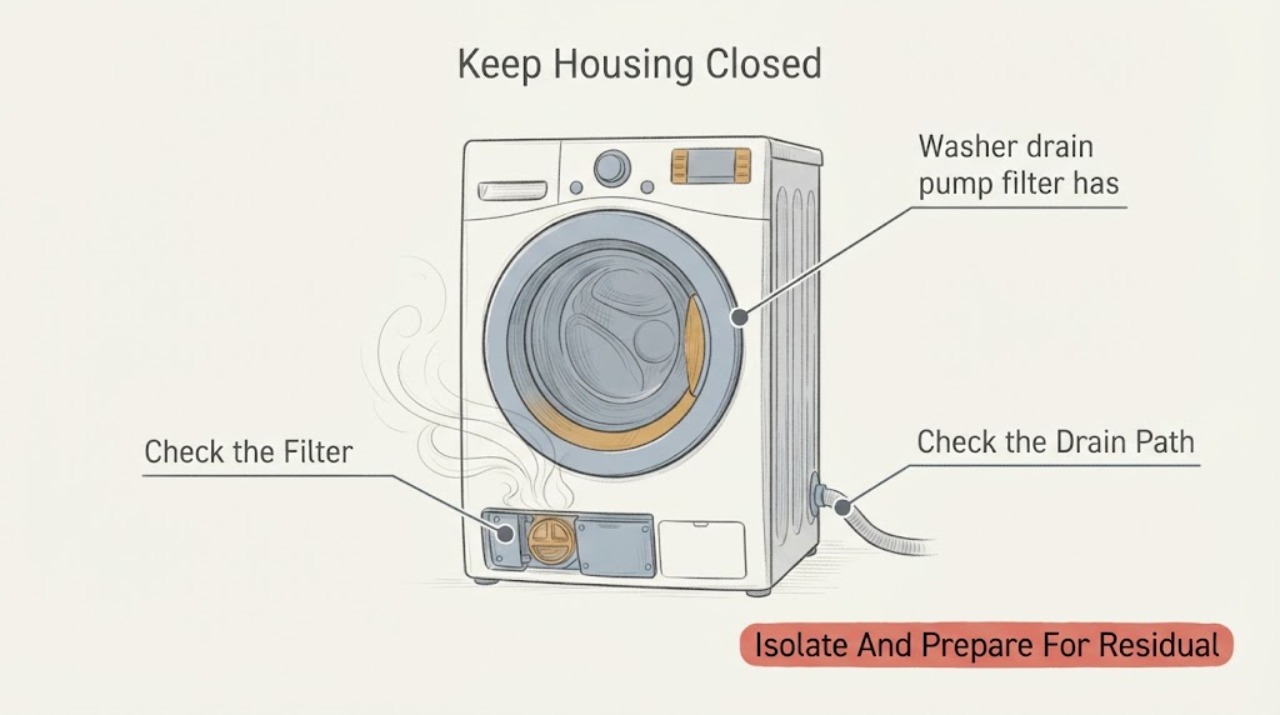
A bad smell at a washer drain-pump-filter area most often means lint, coins, detergent residue, or retained dirty water is sitting in the filter, filter housing, or drain path. First confirm that the washer actually has an owner-accessible filter; many front-load and combo models do, while top-load designs may not. Turn the washer off and unplug it with dry hands, check the model instructions, and use a shallow pan before opening an access door. If the residual water may be hot, the tub is full, the filter cannot be accessed safely, there is a burning or electrical smell, or the odor remains after the filter and an empty manufacturer-approved cleaning cycle, stop and arrange appliance service. A sewage-like odor can instead come from the drain hose, standpipe, door gasket, dispenser, or household drain.
Before you begin
Safety first
- This article covers identifying the odor path, using the exact manual, safely containing cool residual water, cleaning an intact accessible filter, and observing an empty verification cycle. Do not work on energized parts, reach into standing or hot water, force the pump or filter, remove panels, or bypass a safety condition.
Work through in order
Diagnostic checks
Use only checks that match the exact appliance or system and its official guide.
-
Check 1
With the washer stopped, identify whether the odor is strongest at the drain-pump-filter access, door gasket, detergent drawer, drain hose or standpipe, and note whether the machine is a front-load, combo, or top-load design; do not reach into standing water.
Expected result: Record musty or sour odor with lint/sludge, sulfur or sewage odor, a burning/electrical odor, and whether the washer has a labeled lower service panel or owner-accessible filter.
Next step: Use the exact model manual to confirm the filter location and procedure; if the smell is burning/electrical, smoke is present, or the source cannot be approached safely, stop and arrange appliance service.
Stop if: Do not force an access panel, reach into water, or assume that another washer model's filter location applies.
Why this matters
Why: Musty odor at a dirty filter makes trapped residue or retained water more likely. Sulfur/sewage odor with a clean filter makes drain-hose, standpipe, or plumbing return more likely. Burning/electrical odor is outside routine filter cleaning, and a top-load or unlabeled design may not have this serviceable filter.
-
Check 2
Empty the drum if practical, turn the washer off, unplug it with dry hands, read the model instructions, and place a shallow pan and towels at the specified filter access before opening it.
Expected result: Note whether water is visible in the drum or hose, whether the water could be hot, whether the pan can contain the expected discharge, and whether the manual identifies an emergency-drain hose.
Next step: Proceed only when the model procedure, cool accessible water, and containment arrangement are clear; otherwise keep the washer off and request appliance service.
Stop if: Do not open the filter while water may be hot, while the tub is heavily full, or while the washer remains powered.
Why this matters
Why: Residual water can spill when the filter is loosened, and the water may be hot after a cycle. A full drum, hot water, missing drain hose, or inadequate containment makes this an unsafe homeowner cleaning attempt rather than a simple odor check.
-
Check 3
Following the model procedure, drain residual water through the emergency hose into the pan if provided, cap that hose, then loosen and remove the drain-pump filter slowly while keeping the opening directed toward the pan.
Expected result: Record whether water is trapped, the filter is packed with lint, hair, coins, or sludge, the filter screen is damaged, or the opening contains debris or a foreign object.
Next step: Keep small debris for identification, photograph damage or obstruction, and continue to cleaning only if the filter and housing are intact and the manual permits it; otherwise stop and arrange service.
Stop if: Do not reach deeply into the pump, force a jammed filter, or continue if water is hot, uncontrolled, or exposing electrical parts.
Why this matters
Why: Retained water and organic debris can support the musty smell and can also restrict draining. A damaged filter, obstructed housing, or unusually large discharge suggests a repair or leak risk rather than a normal rinse alone.
-
Check 4
Wash the removed filter by hand with warm water and a soft brush, wipe accessible residue from the filter seat, then reinstall the filter in the model-specified direction until fully seated and close the access panel.
Expected result: Check that the screen is clear, the seal and threads are not visibly damaged, the residual-hose cap is closed, and the filter and panel sit flush without cross-threading.
Next step: Leave the washer empty for the first verification and watch the filter area for leaks during a model-approved rinse or cleaning cycle; obtain the exact replacement only after the model and damaged part are confirmed.
Stop if: Do not overtighten, operate with a missing filter or cap, or use a damaged seal as a temporary fix.
Why this matters
Why: A clean, correctly seated filter removes one common source of trapped odor. A damaged seal, filter, or cap, or a filter that will not seat, can cause leakage and leave odor or drain problems unresolved.
-
Check 5
With the filter secured, compare the odor at the door gasket, detergent drawer, drum, drain hose, and standpipe; clean only the accessible areas and run the empty tub-clean or self-clean cycle named in the washer's manual.
Expected result: Note whether odor is strongest in gasket folds or the dispenser, returns from the drain hose or standpipe, remains in the drum, or decreases after the filter clean and empty cycle.
Next step: Follow the model's drain-hose installation requirements or arrange plumbing/appliance diagnosis when the odor is sewage-like or not localized to the filter; do not apply a universal hose depth or chemical recipe.
Stop if: Do not mix bleach, vinegar, or other cleaners, and do not pour chemicals into an unknown drain path.
Why this matters
Why: Water and foreign objects in a gasket, detergent buildup, wet laundry, or an improperly arranged drain hose can mimic a filter odor. Samsung specifically treats sulfur/sewage smell from drain-water return as a drain setup issue, while LG advises tub cleaning and gasket care for persistent buildup.
-
Check 6
Run an empty rinse, spin, or model-approved cleaning cycle while observing from a dry, safe position for normal draining, leaks at the filter access, and a return of the smell; then wipe the gasket and leave the door and detergent drawer open when the washer is not in use.
Expected result: Record whether the washer drains fully, whether water leaks from the filter or hose cap, and whether the odor is gone, reduced, or unchanged after more than one manufacturer-approved cleaning cycle.
Next step: Arrange appliance service for a leak, poor draining, persistent odor, a damaged filter housing, or an odor that remains after repeated model-approved cleaning; report the exact observations and cycle history.
Stop if: Stop immediately for burning smell, smoke, electrical noise, uncontrolled water, or a leak that reaches electrical components.
Why this matters
Why: A dry filter area and reduced odor support residue as the cause. A leak indicates an assembly, seal, cap, or housing problem. Persistent odor after proper filter and tub maintenance points to a drain path, gasket, pump, or internal buildup that needs diagnosis.
Use your observations
Decision map
Find the observation that best matches what you see, then follow the next safe action.
-
PATH 01Safety boundary
What you see
The filter contains lint, hair, coins, or sludge, the filter housing is wet or foul, and the odor decreases after safe cleaning and an empty cycle.
Do this next
Keep the filter-maintenance interval specified by the washer manual, remove wet laundry promptly, dry the gasket, and leave the door or drawer open between cycles.
Why this path and its safety boundary
Why it matters: Trapped residue and retained water in the filter/drain path are the most likely source for this episode.
Safety stop: Arrange service if the smell quickly returns, draining remains slow, or the filter cannot seat without leaking.
-
PATH 02Safety boundary
What you see
The filter is reasonably clean, but a sulfur or sewage odor is strongest at the drain hose or standpipe, especially after draining.
Do this next
Compare the installation with the exact washer manual and have an appliance technician or plumber assess the drain path when the installation is uncertain; do not copy a dimension from another model.
Why this path and its safety boundary
Why it matters: Drain-hose routing, siphoning, standpipe arrangement, or household drain conditions are more likely than filter debris; Samsung notes that incorrect hose insertion can allow drain water to return on its models.
Safety stop: Do not force the hose deeper, seal the standpipe closed, or pour drain chemicals into the washer connection.
-
PATH 03Safety boundary
What you see
The filter has little residue and no unusual retained water, while odor is strongest in gasket folds, the detergent drawer, or the drum.
Do this next
Clean accessible gasket and dispenser surfaces according to the manual, run its empty tub-clean routine, and dry/vent the washer after use; seek service if odor persists after multiple cycles.
Why this path and its safety boundary
Why it matters: Mildew, detergent buildup, foreign objects, or moisture left in the gasket/dispenser is more likely than a blocked pump filter.
Safety stop: Do not remove the gasket, disassemble the dispenser, or mix cleaning agents as a homeowner experiment.
-
PATH 04Safety boundary
What you see
The smell is burning or electrical, smoke is present, water is hot or uncontrolled, the tub is heavily full, or the filter cannot be safely accessed with the power off.
Do this next
Stop using the washer, disconnect power only if it can be done from a dry safe position, keep clear of water and smoke, and arrange urgent appliance service.
Why this path and its safety boundary
Why it matters: This is not routine filter maintenance and may involve an electrical, thermal, water-containment, or internal appliance hazard.
Safety stop: Do not restart the washer, reach through water, remove panels, or attempt electrical or pump repair.
-
PATH 05Safety boundary
What you see
The filter is cleaned and reinstalled, but water leaks at the access area, draining is still poor, or odor remains after repeated model-approved cleaning cycles.
Do this next
Keep the washer off if leaking or not draining and arrange appliance service with photos of the filter, cap, leak location, and cleaning-cycle result.
Why this path and its safety boundary
Why it matters: A cap, seal, filter housing, pump, drain hose, gasket, or internal buildup may still be involved; a clean screen alone does not prove the pump path is sound.
Safety stop: Do not keep running cycles to flush the odor, operate with a leaking filter, or replace a part without exact model compatibility.
Helpful context
Understand the symptom
Confirm that the smell really comes from the filter
A washer can spread one odor through the drum, gasket, dispenser, drain hose, and lower service area. With the washer stopped, compare the smell at the filter access area, the door seal, the detergent drawer, and the drain hose or standpipe without putting hands into standing water. Musty odor with lint or sludge points toward retained residue; sulfur or sewage odor with a clean filter points toward drain setup or plumbing; a burning or sharp electrical odor is not a cleaning problem.
Use the model procedure for the filter
Filter locations and emergency-drain arrangements vary. On the applicable LG front-load and combo designs described in the support instructions, the lower front panel exposes a residual-water hose and filter. The hose is drained into a shallow pan before the filter is removed. Other washers may use a different panel, a different filter arrangement, or no user-accessible filter at all, so do not force a panel or substitute another model's procedure.
Clean the filter, then investigate the remaining odor
After residual water is safely contained, remove visible lint and objects from the filter and its opening, wash the filter by hand with warm water and a soft brush, and reinstall it fully according to the manual. A loose filter or cap can leak. If the filter is clean but the odor persists, inspect the gasket, dispenser, drain hose, and standpipe as separate paths and run only the empty cleaning cycle specified for the model. Do not mix cleaning chemicals.
Safety boundary
Stop conditions
- Stop and arrange appliance service for a burning or electrical smell, smoke, uncontrolled water, a filter-area leak, poor draining, or odor that persists after the model's filter and empty cleaning procedures.
- Do not open the filter while the washer is powered, while residual water may be hot, or when the tub is heavily full or cannot be drained into safe containment.
- Do not force the filter, reach into the pump, remove panels, disassemble the gasket or pump, or attempt electrical repair as an odor test.
- Do not mix bleach, vinegar, or other cleaners, and do not use a generic drain-hose dimension or chemical recipe in place of the exact washer instructions.
Only after diagnosis
Potential parts
- washer drain-pump filter
Consider this class only when the exact model manual and technician or careful inspection confirm that the filter is cracked, missing, damaged, or cannot seal after correct cleaning.
Match the exact washer brand and model, filter shape, threads, screen, and seal; many top-load designs do not use the same accessible filter. - drain-pump filter cap or seal
Consider this class only when a leak or odor remains at the filter access after correct seating and the model-specific diagnosis identifies a damaged cap or seal.
Match the exact model and seal design; do not substitute a generic gasket or operate with a leaking filter access. - washer residual drain hose cap
Consider this class only when the model has a residual-drain hose and its cap is cracked, missing, or unable to close securely after inspection.
Match the exact service-panel assembly and model; a hose cap is not interchangeable across washer families without confirmation.
When checks do not resolve it
Need a professional?
Arrange appliance service when the smell is burning or electrical, smoke or uncontrolled water is present, the washer will not drain, the filter or housing is damaged, the filter cannot be removed or reseated safely, the access area leaks after reassembly, or odor remains after multiple manufacturer-approved cleaning cycles. A sewage-like smell that is not localized to the filter may require the washer drain installation or household plumbing to be assessed.
Safety scope: This article covers identifying the odor path, using the exact manual, safely containing cool residual water, cleaning an intact accessible filter, and observing an empty verification cycle. Do not work on energized parts, reach into standing or hot water, force the pump or filter, remove panels, or bypass a safety condition.
Common questions
FAQ
Does every washer have a drain-pump filter?
No. The accessible filter procedure varies by design and model. LG describes it for applicable front-load and combo washers, while a top-load washer may not expose the same part. Use the owner's manual instead of forcing a lower panel.
Why does the filter smell after I clean it?
Residual water, sludge in the filter seat or pump path, gasket or dispenser buildup, or a drain-hose/standpipe odor can remain even after the screen looks clean. Recheck where the odor is strongest, run the exact empty cleaning cycle, and arrange service if the odor persists or draining is poor.
Can I use bleach or vinegar to remove the smell?
Do not mix cleaning chemicals or use a generic recipe. Use only the cleaning product and empty cycle specified by the washer's manufacturer, and clean accessible gasket, drawer, and filter areas separately as directed.
When is a bad washer smell a service problem?
Call for appliance service for a burning or electrical smell, smoke, uncontrolled or leaking water, poor draining, a damaged filter or housing, unsafe access, or odor that remains after the model's filter and repeated empty cleaning procedures. A sewage-like smell at the drain connection may also require plumbing or drain-installation diagnosis.
Read the exact guide
Official sources
- LG Washer - Troubleshooting Odor / BuildupLG USA Support · LG odor troubleshooting guidance; exact controls, cleaning products, and cycles depend on the washer model.
- LG Front Load Washer MaintenanceLG USA Support · LG front-load maintenance article; use the exact owner's manual for other designs and cycles.
- LG Washer – How to Clean the Drain Pump FilterLG USA Support · LG support article; its procedure applies only to LG models equipped with the described accessible filter and must not be generalized to every washer.
- LG Washer - Why Isn't My Washer DrainingLG USA Support · LG draining troubleshooting article; exact service cover and filter arrangement vary by model.
- Samsung washing machine or laundry smells badSamsung Support · Samsung support guidance; hose arrangement and maintenance controls are model-specific and are not universal washer dimensions.
Community feedback
Share a repair observation
Share a plain-text repair observation. Accepted observations are published automatically; this page may take a moment to update.