
On this page
Start here
Quick answer
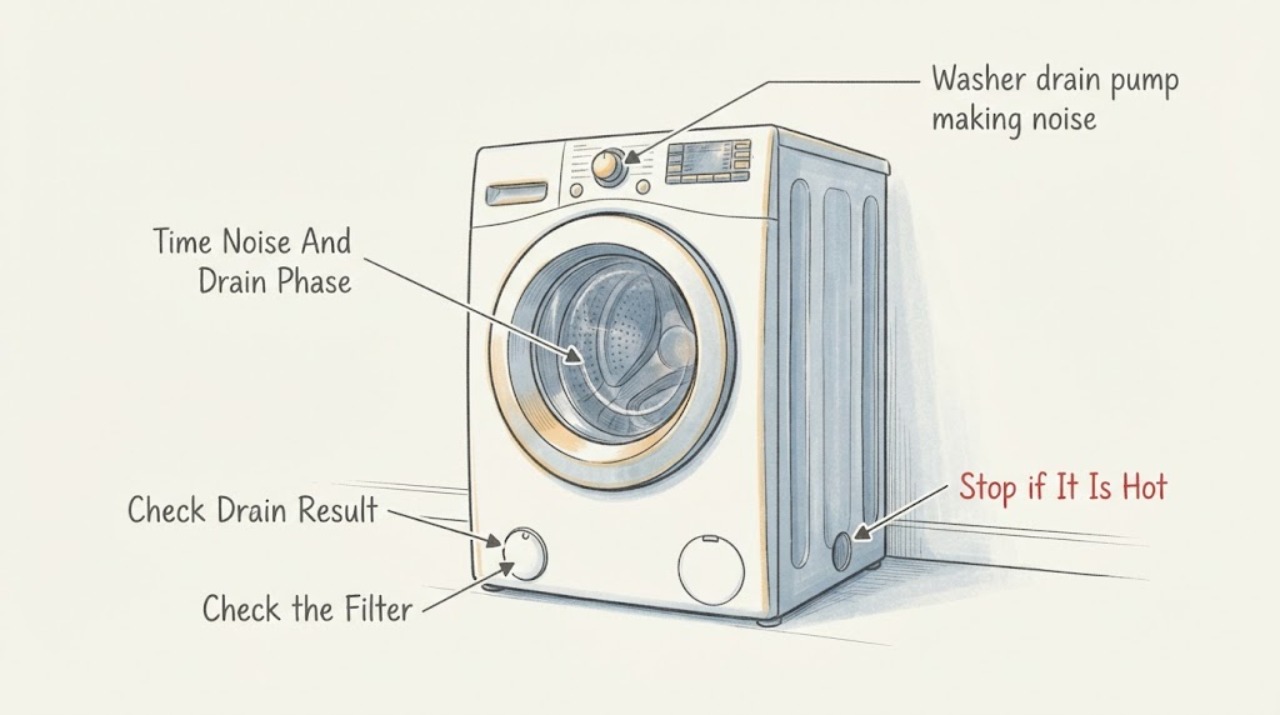
A washer drain pump normally makes a hum, gurgle, or slurping sound while it removes water, especially near the end of draining. A new grinding, rattling, scraping, or unusually loud hum can indicate a coin or thread in the pump filter, a restricted drain path, a hose striking the cabinet, or a worn pump; the noise alone does not prove the pump motor has failed. First note when the sound occurs and whether water drains normally. With the washer stopped and unplugged, clean an external pump/debris filter only if the exact model's user manual provides one and you can safely contain residual water. Do not reach into a moving drum, open the cabinet, test live wiring, or run the pump with a removed cover. Stop and arrange service for persistent harsh noise, poor draining, a leak, burning odor, a tripped breaker, or any fault that requires pump or wiring access.
Work through in order
Diagnostic checks
Use only checks that match the exact appliance or system and its official guide.
-
Check 1
From outside the washer, note whether the noise occurs during fill, agitation, spin, or the drain phase, and compare the sound with whether water is visibly leaving the tub; do not open a lid or door while the drum is moving.
Expected result: Record a steady hum or gurgle only while draining, a noise that continues after the tub is empty, a metallic rattle, grinding/scraping, or a sound that occurs only during spin.
Next step: Record the sound and drain result, then use the relevant branch. Stop repeated cycles once the pattern is clear or any hazard appears.
Stop if: Stop immediately for smoke, burning odor, water leakage, a tripped breaker, a hot enclosure, violent vibration, or a grinding sound that worsens.
Why this matters
Why: A drain-phase hum or gurgle can be normal pump operation. A harsh sound with poor drainage points toward an obstruction or pump/hosing fault, while a spin-only noise shifts attention to load, leveling, drum objects, or drive components.
-
Check 2
After the noisy drain attempt has stopped, check only the visible tub and floor area for standing water, a slow drain, an error indication, or a normal empty tub; do not reach into the washer or disconnect the drain hose.
Expected result: Record normal drainage, slow or incomplete drainage, no drainage with a hum, no drainage without a hum, water on the floor, or an error/lockout.
Next step: If the machine has standing water or an error, keep it off until the model's safe drain/filter procedure is verified or service is arranged. Do not tilt the washer to empty it.
Stop if: Do not continue if water is near the power cord, outlet, controls, or other electrical equipment, or if the machine is unstable.
Why this matters
Why: Normal drainage makes a normal pump sound, external vibration, or incidental noise more likely. Slow/no drainage with humming can indicate a restricted filter, hose, or pump; no pump sound with no drainage requires electrical/control or pump service rather than repeated testing.
-
Check 3
Only when the exact model manual identifies an external user-accessible drain/debris filter, switch the washer off, disconnect power as directed, prepare a shallow container and towels for residual water, and inspect the filter opening without reaching into an unseen pump cavity.
Expected result: Record a clear filter, coins/hair/thread or other debris, a damaged filter or seal, a filter that cannot be removed normally, or water that remains uncontrolled.
Next step: Remove only loose debris the manual says the user may remove, reinstall the filter securely, and perform no more than one model-approved drain test. Arrange service if the filter is damaged, stuck, or the noise persists.
Stop if: Do not force the cap, use tools inside the opening, run the washer with the filter/cover removed, or continue if hot/dirty water, flooding, or electrical exposure is present.
Why this matters
Why: Debris can make the pump unusually loud and restrict drainage; a clean filter with persistent harsh noise makes an internal pump, impeller, hose, or control issue more likely. Filter design and access vary by washer.
-
Check 4
With the washer off, inspect the visible drain hose, inlet hose, power cord, nearby shelf, and cabinet clearance for a hose or object that could knock against the machine during draining or spin; do not pull the appliance out under tension.
Expected result: Record a hose touching the cabinet, a loose object or shelf contact, a secure hose route, a kink or crushed section, or no external contact.
Next step: Reposition only a loose external hose or object that can be moved without shifting the washer or disconnecting plumbing. If the hose is damaged, restricted, or inaccessible, arrange service or plumbing help.
Stop if: Do not disconnect hoses, remove clamps, drag or tilt the washer, or continue if the floor is wet or the hose is under tension.
Why this matters
Why: A hose or surrounding object can produce banging or tapping that is not a pump fault. A kinked or damaged drain hose can also impair drainage and make the pump work against restriction; no visible contact leaves the pump/filter path more likely but unconfirmed.
-
Check 5
If the noise is strongest during spin rather than drainage, with the washer stopped check the visible drum for a loose item and confirm the machine is stable and not rocking; do not reach into a moving drum or remove a trapped object through a gap.
Expected result: Record a coin/button or other loose object, an uneven load, a rocking or unlevel cabinet, a stable washer with no visible object, or a noise that remains tied specifically to pump operation.
Next step: Remove only a clearly loose object from the open drum and redistribute a safe load as the manual directs. Arrange service if an object is trapped, the washer remains unstable, or the noise is harsh or recurring.
Stop if: Do not reach behind the drum, remove panels, bypass the lid lock, or run a test with a damaged or unstable washer.
Why this matters
Why: A load, leveling, or drum-object issue can create vibration or clacking that is unrelated to the drain pump. If the washer is stable and the sound returns only while the pump drains, return to the filter/hose/pump branch.
-
Check 6
Prepare a service handoff with the exact washer model, sound description and timing, drainage result, error text, filter/debris result if the manual allowed access, visible hose route, load/level observations, and any leak, odor, heat, or power symptom.
Expected result: Confirm that the record contains external observations and model-authorized filter maintenance only, with no cabinet, pump, impeller, wiring, or hose connection disturbed.
Next step: Arrange qualified appliance service for persistent abnormal pump noise, poor drainage, repeated errors, a stuck or damaged filter, leaks, or any need to access the pump, wiring, internal hose, or control.
Stop if: Stop all homeowner work when diagnosis requires cabinet removal, live testing, pump disassembly, internal hose access, or moving the washer.
Why this matters
Why: The record helps the technician distinguish normal pump noise, filter obstruction, hose/cabinet contact, load vibration, pump/impeller damage, internal hose restriction, and electrical/control faults.
Use your observations
Decision map
Find the observation that best matches what you see, then follow the next safe action.
-
PATH 01Next step
What you see
The washer hums or gurgles only while water is draining, empties normally, and the sound fades as the tub empties.
Do this next
Monitor the sound for change and follow the model's routine maintenance guidance. Arrange service if it becomes unusually loud or drainage worsens.
-
PATH 02Next step
What you see
The pump hum is louder than usual, drainage is slow or incomplete, and a model-provided external filter contains coins, hair, thread, or other debris.
Do this next
Clean and reseat only the user-accessible filter as the exact manual directs, contain residual water, and run one approved drain test. Escalate if noise or poor drainage remains.
-
PATH 03Next step
What you see
The model-authorized filter and visible hose route are clear, but grinding, scraping, rattling, or a repeated abnormal hum returns during drainage.
Do this next
Leave the washer off and arrange qualified appliance diagnosis. Do not run the pump with a cover removed or order a pump before model and fault confirmation.
-
PATH 04Next step
What you see
The sound is banging or tapping, drainage is normal, and a hose, shelf, loose object, unlevel cabinet, or uneven load matches the timing better than pump operation.
Do this next
Correct only a loose visible external contact or safe load/level issue according to the model instructions. Request service if the washer remains unstable or noise persists.
-
PATH 05Next step
What you see
The washer does not drain, the pump is silent or repeatedly stops, an error returns, water leaks, the breaker trips, or the cabinet/power area becomes hot or smells burnt.
Do this next
Keep the washer off, do not perform live tests or open the cabinet, and arrange qualified appliance/electrical service. Use emergency help for smoke, fire, shock, or uncontrolled flooding.
-
PATH 06Next step
What you see
Standing water remains and the washer has no documented user-accessible filter, the filter is stuck, or residual water cannot be controlled safely.
Do this next
Leave the washer off, protect the area without moving the machine, and arrange qualified appliance service rather than tilting or dismantling it.
Helpful context
Understand the symptom
First decide whether the sound is actually abnormal
The drain pump is expected to make noise when it moves water. GE describes sucking, slurping, and gurgling early in spin as water being extracted, and Whirlpool describes continuous humming with periodic gurgling or surging as the final water leaves. A sound that follows the drain phase and fades as the tub empties is more likely normal. A sudden change in pitch, a metallic rattle, grinding, or a hum with little or no drainage changes the diagnosis.
A filter or foreign object can imitate a bad pump
Coins, hair, thread, or another small object can reach the drain system and obstruct or disturb the pump. LG directs owners of applicable models to unplug the washer, manage residual water, and clean the pump filter; Samsung likewise connects unusually loud drain humming with debris in the filter. Do not assume that every washer has the same filter location or user access. Use only the exact model instructions and stop if the filter cannot be reached safely or water cannot be controlled.
Not every drain-cycle noise comes from the pump
A drain hose can knock against the rear cabinet, a loose object can rattle in the drum, or an unlevel washer can amplify vibration during spin. LG lists hose contact, foreign objects, and leveling among noise causes, while GE identifies an unsecured drain hose as a source of banging during drain. Compare the sound with the drain phase and with spin before ordering a pump.
When the pump itself becomes the likely service target
If the filter and visible hose route are clear but the pump makes a persistent grinding or scraping sound, drains slowly, leaves standing water, or trips protection, the pump, impeller, internal hose, control, or wiring needs qualified testing. A hum shows that the pump may be receiving a demand; it does not prove that the impeller is moving water correctly. Keep the washer off when the symptom is severe or accompanied by leakage, odor, heat, or electrical behavior.
Safety boundary
Stop conditions
- Do not reach into a moving drum, bypass a lid or door lock, open the cabinet, test live wiring, or run the washer with a pump filter or cover removed.
- Do not tilt or drag the washer, disconnect pressurized or internal hoses, force a filter cap, probe the pump cavity, or order a pump based only on a noise.
- Stop immediately for leakage, water near electrical equipment, burning odor, smoke, heat, a breaker trip, shock, violent vibration, or uncontrolled flooding; keep clear and arrange qualified or emergency help.
Only after diagnosis
Potential parts
- washer drain pump assembly
Consider this only after qualified diagnosis confirms the pump or impeller is damaged or unable to drain with the filter, hose, and inlet path clear.
Confirm the exact washer model, pump design, electrical connector, mounting, flow direction, and manufacturer-approved fit before selection or installation. - drain-pump filter, cap, or seal
Consider this only when the model has a user-serviceable filter and inspection confirms a damaged cap, seal, or filter that causes leakage or cannot seat correctly.
Verify the exact model, filter housing, seal material, cap interface, and user-manual installation procedure before replacement. - washer drain hose
Consider this only when inspection confirms the visible drain hose is split, crushed, incorrectly supported, or otherwise restricting drainage and creating noise.
Match the exact model, hose diameter and ends, routing, support, standpipe requirements, and manufacturer installation instructions. - internal tub-to-pump hose or clamp
Consider this only when qualified service finds an internal hose obstruction, collapse, leak, or failed clamp after the external filter and drain path are clear.
Confirm the exact model, hose shape, temperature and detergent duty, clamp type, routing, and access procedure before installation.
When checks do not resolve it
Need a professional?
Arrange qualified appliance service when drain-pump noise becomes grinding, scraping, rattling, or unusually loud; when drainage is slow or incomplete after a model-authorized filter and visible hose check; when the filter is stuck or inaccessible; or when the symptom requires pump, impeller, internal hose, control, wiring, cabinet, or live electrical access. Stop immediately for water near electrical equipment, a leak, burning odor, hot cabinet, breaker trip, smoke, fire, shock, violent vibration, or uncontrolled flooding.
Have this ready
- Provide the exact model, sound type and cycle timing, drainage result, error text, filter/debris result if model-authorized, hose/contact observations, load and level observations, and any leak, odor, heat, breaker, or smoke symptom.
Common questions
FAQ
Is humming from a washer drain pump normal?
Often yes. Manufacturers describe humming, gurgling, slurping, or sucking while the pump removes water as normal. It becomes more concerning when the sound is new or unusually loud, drainage changes, or grinding, scraping, metallic rattling, leakage, or an error appears.
Can a coin make the drain pump noisy?
Yes. Whirlpool and LG identify coins and other small objects in the drain system or filter as possible causes of metallic or unusually loud noise. Check the drum and an external filter only as the exact model manual permits, with power and residual-water precautions.
Should I open the washer and test the pump?
No. Limit homeowner work to model-authorized external filter or hose checks. Pump disassembly, cabinet removal, wiring tests, and live electrical diagnosis require qualified service, especially when water remains in the machine.
Why does the washer bang during draining if the pump is fine?
A drain hose can strike the cabinet or rear wall, and nearby objects can transmit vibration. GE and LG recommend checking hose contact and installation, while spin-only noise can come from load balance or leveling rather than the pump.
When is a noisy washer drain pump urgent?
Stop using it for a leak, water near electrical equipment, burning odor, hot cabinet, breaker trip, smoke, fire, shock, violent vibration, uncontrolled flooding, or no-drain condition that cannot be handled by the model's safe user procedure. Arrange qualified service; use emergency help for smoke, fire, shock, or flooding.
Read the exact guide
Official sources
- Washer - Normal Noise When DrainingGE Appliances Support · GE washer support guidance used for general sound interpretation; exact washer installation instructions govern hose routing.
- [LG Front Loader] Noise During Spin DryLG USA Support · LG washer guidance used for general noise triage; exact model instructions govern filter access and procedures.
- Why is my Samsung washing machine making noises?Samsung Support · Samsung washer support guidance used for general noise triage; exact model filter and service instructions govern.
- LG Washer - Troubleshooting Washer Does Not Drain or Spin (Clothes Too Wet)LG USA Support · LG front-load washer guidance used for conditional filter and drainage checks; access and cycle steps vary by model.
- WASHER/DRYER USE AND CARE GUIDEWhirlpool · Whirlpool washer/dryer guide used for general sound and safety reasoning; exact model manual governs.
Community feedback
Share a repair observation
Share a plain-text repair observation. Accepted observations are published automatically; this page may take a moment to update.