
On this page
Start here
Quick answer
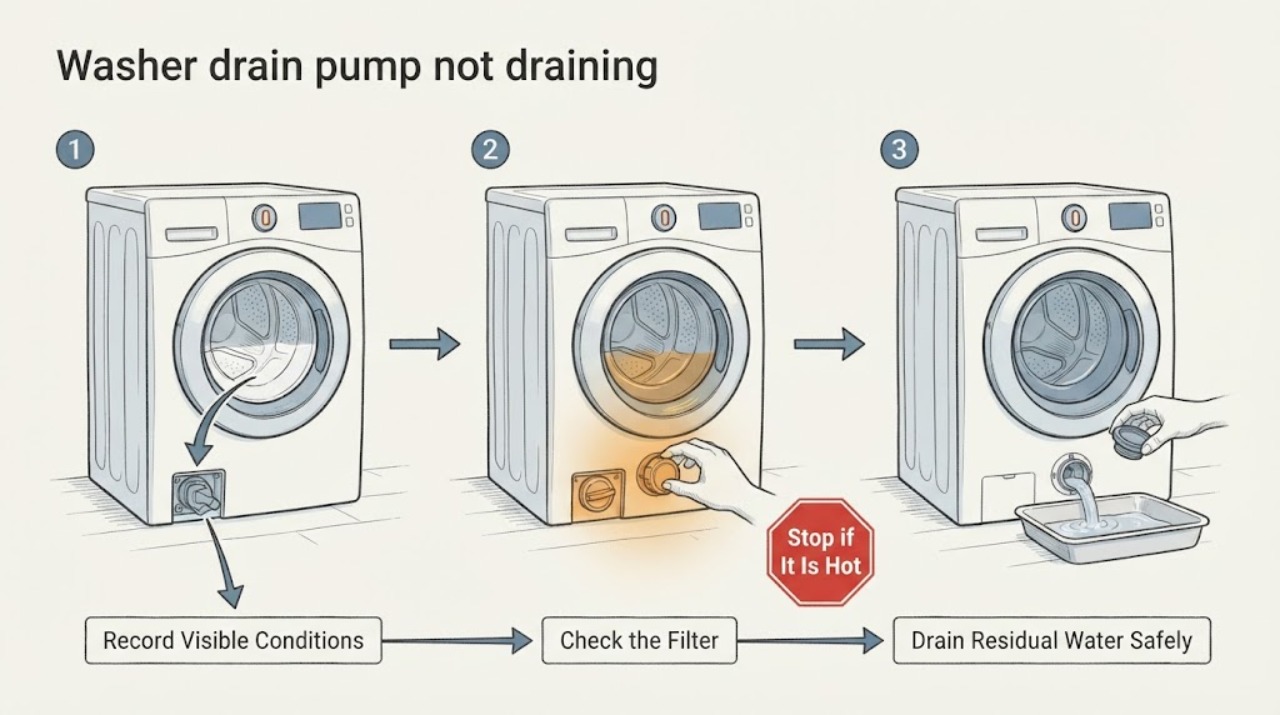
A washer that will not drain can have a blocked filter or pump, a kinked or compressed drain hose, a blocked standpipe, a drain-hose installation problem, or a pump/control fault. First stop the cycle and check the owner's manual for the exact filter location: not every washer has a user-accessible pump filter, and front-load and top-load designs differ. If the manual allows filter access, turn the washer off, protect the floor with a shallow container and towels, and drain residual water before opening the filter; water may be hot. Clean only the accessible filter and reassemble it fully. Then inspect the hose and drain opening for kinks, compression, or backup. If the pump hums without moving water, makes grinding noises, the filter is clear but draining still fails, the machine leaks, the breaker trips, or access requires panels or live electrical testing, stop and arrange qualified appliance service.
Work through in order
Diagnostic checks
Use only checks that match the exact appliance or system and its official guide.
-
Check 1
Stop the cycle using the washer's normal controls, note the selected cycle and any displayed message, and observe the remaining water level and pump sound without opening panels or reaching into the tub while it is moving.
Expected result: Classify the washer as fully full, slowly draining, draining then backing up, leaving only a small amount of water, humming without flow, grinding, or silent when a drain should begin.
Next step: Write down the pattern and continue only with the model's user-level filter and hose checks; arrange service if the tub is full, the noise is abnormal, an error repeats, or the washer cannot be safely stopped and drained.
Stop if: Stop immediately for burning odor, smoke, exposed wiring, an active leak, repeated breaker trips, or water hot enough to create a burn hazard.
Why this matters
Why: Slow flow or backup keeps a restriction in the filter, hose, or household drain in consideration. Humming without flow makes an obstruction or pump-flow issue more likely; grinding raises concern for hard debris. Silence can involve a control, interlock, wiring, or pump fault, but none of these observations alone identifies a failed pump.
-
Check 2
Identify the washer's model and consult its owner's manual to determine whether a drain-pump filter is present and intended for user cleaning; do not assume a top-load or front-load design has the same access.
Expected result: Record whether the manual shows a lower service cover and residual-water hose, a removable filter, a different user-cleaning procedure, or no user-accessible filter.
Next step: Follow only the documented user procedure, or give the model and symptom to a qualified technician when the manual does not authorize access.
Stop if: Do not remove the rear or cabinet panels, defeat a lid or door interlock, or force a cap, drawer, or service cover.
Why this matters
Why: A clearly documented filter supports a contained cleaning check. No documented filter or a cover that requires cabinet removal means the pump and internal drain path are not a homeowner-accessible diagnosis; searching for a hidden filter can create leaks or damage.
-
Check 3
Only if the exact manual provides a user-accessible residual-water procedure, keep the washer off, place a shallow container and towels under the access point, and drain through the documented hose or opening without reaching into moving or energized parts.
Expected result: Note whether water drains freely, stops because the small hose or outlet is restricted, spills unexpectedly, appears unusually hot, or cannot be contained on the floor.
Next step: Stop and dry or protect the area, then follow the manual's next step or call service; do not improvise a hose extension, tip the machine, or remove a different panel.
Stop if: Do not proceed if water is hot, the floor could be damaged, water reaches electrical components, the drain hose will not stay secure, or the procedure is not documented for the model.
Why this matters
Why: Free drainage through the documented outlet makes the filter or pump opening safer to inspect. Restricted flow can be a hose or filter obstruction; unexpected spill, hot water, or inability to contain water makes continued access unsafe and does not prove a pump failure.
-
Check 4
With residual water handled and the manual authorizing access, remove the accessible drain-pump filter as directed, inspect it and the visible opening for lint, coins, buttons, hair, or other foreign objects, and clean the filter with the documented gentle method.
Expected result: Record whether debris blocks the filter, the filter is clear, the filter is cracked or missing a seal, the visible pump opening contains debris, or the cap will not reseat without force.
Next step: Rinse or brush only as the manual permits, reinstall the filter and hose cap completely, and stop for service when parts are damaged, missing, inaccessible, or still obstructed after safe cleaning.
Stop if: Do not reach deep into the pump, pry an impeller, use sharp tools, leave the filter out, run the washer with a loose cap, or force a threaded filter.
Why this matters
Why: Lint or a foreign object can restrict drain flow and may explain a slow or failed drain. A clear filter shifts attention to the hose, standpipe, pump, interlock, wiring, or control. A damaged filter, seal, or cap can cause a leak and needs the exact replacement or service procedure.
-
Check 5
Inspect the visible drain hose behind the washer and the receiving standpipe or utility sink for a kink, compression, visible blockage, poor routing, or water backup; do not disconnect a full hose unless the manual gives a safe contained procedure.
Expected result: Record whether the hose is crushed by the wall, the drain opening accepts water, water rises or backs up, the hose end is installed contrary to the manual, or the external path looks clear.
Next step: Correct only an obvious external kink without pulling on fittings, keep the hose routing as specified by the manual, and call an appliance or plumbing professional if the receiving drain backs up or the path cannot be checked safely.
Stop if: Do not use chemical drain cleaner in the washer, fish tools into the pump, pull the appliance by its door or hoses, or operate with a leaking connection.
Why this matters
Why: A compressed hose can limit flow even when the pump is operating. Backup at the standpipe or sink points toward a household drain restriction. A clear hose and receiving drain make the pump, tub-to-pump path, interlock, wiring, or control more likely, but require further model-specific diagnosis.
-
Check 6
After any permitted filter cleaning and external hose correction, reassemble every cap, plug, cover, and hose exactly as documented, then run only the manual's suitable short drain or spin test while watching for leaks and abnormal sound.
Expected result: Record whether water exits normally, drains slowly, backs up, the pump hums or grinds, an error returns, or a leak appears at the filter or hose connection.
Next step: Stop the test, keep the washer off, and request qualified service for persistent failure, abnormal noise, leaks, repeated errors, or any diagnosis requiring internal access or electrical testing.
Stop if: Do not run another cycle to force drainage, measure live voltage, open energized panels, or continue after smoke, burning odor, breaker trips, or water reaches electrical parts.
Why this matters
Why: Normal drainage after removing debris supports a restricted filter as the cause. Persistent failure with a clear filter and hose makes an internal obstruction, pump, interlock, wiring, or control problem more likely. A leak after reassembly means the seal or cap is not safe to operate.
Use your observations
Decision map
Find the observation that best matches what you see, then follow the next safe action.
-
PATH 01Next step
What you see
The model manual provides filter access, residual water is safely contained, and lint or a foreign object is visibly blocking the filter.
Do this next
A restricted filter is a plausible cause. Clean and reinstall it exactly as directed, then perform the permitted test while checking for leaks; persistent failure requires service rather than repeated filter removal.
-
PATH 02Next step
What you see
The hose is visibly kinked or compressed, or water drains from the washer's hose but backs up at the standpipe or utility sink.
Do this next
The external drain path is more likely than a failed pump. Correct only an obvious hose position issue within the manual's limits; have a plumber clear a household drain restriction when the receiving drain backs up.
-
PATH 03Next step
What you see
The filter and visible hose are clear and correctly reassembled, but the pump hums without moving water, grinds, or the washer still will not drain.
Do this next
An obstruction farther along the tub-to-pump path, a jammed or failed pump, or a related control problem becomes more likely. Keep the washer off and arrange appliance service; do not pry the pump or impeller.
-
PATH 04Next step
What you see
A drain command produces no pump sound, the filter and hose checks are clear, and no user-level error recovery restores draining.
Do this next
A lid or door interlock, wiring, pump-power, or control fault is more likely than a simple clogged filter. Request qualified service and do not perform live electrical tests.
-
PATH 05Next step
What you see
Water is hot or uncontrolled, a filter cap or hose leaks after reassembly, water reaches electrical parts, there is burning odor or smoke, or the breaker trips repeatedly.
Do this next
Stop using the washer, keep clear of the hazard, and arrange qualified appliance service or appropriate emergency help. Do not reset the breaker repeatedly or restart the washer to test it.
Helpful context
Understand the symptom
Separate a blocked drain path from a failed pump
The drain pump is only one part of the path from the tub to the household drain. A filter or hose restriction can let the pump run without moving enough water, while a blocked standpipe can make a washer appear to have a pump problem. A wash setting, excessive suds, an unbalanced load, or a lid/door condition can also prevent the washer from completing a drain or spin sequence. Note whether the tub is completely full, drains slowly, drains and then backs up, or never produces pump sound. That pattern determines the next safe check; it does not by itself prove that the pump motor needs replacement.
Use model-specific access instructions
Filter locations and even filter availability vary. Manufacturer instructions for some front-load machines use a lower service cover, a residual-water hose, a container, and a filter cap, while some top-load machines do not provide the same access. Check the model number and owner's manual before removing a cover or cap. Keep the washer off, allow a hot load to cool, protect flooring, and expect residual water. If the cover is not clearly intended for user maintenance, water cannot be contained, or the filter will not turn without force, close the access point and call service.
Check the hose and household drain separately
A hose can be kinked or crushed where the washer sits against a wall, and a standpipe or utility sink can be blocked downstream of the appliance. If the washer's model instructions permit a controlled drain-hose check, observe where the water exits and whether the household drain accepts it without backing up. A washer that drains through a detached hose but backs up at the standpipe points away from the pump and toward the household drain. Do not use drain-opening chemicals inside the washer, and do not pull the machine out or disconnect a hose when the water cannot be contained safely.
Interpret pump sounds cautiously
A steady hum with no water movement can be consistent with a jammed impeller, a blockage, or a pump that is not developing flow; grinding can indicate hard debris. No pump sound during a commanded drain can point toward a door or lid interlock, wiring, control, or pump-power problem, but it is not a reason to measure live voltage. A clear filter and correctly routed hose do not rule out an obstruction between the tub and pump or an internal pump, motor, wiring, or control fault. These are service-level checks unless the exact manual explicitly defines a safe user procedure.
Document the symptom before requesting repair
Record the washer type and model, water level, cycle and error message, whether the pump hums or grinds, what was found in the filter, whether the hose or standpipe backs up, and whether the issue began after a move, plumbing change, or foreign object entered a pocket. Include photos of the filter, hose routing, and any leak without exposing serial numbers publicly. This lets a technician distinguish a restricted drain path from a pump, interlock, wiring, or control problem and select a compatible part only after diagnosis.
Safety boundary
Stop conditions
- The tub contains hot water, residual water cannot be contained, or water reaches electrical components.
- There is a burning odor, smoke, damaged wiring, repeated breaker trip, or any electrical hazard.
- The filter, cap, seal, hose, or service cover is damaged, missing, leaking, or will not reseat without force.
- The model manual does not authorize the proposed filter, hose, or residual-water procedure.
- Diagnosis would require removing cabinet panels, defeating a lid or door interlock, reaching into the pump, or testing live voltage.
Only after diagnosis
Potential parts
- Match the exact washer model and filter assembly; do not substitute a generic filter or operate without the filter.
- Pump fit and electrical characteristics are model-specific; confirm with the model documentation or technician.
- Use the exact model-compatible hose and routing hardware; a longer or improvised hose can create draining or siphoning problems.
- Do not infer a control or interlock replacement from silence alone; match the exact model and have service verify the fault.
When checks do not resolve it
Need a professional?
Call a qualified appliance technician when the washer still will not drain after the documented filter and hose checks, the pump hums or grinds without moving water, no pump sound occurs during a drain command, an error returns, a leak appears, or the suspected obstruction is inside the cabinet. Call a plumber when the washer's hose drains but the standpipe or utility sink backs up. Stop immediately for smoke, burning odor, exposed wiring, repeated breaker trips, uncontrolled hot water, or water near electrical parts.
Common questions
FAQ
How do I know whether the washer drain pump is actually blocked?
A filter or visible hose may contain lint or a foreign object, and a pump may hum without moving water when flow is restricted. Check only the model-documented user-accessible filter and hose path; a clear path with persistent failure needs service rather than a pump replacement guess.
Can I open the drain-pump filter while water is still in the washer?
Only if the exact owner's manual provides that procedure and you can safely contain the residual water. Turn the washer off, use the documented drain hose or opening, protect the floor, and account for hot water. Stop if water is uncontrolled, hot, or near electrical parts.
Why does the washer pump hum but not drain?
A restriction, jammed impeller, failed pump, or blocked tub-to-pump path can all produce that symptom. Clean the documented filter and inspect the visible hose; do not pry the pump or reach into internal parts. Persistent humming without flow calls for appliance service.
What if the filter is clean but the washer still will not drain?
Check the visible hose and the receiving drain for a kink, compression, or backup if the manual allows it. If those are clear, the remaining possibilities include an internal obstruction, pump, interlock, wiring, or control fault, which require qualified diagnosis.
Read the exact guide
Official sources
- Cleaning the Drain Pump FilterWhirlpool · Whirlpool front-load washer pump-filter maintenance where the model provides access
- LG Washer – How to Clean the Drain Pump FilterLG · LG front-load washers and combo units with a drain-pump filter
- Not Draining - Front Load WasherWhirlpool · Whirlpool front-load washer drainage troubleshooting
- Washer Not Draining or Spinning? Troubleshooting GuideWhirlpool · Whirlpool washer drain and spin troubleshooting concepts
- [LG Washing Machine] Water Not Draining (OE Error)LG · LG washer drainage troubleshooting and pump-filter procedure
Community feedback
Share a repair observation
Share a plain-text repair observation. Accepted observations are published automatically; this page may take a moment to update.