
On this page
Start here
Quick answer
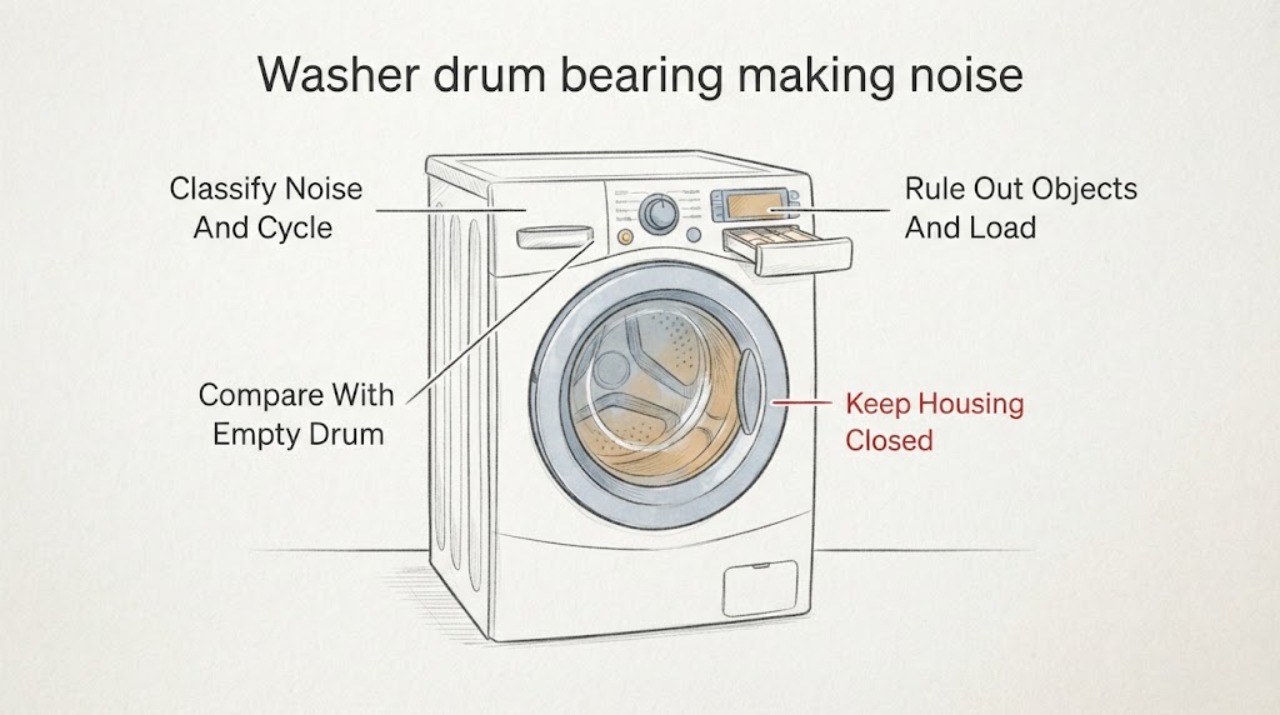
A washer that sounds as though its drum bearing is failing should not be diagnosed from noise alone. First note whether the sound occurs only with a particular load or during high-speed spin, then run the manufacturer's safe empty-drum check. Rattling, clanking, thumping, or shaking that disappears when the load is removed points more toward clothing, a foreign object, shipping material, leveling, or suspension. A persistent rough grinding or rumbling sound with an empty drum, a drum that is visibly off-center, or grinding/clanking when the basket is moved by hand makes a bearing, suspension, or another internal rotating part more likely. Turn the washer off and unplug it before any hand inspection; do not open the cabinet. If the noise persists on an empty test, the drum has excessive movement, water or rust is appearing at the rear, the machine walks, or any burning smell or leak is present, stop using it and arrange appliance service.
Before you begin
Safety first
- This article covers external sound classification, an empty-load comparison, visible load and installation checks, and a gentle power-isolated drum observation. Do not defeat locks, reach into a moving appliance, remove the cabinet or tub, handle exposed wiring, or attempt bearing, suspension, motor, pulley, or seal repair.
Work through in order
Diagnostic checks
Use only checks that match the exact appliance or system and its official guide.
-
Check 1
From a safe position, note the noise type, when it starts, and where it seems loudest: wash agitation, draining, acceleration, high-speed spin, or coast-down; do not reach through a moving drum.
Expected result: Record rattling or clanking, thumping or banging, squealing, scraping, grinding or rumbling, and whether the noise follows drum speed or occurs only when the pump is running.
Next step: Continue to the empty-drum comparison only after the cycle stops safely; if there is smoke, a burning smell, metal-on-metal scraping, or uncontrolled movement, stop using the washer and arrange service.
Stop if: Do not put hands into the drum, defeat the lid or door lock, or keep operating through a harsh grinding or scraping sound.
Why this matters
Why: Rattling, thumping, and shaking commonly follow load balance, loose objects, installation, or hose contact. A grinding or rumbling sound that tracks drum rotation is more concerning for a bearing, suspension, pulley, or other rotating assembly, but sound alone cannot identify the part.
-
Check 2
Pause the cycle using the washer's controls, wait for the door or lid to unlock, remove the laundry and loose items, and use the model-approved empty rinse, spin, or hand-rotation check with power isolated as the manual allows.
Expected result: Note whether the noise disappears without laundry, remains while an empty drum rotates, or can be heard when the empty drum is turned gently by hand after the washer is off and unplugged.
Next step: If the sound is gone, inspect pockets and rebalance future loads. If it remains, leave the washer off and continue with visible drum and installation checks rather than opening the cabinet.
Stop if: Do not run an empty test if the washer leaks, walks, has exposed wiring, or the drum is rubbing severely; do not force a locked door or lid.
Why this matters
Why: A noise that disappears with an empty drum points toward load balance, clothing fasteners, or an object carried by the load. A persistent noise with no laundry makes a washer component or installation issue more likely; persistent grinding during gentle hand movement warrants service diagnosis.
-
Check 3
With the washer stopped, inspect the drum, door seal or lid area, pockets, and the removed load for coins, wires, buckles, zippers, or a single bulky or waterproof item; redistribute or remove the item before any repeat test.
Expected result: Record a loose object, an item trapped at the seal, a single heavy load, a tangled load, or no load-related explanation.
Next step: Run only a light, balanced test load if the manual permits and the washer is otherwise safe; if the same noise returns with a balanced load, stop testing and arrange service.
Stop if: Do not reach behind the inner tub, pull a trapped object through a narrow gap, or continue if the seal is torn or the drum is scraping it.
Why this matters
Why: Foreign objects can create rattling or clanking, while bulky or uneven loads can create thumping and vibration that may be mistaken for a failing bearing. No object and a persistent empty-drum noise makes an internal or installation cause more likely.
-
Check 4
Check from outside that the washer sits on a solid floor, all feet contact the floor, the cabinet does not rock corner-to-corner, and—if newly installed—the shipping bolts and packing materials were handled as the exact manual specifies.
Expected result: Note cabinet rocking, an uneven floor, loose leveling feet, a pedestal that moves, or shipping hardware still installed; compare the noise before and after safe installation correction.
Next step: Correct only the external leveling or installation item described by the manual, then retest with a light balanced load; leave the washer off and call service if it still shakes or makes the same noise.
Stop if: Do not tilt or lift the washer alone, remove cabinet panels, or remove shipping hardware from an occupied or stacked installation without model-specific instructions and safe assistance.
Why this matters
Why: An unlevel washer, unstable floor, loose pedestal, or retained shipping hardware can cause severe vibration and noise without a failed bearing. If these conditions are absent and an empty-drum rumble persists, an internal rotating or suspension problem becomes more plausible.
-
Check 5
With power isolated and the drum empty, view the basket through the opening and gently move it only within the normal range described by the owner's manual; do not pry, lift forcefully, or remove the door seal.
Expected result: Record a centered basket with smooth movement, visible sag or off-center position, a rough/gritty rotation, grinding or clanking, excessive looseness, or a seal that rubs the drum.
Next step: Photograph the drum position and record whether the movement is vertical, front-to-back, or side-to-side; stop using the washer and provide those observations to a qualified appliance technician.
Stop if: Do not disassemble the cabinet, tub, bearing, seal, suspension, motor, or pulley, and do not run the washer when the drum rubs the seal or cabinet.
Why this matters
Why: A centered basket with smooth movement lowers the likelihood of a severe bearing or suspension fault, although it does not rule one out. Off-center movement, excessive looseness, rough rotation, or grinding/clanking makes worn bearing, suspension, tub, or another internal part more likely and cannot be confirmed safely by a homeowner.
-
Check 6
If no hazard or severe movement was found, run only the exact model-approved light-load or empty verification cycle while observing from a dry position for repeatable noise, movement, drainage, leaks, and changes with drum speed.
Expected result: Record whether the sound is absent, load-specific, present in an empty drum, louder at high spin, accompanied by shaking, or followed by a leak, error, or burning smell.
Next step: Stop using the washer for persistent empty-drum noise, excessive movement, leaks, or burning odor and arrange appliance service with the model, sound recording, cycle, load, and observations; do not order a bearing from sound alone.
Stop if: Stop immediately for smoke, burning smell, exposed electrical parts, uncontrolled water, severe walking, or metal-on-metal scraping.
Why this matters
Why: A load-specific sound supports a load or balance correction. A repeatable empty-drum grinding or rumbling sound, especially with looseness or high-spin worsening, supports a service diagnosis for bearing, suspension, tub, pulley, motor, or related parts rather than more balancing attempts.
Use your observations
Decision map
Find the observation that best matches what you see, then follow the next safe action.
-
PATH 01Safety boundary
What you see
The sound occurs with towels, bedding, one bulky item, or metal fasteners but disappears when the drum is empty or the load is redistributed.
Do this next
Remove pocket items, distribute the load, avoid overloading, and use the cycle recommended for bulky or waterproof items; retest only if the washer remains stable and quiet when empty.
Why this path and its safety boundary
Why it matters: Load imbalance, a foreign object, clothing fastener, or a load-related thump is more likely than a continuously failing drum bearing.
Safety stop: Arrange service if noise returns with ordinary balanced loads, the drum is visibly loose, or the washer begins to walk.
-
PATH 02Safety boundary
What you see
The washer rocks, a foot or pedestal is loose, the floor is unstable, shipping hardware remains after a recent installation, or a hose is striking the cabinet.
Do this next
Follow the exact manual for safe external leveling, shipping-material handling, or hose securing, then perform a light controlled test; call service if the installation correction does not change the noise.
Why this path and its safety boundary
Why it matters: Installation and external vibration are more likely than a drum-bearing failure and can create loud thumping or rattling during spin.
Safety stop: Do not tilt a heavy or stacked washer alone or remove panels to chase a vibration.
-
PATH 03Safety boundary
What you see
The empty drum still produces a repeatable rough grinding, rumbling, or clanking sound that follows rotation, especially when the basket feels loose, sags, rubs the seal, or worsens at high spin.
Do this next
Keep the washer off and arrange qualified appliance service for an internal diagnosis; provide the model, sound timing, drum movement, and any leak or rust evidence.
Why this path and its safety boundary
Why it matters: A bearing, suspension, tub, pulley, motor, or another internal rotating part is more likely than a load problem. The sound and hand check do not identify which part failed.
Safety stop: Do not continue high-speed cycles, remove the tub, replace a bearing, or disassemble the cabinet as a homeowner test.
-
PATH 04Safety boundary
What you see
The sound is a low hum only while draining, a brief normal click at door lock or water fill, or a rattle that comes from the drain hose or a loose object outside the drum.
Do this next
Compare the timing with the manual's normal-sound guidance, secure only accessible external items, and arrange service if the sound changes to grinding, persists when empty, or is accompanied by poor draining.
Why this path and its safety boundary
Why it matters: The observed pattern is less consistent with a drum bearing and more consistent with a pump, valve, hose-contact, or loose-object sound; the exact manual remains the authority for normal operating sounds.
Safety stop: Do not open the pump or motor housing or reach into the drain path while powered.
-
PATH 05Safety boundary
What you see
The washer has smoke, a burning or electrical smell, exposed wiring, uncontrolled water, severe walking, metal-on-metal scraping, or a drum rubbing the cabinet or seal.
Do this next
Stop the cycle, disconnect power only from a dry safe position if possible, keep clear of water or smoke, and arrange urgent appliance service.
Why this path and its safety boundary
Why it matters: The appliance may present an electrical, water, mechanical, or fire hazard; noise troubleshooting should end immediately.
Safety stop: Do not restart the washer, bypass a door or lid lock, remove panels, or attempt electrical or internal rotating-part repair.
Helpful context
Understand the symptom
Why a bearing is easy to misidentify
Spin speed amplifies several different sounds. A coin or fastener can rattle, a tangled towel can thump, an unlevel cabinet can shake, and a drain hose can knock against the rear panel. A bearing concern becomes more credible when a rough grinding, rumbling, or clanking sound continues with the drum empty and is accompanied by unusual basket movement. That pattern still needs model-specific service diagnosis rather than a sound-based parts order.
Separate a load problem from an internal rotating problem
Pause safely, remove the laundry after the door or lid unlocks, and compare the sound with an empty, low-risk test allowed by the owner's manual. If the sound disappears, inspect the load and pockets before blaming the washer. If it remains, turn the appliance off and use the drum and cabinet observations below. Never keep running a machine that is walking, scraping, leaking, or producing a burning smell.
Bearing work is a service-level repair
Many washers require substantial disassembly to reach a drum bearing, tub, seal, suspension, motor, or pulley. The homeowner checks here are limited to sound timing, visible balance, gentle movement with power isolated, load and installation observations, and a safe test. A technician should confirm the failed part, inspect for water damage, and verify model-specific repair requirements before any part is ordered.
Safety boundary
Stop conditions
- Stop using the washer and arrange appliance service for persistent empty-drum grinding or rumbling, excessive drum looseness, a drum that rubs the seal or cabinet, severe walking, a leak, smoke, or a burning/electrical smell.
- Do not diagnose or replace a drum bearing from sound alone. Internal bearing, tub, suspension, pulley, and motor work may require cabinet or tub disassembly and should be handled by a qualified professional.
- Do not defeat a door or lid lock, reach into a moving drum, work around exposed wiring, tilt a heavy or stacked appliance alone, or run repeated high-speed tests when the machine is unstable.
- Use the exact owner's manual for shipping hardware, leveling, test-cycle, and model-specific service instructions; do not transfer a procedure or part fit from another washer.
Only after diagnosis
Potential parts
- washer drum bearing or bearing assembly
Consider this class only after a qualified diagnosis confirms that persistent empty-drum grinding, rumbling, or excessive drum movement is caused by the bearing rather than suspension, tub, pulley, motor, or load conditions.
Confirm the exact washer model, tub design, bearing arrangement, seal requirements, and whether the manufacturer supplies a complete tub or bearing service assembly; do not order from noise alone. - washer tub seal or bearing seal
Consider this class only when inspection finds water or rust evidence at the bearing area or a technician confirms a seal failure associated with the bearing or tub repair.
Match the exact model and tub/bearing assembly; a seal is not a substitute for a worn bearing or damaged tub. - washer suspension or shock absorber assembly
Consider this class only when the diagnostic pattern is severe spin vibration, off-center movement, or load-independent shaking and a technician identifies suspension wear rather than a bearing fault.
Match the exact washer model, suspension position, load rating, and manufacturer design; do not infer fit from appearance.
When checks do not resolve it
Need a professional?
Arrange appliance service when grinding or rumbling continues with an empty drum, the basket is loose or off-center, the washer shakes after load and leveling checks, the noise is accompanied by a leak or rust evidence, or the source may be a bearing, suspension, tub, pulley, motor, or other internal part. Stop immediately for smoke, burning odor, exposed wiring, uncontrolled water, severe walking, or metal-on-metal scraping.
Safety scope: This article covers external sound classification, an empty-load comparison, visible load and installation checks, and a gentle power-isolated drum observation. Do not defeat locks, reach into a moving appliance, remove the cabinet or tub, handle exposed wiring, or attempt bearing, suspension, motor, pulley, or seal repair.
Common questions
FAQ
How can I tell if my washer drum bearing is bad?
You cannot confirm a bearing from sound alone. A persistent rough grinding or rumbling sound with an empty drum, combined with unusual looseness, sagging, or rough hand movement after power is isolated, makes an internal bearing, suspension, tub, or related rotating part more likely. Stop using the washer and have the exact model diagnosed.
Why does my washer only make noise during spin?
Spin magnifies load imbalance, an unlevel cabinet, retained shipping material, hose contact, foreign objects, suspension problems, and bearing or other rotating-part problems. Remove the load, check external installation conditions, and compare with the model-approved empty test. Persistent empty-drum noise needs service.
Is a rumbling washer always a drum bearing?
No. A drain pump, loose object, hose, unbalanced load, suspension, pulley, motor, or tub can produce overlapping sounds. The important decision is whether the noise remains with an empty drum and whether the basket has abnormal movement; those findings determine whether to stop and request an internal diagnosis.
Can I replace a washer drum bearing myself?
Do not begin with a generic bearing replacement procedure. Bearing access and tub construction vary, and reaching the part may require opening the cabinet or separating the tub. Have a qualified appliance technician confirm the failed component and the model-specific repair or complete-assembly requirement first.
Read the exact guide
Official sources
- Washing Machine Vibrating and NoisySamsung Support · Samsung support page; model-specific installation and repair instructions control.
- LG Washer - Troubleshooting Noises During the CycleLG USA Support · LG washer support article; procedures vary by front-load/top-load model and do not establish a bearing diagnosis for every washer.
- LG Washer – Troubleshooting Vibration IssuesLG USA Support · LG washer vibration guidance; exact installation and test-cycle steps vary by model.
- Washing machine drum making grinding noisesBosch Home Appliances · Bosch US support page; it gives an escalation path rather than a homeowner bearing-replacement procedure.
- Why is My Bosch Washing Machine Making Loud Noises?Bosch Home Appliances · Bosch US washer troubleshooting page; model-specific manuals control exact procedures and the bearing possibility is not a universal diagnosis.
- HOW TO STOP A WASHER FROM SHAKINGMaytag · Maytag general washer guidance; exact inspection and repair steps depend on the model.
- Laundry Washers Noises GuideElectrolux · Electrolux general washer noise guide; exact model manual controls installation, cycle, and service details.
Community feedback
Share a repair observation
Share a plain-text repair observation. Accepted observations are published automatically; this page may take a moment to update.