
On this page
Start here
Quick answer
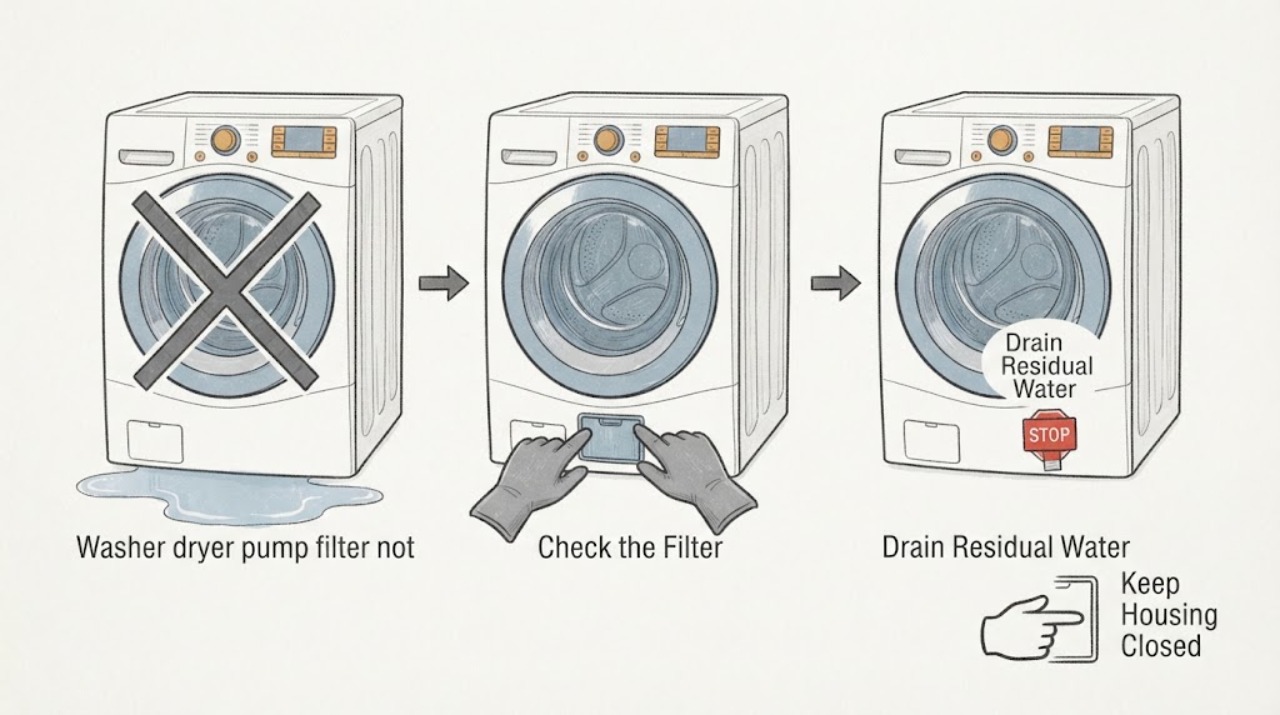
Do not keep opening a pump filter while the drum may contain hot water. Turn the washer-dryer off, disconnect power, consult the exact model manual for the filter and residual-water hose location, and place a broad shallow container and towels below the access point. Drain residual water slowly if the model provides a drain hose, then remove and clean the pump filter only as the manual describes. Lint, coins, and other objects can block the filter or pump, while a kinked drain hose, blocked standpipe, frozen hose, incorrectly seated filter, or failed drain pump can cause the same no-drain symptom. Reassemble the filter and hose cap fully before any controlled drain test. If water remains trapped, the filter will not turn, the impeller will not move freely, the pump only hums, the leak continues, or the filter is not user-accessible, leave the appliance off and call a qualified appliance technician.
Work through in order
Diagnostic checks
Use only checks that match the exact appliance or system and its official guide.
-
Check 1
Stop the washer-dryer, disconnect power, and check from a safe position whether water in the drum may be hot or whether water has reached the plug, receptacle, or controls.
Expected result: Record cool-looking residual water, a recent hot cycle, water near electrical equipment, flooding, a burning odor, smoke, or no safe way to disconnect power.
Next step: Allow hot water to cool and keep clear of wet electrical equipment. Use qualified appliance, electrical, or emergency help when the area cannot be made safe without contact or movement.
Stop if: Do not open the filter, reach into standing water, move the appliance, or restore power while water is near electrical equipment or a safety warning is present.
Why this matters
Why: Cool, contained water may allow a model-directed filter procedure; hot water, electrical exposure, flooding, or combustion warning is an immediate stop boundary.
-
Check 2
Read the exact washer-dryer manual and identify whether the model has a lower service flap, pump filter, and residual-water drain hose accessible to the owner.
Expected result: Record a clearly documented accessible filter, a residual hose with cap, a filter with no drain hose, no user-accessible filter, or instructions that require service.
Next step: Follow only the model-specific procedure when access is explicitly provided. If the manual does not show the filter or directs service, leave the appliance off and arrange a technician.
Stop if: Do not remove panels, pry open an unlabeled cover, or improvise filter access because another washer-dryer model has a filter in that location.
Why this matters
Why: Access varies by model; a documented owner procedure supports a careful clean, while an inaccessible or service-only filter makes cabinet access unsafe and unnecessary.
-
Check 3
Place a broad shallow container and towels below the access point, then use the model's residual-water hose or slowly loosen the pump filter as directed to control water flow.
Expected result: Record steady residual water, only a small amount of water, no flow from the drain hose, water that is hot, or water that spills toward electrical equipment or the floor.
Next step: Drain in small amounts and empty the container as needed only while the procedure remains safe. Stop and call service if the hose or filter will not release water without force or flooding.
Stop if: Do not force the cap, tip the appliance, puncture a hose, or continue when water is hot, flooding, or approaching electrical equipment.
Why this matters
Why: Steady or absent flow can indicate a kinked residual hose, a blocked filter path, or a remaining volume of water; hot or uncontrolled water is a scald or property-damage boundary.
-
Check 4
With residual water controlled and power disconnected, remove the documented pump filter, clear lint and foreign objects from the filter and opening, and make only a gentle visual or fingertip check for an object preventing free impeller movement.
Expected result: Record lint or coins in the filter, an object in the pump opening, a clean filter with a free-looking impeller, an impeller that will not move, or a jammed object that cannot be removed safely.
Next step: Clean the filter with the model-approved method and stop for service if the impeller remains stuck, an object is deep in the housing, or the pump is damaged.
Stop if: Do not insert tools deeply, force the impeller, cut internal hoses, or work in the pump opening while power or water remains connected.
Why this matters
Why: Debris supports a filter or pump blockage; an immobile impeller or inaccessible obstruction can indicate a deeper pump problem and is not proof that the pump should be replaced.
-
Check 5
After the filter area is closed, inspect only the accessible drain hose and household drain for kinks, compression, freezing, blockage, an airtight or displaced fit, or water backing up at the standpipe or sink.
Expected result: Record a kinked or crushed hose, a frozen section, a clear hose with water backing up in the household drain, a clear drain path, or an inaccessible path behind the appliance.
Next step: Correct only an obvious accessible routing issue according to the manual. Call a plumber for household drain backup and an appliance technician when the path is clear but water still will not drain.
Stop if: Do not remove wall plumbing, use an unapproved chemical in the appliance, pull a secured hose from an inaccessible location, or move a stacked unit alone.
Why this matters
Why: A hose or household-drain restriction can prevent the pump from emptying even when the filter is clean; a clear path makes the pump, internal hose, or control more relevant.
-
Check 6
Reinstall the pump filter, residual-hose cap, and service cover completely as shown in the manual, then perform only a permitted Drain or Spin test while watching the filter area and outlet.
Expected result: Record normal water flow, a leak at the filter or hose cap, a humming pump with no flow, a recurring drain error, water backing up at the household drain, or no safe way to test.
Next step: Stop the test at the first leak, unusual noise, error, or no-flow condition. Keep the appliance off and provide the observations to an appliance technician or plumber.
Stop if: Do not run the washer without the filter, cap, or cover, repeat failed tests, open the cabinet, or test with standing water near electrical equipment.
Why this matters
Why: Normal flow after a sealed reassembly supports a resolved blockage; a leak can indicate incorrect seating or a damaged seal; hum without flow or a recurring error needs appliance diagnosis; backup points to plumbing.
Use your observations
Decision map
Find the observation that best matches what you see, then follow the next safe action.
-
PATH 01Next step
What you see
The model has an accessible pump filter, the residual water can be safely drained, and lint, coins, or other debris are found; after correct reassembly, the permitted drain test moves water normally.
Do this next
Resume use only after the filter, cap, and cover are fully seated and the area remains dry. Record the cleaning date and follow the model's maintenance schedule.
Why this path and its safety boundary
Why it matters: A filter or pump-opening obstruction was the leading cause, and the successful sealed test supports resolution without naming a replacement pump.
-
PATH 02Next step
What you see
The pump filter is clear or cleaned, but the drain hose is kinked, compressed, frozen, blocked, displaced, or the household drain backs up.
Do this next
Correct only an obvious accessible hose-routing issue per the manual, or call a plumber for household drain backup. Keep the appliance off if water remains in the drum.
Why this path and its safety boundary
Why it matters: The restriction is outside the filter housing, so replacing the filter or pump is not established; the outlet path needs correction or plumbing service.
-
PATH 03Safety boundary
What you see
The filter and accessible drain path are clear, but the pump hums without moving water, the impeller will not move freely, the drain error returns, or water remains trapped.
Do this next
Leave the washer-dryer off and arrange qualified appliance service. Provide the model, error if shown, filter findings, pump sound, and whether water reaches the drain hose.
Why this path and its safety boundary
Why it matters: A jammed or failed drain pump, internal hose restriction, control issue, or incorrectly reassembled filter remains possible and requires model-specific testing.
Safety stop: Do not energize the pump with the filter removed, force the impeller, open the cabinet, or order a pump based only on a no-drain symptom.
-
PATH 04Next step
What you see
The manual does not show a user-accessible pump filter, the filter is behind a panel, or residual water cannot be controlled safely at the documented access point.
Do this next
Keep power off, do not tip or dismantle the washer-dryer, and request a qualified appliance technician to drain and diagnose it.
Why this path and its safety boundary
Why it matters: Model design or the water volume has exceeded the safe owner procedure; forcing access can cause flooding, damage, or injury.
-
PATH 05Safety boundary
What you see
Residual water is hot, flooding, near electrical equipment, the appliance is unstable, there is a burning odor or smoke, or a breaker trips during the incident.
Do this next
Keep clear and use appropriate appliance, electrical, plumbing, or emergency help from a safe position. Do not restore power or water to test the machine.
Why this path and its safety boundary
Why it matters: The immediate risk is scalding, electric shock, fire, or property damage rather than identifying a clogged filter.
Safety stop: Do not enter standing water near electrical equipment, touch hot residual water, move the appliance, or continue filter work.
Helpful context
Understand the symptom
Make the residual water safe to handle
A washer-dryer that stops with water in the drum can release a large amount of residual water when the service flap or filter opens. Turn the appliance off and disconnect power before accessing the pump area, and allow a recent hot cycle to cool. Use the manual to confirm that your model has a user-accessible pump filter and residual-water hose; some models do not provide the same access. Keep water away from the plug, receptacle, and controls, and stop if the floor would become unsafe or the water is hot.
Drain the trapped water before removing the filter
Place a broad, shallow container and towels under the lower service opening. If the model has a small residual-water hose, use it to drain into the container a little at a time; otherwise follow the manual's procedure for loosening the filter slowly. Empty the container as needed instead of letting water run across the floor. Do not force a cap, pull an unknown hose, or open a filter that is still under a hot or pressurized condition.
Clean the pump filter and inspect the pump opening
Once the residual water is controlled, remove the pump filter only in the direction and manner specified for the model. Remove lint, coins, fabric, and other foreign objects from the filter and filter housing, then rinse the filter as permitted. Look for an object that prevents the pump impeller from moving freely, but do not reach deeply into the housing or pry a jammed object. A clean filter does not rule out a blocked internal hose or a failed pump.
Check the drain path separately from the pump filter
A filter can be clear while the drain hose is kinked, compressed, frozen, blocked, or installed in a way that prevents free flow. Check only the accessible hose and the household standpipe or sink for an obvious obstruction, using the model manual for routing requirements. If water drains from the hose but backs up at the standpipe, the household drain is the likely path for plumbing service. If the hose remains dry while the pump is supposed to run, the pump or an internal hose needs appliance diagnosis.
Reassemble before a limited test
Refit the filter, drain-hose cap, and service cover completely, with the filter seated as the manual shows. Check for a drip around the filter before allowing a normal cycle. If the manual permits a Drain or Spin test, stay nearby and stop at the first leak, unusual hum, repeated error, or failure to move water. A filter that was cleaned but is not seated correctly can itself leak, so do not run the appliance with the filter or cap loose or missing.
Safety boundary
Stop conditions
- Stop immediately for hot residual water, flooding, water near electrical equipment, a burning odor, smoke, an unstable appliance, or a breaker that trips during the problem.
- Leave the washer-dryer off when the filter will not turn, the impeller will not move freely, the pump hums without flow, a drain error returns, the filter is not user-accessible, or the household drain backs up.
- Do not force a filter cap, energize the pump with the filter removed, insert tools deeply, open appliance panels, tip or dismantle a stacked unit, or run the machine without the filter, hose cap, and service cover correctly seated.
Only after diagnosis
Potential parts
- drain pump filter or filter seal
Consider this only when the exact model uses a replaceable filter or seal and inspection confirms damage, missing sealing material, or a filter that cannot seat correctly.
Match the exact appliance model and manual. A clean filter that still does not drain does not by itself justify replacing the filter. - drain pump assembly
Consider this only after a qualified technician confirms the filter and drain path are clear and the pump is jammed, electrically failed, leaking, or not moving water.
Confirm the exact model, pump design, electrical and plumbing connections, and manufacturer-approved fit before ordering; do not infer fit from appearance. - residual-water drain hose or cap
Consider this only when the model has a separate residual-water hose and the hose or cap is visibly split, missing, kinked, or unable to seal after correct reassembly.
Use the model-specific part and sealing arrangement. Do not improvise a cap or bypass the residual-water hose.
When checks do not resolve it
Need a professional?
Call a qualified appliance technician when the pump filter is inaccessible, residual water cannot be drained safely, the impeller is stuck, the filter and drain hose are clear but the washer-dryer still will not drain, a recurring drain error or pump hum remains, or the filter area leaks after reassembly. Call a plumber when water backs up at the household standpipe, sink, or drain piping. Use appropriate emergency or electrical help for flooding, hot water, smoke, burning odor, or water near energized equipment.
Have this ready
- Provide the appliance brand and model, whether it is a washer-dryer combo or stacked pair, error code if shown, remaining water temperature impression, filter location, debris found, impeller observation, drain-hose and household-drain findings, pump sound, photos of any leak, and the steps already performed with power disconnected.
Common questions
FAQ
Why will my washer-dryer pump filter not drain the water?
The residual-water hose or filter path may be kinked or clogged, the water may still be hot, or the model may require a different access procedure. Turn the appliance off and disconnect power, use the exact manual, and stop if water cannot be controlled safely or the cap will not release without force.
What should I do before opening a washer pump filter?
Turn the appliance off and disconnect power, allow recently heated water to cool, confirm the manual shows a user-accessible filter, and place a broad shallow container and towels below the access point. Use the residual-water hose if the model provides one.
What if the pump filter is clean but the washer-dryer still will not drain?
Check the accessible drain hose and household drain for kinks, compression, blockage, freezing, or backup. If those paths are clear but the pump hums without flow, the impeller is stuck, or a drain error returns, leave the appliance off and call a qualified appliance technician.
Can every washer-dryer pump filter be cleaned by the owner?
No. Filter locations and access vary, and some models do not have a user-accessible filter. Use the exact model manual; do not remove panels or tip a stacked unit to reach a filter. Request service when access is not documented or residual water cannot be controlled.
Read the exact guide
Official sources
- Product Guide: Cleaning the Drain Pump Filter/Draining Residual WaterWhirlpool · Whirlpool's official product guide provides a concrete example of a front-access filter and residual-water procedure; the installed model manual controls whether this procedure applies.
- Steps to resolve water drainage issues with your Samsung washerSamsung · Samsung's official support page provides independent no-drain context and notes that pump-filter cleaning is for applicable front-load models; the exact installed manual controls access.
- [LG Washing Machine] Water Not Draining (OE Error)LG Electronics · LG's official support article provides model-general pump-filter and no-drain guidance; the installed appliance manual controls the exact access and procedure.
- Why is My Washing Machine Not Draining?Whirlpool · Whirlpool's manufacturer article supports the distinction between filter, pump, drain pipe, model access, and cycle causes; exact washer-dryer instructions govern the installed appliance.
- Why Won't My Bosch Washing Machine Drain? How to ResolveBosch · Bosch's official support article supports general pump-filter safety and the distinction between hose, filter, impeller, and service faults; exact model documentation controls the procedure.
Community feedback
Share a repair observation
Share a plain-text repair observation. Accepted observations are published automatically; this page may take a moment to update.