
On this page
Start here
Quick answer
A washer odor that remains after a cycle is commonly caused by trapped moisture, detergent or fabric-softener residue, a damp gasket or dispenser, laundry left in the drum, or a drain path that leaves water behind. First identify whether the smell is musty, sewage-like, detergent-like, or burning, and whether it is present in the empty washer or only on clothing. Remove laundry promptly, dry visible moisture, clean only accessible gasket and dispenser areas, and run the model-approved Tub Clean or washer-cleaning cycle with the cleaner specified by the manual. Check only visible drain-hose routing and model-approved filter access. Leave the door or lid and dispenser open to dry. Stop for an electrical, burning-rubber, or smoke smell, and arrange qualified service if water remains, the odor persists after repeated model-approved cleaning, or the drain, pump, seal, or internal area needs access.
Before you begin
Safety first
- Keep the washer off for smoke, electrical or burning-rubber odor, arcing, a hot plug or outlet, a leak near electrical parts, pooled water, or repeated breaker trips. Do not open the cabinet, bypass a safety device, force wet access, or continue testing.
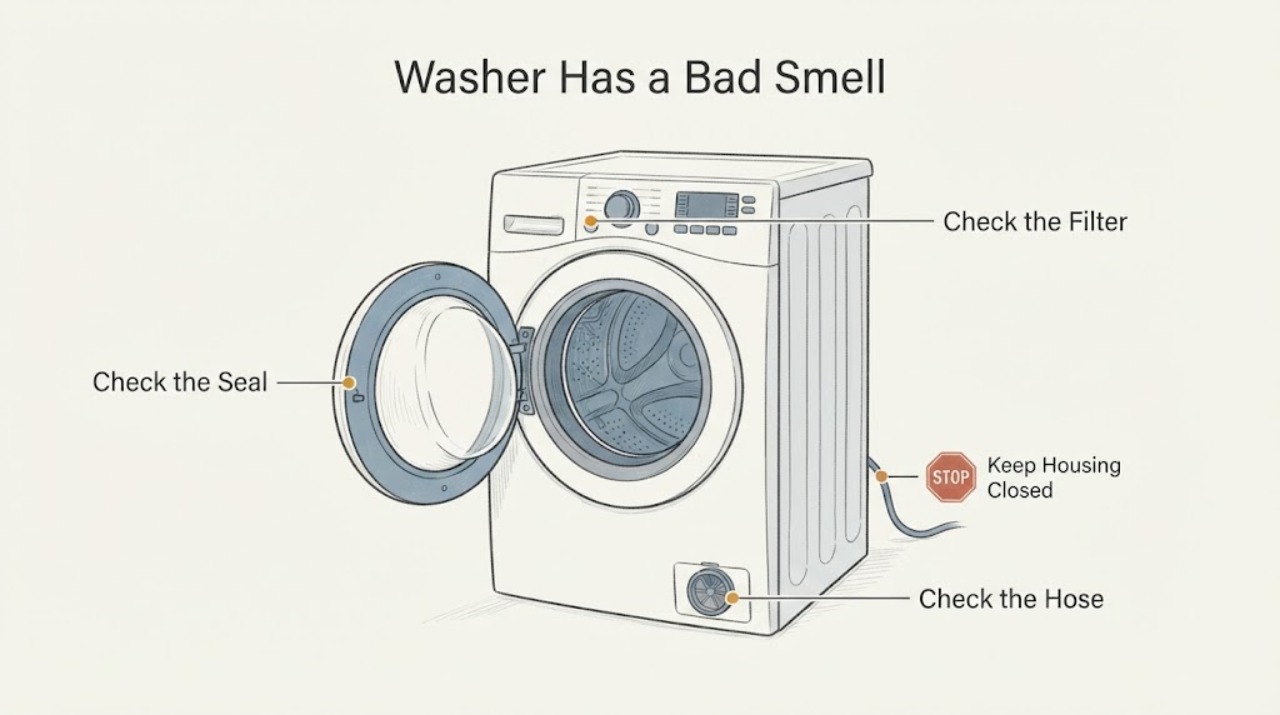
Work through in order
Diagnostic checks
Use only checks that match the exact appliance or system and its official guide.
-
Check 1
Empty the drum and identify the odor as musty or mold-like, sewage-like or sulfur-like, detergent-like, or electrical, burning-rubber, or smoky. Compare the empty washer with one recently washed load, and note whether water remains or the smell is strongest at the gasket, dispenser, drum, or drain area.
Expected result: The empty machine smells, only the clothing smells, water remains, the odor is drain-like, or the odor is hot, electrical, burning-rubber, or smoky.
Next step: Follow the matching branch below. For burning, electrical, rubber, or smoke odor, stop using the washer and arrange qualified service; do not run another cycle to test it.
Why this matters
Why: An odor in the empty washer favors retained moisture or residue. An odor limited to clothing favors wash-product or laundry handling issues. Standing water or a drain-like smell shifts attention to drainage. Burning or smoke is not an ordinary washer-cleaning condition.
-
Check 2
With the washer stopped and the drum empty, inspect the accessible door or lid gasket, door glass or rim, tub opening, and detergent dispenser. Wipe visible water and remove reachable lint, hair, or residue without removing panels or forcing the seal.
Expected result: Moisture, residue, lint, hair, or visible mildew is present; the area is clean and dry; or the gasket is torn, deformed, or not seating correctly.
Next step: Clean the accessible areas using the exact model guidance, then ventilate the washer. Stop and request service for a damaged seal, a leak, inaccessible buildup, or an odor that remains after the documented cleaning path.
Why this matters
Why: Moisture and residue can support musty odor. A damaged or poorly seating gasket can retain water or allow a leak and needs a model-specific repair decision rather than improvised cleaning.
-
Check 3
Inspect the external drain hose and the area behind or beside the washer for an obvious kink, crushing, loose visible connection, wastewater backup, or standing water. Compare its routing with the exact owner manual; do not disconnect a wet connection or move a heavy washer by yourself.
Expected result: The hose is visibly restricted or incorrectly positioned, wastewater backs up, water remains in the tub, or the hose and household drain look normal.
Next step: Correct only a clearly documented external routing issue and make one supervised drain attempt if the floor and connections are dry. Stop for a leak, backup, repeated standing water, or inaccessible filter or pump access and arrange appliance or plumbing service.
Why this matters
Why: A restricted or incorrectly routed drain can leave or return water and make an odor persist. A normal visible route does not rule out an internal pump, filter, or household drain problem.
-
Check 4
Clean the accessible detergent dispenser and, only if the exact model provides safe user access, follow its instructions for the pump-filter area. Use no unapproved chemical mixture, do not reach into moving or energized parts, and do not force a filter cap with trapped water.
Expected result: Detergent or softener residue, lint, or debris is present; the filter area is inaccessible or water is trapped; or the accessible areas are clean but the odor persists.
Next step: Rinse and dry only as the model manual directs, then leave the dispenser open. Request service if the filter cannot be safely accessed, water will not drain, debris is behind a cover, or the odor continues.
Why this matters
Why: Buildup in a dispenser or approved filter area can feed odor. Trapped water or inaccessible components make the check a service boundary. Clean accessible areas do not prove that hidden tub or drain buildup is absent.
-
Check 5
Run the washer's model-approved Tub Clean, Drum Clean, or equivalent cleaning cycle with an empty drum, using only the cleaner and procedure specified by the owner manual or cleaner label. Do not add normal laundry or mix cleaning chemicals.
Expected result: The cycle completes and the odor improves, the odor returns quickly, the washer cannot complete the cleaning cycle, or a warning, leak, smoke, or abnormal sound occurs.
Next step: After a successful cycle, wipe remaining moisture and leave the door or lid and dispenser open. If the odor persists after the manual's repeated cleaning path or any safety symptom appears, keep the washer off and arrange qualified service.
Why this matters
Why: Improvement supports removable residue or moisture as the primary cause. A quick return, incomplete cycle, warning, leak, smoke, or abnormal sound indicates that cleaning alone is not resolving the underlying condition.
-
Check 6
For a washer that is clean, dry, and free of safety symptoms, record whether prompt laundry removal, correct model detergent use, a less-packed load, and ventilation change the odor on the next ordinary load. Do not keep testing if the smell is electrical, hot rubber, smoky, or accompanied by a leak or poor drainage.
Expected result: The odor improves when wet laundry is removed promptly and the washer is ventilated, only clothing smells, or the odor remains in the empty washer despite these changes.
Next step: Continue the model's maintenance guidance when the odor clearly improves. For persistent empty-drum odor, repeated standing water, a leak, or any burning or electrical smell, stop user-level testing and request service.
Why this matters
Why: Improvement with drying and laundry handling supports moisture or residue management. An odor that remains in the empty machine after cleaning and ventilation suggests hidden buildup, drainage, gasket, pump, or another internal fault.
Use your observations
Decision map
Find the observation that best matches what you see, then follow the next safe action.
-
PATH 01Next step
What you see
The odor is musty or mold-like, and moisture or residue is visible around the gasket, dispenser, door, lid, or tub.
Do this next
Clean accessible areas using the model guidance, run the approved empty tub-clean cycle, and ventilate afterward. If the smell remains after the documented cleaning path or the seal is damaged, arrange service.
Why this path and its safety boundary
Why it matters: Retained moisture and product buildup are more likely than a sudden mechanical failure.
-
PATH 02Next step
What you see
The odor is sewage-like or sulfur-like, and water remains, returns, backs up, or the drain hose routing conflicts with the manual.
Do this next
Correct only an obvious, model-documented external routing issue. Do not disconnect wet plumbing or force filter access; stop for recurring standing water or backup and arrange appliance or plumbing service.
Why this path and its safety boundary
Why it matters: A drain setup, household drain, restriction, or pump/filter issue is more likely than ordinary surface residue.
-
PATH 03Next step
What you see
The empty washer has little odor, but clothing smells after a load, especially when laundry sits damp or detergent use is excessive.
Do this next
Remove laundry promptly, use the exact detergent type and amount specified for the model, avoid overloading, and keep the door or lid and dispenser open to dry. Clean the washer if odor later appears in the empty drum.
Why this path and its safety boundary
Why it matters: Laundry handling, product residue, load size, or insufficient ventilation may be contributing more than an internal washer fault.
-
PATH 04Next step
What you see
The smell is electrical, hot rubber, smoky, or accompanied by heat, arcing, a hot plug, or a breaker trip.
Do this next
Stop the washer and keep people away. Isolate power only from a safe, dry location if that can be done without contact with heat, water, or damaged equipment; arrange qualified service or emergency help as appropriate. Do not restart it to test.
Why this path and its safety boundary
Why it matters: This is a potential electrical, motor, belt, or fire hazard, not a normal mildew or detergent issue.
-
PATH 05Next step
What you see
The odor remains in the empty washer after accessible cleaning, an approved tub-clean cycle, and ventilation, or it returns quickly with standing water or a leak.
Do this next
Keep the washer off if water, leaking, poor drainage, or abnormal operation is present. Give service the odor type, whether the drum was empty, the cleaning steps completed, water behavior, model, and any visible damage; do not open the cabinet.
Why this path and its safety boundary
Why it matters: Hidden tub or drain buildup, a gasket, pump, filter, drain, or another internal condition may be involved and cannot be confirmed safely from the outside.
Helpful context
Understand the symptom
The odor type changes the first check
Musty or mold-like odor usually points toward retained moisture and residue around the tub, door or lid gasket, dispenser, or other damp surfaces. A sewage-like or sulfur odor makes the drain route and standing water more important. A detergent-like smell often follows excess product or buildup. An electrical, hot-rubber, or smoke smell is a safety stop, not a cleaning problem. Compare an empty washer with a recently washed load so you know whether the source is the machine, the laundry, or both.
Dry surfaces and remove residue without guessing at a cycle
After the washer is stopped and the drum is empty, wipe accessible moisture from the gasket, door or lid area, and dispenser. Remove only visible lint, hair, or residue that can be reached without dismantling the appliance. The tub-clean name, cleaner, and procedure vary by model; use the owner's manual and the cleaner's label rather than substituting a generic chemical mixture. When finished, leave the door or lid and dispenser open so the interior can dry.
A drain smell or returning water needs a different boundary
If water remains in the drum, returns after draining, or the odor is sewage-like, inspect only the external drain hose for obvious kinks, crushing, or an installation position that conflicts with the manual. Do not pull a hose connection apart with water present or pour drain cleaner into the washer. A blocked household drain, inaccessible pump filter, repeated standing water, or a hose arrangement you cannot safely identify belongs with qualified appliance or plumbing service.
Persistent odor after cleaning is a service clue
One cleaning cycle may not remove established buildup, but repeated model-approved cleaning should produce a clear improvement. If the smell remains after the manual's cleaning path, returns quickly, or is accompanied by poor draining or a leak, hidden buildup, a seal, pump or drain fault, or an internal component may be involved. Do not open the cabinet or replace a part based on odor alone.
Safety boundary
Stop conditions
- Stop immediately for smoke, an electrical or burning-rubber smell, arcing, a hot plug or outlet, a repeated breaker trip, or a washer that is hot in an abnormal way. Do not restart it to test.
- Stop for a leak near electrical parts, pooled water, wastewater backup, water that remains in the drum, a damaged power lead, or a damaged or displaced gasket. Close the supply faucet only if it is safe to reach and arrange qualified service.
- Do not open the cabinet, reach into moving or energized parts, force a wet filter cap, disconnect a water-filled hose, use drain cleaner in the washer, or mix cleaning chemicals.
- Do not keep running cleaning or ordinary cycles when the odor persists after the model-approved cleaning path, a warning appears, the cycle cannot complete, or abnormal noise, vibration, or draining accompanies the smell.
Only after diagnosis
Potential parts
- door or lid gasket
Consider this category only when qualified inspection finds a torn, deformed, leaking, or persistently contaminated gasket after accessible cleaning.
Gaskets vary by washer style, region, and exact model. Confirm the model and diagnosis before selecting a part. - drain pump or pump filter
Consider this category only when standing water, poor draining, a returning drain symptom, or qualified testing identifies the pump or filter after visible hose checks.
Pump and filter access and fit vary by model. Do not order or install a component from odor alone. - detergent dispenser assembly
Consider this category only when residue, restricted dispensing, leakage, or damage remains after correct cleaning and qualified inspection links it to the dispenser.
Dispenser designs are model-specific. Confirm exact model fit and service instructions before any replacement decision.
When checks do not resolve it
Need a professional?
Arrange qualified appliance service when the odor persists in an empty washer after the model-approved cleaning path, returns quickly, or comes with standing water, poor draining, a leak, a damaged gasket, an inaccessible filter or pump, abnormal noise, or a warning. Plumbing service may be needed for a household drain backup. Treat smoke, an electrical or burning-rubber odor, arcing, a hot plug or outlet, or repeated breaker trips as immediate safety issues.
Safety scope: Keep the washer off for smoke, electrical or burning-rubber odor, arcing, a hot plug or outlet, a leak near electrical parts, pooled water, or repeated breaker trips. Do not open the cabinet, bypass a safety device, force wet access, or continue testing.
Common questions
FAQ
Why does my washer still smell after a cleaning cycle?
A single cleaning cycle may not remove established residue, and the odor may be coming from a gasket, dispenser, drain path, pump-filter area, or moisture that remains after the cycle. Compare the empty drum with clothing, complete the exact model's cleaning path, ventilate the washer, and request service if the odor persists or water remains.
Is a musty smell in a washer usually mold?
Musty odor often indicates retained moisture and residue, but odor alone cannot identify mold or its location. Check the accessible gasket, dispenser, door or lid, and tub, use the model-approved cleaning cycle, and have persistent or inaccessible buildup evaluated by service.
Why does my washer smell like sewage after a cycle?
A sewage-like smell makes standing water, drain-hose routing, wastewater backup, or a restricted pump or filter more likely. Inspect only visible hose routing against the exact manual; do not disconnect wet plumbing or force access, and arrange appliance or plumbing service for recurring water or backup.
Should I leave the washer door open after washing?
When the model and installation allow it, leaving the door or lid and detergent dispenser open helps accessible surfaces dry. Remove damp laundry promptly and follow the exact model guidance, especially if children or pets could access the opening.
Can I use bleach, vinegar, or another chemical to remove the smell?
Do not mix cleaning chemicals or assume a product is safe for the washer. Use only the cleaner and procedure named by the owner manual or product label for the approved tub-clean cycle; use qualified service when the odor persists.
Is a burning smell from a washer safe to ignore?
No. A burning-rubber, electrical, or smoky smell is a stop condition. Keep the washer off, avoid touching hot or wet electrical equipment, isolate power only from a safe dry location if possible, and arrange qualified service or emergency help as appropriate.
Read the exact guide
Official sources
- LG Washer – Troubleshooting an Electrical or Burning Rubber SmellLG Electronics · Manufacturer safety guidance; persistent electrical or burning odor on any washer warrants a qualified diagnosis.
- LG Washer - Troubleshooting Odor / BuildupLG Electronics · Manufacturer guidance used for general washer checks; exact model instructions control products and access.
- Samsung washing machine or laundry smells badSamsung Electronics · Manufacturer support guidance; exact washer model and regional instructions control any model-specific cycle, cleaner, or filter access.
- [LG Washing Machine] Troubleshooting Musty OdorsLG Electronics · Manufacturer support example; washer style and model-specific instructions may differ.
- LG Washer - How to Clean the Tub of Your Washing MachineLG Electronics · Manufacturer cleaning guidance; use the exact model manual and cleaner directions for a different washer.
Community feedback
Share a repair observation
Share a plain-text repair observation. Accepted observations are published automatically; this page may take a moment to update.