
On this page
Start here
Quick answer
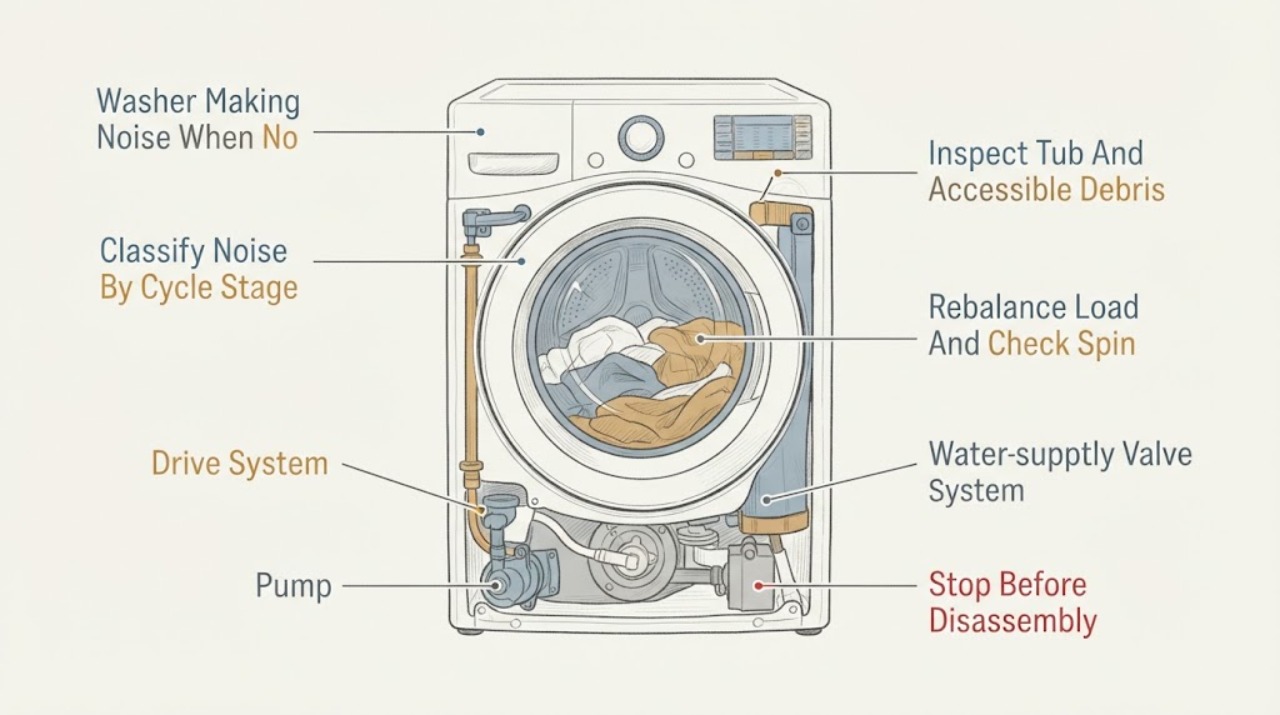
If the tub is clear but the washer still makes noise, identify the sound and the cycle stage before assuming an internal part has failed. A click, splash, or steady motor sound can be normal in some models; pounding or rattling during spin is more often linked to an unbalanced load, an unlevel washer, or nearby objects touching the cabinet. With the washer stopped, remove the laundry and check the tub, wash plate, gasket area, and accessible drain-filter area for a trapped wire or other debris. Then test a smaller, evenly spread load and note whether the noise remains with an empty, manufacturer-approved spin test. If the noise is scraping, grinding, roaring, intermittent with no load, or accompanied by a leak, burning odor, smoke, violent movement, or a control warning, stop using the washer and arrange qualified appliance service.
Work through in order
Diagnostic checks
Use only checks that match the exact appliance or system and its official guide.
-
Check 1
From a safe standing position, note whether the noise occurs while water enters, during wash agitation or tumbling, during drain, as spin accelerates, at maximum spin, or as the drum stops. Describe it as a click, hum, splash, squeak, rattle, thump, scrape, grind, or roar, and note whether the cabinet moves or touches a shelf or wall.
Expected result: The sound is a brief valve click or water sound, a repeating thump or rattle in spin, a high-pitched squeak, a scrape or grind, or a noise that continues after the drum stops.
Next step: Use the matching checks below and record a short description for the technician. Stop the washer for grinding, roaring, violent movement, or a sound that persists after the cycle stops.
Stop if: Do not keep running cycles simply to reproduce a harsh noise, and do not place hands near the moving tub.
Why this matters
Why: A brief water-valve or motor sound can be part of normal operation, while repeating spin noise makes imbalance, level, and external contact more likely. Scraping, grinding, roaring, or a persistent noise is not explained by an empty tub alone and needs a more cautious service decision.
-
Check 2
Stop the washer, wait for the drum or wash plate to stop, and remove the laundry. Inspect the visible tub holes, wash plate or agitator area, door gasket, and any user-accessible filter area described in the owner manual for a trapped wire, hairpin, zipper piece, coin, or other debris. Gently rotate the empty drum only if the model instructions permit it and there is no resistance or sharp edge; do not reach into gaps or dismantle anything.
Expected result: A foreign object is visible, the empty drum turns smoothly and quietly, the drum scrapes or resists, or the suspected object is out of reach.
Next step: Remove only a loose, reachable object without tools entering a gap. If the sound remains, the drum resists, or the object is caught between components, leave the washer off and arrange qualified service.
Stop if: Do not use pliers or improvised tools in a tub gap, remove the wash plate, or open a panel to retrieve an object.
Why this matters
Why: A trapped object can scrape the tub or wash plate even when the main tub appears clear. Smooth, quiet movement with no laundry makes an accessible-object explanation less likely. Resistance, scraping, or an inaccessible object can damage the tub or drive system if the washer continues.
-
Check 3
If the noise occurs with laundry, pause the washer and spread the load evenly. Remove an unusually bulky, waterproof, rubber-backed, or single heavy item, and avoid tightly packing the tub. Use the model's suitable cycle for the remaining fabrics, then observe whether the noise returns as spin speed increases.
Expected result: The load was stuck to one side, contained a single bulky item, was tightly packed, or became quiet after redistribution; the same noise returns with a balanced load.
Next step: Continue only with loads that the manual permits and that can move freely. If a balanced, ordinary load still produces the same harsh noise, stop repeated testing and move to the level, installation, and service checks.
Stop if: Do not hold the lid or door open to reach a moving load, and stop if the washer walks, bangs violently, leaks, or shows a warning.
Why this matters
Why: Laundry that shifts the tub's center of gravity can cause pounding, rattling, vibration, and a longer or interrupted spin even when no loose object is present. Noise that returns with an evenly spread load is less likely to be ordinary imbalance.
-
Check 4
With the washer stopped, check whether it rocks when gently pushed at the corners and whether shelves, storage, hoses, or the wall touch the cabinet. Look at the visible feet and floor for an obviously unstable position. Do not pull the machine forward or adjust feet that require access behind a connected washer unless the exact installation instructions and a safe empty setup support it.
Expected result: The cabinet rocks, the floor flexes, an object touches the washer, or the machine is stable with clearance around it.
Next step: Remove only an obvious nearby object and have leveling corrected according to the model installation instructions. If leveling requires moving the connected washer, arrange qualified help; if the cabinet remains stable and the noise persists, continue to the empty test and service boundary.
Stop if: Do not tip, drag, or place hands behind a connected washer to adjust feet, and do not operate it while it rocks or contacts a hard object.
Why this matters
Why: An unlevel washer or unstable floor can amplify spin vibration into pounding and rattling. A shelf, wall, or hose touching the cabinet can transmit a normal vibration as a new noise. Stability and clearance that are already normal make an internal or load-related cause more plausible.
-
Check 5
Compare the sound with the cycle stage and the model's normal-operation guidance. During water supply, listen for a brief valve click or a steady valve hum; during wash, note the normal movement of garments; during spin, note whether the sound rises and falls with speed. Do not remove a water-supply filter or open a service area solely to investigate a sound.
Expected result: The sound is brief and tied to water-valve operation, a normal wash-motion sound, a speed-related motor hum, or an unexplained rattle, squeal, scrape, or grind.
Next step: If the sound matches the model's normal guidance and there is no movement or damage, monitor it. If it is new, worsening, or outside the described pattern, stop testing and arrange appliance service with the cycle stage and recording of the sound.
Stop if: Do not dismantle the inlet or pump system for a sound comparison, and do not continue operation when the noise is accompanied by heat, odor, smoke, or a leak.
Why this matters
Why: Some clicks, splashes, garment impacts, and motor sounds are normal for a washer design. An unexplained harsh sound, especially one not tied to a particular normal stage, cannot be cleared by the absence of loose objects and should not be treated as normal by default.
-
Check 6
Only when the washer is stable on a dry floor, has no leak or electrical warning, and the exact model instructions allow it, run the model-approved empty spin or rinse-and-spin observation. Stand clear and stop the cycle if the noise becomes harsh, the cabinet moves, or a warning appears. Compare the empty result with the earlier loaded result.
Expected result: The noise disappears when empty, remains as a squeak or rattle, becomes a loud scrape or roar, or the washer vibrates or displays a warning.
Next step: If the empty test is quiet, use balanced loads and monitor. If it is not quiet, record the pattern and arrange qualified service; do not infer a specific bearing, suspension, motor, or pump part without model diagnosis.
Stop if: Do not run the empty test when there is an active leak, damaged wiring, smoke, burning odor, violent movement, or an unstable floor.
Why this matters
Why: A quiet empty test makes load balance or garment contact more likely, while noise with no laundry makes an internal, leveling, installation, or drive-related issue more likely. A worsening sound, movement, or warning means the washer should not be operated for further diagnosis.
Use your observations
Decision map
Find the observation that best matches what you see, then follow the next safe action.
-
PATH 01Next step
What you see
The tub and wash plate are clear, the empty test is quiet, and pounding or rattling appears only with laundry during spin.
Do this next
Redistribute or reduce the load, use the suitable cycle, and confirm the washer is stable and clear of nearby contact. Arrange service if the same noise returns with ordinary balanced loads.
Why this path and its safety boundary
Why it matters: Load balance, bulky or waterproof items, load size, or the washer's level is more likely than a loose object in the tub.
-
PATH 02Next step
What you see
The tub is clear and the noise remains during an approved empty test or when the empty drum is gently checked according to the manual.
Do this next
Stop repeated tests and arrange qualified appliance service. Provide the sound description, cycle stage, empty-test result, and any movement or warning; do not order a part from the sound alone.
Why this path and its safety boundary
Why it matters: A load-specific explanation is less likely; an installation, leveling, drive, suspension, pump, or other internal issue remains possible.
-
PATH 03Next step
What you see
The sound is a brief click, water sound, garment impact, or speed-related motor hum that matches the model's normal-operation guidance and is not worsening.
Do this next
Monitor the sound and keep pockets, zippers, and buttons managed in future loads. Request service if it becomes harsh, persistent, or different from the documented pattern.
Why this path and its safety boundary
Why it matters: The sound may be a normal valve, motor, or wash-motion sound rather than a fault.
-
PATH 04Next step
What you see
The washer rocks, vibrates against a wall or shelf, or the sound changes after nearby contact is removed or the load is redistributed.
Do this next
Correct only an obvious nearby obstruction and follow the exact installation instructions for leveling. Get help before moving a connected washer; service is appropriate if it cannot be stabilized safely.
Why this path and its safety boundary
Why it matters: Leveling, floor stability, clearance, or load distribution is more likely than a tub object.
-
PATH 05Next step
What you see
A scrape, grind, roar, worsening squeal, burning odor, smoke, leak, damaged wiring, violent movement, or control warning occurs even though no tub object is found.
Do this next
Stop using the washer and arrange qualified appliance service; use local emergency guidance for smoke, fire, or active electrical danger. Keep the cabinet closed and provide the sound and cycle-stage observations.
Why this path and its safety boundary
Why it matters: This is not a routine load adjustment. Continued operation could worsen a mechanical, water, or electrical fault.
Helpful context
Understand the symptom
The sound pattern matters more than the fact that the tub is empty
A washer can make sound without a loose coin or object in the tub. During normal operation, water valves, the drain pump, motor, and the movement of garments can each sound different. A spin-stage pounding or rattling pattern points first toward balance, level, or nearby contact. A scraping, grinding, or noise that remains with no laundry is a different pattern and needs more caution. Note when the sound begins, whether the drum speed changes it, and whether the cabinet moves.
Keep the check external and controlled
Stop and pause the washer before rearranging anything. Do not reach into a moving drum, remove panels, or pull the washer forward against its hoses. A short empty test is useful only when the floor is dry, the washer is stable, there is no leak or electrical warning, and the exact model instructions allow it. If the noise is harsh or the washer moves violently, leave it off for service.
Only after diagnosis
Potential parts
- model-specific suspension or leveling component
Consider this only after a technician confirms that the washer is installed correctly but a suspension or leveling component is causing noise with an appropriately balanced load.
Suspension, feet, and installation hardware vary by washer style and model. Confirm the exact model and diagnosis before selecting a part. - model-specific drive, tub, or pump component
Consider an internal drive, tub, bearing, motor, or pump component only when qualified testing finds a persistent noise with no laundry and rules out installation and external causes.
Internal washer components are model- and revision-specific and can require cabinet access. Do not choose one from the sound description or a visual match.
When checks do not resolve it
Need a professional?
Arrange qualified appliance repair when the washer makes a scrape, grind, roar, or persistent squeal with an empty tub, when it remains noisy after balancing and level or clearance checks, when a suspected object is inaccessible, or when internal drive, pump, suspension, or tub diagnosis is needed. Stop using the washer for violent movement, a leak, smoke, burning odor, damaged wiring, a hot or erratic control, or another immediate safety warning; use local emergency guidance for fire or active electrical danger. Do not open panels, reach into moving parts, tip or drag a connected washer, or select an internal replacement part from sound alone.
Common questions
FAQ
Why is my washer noisy when there are no coins or loose objects in the tub?
Noise can come from an unbalanced load, an unlevel or unstable washer, nearby contact, normal water-valve or motor operation, garment hardware, or an internal pump, drive, suspension, or tub issue. The sound's timing and whether it remains with an empty tub are more useful than the absence of a loose object.
Is a click or hum during a washer cycle normal?
It can be. Manufacturer guidance describes valve clicks and operating hums during water supply, normal motor sounds, and garment movement or hardware contacting the tub. A new, harsh, persistent, or worsening sound should not be assumed normal; compare it with the exact model guidance and arrange service if it continues.
Can an unbalanced load make a washer rattle even when the tub is clear?
Yes. Heavy, bulky, waterproof, tightly packed, or single-item loads can shift to one side and create pounding, rattling, vibration, or a prolonged spin. Pause safely, redistribute or reduce the load, and test a suitable balanced load. If the noise remains with ordinary loading, have the washer inspected.
How can I tell if the washer itself is making the noise?
When the floor is dry, the washer is stable, and there is no safety warning, an empty spin or rinse-and-spin observation approved by the model manual can help. Quiet when empty makes load or garment contact more likely. Noise that remains empty, especially scraping, grinding, or roaring, needs qualified diagnosis rather than a guessed replacement part.
When should I call a professional for a noisy washer?
Call when harsh noise remains with no laundry, the washer rocks or walks, a suspected object is inaccessible, the sound worsens after balancing and clearance checks, or an internal pump, drive, tub, or suspension diagnosis is needed. Stop using it for violent movement, a leak, smoke, burning odor, damaged wiring, or a hot or erratic control.
Read the exact guide
Official sources
- LG Washer - Common Noises During the Washer CycleLG USA Support · LG washer normal wash-motion, zipper, and button sounds
- [LG front load washer noise] The washing machine makes a squeaking noise when it stopsLG USA Support · LG front-load washer squeak, spin-stop behavior, empty-spin comparison, and service boundary
- [LG top load washing machine noise] A noise occurs when spinning.LG USA Support · LG top-load washer spin noise, load balance, level, foreign objects, nearby contact, and empty-tub checks
- LG Washer - Troubleshooting Noises During the CycleLG USA Support · LG washer noise diagnosis by cycle stage, load balance, foreign objects, level, and empty-tub behavior
- LG top load washing machine - A noise is heard during water supply.LG USA Support · LG top-load washer water-supply valve and filter noise behavior
Community feedback
Share a repair observation
Share a plain-text repair observation. Accepted observations are published automatically; this page may take a moment to update.